Author Archives: Rob Atkinson

Leeds’ New Home Shirt: Aaaaaaaarrrgghhhhhh!!

Image

Ugh

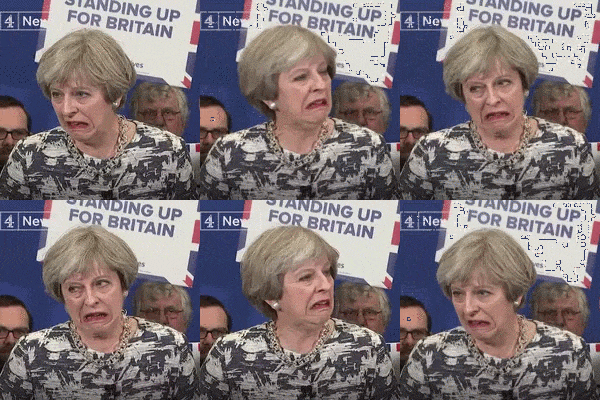
No, Leeds, no, no, no!  I’m sorry to come across all Thatcheresque, but sometimes you just have to put your foot down with an almighty stomp and have a tantrum in a worthy cause.

This new shirt.  It has stripes!!  Horrible big fat stripes that look like tyre tracks, as if our poor players have been caught unawares by a runaway blue-paint liner.  It’s tawdry, it’s unnecessary.  It’s a massive departure from fifty years of tradition during the vast bulk of which we’ve been resplendent in pure brilliant white shirts.  I mean, I know we were never going to go back to the simplicity of the 1972 kit – obviously flashes and piping and logos and other such fripperies are a part of the scene these days, more’s the pity.  But this?  It’s an abomination!

In the interests of balance though, I should say that some people like it.  There, that’s that done.

We are now destined to enter a new season where Swansea and Spurs are going to look far more like Leeds United than Leeds United do – and frankly, it’s wasted on them.  They’re hardly going to appreciate the fact, are they?

I’m sure we’re stuck with this unfortunate monstrosity, worse luck.  Well, they can stick it for me.  I’m not having one.  What I will do is sally forth to the Club Shop/Tat Emporium/Bates Retirement Fund Megastore, and purchase for myself one pristine, tasteful, fully authentic retro home shirt of a 1992 vintage, which I shall wear as a protest against the sheer bad taste of this awful, awful Macron creation.  And I shall sneer openly at anyone I encounter wearing the ugly thing that’s being foisted upon us..

Leeds United, for heaven’s sake:  what were you thinking of??

Leeds United’s Roller-Coaster Ride to Mediocrity Must End Soon

Image

The Lifeblood of LUFC

At a time when, once again, there’s a bit of cautious optimism drifting around Elland Road it’s worth reflecting that we’ve been here before, several times in fact since the club returned to what should be its absolute minimum status as a second tier club. In those three seasons, we’ve ridden the traditional roller-coaster; great Cup performances against nominally superior foes at one end of the scale, awful, abysmal defeats against teams we should be easily out-matching at the other. The roller-coaster is a suitable analogy – you go up and down and there are thrills along the way, but ultimately you get nowhere, ending up back where you were and feeling slightly sick.

Is there any real difference this time? Well, maybe. The man we now have in charge is young(ish), undeniably hungry after what seemed an unfortunate dismissal at Reading, and able to point to a Championship record at his former club which is little short of remarkable. Brian McDermott operated on a tight budget at the Madejski Stadium, being forced to sell several of his better players (for a fat profit to the club), and bring through adequate replacements for a fraction of the sum coming in. Yet he oversaw a surge in the league last season from 18 points back to actually pip Southampton for the title, and that doesn’t happen by chance.

So there is possibly cause for optimism for our prospects next season – IF the owners get it right. McDermott has pointed out that he doesn’t want to hear talk of the club backing him – the club should be backing themselves, investing in their own future. He is simply right. His is a message of realism and genuine hope, something we should all appreciate after the confusing messages sent out by Neil Warnock over the past year or so. McDermott has been there and done it, as had Warnock before him. But Warnock’s appointment smacked of desperation and papering over the cracks that were widening as last summer’s takeover saga stretched out to a ridiculous length. McDermott has come in looking a better fit for the club, a round peg in a round hole. It looks very much, just now, as if Leeds United and Brian McDermott need each other almost equally.

Let’s face it, though. Leeds United isn’t going to feel quite right again until we’re back where most of us still feel we rightfully belong: in the top flight, and what is more – pushing towards the top end. Over the past 50 years, that has been the general profile of the club and even after going on for a decade at a lower status, it still looks wrong for that name – Leeds United – to figure outside of the elite. The last real high time we had was promotion from the third level, an escape from a truly shameful period in our history. Thanks, Simon Grayson, you did the job for us. The next peak should be elevation to the Premier League, and we will hope we can thank McDermott for that in the not-too-distant future. But what lies ahead afterwards?

The Premier League is now a big-money cartel, as it really goes without saying. Should we be in a position where promotion to that level appears likely, it will be time – well in advance of the actual confirmation of higher status – to think about exactly what direction Leeds United should be aspiring to. We simply cannot go into this with our eyes shut or blinkers on. Some clubs may be able to go up and budget for immediate relegation, rubbing their hands at the prospect of parachute money. Not Leeds, I would suggest. The weight of history hangs too heavy about our shoulders, the expectations of the fans and their collective pride – a throatily raw and raucous thing – should not encourage or even permit such a negative and unambitious mindset. We have to get there first, but once we do – we have to GO for it, because We Are Leeds. It’s as simple as that. We Are Leeds.

If the people at the top of the club really don’t recognise the import of those three words, then they are certainly not the right people. Mediocrity served Leeds United well for decades, and nothing more was expected of them, not even by died-in-the-wool supporters. Don Revie changed all that, changed it for good; so 24 years after his death, the legacy of the Don still dictates the expectations surrounding the club. However hard it may be to compete these days, in the vastly different game we have now compared to the one that we knew then, that will remain the case because of the worldwide name of Leeds United, and the pride of their followers around the globe, motivated not by glory or trophies, but by the fact that We Are Leeds.

With support like that, with pressure like that, mediocrity is never an option. Once we’re there, we have to go in to win.

Leeds: Promising Transfer Rumours as McDermott Ponders Options

ImageSome of the suggested targets of new United manager Brian McDermott will likely have Leeds fans sitting up and taking notice – as well as licking their lips in anticipation. It has been frustrating to see lesser clubs picking up gems in the market, while our own beloved Leeds have sat by and under-achieved. Now we understand that Brian is possibly of a mind to raid his old club Reading for Adam le Fondre, a man much linked with Elland Road when he was at Rotherham. From what I’ve seen of le Fondre this season he’s done well at Premier League level in a team that has always struggled – surely the sign of a man who would prosper in our league, with his instinctive fox-in-the-box movement and awareness. And what’s more, the talk is that, despite possible interest from middle-ranked top flight clubs, Adam would relish a move to Leeds and a reunion with the manager who gave him such a big chance in the big time.

Another striker often tipped to come to Leeds in the past is Billy Sharp, and this is one I’ve always thought would eventually end up on the strength sooner or later. Sharp is currently on loan at Forest, but his parent club Southampton will probably see a big turnover in the summer, and Billy could be making a permanent move away somewhere. Why not to Elland Road? It will, of course, all depend on the finances.

A less obviously popular signing could be Ian Harte, of whom we might think we know much to put us off. Looking at Hartey’s well-known plus points – he would certainly still present a threat around the opposition penalty area with that quality hammer of a left foot. It was often said though that – for a left back – he could be exposed by pace and that defending wasn’t his strong point. I think though that, for a lot of Harte’s time in his Elland Road career, he suffered from playing behind Harry Kewell, a notoriously lazy git when it came to tracking back and one who, when the going got tough, would frequently limp off. This was particularly noticeable in his Liverpool days, and the less said about his subsequent career, the better.

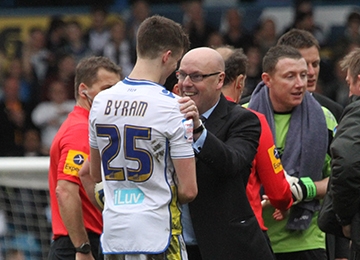
So maybe Hartey could still do a job at Leeds, operating behind a more industrious wide-left player? I’d be inclined to back McDerrmott’s judgement on that one, whatever it might be. Speaking of which, the question of who we keep is at least as important as that of who we sign. Please, Brian – let us hang onto Super Sam Byram.

There’s going to be many more names thrown up by various media as possible signings between now and the start of next season than the three mentioned above. Who we’ll end up with is anyone’s guess and there remains the worrying possibility that it could be yet another big let-down. But Brian seems to want to import some quality, and you get the feeling he’ll have made his wishes known where it counts. Let’s hope so, and let’s hope that the summer that’s a-coming in proves to be rather more exciting and inspiring than some of the fallow transfer windows of recent years.

Memory Match No. 7: Blackburn Rovers 3, Leeds United 4 – 14.9.1997

Image

George Graham’s Opinion of the Back Four

1997-98 had got off to a stuttering start as a raft of new signings settled into the club. The first two games had been encouraging; a draw at home to an Arsenal side which would eventually win a deserved Title, and a comfortable success away to Sheffield Wednesday. But three defeats followed to Crystal Palace, Liverpool and Aston Villa, and in none of those games did Leeds United manage so much as a goal. George was not a happy man.

As the teams walked out before a 21956 crowd and live Sky cameras at Ewood Park, we wondered if this was going to be another hapless, goalless performance which would see the season drifting towards under-achievement again – or would Leeds bounce back and rekindle our faith? In a roller-coaster of a game, an archetypal game of two halves, that question was answered emphatically.

I always enjoy watching football at Ewood Park, whether live from the stands, or even on TV. Something about the ground appeals; there’s a faintly Hovis-advert atmosphere outside, an air of cobblestones and tripe. Inside, the changes wrought by Jack Walker’s legacy were apparent to those of us who remembered clashes here before rickety old stands in the 80’s. There’s a spacious feeling to the stadium compared to the cramped impression you get at some grounds. On the telly too, the aspect is pleasing, whether it’s because of a good high camera position or some other trick of the environment, there seems to be lots of room; you can see the pattern of play and appreciate what the teams are up to.

In this game, both teams seemed to be up to the old game of OK, let’s abandon all pretence of a tactical battle here, let’s just score more bloody goals than the other lot and get the points – or at least that was the script until half-time, when two harassed managers got to grips with their too-generous defences and raised the drawbridge. But, oh – that first half.

Leeds were off to an absolute flyer, two goals to the good after a mere six minutes and apparently well and truly over their barren run in front of goal. After only three minutes had elapsed, Gunnar Halle played a great diagonal ball from wide right just inside the Blackburn half, finding Jimmy Floyd Hasselbaink on the left wing. Jimmy controlled and crossed in the same movement, so it seemed, standing the ball up at the far post where young Harry Kewell directed a firm header towards goal and Rod Wallace was there to scramble the ball over the line.

Usually, an early goal away from home was the cue for nail-biting among the Leeds fans as our heroes sat back and invited the home team to attack, inevitably conceding when they might have gone on to build a clear advantage. But on this occasion, Leeds did strike again, before Blackburn had even come to terms with being one behind. A corner on the right from Gary Kelly dropped around the penalty spot where Robert Molenaar, in acres of space, met the ball as sweetly as you could wish and directed a firm side-foot volley into the net past a startled Tim Flowers. 2-0 after six minutes, and everything was coming up roses.

However, this was Leeds – and just when you think things are going well, they remind you that’s not how it’s supposed to be. Two minutes further into the game, and the lethal Kevin Gallacher won the ball thirty yards out, glanced up and delivered a thunderous shot into the far corner with Nigel Martyn helpless. Now we looked at each other and grimaced, because a 2-0 lead reduced to 2-1 is a dangerous situation for our beloved club; suddenly you can smell the fear and you suspect that there will be tears before bedtime. Referees tend to be the villains of the piece when we do let leads slip, and Mr Dunn of Bristol hardly covered himself with glory by awarding Blackburn a penalty in what was still only the 16th minute. Martin Dahlin tried to turn Molenaar in the area, there was a “coming together” which ended up with the Swede on the floor and the Dutchman looking innocently bewildered as the ref almost spat out his whistle in his eagerness to blow for a penalty. It was a soft decision of the type we have seen many times over the years – the kind of penalty Man U get loads of and concede none of. THAT kind of penalty. Even Alan Parry seemed surprised. Chris Sutton unceremoniously blasted the ball down the middle and we were level again at 2-2, right back where we started. Despair. Would we now go on to capitulate? Blackburn had been riding high in the league under new manager Woy Hodgson (whatever happened to him?) and they now seemed set to continue their good form by finishing us off.

Happily, it was not to be. Instead of sulking at perceived injustice, Leeds rolled up their sleeves and set about restoring an advantage. A delicious turn in midfield – sort of Cruyff and Dalglish combined – saw the quicksilver Kewell sprinting clear towards the Rovers penalty box where he slipped the ball to Wallace on the left corner of the area. Little Rod controlled the ball and then set off on a jinky dribble across the eighteen yard line, holding off opponents, looking for that fraction of space. As soon as he found it, he wrapped his right foot around the ball and sent it hurtling into the top right hand corner of Flowers’ goal for a sensational and finely-crafted goal. Cue pandemonium in the Leeds end as they watched the Leeds players celebrate in front of the disconsolate home fans. Then, another miracle – what seemed a far clearer call for a Blackburn penalty was ignored by the ref, who may just have been feeling slightly uncomfortable about his earlier award, and so compounded the impression of incompetence by evening things up. It looked blatant and Halle looked guilty, but were we complaining?

And then more joy, as Leeds restored a two goal cushion. Fine play on the left between Wallace and Hasselbaink saw Jimmy showing pace and determination as he surged into the penalty area, then checked back to roll a tempting pass into the path of the onrushing David Hopkin. Hopkin snapped up the chance eagerly, one touch to control and then a slide-rule finish just inside the far post. 4-2 for the Whites. SIX goals by the 23rd minute, and FOUR of them for us. What a great away day – where would it end?

In fact, the end was already in sight. There was still time before the interval for the ref, bless him, to ignore another decent penalty shout for Blackburn as Molenaar appeared to barge into Dahlin in the box. Three penalty decisions, and most probably Mr Dunn got all three wrong, but for once Leeds were on the positive side of the equation. And then, as if to prove our team don’t like us to have it too easy, we managed to get pegged back to 4-3 just after the half-hour, Dahlin turning past a challenge inside the Leeds penalty area and finishing with a smart angled shot. A crazy 33 minutes had seen seven goals, and by half-time just about everyone in the stadium was breathless with the nuttiness of it all.

The second half was an inevitable case of “after the Lord Mayor’s Show” – both teams had clearly been told in no uncertain terms to sort out the defensive shambles, and the game settled back into a battle of give-and-take – still highly competitive, and even quite entertaining, but no match for that riotous first period. No further goals were scored, and Leeds had emerged with a highly creditable victory, to leave George purring about his dearly-valued “comeraderie” which – if it truly is a hybrid of comedy and camaraderie – seemed to fit the bill precisely. It was a victory that set Leeds off towards a decent season ending in European qualification, when defeat might so easily have started us worrying about the other end of the table.

George meanwhile was doubtless unamused at the tendency to let goals in when leading comfortably – a sin perpetrated twice in this match – but he was committed to a more attacking approach this year than last, and we would reap the benefits in other glorious goal-fests as the months went by. 1997-98 is a season I remember fondly for that, a time when the future looked bright under George and you wondered if he could build at Leeds what he had so successfully at Arsenal. Sadly, it wasn’t to be, but there are some very happy memories, and this fun in the sun day at Blackburn is one of the best.

Next: Memory Match No. 8: Sheffield Utd 2, Leeds United 3. On the 21st anniversary of our League Championship triumph, a look back to the crazy, gale and Gayle-affected match at Beautiful Downtown Bramall Lane which paved the way for Sgt Wilko’s Barmy Army to call themselves the best in the land.
Another Hollow Triumph for Money, Murdoch and Man United

Image

We deserve the Title! We DO!!! Waaaahh!!!

More than likely they’ll be tenaciously cavorting away in dutiful triumph tonight at The Theatre of Hollow Myths, as Man United celebrate another processional title triumph, brushing aside what I expect to be feeble resistance from Aston Villa..

Since Murdoch bought the game, the Trafford-based club have been on easy street. Better-placed than the rest – given their global fan-base – to capitalise on a league based on glitz and merchandise, their fortunes have been linked inextricably with the fortunes of Murdoch’s Sky TV empire as it has tightened its grip on what used to be our national game.

In 1967, Manchester United won the Football League Championship.  Brief flickering highlights were shown in grainy black and white as the champions paraded the famous old trophy.  England were World Cup holders, Harold Wilson was Prime Minister and a pint of bitter cost about 8p.  It would be two years before Man set foot on the moon and Jimmy Greaves had hair.  It was that long ago.  Matt Busby and his team celebrated another trophy, but their era of success was coming to an end.  Man U would never win the Football League Championship again.

Fast forward 25 years, and Man U came as close as they had ever come to regaining the Holy Grail, only to see it snatched from their sight forever as Leeds United took the prize in 1992 by four clear points, becoming the last ever proper League Champions.  But things were about to change, and not before time.  It had been a clear quarter of a century since the media’s favourite team had won the league; that most marketable of clubs had failed, utterly, to rise to the top of the game where their profit potential could best be realised.  The money men in their grey suits were frustrated.  This could not be allowed to go on.

And so the Premier League was born, in a blitz of fireworks, tickertape and dancing girls, complete with cheesy music, the hirsute Richard Keys, a league title trophy modelled on the lines of Thunderbird One and all the bells and whistles an Australian entrepreneur could dream of.  Behind the window-dressing, bigger changes were afoot.  The money would be channelled upwards, in defiance of gravity and the previous trickle-down economics of the game which had afforded some protection to the relative paupers.  The big and the rich would get progressively bigger and richer; the days of the League Title being won mainly on merit were done.

From now on, the destiny of the title would be decided largely on the basis of pre-season balance sheets.  From a situation where he who dared, won – we would now see an era where he who spends biggest stands the best chance.  One club above all others stood to benefit from this Brave New World – Man U, heralded as the Biggest Club In The World (to a background of incredulous giggles in Milan, Barcelona and Madrid) had built up a worldwide following with their relentless harking-back to the legacy of the Busby Babes and the Munich disaster.  Their history had made them everyone’s second-favourite club; now Murdoch’s revolution put them in pole position to capitalise on that, and reap a harvest of trophies from the seeds they’d sown in flogging Man U tat to a globe-full of eager and undiscriminating consumers.

Resistance became sporadic; almost futile (were Man U the sporting equivalent of Star Trek’s Borg?)  Man U won the first two “Premiership” titles before a cash-rich Blackburn out-spent and out-fought them in 1995.  After that the procession continued, the titles piled up at the Theatre of Myths, only Arsenal, Chelsea and Man City have interrupted the monotonous toll of the bell signalling more success for the most effective franchise in football.

Tonight will see the 20th “Title” for the club that used to be loved by many outside of their immediate support, but are now regarded with a dull hatred by proper football fans.  This is put down to jealousy of course; but every fan has a choice, and jealousy is an unnecessary emotion.  Tonight’s latest success will see the appearance of more Man U acolytes everywhere, as the need to be identified with size and success sucks in those of questionable character and inadequate self-esteem.  More Man U shirts in Torquay and Milton Keynes, more tacky memorabilia sold in Stoke and Londonderry.

The 20th title then – but there remains a clear demarcation.  7 titles in their history up to 1967.  13 in the 20 years since 1993.  Is this just a coincidence?  Of course it’s not; if anything it’s an indictment of Man U’s failure.  Somehow, in seven of those years, they’ve failed to win the league, despite the financial and psychological disadvantages of their rivals, they’ve let it slip away.

The fact is that the titles won since 1993 are devalued by the steep slope in Man U’s favour of the playing field on which all have to compete.  Liverpool were dominant in an even competition for the best part of two decades up to the 90’s; it is now 23 years since they were Champions, but their overall record remains formidable.  Whatever Man U might want to make of it as they crow about 20 titles to 18, they know in their heart of hearts that the baubles won in the Murdoch era are of a lesser water than the diamonds Liverpool gathered to them.  The exchange rate is against them; their achievements are relatively less.  If they maintained their current rate of success for another twenty years (and who knows, they might – but it would kill the game), then maybe they could be compared to Liverpool, the acknowledged masters at the time Murdoch’s coup took place.

But for the moment, I say – as a devoted fan of Leeds United – Liverpool are still The Greatest.

Demand a Public Enquiry Into 1300 Deaths After Atos Medicals: Petition, Please Sign and Share

Image

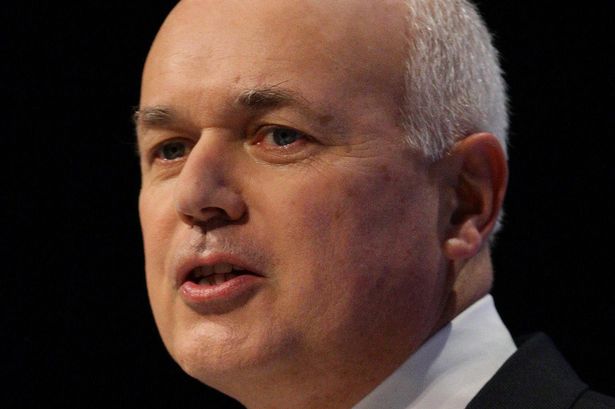
Iain Duncan-Smith

The petition calling upon Iain Duncan-Smith to instigate a Public Enquiry into the conduct of Atos, with particular record to this appalling fatality rate has so far attracted 4,346 signatures.  That’s not a bad start, but much more is needed.  YOUR support, and YOUR willingness to help network this petition could be vital; if a Public Enquiry could be brought about, Atos would be well and truly under the spotlight and it’s possible they may be forced to change their way of working.  It’s not over-stating the case to say that this could save lives.  YOUR signature, YOUR support could actually SAVE LIVES.  It’s that vital.

An Enquiry would seem appropriate in any case, for an organisation which has been branded “Not fit for purpose” by the British Medical Association, and which has itself recently issued a wheedling apology to the people it has wrongly found fit for work. The apology is aimed at the survivors of the Atos experience, you understand. Sadly, it is too late to apologise to the 1300 who have died.

The petition I’m asking you to sign can be accessed here. Please click the link, sign the petition, and share it as widely as possible. Share this article too. It all helps, and maybe if things go well, we can make a difference. A lot of people are out there, counting on your support to start some sort of change for the better. Help them, in memory of the 1300 who have paid the ultimate price for official incompetence and callous disregard for how human beings are being treated.

Iain Duncan-Smith treated a previous petition, calling on him to do as he said he could and live on £53 a week, with the utmost arrogance and contempt, dubbing it “a stunt”.  This is the measure of the man’s utter disregard of public opinion, or indeed anything that doesn’t help advance his own malicious agenda.

Don’t let him get away with it again.  Become pro-active.  Make this man see that the voice of the people will not be ignored.  Sign and share, and make a difference today.

Please.  Share If You Care.

Ingenious Suggestions Invited

ImageSo, I’m writing this book.

It’s going to be about my team, Leeds United, and how the club have accompanied me on the highs and lows of my life, giving me misery when I’ve been at my happiest, and more misery when I’ve been down. It’s been done before, but every fan’s story stands alone and is unique in its way. Football affects us all differently, and we all react in an individual way to the slings and arrows of outrageous misfortune that the game visits upon us. I started relatively late watching Leeds, and it was all my dad’s fault when I finally got round to it. Thanks, Dad. I think.

Really, I wasted the first 13 years of my life farting about watching old films and reading Biggles and Billy Bunter books, when I could have been watching Revie’s heroes stomping all the opposition into submission, and winning the occasional pot along the way. Instead of seeing us win our solitary FA Cup, I was reading a poem out loud at a Music Festival in Ponte, finishing runner-up in true Leeds United style. Instead of watching us take two league titles, I was being a bookworm and dreaming of a career as an astronaut. Talk about a misspent youth.

I finally started watching Leeds in April 1975. Revie had gone to his ill-fated stint as England boss. Big Jack had gone. The great days had gone too, although that wasn’t apparent at the time. Leeds were on their way to the European Cup Final, and my first game was a 0-2 defeat to Liverpool four days before I saw us beat Barcelona 2-1 in the European Cup Semi, First Leg, Cruyff, Neeskens and all. So, fittingly it was Billy Bremner who gave me my first Leeds goal, rocketing a shot into the top left corner in front of the South Stand as I watched stood precariously on my milk crate in that weird shelfy bit halfway up the Lowfields Stand. I still have the commentary of that goal as a ringtone on my iPhone. Fantastic.
And the rest is history; my history and the downs and ups of Leeds United FC over the subsequent 38 years to date. I hope you’ll buy the book, when it appears, and read more of my memories, interspersed with various rants here and there about how the game was, is and (I’m afraid) will be.

The thing is – I really need a title. I’m a bit stuck there, call it sub-editors’ block. The actual book is coming along nicely, and I think a lot of Leeds fans will empathise with what’s contained between the dust-covers – but I’m damned if I can think of a title for the front. Hang on – “The Damned United”?? Hmmmm, ideal – but I have the feeling it’s been done.

I would really appreciate some suggestions. If I end up using one of them, I will happily credit the owner of the idea on the inside front cover, as you do with proper books. And I’ll furnish a complimentary copy also, so you don’t have to wait for it to appear in the bargain bins for 99p. Can’t say fairer than that.

Honestly, I’m fresh out of original, snappy titles. Please help. As Brian McDermott says, we need to sing Marching On Together, and really mean it, suiting actions to words – so your support and inspired suggestions would be right in line with that Leeds United MOT spirit.

I look forward to some brilliant ideas, thanks in advance.

Capital Punishment – It’s Not Quite As Simple As It Seems

ImageIn the wake of recent atrocities abroad, and our own tragedies here in the UK, we can sadly reflect that the gap in between these appalling stories seems to grow ever shorter, as we look ahead gloomily and wonder: whatever next? That the proliferation of different types of news media is quite probably giving a skewed picture of how common these calamities are, is pretty cold comfort. Bad things are happening out there, all the time it would seem, and the world doesn’t feel a particularly safe place to be.

Another effect of rolling 24-hour news stations and the exponential growth of social media is that, as fast as the information comes out to the public, so we – the recipients of all the bad news – are able to give our own instant reactions. All too often this will take the shape of lurid demands for death to be answered with death; the calls for a return of capital punishment grow more vociferous with every awful case that hits the headlines. Facebook pages will see a rash of images, prominently featuring the symbolic noose and demanding support for the view that the latest culprit should face the ultimate penalty. Feelings run high; the anti-hangers are just as passionately convinced as those who shout “Bring back the rope”, and the debate waxes hot and emotive.

Perhaps the most emotive argument put by the pro-hanging brigade runs as follows: If it were your son or daughter who was the victim of the latest murder or rape – wouldn’t you want the culprit to pay with his or her life? My answer to that tends to be an honest “yes”. If my daughter were to become a tragic statistic, I’d certainly want to kill the perpetrator myself; I believe this to be a normal human reaction. But it is also the reason why the relatives of victims don’t sit in judgement of those accused, and aren’t responsible for deciding the penalty that the law shall hand down. Justice requires dispassionate and impartial appraisal of the facts and circumstances, something that would surely be beyond the ken of anybody personally involved or actually bereaved.

I’ve tried, when defending my anti-capital punishment stance, to explain this distinction, but I’m usually accused of fudging the issue. But what if we were to put the opposite or reciprocal situation? Imagine this. Your son or daughter is accused of a murder, and the evidence against them is incontrovertible. You see them convicted, you watch in horror from the courtroom as the judge dons the black cap and pronounces sentence of death upon your flesh and blood. You, a lifelong proponent of capital punishment, a vociferous campaigner for the retention of the rope, see your offspring led, terrified and weeping, down to the cells to embark upon the wait that will end with a walk to the gallows.

Time goes by. Legal avenues of appeal are exhausted; pleas for clemency are entered, to no avail. Justice must take its course. You’re on record as enthusiastically backing the death penalty; you’ve written strongly-worded letters in the past to the quality press, emphasising the folly of removing this ultimate sanction, this absolute deterrent. Now your own child’s options have run out, and they will be put to death early tomorrow.

At home, you’re up at seven after no sleep. You can’t eat anything. You can’t meet the eyes of your family; they know your views from a lifetime of theoretical but heated discussion. Now that the reality you never foresaw is here, there is no appetite to go over those old arguments again. The clock draws closer to eight o’clock. There is a priest in the cell with your child, trying as best he can to ease these final moments, to give the comfort that you’re barred from providing. As the clock strikes eight, you know that there is a sudden burst of activity, your offspring ordered to bolt down a measure of rum, then arms and legs pinioned, a hood jerked over their head and assisted, blindly stumbling, into the neighbouring execution chamber. Within seconds, the trap has opened; your precious son or daughter has plummeted downwards to a sickening jerk as their life is snuffed out at the behest of the law. Your child is dead.

In your silent living room, you join together with your grief-stricken, heartbroken family, seeking such comfort as you can give each other as the awful reality sinks in. You look at each other, and you see the real victims of capital punishment, of so-called judicial execution. You have just embarked on a life-sentence of mourning one of your own family; killed by the state in the name of justice, condemning you and the rest of your kin, who have done nothing wrong, to years of misery and bitterness. You will live with the effects of this sentence, your miscreant son or daughter is beyond all that, and right now their body is being recovered by the functionaries who saw sentence of death carried out.

Anybody who supports the return of capital punishment should do themselves a favour; think about it in these terms. It’s beyond unlikely that you might ever be called upon to deliver a vigilante-type summary justice to someone who has harmed your son or daughter. But in a country regressive enough to have a law to enable the state to kill, it would always be possible that the alternative scenario could become a shocking reality for you and yours. If you really think you could accept it, as the price of a principle you hold sincerely – then go ahead and campaign away, post those images of a noose on Facebook, demand death for someone you’ll never know. You have more resolve than I could muster.

But I honestly beg leave to doubt it. I frankly defy anyone to say that they could accept becoming a collateral victim of capital punishment, bereaved by the law, forced to live out their own guiltless life in the knowledge that their country killed their child.

Capital punishment is no easy answer. It is a barbaric, horrific and out-dated relic, tainted by the nightmare grisly ceremony of the whole process, something incongruous to a modern society and rightly consigned to the dustbin of history. It must never return.

Leeds Boss Brian McDermott Deserves Total Support of GFHC

Image

Brian of Leeds

A few weeks back, things could hardly have looked gloomier at Leeds United.  The team’s form was awful, results dire, the football worse – indescribably so in fact, without resorting to the language of the gutter.  Manager Neil Warnock, who had brought with him a reputation as somewhat of a magician when it comes to getting promotion, was fresh out of his initial hubris, totally deflated, a tired and rather testy man clearly aching for his Cornwall home and the comforting feeling of his trusty Massey-Ferguson tractor beneath him, rather than the too-hot Elland Road hot-seat.  The new owners, who had come in trumpeting their support for Warnock, had subsided into an uneasy silence, seemingly aware of the vultures circling around LS11.  The players looked apathetic and un-motivated.  The fans were lapsing into coldly mutinous mode.  The job was proving too big for a superannuated “Colin”.

Now look at Leeds.  As soon as Warnock went, the place perked up a bit, though various misguided and frankly mischievous headlines suggesting Mark Hughes was favourite to replace him had an irritant effect.  But hey, it was only The M*rror.  When we finally did get our new man, he wasted no time.  Officially appointed on the Friday, he was in the dugout on the Saturday to greet a victory over Sheffield Wednesday, and the delight with which he did greet the welcome win – on the back of four hapless defeats – was a joy to behold.  The fans were impressed, our cockles were warmed.  This bloke appeared to be alright.

Even the post match interviews on what had previously been known as Propaganda FM – the club’s in-house radio station – showed welcome signs of a new protocol.  Relations between the Yorkshire Radio broadcasters and Neil Warnock had seemed strained of late; since the forcing into the background of Ken Bates, the interviewers had been pecking at Warnock more than they had previously felt able, and Colin’s giggly evasions and annoyingly cliched excuses were wearing thin.  But now Eddie Gray was chatting amiably to a Brian McDermott who was quite open about being a massive fan of the former wing wizard.  This promises a working relationship that Eddie will relish, and for Brian’s part, he seems to speak fluently the language of “saying all the right things”.

Two matches, two wins and two mutually cuddly Eddie/Brian exchanges, and things seem vastly better on Planet Leeds United – despite the fact that the play-offs are unattainable, despite the club’s inadequate league placing, despite the undeniably-narrow escape we’ve had from the horror of a humiliating second relegation to the horrors of League One.  Some of us are bemoaning the fact that a change wasn’t made earlier, perhaps when Colin first started making “I wanna go home” noises; but McDermott had of course not been available that long, and you’ll have to hunt far afield right now for a Leeds fan who’d have wanted anyone different.

What’s most important now is that the club should adhere to whatever undertakings they have made to McDermott in order to get him on board.  We understand that he felt no need for an immediate return to management and that he was determined to wait for the right club, with the right backing and the right degree of ambition.  If Leeds United have persuaded him that the club ticks all those boxes, then he must be quietly confident – and this is a man who you feel is big on quiet confidence – that he can deliver for his new employers the progress they will expect in year one, and more tangible success shortly thereafter.  McDermott’s record at this level speaks for itself, the ball is very much in the club owners’ court as regards the how and when of promotion.  They simply have to provide what any manager needs to get out of this league, and trust in McDermott and his on-field and back-up teams to do the rest.

This Saturday, Leeds face Birmingham City away in a match that – for once – has hardly any real pressure attached to it.  Leeds’ away form has been awful, as it almost goes without saying.  They have also managed to go a ridiculous amount of time – I’m honestly too depressed about this even to be able to bring myself to look the actual figure up – without a first-half goal.  Maybe someone can tell me how long it’s been.  But it’s a bloody long time.  So maybe Leeds can break a couple of bad runs at Birmingham, and score in the first half to set up a long-overdue away victory.  We did manage to win at St Andrews in an FA Cup replay earlier in the season, so it is at least demonstrably possible.  But the nice thing is, it doesn’t matter too much if the Whites win, lose or draw.  It’s all rather academic now, as far as this season goes, but the players should know that they had better be giving of their best, and listening to his mantra of “Pass the ball.”  Because Brian will be sat there, watching, assessing, deciding.

And, more than likely, plotting his assault on the Championship next season.

Our Greatest Prime Minister

Today, Wednesday 17 April, as the late Margaret Thatcher is finally laid to rest; let us take a minute to observe a respectful silence and remember the life and achievements of undeniably the greatest peacetime Prime Minister of the last century (and some argue with justification the greatest British Premier ever). Radical and reforming, taking on the reins of power after a period of national crisis when, at times, all seemed lost, the beneficial impact of this pioneering administration on UK politics, and on the country as a whole, remained undiminished 30 years on. This was a Prime Minister with a vision, and the courage and determination to see it come to fruition, something we all have cause to be thankful for even now.

What is more, this was a Prime Minister who can quite fairly be said to have saved this country in hard times when all was chaos and confusion, from enemies without and within; a pivotal and inspirational figure when conflict raged, and an outstanding leader and innovator in times of peace; someone who dared against all precedent to think outside of hidebound tradition and vested interests, and who managed to find a gloriously better way.

Ladies and gentlemen, fellow Britons all, the toast is to our Greatest Prime Minister, with all the thanks and deep, abiding respect due to a national hero. I give you:-

Clement Richard Attlee,
1st Earl Attlee
(3 Jan 1883 – 8 Oct 1967)

Oh and – bye, Thatch.

20130417-010123.jpg