Category Archives: Family

Leeds United: Will “Fame” Attract Quality Signings Over Money?

Image


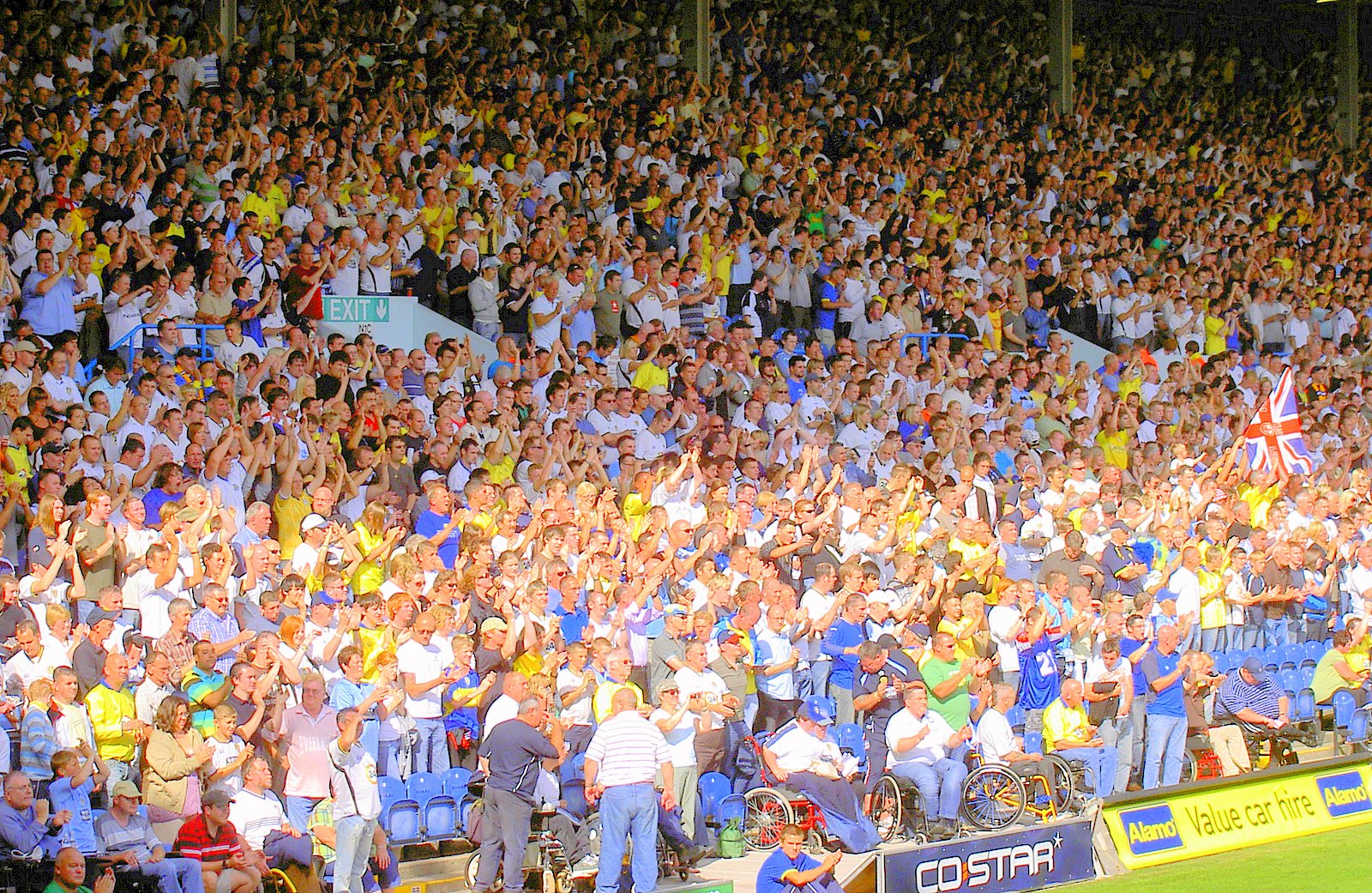
The most worrying sound bite I’ve heard out of Elland Road this summer – and I won’t name names here – is the following little gem: “If a player has the chance to play for Leeds United, but turns it down for the sake of a few extra bob elsewhere, then we’re not interested in that player anyway.”  Or words to that effect.  Now that really worries me – and whether it’s arrogance we’re seeing here, or just naivety – I think it should worry all of us who have the club’s best interests at heart.

In case I need to remind anyone – professional football is about money, first and foremost.  Really, let’s not kid ourselves otherwise.  There’s a clue right there in the name: Professional Football.  The players are professionals – so are the coaching staff.  Even the directors are these days, though you might beg leave to differ on that one.  But no-one’s in it for the pure and simple love of the game; they’re all there to earn a crust or, in the current lollied-up climate, more likely a whole bakery full of bread.  This is not small boys and jumpers for goalposts.  This is the hard-nosed, mercenary world of professional sport.

So when a senior representative of Leeds United Football Club says – in all seriousness one presumes – that if a player declines the honour of wearing the famous white shirt with the fat blue stripe for more money elsewhere, then he can basically sling his hook; how should we feel?  Honoured, maybe, to support a club with such a clear appreciation of its own innate desirability?  Pride, at the sound of our club stating its values in the face of a money-grabbing world?  Or despair at the sheer, fatuous stupidity and hollow arrogance of imagining that any player worth his salt is going to put “prestige” ahead of the bottom line?  Make no mistake – this is arrogance.  It’s an unattractive characteristic we can ill-afford in our current, humble circumstances, and it’s one of those unwelcome features that gives our club, and indeed us fans, a bad name.

Prestige is all well and good.  It’s fine and dandy to be a world famous football club, albeit fallen on hard times, yet with a history containing a certain amount of glory (together with a whole lot of bad luck and “we wuz robbed” stories).  All of that is very nice, and we’re all suitably proud – let’s face it, it’s better than being Barnsley.  But prestige butters no parsnips, not on its own.  It doesn’t pay the rent, nor does it foot the bill for that penthouse apartment and flash car; the hallmarks of even Mr Joe Average Footballer in these Sky-funded times.  Sadly, in today’s Real World, you need lots of cold, hard cash for that sort of thing, and if Joe Average isn’t going to get it at Leeds, then he’s going to say “thanks, but no thanks” and head for somewhere more financially enlightened.  And where does that leave Leeds?  Still holding forth about what a great club we are, and what an honour it is to play for us?  Or might we perhaps, hurt and wounded by such rejection, sadder and wiser as to the ways of the world, give our head a shake and reflect that if you pay peanuts, you’ll attract only monkeys?  (This is all imagery and metaphor, Mr Brown, and no reflection upon any of the current playing staff, so chill.)

If Leeds start the new season having missed out on a succession of Joe Averages, and therefore with a team populated instead by too many Michael Mediocres, and all for the lack of that extra few bob, then the notoriously easy to disgruntle body of support will have good reason to be less than happy. What, they might ask, are we trying to achieve?  Can we not look to the negative example of the current government, who are achieving outstanding levels of apathy, feeble performance and general lassitude and failure to compete by the simple expedient of austerity as an alternative to investment?  Isn’t investment, indeed, what it’s all about?  The shimmering yet distant prospect of the Premier League with its promise of more millions than you could shake a stick at – surely that’s a prize worth investing in a chance to compete for?  Well, you’d think so.

Last season, around January transfer window time, there was talk of signing Birmingham City’sChris Burke, the kind of winger that might, just possibly, have solved our goal-scoring problems by increasing the quality of supply to our starving strikers.  For the want of £300,000, we now hear, that deal died a death.  And yet at that point in time, the play-offs were a realistic prospect, and that small shove in the right direction might have seen us over the line, and lo! The Promised Land might have beckoned.  Instead, we finished in a desperately disappointing lower mid-table position, reduced to the ranks of party-poopers for Watford on the season’s final day.  300 grand could have made such a difference, and reaped such rewards, but no-one was willing to be so visionary and to dare speculate with a view to accumulating a promotion.  How depressingly short-sighted is that?

Wind forward twelve months from now and – judging by the pearls of wisdom falling from the various media outlets of Leeds United so far this summer – we might easily be looking back on another drab and disappointing season.  And all because we’ve persisted with this policy of trying to make ten bob do the work of a quid.  If the people in charge of Leeds genuinely believe that the kind of players we now need to get us up where we still think we belong – the equivalents of Strachan, Sterland, Jones, Hendrie and Fairclough – are actually going to sign on the dotted line because “it’s an honour to play for the club” – then they’re sadly mistaken and bigger fools than I thought.  Investment is needed, if not in transfer fees – I’ve nothing against free transfers as such, there are diamonds out there in these Bosman days – then certainly in wages to make us competitive with the others who will be vying for the riches of the top flight.  Surely, after too many seasons of hollow promises and under-funding, someone at Leeds must see this?

Fingers crossed.

Leeds United Needs a New Vinnie

Sir Vincent Jones

Sir Vincent Jones

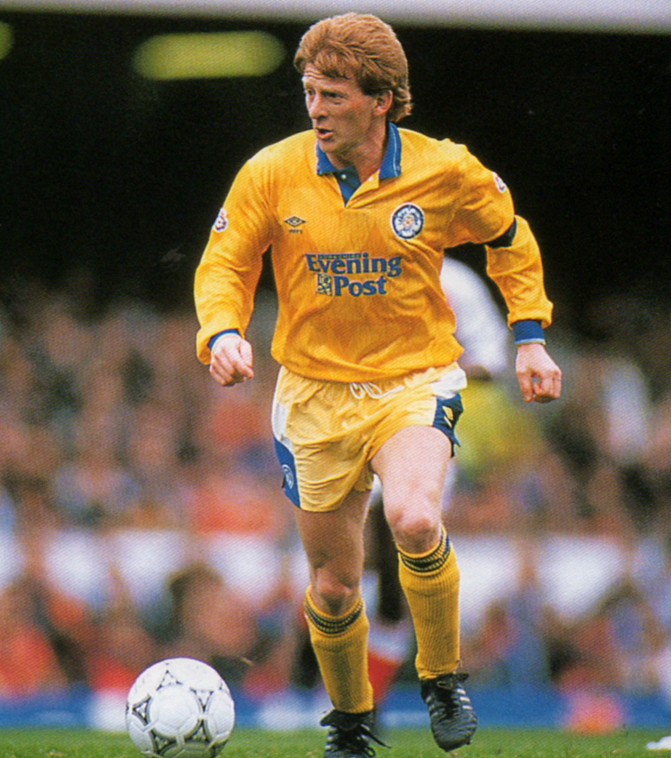
The men who took Leeds United back into the top-flight the last time it happened in 1990 are, of course, legends now.  They rank alongside some of the Revie boys because they rescued the club from eight years in the wilderness and restored us to the big time.  We had our own diminutive red-haired midfielder as a sort of latter-day homage to Billy Bremner – wee Gordon Strachan, who played a mighty part in the renaissance of Leeds with his leadership and goals.  It was a team effort though, and it was as a team that they succeeded – Strachan apart there was no major star, but the guts and drive of the collective effort eclipsed all rivals by the end of that fantastic season when we were crowned Second Division Champions in sun-drenched and strife-torn Bournemouth.  And nobody in the whole club at that time epitomised guts and drive, as well as sheer fist-clenched, vein-throbbing commitment and fight, better than Mr Vincent Peter “Vinnie” Jones.

I’d been aware of Vinnie, of course – who hadn’t?  His Crazy Gang antics were legendary and he’d lifted the FA Cup, but he was regarded as a bit of a maverick – still more hod-carrier than footballer.  So never in my wildest dreams did I imagine him as a signing for Leeds United, where stirrings had been going on ever since Sergeant Wilko marched in and started shaking the place up.  The “marquee signing” – you didn’t actually hear that phrase in those days – was Strachan, plucked from under the nose of his old Man U mentor Ron Atkinson at Sheffield Wednesday to provide the quality at the heart of the Leeds engine room.  Now that was the sort of signing I’d hoped and prayed for, and with the likes of Chris Fairclough joining Gordon at Elland Road it seemed to bode well for a real challenge as the close season wore on and 1989-90 loomed closer.

I was in a caravan on the east coast when I heard on the radio that Vinnie was signing for Leeds for around £650,000.  I frankly didn’t believe it, but when the reality sank in, my reaction was to think – bloody hell, Wilko, what are you playing at?  The signings of John Hendrie and Mel Sterland reassured me somewhat, but I was having trouble seeing what the Jones Boy would bring to the United table.  The early signs were not encouraging.  Strachan tells of an incident in a pre-season game against Anderlecht, where he saw an opposing player go down with his nose spread halfway across his face and blood greatly in evidence.  Vinnie had casually “done” him en passant before sidling off looking innocent, and Strach recalls thinking: my God – what have we signed here?  Vinnie himself remembers his early days at the club, and being moved to violence by the negative attitudes of some of the players being edged out as Wilko’s new broom started to sweep clean.  Among this disaffected few was John Sheridan, something of a Leeds legend – but Jones stood for no nonsense, and there were punches thrown and people seized by the scruff of the neck as he explained his views on solidarity and team spirit.  Vinnie was obviously going to be a kill or cure measure – there were signs he might have much to contribute to the collective effort, but equally that he might turn out a loose cannon which could blow up in all our faces.  Yet Wilko had a magic touch in those early years, and generally it was proved that he knew what he was doing.

In the event, and despite an uncertain beginning, Vinnie played a massive part in our promotion that year.  The fans took to him from the start – the sight of him coming on as a sub in the first home game against Middlesbrough will live long in my memory.  I can see him now, in the middle of the park with the game poised at 1-1, shouting and screaming as he conveyed encouragement and instruction in equal measure, arms pumping in an ungainly, baboon-like way, team-mates and opponents alike staring at him aghast.  And then he frightened a Boro’ defender into scoring a late, fluky own-goal and we had won, setting us on our way after a disastrous opening-day defeat at Newcastle.

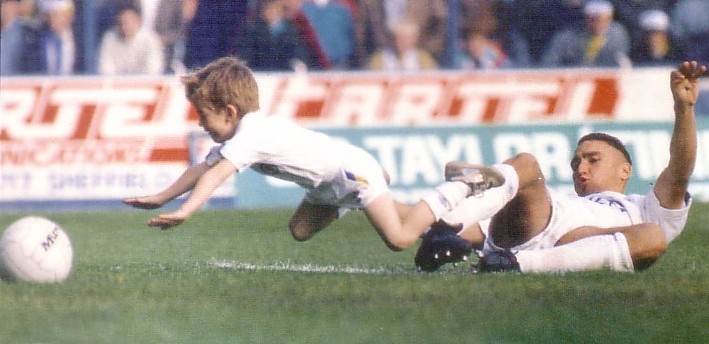
Vinnie just carried on making a difference.  He worked and worked, encouraged and exhorted, fought for the cause and put the fear of God up the enemy wherever he encountered them.  He scored spectacular goals, important goals.  He showed flashes of genuine ability and some of his passing was sublime.  He avoided disciplinary trouble to an amazing degree, given his lurid past.  He sold himself to no less a judge than Strachan as an honest performer who could “play a bit”.   He created a rapport with the crowd I’ve rarely seen before or since, chilling and joking with the wheelchair-users at the front of the West Stand before games, and smoking imaginary cigars as he took the plaudits of the adoring masses after finding the net.  In the warm-up before the Wolves match at Elland Road, he provided one of the great moments of humour in a tense campaign, bringing down 5 year-old mascot Robert Kelly in the area with a signature sliding tackle, much to the delight of the Kop.  Vinnie loved Leeds, the players and fans loved Vinnie and the partnership proved fruitful.  Up we went, and when Vincent Jones finally took his leave for the humbler surroundings of Bramall Lane and Stamford Bridge, it was with a “LUFC Division 2 Champions” tattoo proudly inked onto his expensive leg, a partner for the “Wimbledon FA Cup Winners” one on the other limb.  He was a Leeds United legend in only a little over a year at the club, a larger-than-life personality of massive ebullience and impact – and he is held in the highest of esteem in LS11 even to this day, when he mixes effortlessly in the rarefied, glitzy atmosphere of Hollywood.

So what do we need more right now than another Vinne type, as we hope to embark on another long-overdue return to the top table?  Those Jonesy ingredients of passion and power, guts and gumption, are just as important in this league today as they were in those far-off times as the eighties became the nineties.  Who could possibly fulfil that role now?  I’m really not too sure – Joey Barton maybe?  Even he could hardly be a greater culture shock than Vinnie was 25 years ago, but Barton is likely to be far beyond our purse – and to be frank I think he lacks Vinnie’s essential honesty and sheer bad-boy charm.  It’s difficult to say who if anyone we might secure to play the Vinnie part – but if it were possible, in advance of the season before us, to distil essence of Jones, or to clone him right from his bloodstained boots and tattooed ankles up to his fearsomely-shaven head, then I’d do it, and I’d present the result gift-wrapped for Brian McDermott to deploy as he saw fit.

A man in the mould of Vinnie Jones would be just the shot in the arm our club needs right at this point in time, just the incentive for the crowd to roll up its sleeves and get behind the team for a series of battles in a 46 game-long war of attrition.  If only we could have our Vinnie back now.

Memory Match No. 11: Nottm Forest 0, Leeds Utd 4 29.11.2011

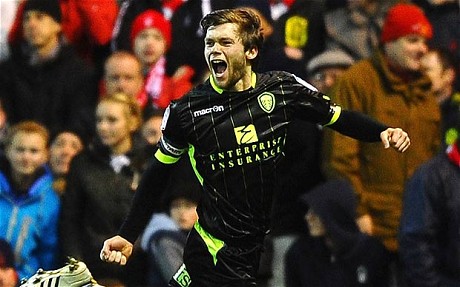
Jonny Howson celebrates at the City Ground

Jonny Howson celebrates at the City Ground

Whatever some people may think of Leeds United fans – and who cares, after all, because we all know what fine, upstanding chaps we are – they certainly know the ideal form when it comes to paying full and emotional tribute to a hero lost long before his time.

In the universe of all things Leeds, the news of Gary Speed’s tragic and untimely death came as a JFK moment: you just know that, years later, you’ll recall exactly where you were when you heard the awful, mind-numbing announcement that such a recent Legend in White was dead, and apparently by his own hand.

The images are certainly clear and sharp over a year down the line: the sea of floral tributes around the foot of Billy Bremner’s statue; the crowds that gathered in silent, respectful tribute; the sight of that fine professional Bryn Law, struggling to contain his tears as he reported from Elland Road on the death of his friend, the female anchor in the studio clearly moved to tears herself as she witnessed his distress.  It was a tragic time of shock and grief.

In retrospect, it is clear that the next opponents for Leeds United in their undistinguished Championship campaign were on an absolute hiding to nothing.  Team and fans alike, emerging from that initial shock into a reluctant acceptance, were determined to pay the finest possible tribute to a fallen hero.  Speedo was, after all, a true legend from the most recent era of real legends, a veteran of the Leeds United renaissance of the late eighties and early nineties.  We had previously mourned our dead of that earlier generation of greats; The Don was gone and so was King Billy, neither having lived to grow old.  But the death of Speed was that much more of a shock; that much more distressing for his relative youth, for his contemporary appeal to a younger breed of Leeds support who had not witnessed Revie’s greats, and for the awful circumstances which had compelled a young man with seemingly everything going for him to take his own life.

The thousands of Leeds fans who descended upon the City Ground that November night may well have been pondering the state of mind that leads to such an awfully final act.  They were certainly determined to pay characteristically raucous tribute: this would be no solemn wake, but a vibrant celebration of all that Gary Speed meant to the Barmy Army of Leeds United’s travelling support. The match itself was necessarily a footnote to the real agenda of the evening.  Forest were pitiful in their ineptitude – a team that would later travel to Elland Road and score seven had nothing to offer in the face of United’s determination to mark the first match after Gary Speed’s death with a thumping victory.  The home team seemed out of the running from the start; it was as if they knew, in the face of the emotional momentum behind the Leeds team and fans, that they had no chance at all – and they meekly accepted their fate.

Before kick-off, there had been the now traditional minute’s applause – such a preferable option to the old-style minute’s silence with its potential to be disrupted by a few shandy-slewed idiots.  In the 11th minute, a tribute to Speed’s occupation of the number 11 white shirt, the 4000-strong Leeds United army behind one goal erupted into a chant of his name, a chant that was intended to be maintained for that poignant number of 11 minutes.  The tribute was interrupted for the best of reasons as Robert Snodgrass fired United into a 20th minute lead, a left foot shot into the bottom corner very much in the style of the man himself.  On the stroke of half time, Jonny Howson doubled the lead with an even better strike, the ball sitting up for him to belt a dipping right-footed effort past a helpless Lee Camp.  2-0 at the interval, and the home side had done little to suggest that it had any intention of detracting from the tributes of Leeds fans and players alike.

In the second half the pattern continued unchanged.  Forest remained awful, the home section of support seemed to expect nothing better and Leeds strolled to two further goals towards a comprehensive victory.  First just four minutes into the second half Luciano Becchio met a left wing cross at the near post to glance a fine header across Camp into the far corner.  Then in the 66th minute, the messiest of fourth goals.  The Forest defence conspired in its own destruction, parting like the Red Sea to lay on a clear chance for Howson to score his second, only for the over-worked and under-protected Camp to first save the effort, and then scramble after the loose ball.  His heroics were to no avail however as Adam Clayton picked up on the rebound to find a yard of space and fire into the empty net.

One thing that stands out in the writing of this article is the fact that, in the relatively short time since Forest were humbled, all four of the United scorers that night have left the club.  It’s a rather depressing thought, but they were certainly all Leeds all the way that night, and delighted to be able to help the Whites fans celebrate the life of one of their heroes with their own loud and proud tributes, and with a thumping victory to boot.  Forest’s only real contribution to the evening came late on when the frustrated and already-booked Andy Reid earned himself a second yellow with an agricultural challenge on Aidy White.  “Can we play you every week?” roared the United fans, a sentiment that would not survive the return game at Elland Road – and they would be glad too that it’s not every week they have cause to mark the passing of a United great at such a tragically young age, and in such awful circumstances.

 Gary Andrew Speed MBE (8 September 1969 – 27 November 2011) Leeds United 1988 – 1996, 2nd Division Championship Winner, First Division Championship Winner, Charity Shield Winner. 

Image

RIP

 Next:  Memory Match No. 12:  Real Madrid 3, Leeds United 2.  The late, great Don Revie always longed for his legendary Leeds United side to be pitched against the biggest legends of them all, and to draw CF Real Madrid in European competition.  Sadly, it never happened in The Don’s lifetime, but when a slightly less vintage era of Leeds finally appeared in the amazing Estadio Santiago Bernebeu, they were not disgraced – indeed, I rather think that Sir Don would have been proud.

Shaker Aamer: Prisoner 239 and the Ongoing Scandal of Guantánamo Bay

Shaker Aamer's children in 2009

Shaker Aamer’s children in 2009

On 14th February 2002 Shaker Aamer became a father for the fourth time, his British wife Zin Siddique bearing him a son, Faris. On the same day, Aamer was incarcerated in Guantánamo Bay detention camp, where he has remained ever since. He has never met his youngest son, now aged 11. There has been no trial. He has never been convicted of, nor even charged with, any crime.

Shaker Aamer had been working for an Islamic charity in Afghanistan in 2001 when he was captured in Jalalabad and handed over to US officials. He was interrogated and then transported to Guantánamo Bay. Based on the evidence of a fellow detainee, Aamer was believed to have been working as a “recruiter, financier, and facilitator” for al-Qaeda. He has consistently denied all such allegations, and it was argued on his behalf by Clive Stafford Smith of Reprieve that the evidence against him was unsafe, being inherently incredible and the product of false promises and even torture.

The Bush administration acknowledged that it had no evidence against Aamer and cleared him for release in 2007. The Obama administration cleared him for release in 2009. Four years on and Shaker Aamer continues to languish in the detention camp at Guantánamo Bay, no charges preferred against him, no apparent bar to his release, his physical and mental health declining as he maintains a hunger strike – a glaring example of the most scandalous abuse of natural justice it is possible to imagine.

It has been speculated that Aamer “knows too much” about the goings-on inside the detention camp; allegations of torture have been made over the years, and Aamer himself has referred to instances where he has had his head beaten against a wall, and on one occasion waking from a severe beating to find a pistol on the table in his cell. It may be felt by some that it is the potential embarrassment to the authorities, consequent upon Aamer being free to speak out, that is the reason behind his continuing imprisonment – not any outstanding issue of national security.

Aamer is a charismatic and eloquent man, sometimes described as the “unofficial spokesman of the detainees”, so it may well be that there is something for some people to fear in what he might have to say when he is fully at liberty to speak. Clive Stafford Smith again: “I have known Shaker for some time; because he is so eloquent and outspoken about the injustices of Guantánamo he is very definitely viewed as a threat by the US. Not in the sense of being an extremist but in the sense of being someone who can rather eloquently criticise the nightmare that happened there.” Whatever the reason, there can be no excuse. The governments of the UK and the US agree that Aamer should be released: there is no charge against him; there is no evidence against him. And yet there he remains having already served longer, and in the harshest of prison regimes, than many a convicted murderer.

The US stands accused in the light of this scandalous situation of behaviour it would roundly condemn if perpetrated by a regime in a third-world country. The UK in its ineffectual stance over efforts to release Aamer, stands complicit in such a charge. Neither country emerges with any credit intact over such a blatant injustice, maintained over such a long period of time. The situation demeans both nations, and casts into a dubious light their mantra of “freedom over fundamentalism, democracy over dictatorship”. In allowing the incarceration of Shaker Aamer to continue, along with that of his fellow detainees who are also imprisoned without charge or trial, the leading lights of the western world are in danger of having their credibility shredded by their failure to act where the dictates of justice and the principles of democracy clearly indicate that urgent action is required.

The viewpoint of some of the public in this country, hearing of Shaker Aamed’s plight on national radio, is perhaps predictable in the climate since 9/11 and particularly this past week since the Woolwich atrocity. But it is nevertheless cause for head-shaking despair at the ease with which people are hoodwinked into ignorant bigotry. “Why are you running this item?” demanded one irate texter. “I am white, British and proud.” Others cited pearls of wisdom such as: “no smoke without fire”, or “well he’s not even a British citizen.” Yet this is a human being, acknowledged by successive political leaders of the nation that has deprived him of liberty and family life for eleven years as “clear to be freed”. That has been his status for the last five years. And yet still he rots away in his prison cell, subjected to daily humiliation and ill-treatment, missing his family growing up. It’s difficult to imagine a more appalling Human Rights abuse, and yet this is being condoned and allowed to continue by the self-styled “Leader of the Free World”. And there are people who applaud this, and recoil in apparent disgust at attempts to stand up for the rights of those detained without trial. It’s almost too depressing for words.

It’s not just the US either. Up to 90 Afghans are held without charge at Camp Bastion by UK forces, allegedly “for their own safety”. This has been described as a “mini Guantánamo Bay” – and when the name of a detention camp is used as a byword for all that is wrong with the legal process and principles behind such imprisonment, you know that there is something fundamentally wrong. Guantánamo Bay may not have the genocidally evil resonance of Auschwitz, Dachau or Belsen, but the metaphorical application is not a million miles away.

Shaker Aamer’s family now live in Battersea in South London. His wife has been ill since he was incarcerated eleven years ago; she has suffered from depression and other episodes of mental health disorder. Aamer himself is worried about how things will be when he finally is released, a prospect he views with touching confidence that it will actually happen; yet with some trepidation too. “I may find it difficult to respond to being called Dad,” he says. “Maybe my kids will have to call me Prisoner 239”. In January 2010, his 12-year-old daughter Johina wrote a letter to then UK Premier Gordon Brown asking for his release. This was three years after President Bush cleared him for freedom and one year after Obama did the same thing. In 2011, Aamer’s father-in-law Saeed Siddique commented, “When he was captured, Shaker offered to let my daughter divorce him, but she said, ‘No, I will wait for you.’ She is still waiting.”

Leeds United Such a Massive Pull in the Blogosphere: Just Ask West Ham

Dr. Weevil Of West Ham - Obsessed With LUFC

Dr. Weevil Of West Ham – Obsessed With LUFC

“We’re not famous any more” sing the Leeds fans, showing a neat grasp of irony in a medium too often dominated by the literal and the just plain crass.  The point is, of course, that we still are famous.  Hugely so.  Our fans scattered all over the globe mean that wherever you go, you’re likely to see a visiting Leeds United shirt to provide a welcome relief from all the tedious Man U rags sported by the clueless locals.  Listen to any Sky Live broadcast from the Theatre of Hollow Myths, and you’ll hear those wurzelly Devon accents mixing in with the nasal cockney whine as the Man U faithful describe how they “all ‘ate Leeds scam, innit”.

And the evidence is there in the ether too, as the web buzzes with references to our beloved Whites, ensuring that even the most facile and puerile of blogs can guarantee itself hits aplenty merely by mentioning those magic words “Leeds United”.  Some have taken it to such lengths that their Leeds-related output has shoved the more mundane stuff about their own desperately anonymous favourites way into the background, which is peculiar, but hey – you have to provide your readers with what they want to read, apparently – and if possible you have to try to attract some of football’s most fanatical fans by being “controversial” – or as we might more accurately describe it: by talking bollocks.

The leading contender for “biggest culprit” in these dubious and unprofessional tactics is a poorly-constructed and ill-written blog, ostensibly concerned with minor London club West Ham United, and entitled “The Game’s Gone Crazy”, which has a specially-created page to allow it to burble on about matters which are, frankly, none of its concern.  The Leeds United content of this page is out of all proportion to the interest you might expect the ‘Appy ‘Ammers to take in our beloved club, and of course it tends to paint the goings-on down at LS11 in the most negative light possible.  He’s been at it again today, capitalising on the 24th anniversary of Don Revie’s death to write another “controversial” article which – naturally – consists of second-hand lies and rumours recycled from various down-market tabloids, some successfully sued by former Leeds United personalities in the past.

Now, it must be said that a cursory examination of the contents of this upstart site (I’d caution you, gentle reader, not to waste too many of your valuable minutes on it) will reveal that the site-owner’s tactics are a hell of a lot sounder than his less-than-impressive literary ability.  He manages to attract a lot of comment and abuse from outraged fans of other clubs, with Leeds obviously prominent among their number.  The simple process of writing about Leeds, writing often and writing groundless rubbish, generates a lot of traffic for this site, traffic that its ‘Ammers stuff could not possibly hope to generate.  So, from that point of view, the author is running a successful operation, but one which owes little to the merits of his creation – which are appallingly few.  The sly Bubble-blower has fastened onto the global appeal of Leeds United to his advantage, and we should perhaps praise his acumen; it certainly far outstrips his ability to string enough sentences together for a decent piece of writing.

As you might expect, a number of his West Ham-oriented readership are a bit embarrassed about this craven behaviour – but their criticism falls on deaf ears by and large.  It’s quite obvious that “Dr. Evil”, as he is referred to by himself (and we presume he fondly hopes that others so refer to him as well), is preoccupied by getting as many reads as possible for his site and – only too well aware that his meagre talent is not going to get him far down that road – has opted instead for setting up as an irritant that will attract opprobrium and attention in equal measures.

It’s a back-handed compliment of course – the world knows that Leeds United is still big news out there, and any LUFC tag will pretty much guarantee a readership made up of Leeds fanatics (many thousands of us) and those who detest the very mention of our great club’s name (positively millions in the Devon/Cornwall hotbed of Man U support alone.)  So we should perhaps be flattered by the attention – it’s better than the dreadful and depressing anonymity suffered by West Ham and other such small fry.  And viewing it like that – not taking it too seriously and dismissing it as the unsubtle attempt to drag in readers that it undoubtedly is – we can smile ruefully and reflect on how much quieter a place the internet would be if Leeds United didn’t exist.  What would they all talk about then?  And where would the hapless and not-terribly-good Dr. Weevil find his victims… ahem… readers??

Shameful: BBC Spit on Don Revie’s Grave

Don Revie OBE:  The Greatest

Don Revie OBE: The Greatest

History, they say, is written by the winners.  In last night’s “Match of the Day”, the BBC provided ample evidence to show that it is also rewritten by hypocritical sycophants who should know better.

The events of the afternoon had not panned out as the scriptwriters would have wished, though all looked well ten short minutes from the end of Man U’s match at West Brom, S’ralex’s last game as manager.  The Plastic Champions were 5-2 ahead, and John Motson had purred, gasped and chuckled his way through 80 minutes of exhibition football, punctuated by comical home defending, and it looked very much as though another team was going to roll over meekly for the men from Salford.

Then S’ralex brought on Paul Scholes for the Ginger Minger’s own last appearance before his latest retirement.  The cameras prepared to adjust to soft focus, Motson drew in another breath preparatory to more shudderingly orgasmic tributes as he was consumed by an ecstasy of highly marketable sentimentality.  The stage was set for the Govan Guv’nor to stump off into the sunset, his purple-blotched features lacerated by a parody of a smile.

Then it all went wrong.  West Brom struck three times in the last ten minutes, Ferguson’s smile dropped to the floor quicker than a Gareth Bale dive and the mighty Man U were holding on at the end to avoid saying goodbye in the face of a last blast from a defeated Hairdryer.  5-5 it finished, and the BBC were denied their expected valedictory stroll in the sun; the Baggies had pooped the Corporation’s party.

Maybe it was this that prompted the spite and small-minded pettiness of the montage which prefaced the Match of the Day highlights late last night.  More likely though that it was always going to be yet another calculated slap in the face to the memory of a great man, a man whose boots the assembled hacks and ex-pros on the MOTD couch are not fit to lick, a true great of the game that the Establishment seem determined to pretend was never there.  Ferguson was painted in admiring and rose-hued tones, to a background of his many achievements as compared to the other “managerial greats.”  Bob Paisley, Brian Clough, Jock Stein, Bobby Robson, Ron Greenwood, Bill Shankly, Matt Busby, Bill Nicholson; all these legends were held up as examples of managerial excellence to be rightly lauded for their achievements and the mark they left on the game.

But no mention of the greatest of them all: Donald George Revie OBE.

This was no mere oversight.  It’s been going on for years, and it’s a premeditated and vicious attempt at the excision from public memory of football’s greatest manager, a cowardly and shameful act of malice aforethought.  It reflects ill on the researchers who put these things together; aren’t they aware of their history, we in the know might wonder.  Don’t they have access to Google?  But they know all about the Don, they know he transformed a tired old joke of a football club into the most feared and respected force in Europe; they know he did it without massive financial backing and without paying obscene wages; they know how he did it all to the dubious background of an initially apathetic support, fans who had only ever known mediocrity at best, and expected nothing else.  Out of all this, Don Revie wrought a miracle – a team that respected judges of the game have described as the finest club side in English football history.

The accidental omission of Revie’s name for any TV item concerning itself with managerial greatness would be unforgivably slipshod; the act of a clueless nincompoop.  But this was much, much worse than that.  It was an exposition of hypocrisy underpinned by malice and the bile of fifty years’ accumulated resentment.  It was a crass attempt at revisionism, a blunderingly clumsy try at pretending Don Revie never existed.  It was wishful thinking in its bitterest and most destructive form, a playground insult to a giant of the game.  The BBC cowards and toadies have exposed themselves as classless fools, deserving only of contempt and ridicule.

“And Leeds will go mad.  And they’ve every right to go mad!” – as Barry Davies memorably put it back in the day, in more realistic times before the game turned plastic, when everybody knew who the heroes were and we weren’t fed a diet of pap and lies.  And Leeds should go mad again.  The city, the club, the fans – none of them should continue to lie down and accept this disgraceful treatment, this attempted erasure of an iconic figure whom we all worship as “Simply The Best.”  There should be a loud outcry, a vehement protest.  This is my small contribution, but the fans as a body have form for hitting back at media and establishment when they feel one of their own wronged.

In 1994, the FA handed down a mandate that all clubs should observe a minute’s silence in respect for the late Matt Busby.  They did this because it’s what you do when a respected figure dies – except of course they’re not consistent.  They failed to mark the death of Don Revie, a tragic and cruel end from Motor Neurone Disease.  They failed even to send a representative to his funeral, although – to his eternal credit – Alex Ferguson was there, and Denis Law, as well as most of the Leeds United greats and other proper football men.  But none of the hypocrites in suits from the game’s ruling authorities saw fit to get off their backsides and pay tribute.  Revie was dead; let them get on with pretending he never existed.  So in 1994, when they were supposed to lapse into a respectful silence, the Leeds fans at Blackburn Rovers’ ground exploded in a raucous and repeated cry of “One Don Revie!  There’s only one Don Revie!!”  The great and the good of the sport were scandalised.  People pursed their lips and shook their heads sadly.  How dare these yobboes ruin our tribute to our Chosen One?  But I’m so, so glad that it happened.  We should not knuckle under to the official view; we should never bow down before such blatant hypocrisy.

They’re getting wise to rebellion now.  There tends to be a minute’s applause these days, lest any disrespectful mob should see fit to assert their unwanted point of view the next time some officially-beloved figure keels over.  But the fans will be heard, believe me.  And if the media – typified by these contemptible fools in charge of the increasingly poodle-like Match of the Day – continue so determinedly to ignore and try to obliterate the legacy of The Don, then I hope that defiant cry will be heard again, loud and proud.  While ever Leeds United fans are prepared to stand up and be counted, happy to raise their arms and voices and be heard – then Don Revie will never be forgotten, whatever the wishes of the pompous suits and deluded TV types.

Don Revie, “The Don” (1927 – 1989)  A true legend and a great of the game.  Whatever you might think of him – and God knows, I’m no fan – just ask S’ralex.

The Pride of “The Damned United”

Image

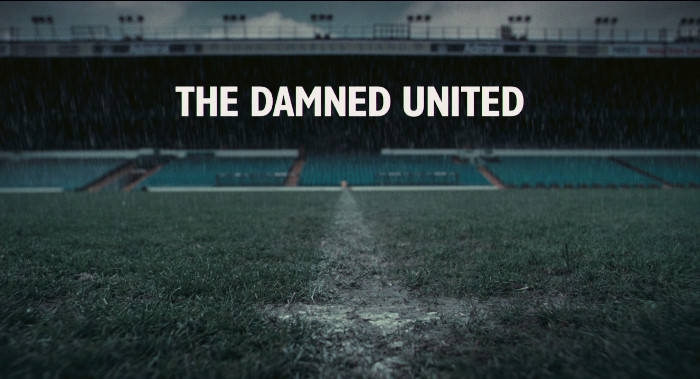
Was ever another phrase so obviously coined with one intention, only to be taken up and brandished with pride to the completely opposite effect? Author David Peace – a Huddersfield Town fan – has described his book “The Damned United” as “an occult history of Leeds United.” The word “history” in this connection is somewhat optimistic – the book is decidedly fictionalised, and the point of view is the imagined perspective of Brian Clough as he struggled through his 44 days in what could fairly be described as enemy territory. The book was a success, met by a measure of critical acclaim. The film it spawned was of more dubious quality, famous for the lengthy list of goofs on its Internet Movie Database page, and widely regarded as particularly one-eyed in its depiction of personalities and events, none of which bears much resemblance to actuality.

It is the tag though – that Damned United tag – which seems set fair to achieve iconic status, and not with the intended pejorative effect. With a typical sense of gallows humour, devotees of the Elland Road club have taken the label and made of it a badge of honour, waving it under the nose of the millions who despise Leeds United as a symbol of inverted defiance. We Are The Damned United, they say – do your worst. The tiresome recycling of allegations about Don Revie, the endless litany of “Dirty Leeds” myths and the omnipresent attitude that the West Yorkshire club exemplify all that is shady about football, all of this is held up to ridicule as those who love the club glory in the new name. Sod the lot of you. We are Dirty Leeds, The Damned United, and we are proud. It’s a unifying message, the foundations of a siege complex that can rally support behind any popularly-hated institution. It’s an assertion of individuality, of a refusal to conform to the cosy standards beloved of media and Establishment. It takes gritty character to be a Leeds fan in the face of such universal hatred, and those of sufficient character know they’re part of something unique and special. We Are The Damned United.

It’s also had the welcome effect of reclaiming a measure of ownership and identification with that word “United”. It’s highly doubtful that Town fan Peace could have foreseen or desired that effect, but there it undoubtedly is. For decades, the press, the football establishment in the UK and elsewhere – and of course Man U themselves – have been unrelenting in their efforts to corner the term “United” exclusively for the Salford-based franchise. It’s been an important marketing tool, a vital part of the attempt to sell the myth of The Biggest Club In The World™ (Copyright © The Gutter Press since the late 50’s) to children of all ages from Devon to Singapore. It’s seeped into the public consciousness like the subliminally insidious selling technique it is, and of course the tat-consuming, replica-shirt-buying, Sky-subscribing suckers have fallen for it in their millions. But now there is The Damned United, inextricably linked with Dirty Leeds, and suddenly that formerly football-related suffix isn’t quite so exclusively Man U any more.

Dirty Leeds The Damned United

The contrasting psyches of the Leeds United and Man U support is an apt illustration of how the two sets of fans have embraced such polar-opposites in terms of club and image. The Man U fans desperately want that monopoly of terminology, they need to believe the press-powered fairy-tale that there’s “only one United”. The motivation for being identified with what they are always being told is the “biggest and best” has a Freudian compulsion at the back of it, a sense that there is an inadequacy which yearns to be compensated for, an insecurity which needs bolstering. There are people like that everywhere, victims of society, and so you find Man U fans all over the place, as common and undiscriminating as flies. Leeds fans, on the other hand, tend to support their team – where the connection isn’t simply local and tribal – for reasons of perverse pride. It’s a manifestation of defiance and a refusal to be categorised as a commercial target group. The pride is palpable, and the negative image of the club feeds this. Sod you lot. We Are The Damned United. The emergence of such a potentially iconic label was not good news for Man U-inclined inhabitants of armchairs everywhere, and again, this is not an effect the author would have counted as one of his aims in producing his work.

Thanks, Mr Peace. You could hardly have aided our cause any more effectively, and Dirty Leeds have gained from the exposure in popular culture. The book may have been an attempted exposition of Clough’s state of mind as that complex character negotiated his time in purgatory; the film may have been an amusing romp through the mythical hinterland that borders but rarely intrudes on the territory of actual fact. But the label will probably out-live the pair of them, and will flutter bravely and proudly in the vanguard of the Leeds United juggernaut as it – eventually – thunders its way back to The Top.

True Cost of Thatcher’s 1983 Election Win to be Revealed??

Image

Later today, figures on the number of suicides since the early eighties among British armed forces personnel who served in the Falklands Conflict are due to be revealed.  The headline figure on casualties of the fighting is clear cut: 649 on the Argentine side, 255 British and 3 Falkland Islanders for a total of 907 human souls lost over a rocky outcrop or two thousands of miles from the supposed “mother country” UK.  Arguments may well wax and wane over the correctness of Britain’s historical claims to the Falklands, or Malvinas as they are known in Argentina.  A rhetorical question often asked goes along the lines of: how would the British national psyche take it if Jersey or Guernsey, for instance, were to be claimed as sovereign territory by, say, Peru?  It’s a hypothesis that perhaps doesn’t get us far, other than maybe to provide an insight into the sensitivity of feeling over the Falklands/Malvinas issue for the citizens of Argentina.

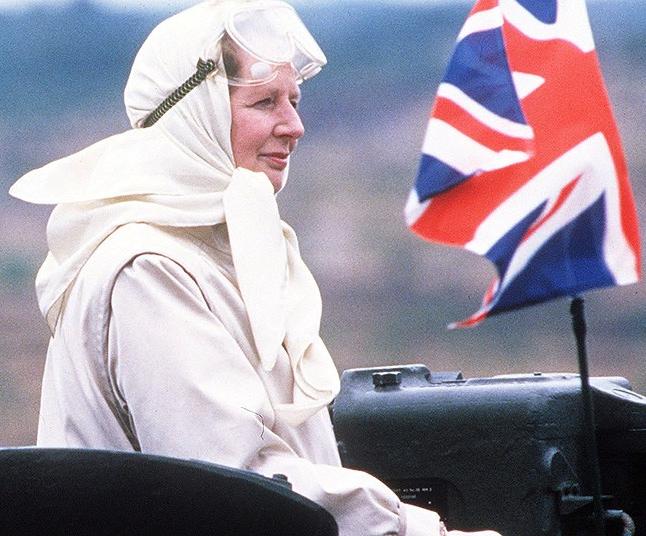
Thatcher: In Command

Thatcher: In Command

Whatever the true cost in lives of the Falklands conflict, what seems indisputable is that the military operation and its success in terms of objective achieved certainly boosted a Tory administration that had seemed in terminal decline at the time of the Argentine invasion.  It has been alleged that the British Government had prior intelligence of a pending military operation  planned by General Leopoldo Galtieri‘s ruling junta, the implication being that Thatcher’s cabinet saw the political potential of a decision to war-war rather than jaw-jaw, and so elected not to nip the situation in the bud.  The extent of the mess that this government found itself in is difficult to over-state; had they successfully deflected any threat of invasion, or had they launched a diplomatic initiative in the wake of the Argentine occupation, it is doubtful whether the impact on the subsequent general election would have been as great.  Pragmatically, “war” (even an undeclared war) was a better option than “jaw” – or so the conspiracy theory goes.

On the Argentinean side too, there appeared to be significant political advantage to be gained from a successful re-acquisition of Las Malvinas.  The Argentine economy was in an even bigger hole than that of the UK, and the effect of the invasion was a major boost to patriotic sentiment and the consequent short-term popularity – or at least acceptance – of the previously despised junta.  The historical precedent of a convenient war, to arouse jingoistic feelings and a surge in national pride, is there for all to see.  Both sides will have been well aware of the stakes, and a certain amount of brinkmanship may well have been at play.  This was probably more the case on the Argentine side, where it seems likely their military operation was calculated on the basis that the British would have neither the will not the logistical capability to mount a response in kind over such a long distance with all the problems of cost, supply lines and communications.  In the UK, the swiftness with which that response actually materialised was a tell-tale sign that Thatcher’s government were not only willing, but eager to launch the most emphatic counter-strike possible, and the fervour with which the public hailed the departing task force was a massive encouragement to the hastily-assembled War Cabinet.

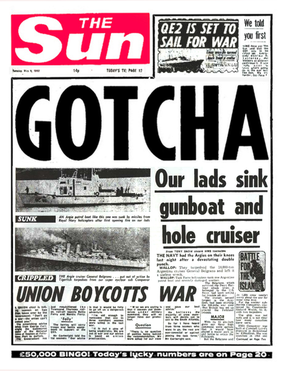
The Sun's Perspective

The Sun’s Perspective

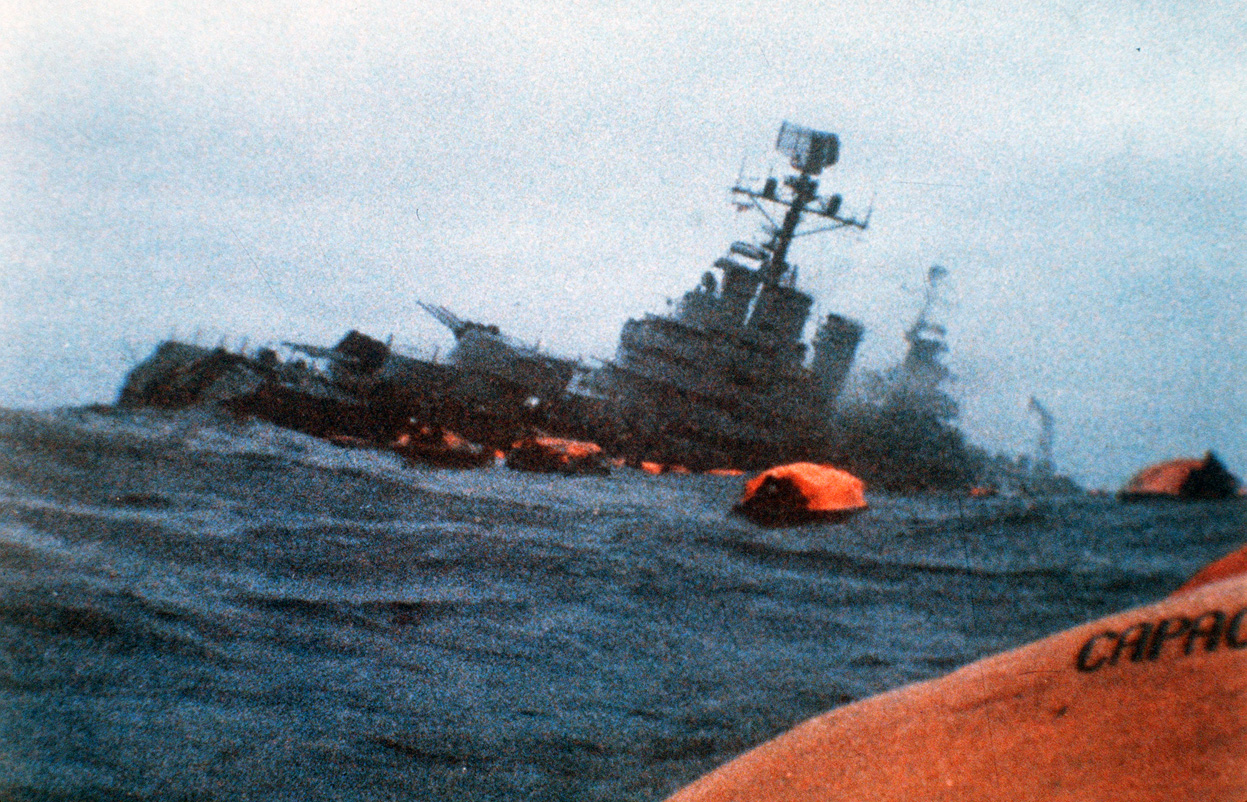
The attitude on the part of the British forces seems throughout to have been one of belligerent determination and ruthlessness.  Despite the problems of distance (mitigated to a large extent by the availability of the strategically-located Ascension Island as a stopping-off point), the task force had the inestimable advantage of its professional make-up; the troops were regulars, hardened pros, and many feared for the fate of the Argentinean rag-bag of conscripts should they ever meet in direct combat.  In the event, the Argentine forces fought bravely and effectively, leading to unexpectedly bloody and costly land engagements such as the Battle of Goose Green.  The conflict as a whole was more a series of sharp engagements on land, at sea and in the air, than any drawn-out and attritional process.  British naval losses were significant – the attack on HMS Sheffield following hard on the heels of the notorious action to sink the ARA General Belgrano.  Both sides were being hard-pressed to hold their political nerve in the face of dramatic losses such as these.

In the end, of course, there could only be one winner and the likelihood all along was that the British forces, superior in training and equipment even though stretched logistically over such a vast distance, would succeed in re-taking the islands.  So it proved, but at a tragic cost on both sides in terms of lives lost.  The die had been cast right from the start in that the losing side would almost inevitably see political change in the wake of the conflict and many now view this, from the perspective of over thirty years, as a calculated risk on the part of both governments concerned.  The determination to press ahead with military action and the relative marginalisation of the United Nations in the matter speaks of a strong political resolve on either side, and the results are clear to see; Galtieri was removed from power in January 1983, whereas Thatcher received an immense boost in the polls, and this “Falklands Factor” saw her sweep to victory with a landslide later that same year.  The monetarist Tory government was not, after all, destined to be a one-term experiment as had seemed so likely prior to 1982.  The course was well and truly set and the old-style of government, with full employment at the root of all its thinking, was consigned to history.  Thatcher may have been the economic disciple of Keith Joseph, but she showed the survival instincts of a polecat to go with her determination to make Monetarism work and banish old-style Socialism.  From that perspective, the loss of a few hundred lives in the South Atlantic may well have been considered expedient against the probability of electoral defeat and a return to what she will have thought of as the economics of disaster.

Thatcher was the big winner in the Falklands conflict.  It has been posited since that a great saving, in terms of money and human lives, could have been effected by ceding the territory to Argentina and providing each islander with a bounty of £1 million and a villa in the South of France.  This is, of course, a simplistic hypothesis, but the numbers certainly add up.  The British government of the day could not contemplate what they would have seen as a craven climb-down, with a devastating effect on how the UK was seen in the eyes of the world.  To this day, pro-Thatcher apologists refer to the way she “made Britain great again” or similarly extravagant claims.

Simon Weston OBE

Simon Weston OBE

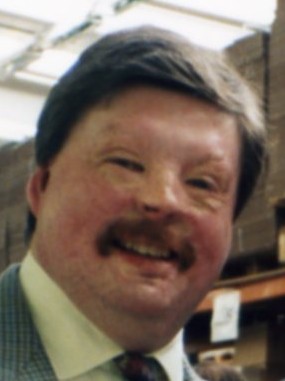
It is notable in this context that one of the most fulsome tributes paid to the late PM, after her death in April this year, was from Welsh Guards veteran Simon Weston OBE who famously suffered extensive burn injuries during the Falklands campaign in the attack on RMS Sir Galahad. Weston is now seen as an inspirational figure for his recovery from his injuries and his charity work, and his endorsement of Thatcher’s premiership was seen as a powerful vindication of her policies, particularly where the Falklands issue was concerned.

What appears absolutely certain is that Thatcher gained herself an extra seven years she would not otherwise have had, to advance her own agenda, and change the face of Britain forever.  Whether you regard the number of lives lost as a price worth paying for that will depend, naturally, on your own political convictions.  But it may be worth noting, later today, just how high that price was when those official Falklands-related suicide figures are finally released.  At a time when our government today is starting to pile up the body count as people take a drastically simple way out of the world being foisted on them, we may reflect on this depressing tendency of governments to view individuals as mere political pawns or economic units, rather than people imbued with a spark of life and the right to an existence outside of macro political considerations.  Life should be seen as far too precious to end up as a statistic of the battle to stay in power.

Where’s That Sick-bag?

A Sickeningly Solemn Moment

A Sickeningly Solemn Moment

Ladies and gentlemen, if you have sick-bags to fill, prepare to fill them now.  If sugary treacle and soft-sawder syrup is your thing, get ready to drown in the stuff.  “Sir” Alex Ferguson is departing the stage, and there won’t be a dry seat in the house.  Sky TV are preparing for an extended weepathon as their hero who hated them, their idol who despised them, climbs down unsteadily from his throne of purchased glory and totters off upstairs to chew gum and glower balefully down at his hapless successor David Moyes.

This afternoon’s live TV offering has a delicately-scripted path to follow.  There will be a soft-focus montage of many of the Purple-Nosed One’s finest moments – Steve Bruce’s 98th minute winner against Sheffield Wednesday to a background of Martin Tyler’s shrieking climax as Man U all but clinched their first plastic Title.  Giggsy-Wiggsy’s finest FA Cup goal of all time as the Arsenal defence parted like the Red Sea and we were treated to an unsolicited view of the Husband of the Year’s chest-rug.  A selection of van Persie’s catalogue of sublime finishes from the Dutchman’s “One Man Title-Winning Season” collection.  It is doubtful however that Eric Cantona’s exposition of martial-arts skills from his South London Show of 1995 will make the cut.

After the moonlight and roses video softener has set the correct ambiance, and armchairs all over Devon and Cornwall are already bedewed with manly tears, we may have an actual interview with the dearly-lamented Departing One.  Subtitles will be provided for this section of proceedings, and yet it won’t so much be what He says, but more the way He says it.  As an example, if you hear a glottal noise along the lines of “Thiznaequayshtyunabootthaaaaat” it means that S’ralex is saying something he wishes you to accept as undisputed fact.  This happens a lot.  But those craggy and broken-veined features of pasty pink splotched with purple may at some point break into a grimace not unadjacent to a smile, and this will be the cue for the suits in the Sky Studio to howl with unrestrained emotion as the tears flow anew.  It’s going to be a harrowing afternoon, and we’re nowhere near kick-off yet.

At some point we will have testimony from a group of the usual suspects as to the essential saintliness and unmatchable achievements of the man.  Lou Macari, Paddy Crerand, Peter Schmeichel, Steve Bruce, Bryan Robson and other such neutral witnesses will speak their lines to camera with all the sincerity and conviction of a tailor’s dummy. Ron Atkinson and Tommy Docherty may even appear if time permits, and attempt to mask their burning resentment at being consigned to the dustbin of history with a few clamp-jawed soundbites of faux admiration, before shambling off, clutching Mr Murdoch’s fat cheque.

And then, the game.  It has been thoughtfully arranged that the final day opponents at the Theatre of Hollow Myths should be a footballing side of attacking ambitions.  The script will call for them to make pretty patterns in midfield whilst offering no great threat to Man U’s rocky defence, where Phil Jones will be frantically gurning in an attempt to frighten off any Swansea attacker who dares venture too close.  At regular intervals, an uncharacteristically misplaced pass from the away team bit-part players will gift possession to Man U, who will then – according to the stage directions – “swoop to score another magnificent goal for the Champions.”  Ecstasy will ensue in the stands and the commentary box, and flowers will be thrown at the feet of the gum-chewing Govan Guv’nor as he performs that annoying little staggery old man’s dance from under the dug-out canopy, champing away in a Wrigley’s rictus of triumph.  It is an image that will be burned on the retinas of a whole football-supporting generation.

After the match – whatever time that might be depending upon how long it takes Man U to score The Winner – we shall have post-game interviews, more video footage to the accompaniment of weeping strings and synth, rambling reminiscence from the assembled sycophants – and maybe a final word from the abdicating Emperor himself, who will remind us, via an interpreter, that there’s “aye anither game tae go yet, by the waaaaay.”  And the crowds will sigh and depart for all points south, the lights will go out at the Theatre of Hollow Myths and the scene will gradually darken as a rainy Salford day fades into the night, as we all must sooner or later.  All that has been missing is the trademark Lone Piper, but he is reserved for even more solemn occasions, and his time is not yet.

And so it will be over.  It will be time for the Sky suits to heave a gigantic, shuddering sigh signifying end-of-an-era grief and regret, and then they must reluctantly move on.  A new hero awaits, and he’s sadly lacking as yet in the trappings of success and the aura that the commercially-aware would wish for him.  A project is to hand now that S’ralex has faded into the sunset, and that project is the reinvention of an Honest Pro into a Demigod, the Greatest Manager Of All, for such is the requirement of the twinned Hyperbole Departments of Sky and Man U for the unsuspecting Mr Moyes.  It’s a work in progress even now, but the momentum will gather as the new season approaches and the threat of upstarts such as Chelsea. Arsenal, Man City and even Liverpool, which has to be repelled for another year.  It will need to be business as usual, even without the Blessed Fergie. Life goes on, and today was merely the schmaltzy climax to the long-running soap-opera which was Man U under S’ralex.  It’s time to dry the tears and count the money.

Now where IS that sick-bag?

San Siro Dom the Perfect LUFC Ambassador

Memory Match No. 9: AC Milan 1, Leeds United 1   8.11.2000

Dom Matteo - Scored a Flippin' Great Goal - In The San Siro....

Dom Matteo – Scored a Flippin’ Great Goal – In The San Siro….

This week’s appointment of United legend Dom Matteo as a club ambassador inevitably brings back fond memories of a November night in Milan in the year 2000 when the defender wrote himself indelibly into Leeds folklore with one emphatic near-post finish.

However much pedants may argue about when the third millennium started – January 1, 2000, or a year later – this season 2000-01 was the first proper 21st Century season, and it was also my annus mirabilis European campaign; having never seen my beloved Leeds play abroad up to this point, I witnessed them competing at the highest level in three true cathedrals of continental football.  Incidentally, I’ve always favoured the Jan 1, 2000 date as the start of the millennium – that’s when the most spectacular fireworks kicked off, that’s when the magical sight of four numerals clicking over was seen – and most importantly that’s when Leeds United were heading the Premiership table, marking what will probably be football’s only thousand year threshold by sitting proudly at the top of the game – a position that the media had been frantically speculating might have been held by the lesser United from the wrong side of the Pennines.

More about other parts of this memorable season elsewhere, but my European experience started in a “sports bar” on Westgate in Wakefield, watching nervously on a big screen as Leeds negotiated the second leg of a tricky Champions League qualifying tie against 1860 Munich.  We were ahead 2-1 from the first leg in Leeds, and such a narrow lead was never that secure.  In the end though, Alan Smith scored the only goal in Munich to close out the tie 3-1 on aggregate.  The subsequent draw saw United pitted against giants Barcelona and Milan as well as Turkish side Besiktas in an incredibly tough first qualifying group.  I was on holiday with my wife and young daughter on a campsite in the South of France when the first game was played, in Spain.  Callously abandoning my ladies to their fate, I impulsively jumped on a train from St Raphael to Barcelona, installed myself in a hotel with a swimming pool on the roof, bought a ticket from a tout, and watched from the midst of the fanatical home support – the Boixos Nois (Crazy Boys) – as Leeds, fielding a side decimated by injuries, slid to a 4-0 defeat.

If you’d told me then that we were destined for the last four, I’d have laughed long and bitterly, but I did enjoy every moment of my first European away-day in the palatial surroundings of the Camp Nou.  I still have two souvenirs – a plastic seat cushion and a big St Georges flag with LUFC Oxford Whites printed on it, which a group of Barca fans had captured and were waving in triumph at the end.  Stupidly, I approached them, feeling that a 0-4 defeat was humiliation enough, and demanded it back (quite politely).  I was getting snarls and throat-slitting gestures, and I remember mumbling something along the lines of “Barcelona no es Galatasaray”, which they seemed to take to heart.  Some of the lads’ girlfriends were regarding me pityingly, obviously wondering if I was drunk, or mad, or both and they urged their men to show restraint.  Luckily for me, they seemed to listen – they handed the flag over, anyway – but if they’d known we were destined to eliminate them from the competition, I doubt they’d have been so conciliatory.

The group then ebbed and flowed – but most results after that first defeat went our way.  We beat Milan at home, came so, so close to beating Barca at Elland Road, denied only at the very death after a world-class display from our rookie ‘keeper Paul Robinson, and we thrashed Besiktas 6-0.  By the last round of group games, the equation was simple – if we could avoid defeat at the San Siro, we would be through to the next stage, whatever Barcelona did to Besiktas.

And so I found myself on an early-morning flight from Leeds Bradford Airport to Milan Malpensa, along with thousands of other Leeds fans intoxicated at the prospect of a famous evening in a truly magnificent stadium.  We would arrive in Milan with plenty of time to look around the place before meeting up with coaches to the stadium, and it proved an eventful day.  There had been violence the previous night, a Leeds fan had been attacked and wounded in an incident which evoked horrific memories of the awful scenes in Istanbul just a few months before.  The city of Milan had been declared “dry” for the day, so it was extremely difficult to find a bar which would serve an obvious Leeds fan.  I was contended enough though, just wandering around the amazing Cathedral Square where I met legend and Leeds fan Ralph Ineson, of “Harry Potter” movie fame, and also memorably “Finchy” in the BBC’s “The Office”.  He was happy to have a chat and a photo, and then I ambled off to have a peek at the world famous La Scala Opera House, where my wife’s great-grandfather had been a violinist, so that was my passing nod to family history.  Finally, with the afternoon stretching before me, I bumped into an old mate from home – we both exclaimed stupidly “What are you doing here?” – and we managed to find a bar that was open, and spent a couple of hours relaxing and happily anticipating the match ahead.  The bar owner was friendly – so much so that he felt able to pop out on some errand, leaving us in charge.  The fearsome reputation of some Leeds fans had evidently failed to penetrate this far into the bar culture of Milano.

The match itself is so famous that I barely need to recount the action kick by kick.  The Leeds fans at one end of the stadium were in fully, throaty voice for most of the proceedings, drawing incredulous glances from the attendant Carabinieri who were in full-on riot gear but friendly enough, muttering to each other about lunatic English tifosi (hooligans.)  The first half was a decent contest – Milan were through already, but not disposed to give Leeds an easy ride – especially after paranoid noises emanating from Barcelona, who – nervous about their own prospects – had done their best to warn Milan off taking it easy against Leeds.  So Milan pressed in front of a crowd of 52289, and their winger Serginho was causing Gary Kelly plenty of problems.  In the 26th minute, a slightly soft penalty was awarded to Milan at our end of the stadium, and 6000 Leeds fans held their collective breath as Andriy Shevchenko took careful aim only to rap Robinson’s right-hand post, the ball bouncing away to safety as the masses behind our goal celebrated as if we’d actually scored.  And then, miraculously, as the first half ebbed away, we did score.  A Lee Bowyer corner from the right found Matteo rising majestically at the near post to meet the ball with a punchy header which soared high into the net.  Cue utter pandemonium at the Leeds end as all the tension, passion and belief exploded in one almighty roar which almost lifted the hi-tec roof off the famous stadium.

The party went on throughout half-time and into the second half, drawing more bemused glances from the Italian police; there was only a brief hiatus in the 67th minute when the superb Serginho deservedly equalised, but then it was mounting fan fever again all the way to the final whistle and beyond as Leeds held out to qualify for an equally difficult second phase of the competition.  The scenes after the game are at least as famous as the events of the ninety minutes; the team coming back out onto the pitch in response to the demands of the faithful who were held back in the interests of crowd safety.  What followed was described by respected football commentators (as well as Alan Green) as the best example of team/fan bonding they’d ever seen.  Fans and players – even a certain Chairman – swapped chants and songs in a spontaneous celebration of a joyous night.  Even the uncertain musical efforts of Lee Bowyer were greeted by a blast of friendly derision.  It was a unique experience, and the Latin cops were clearly by now utterly convinced that these English people were absolutely barking mad.  As football nights go, you’d have to travel a long way to find one more worthy of memory – only a trophy could have improved it, but the spectacle of the game and its aftermath is one I have seen imitated but never repeated.

Dom Matteo was simply a likeable and committed defender before that night, clearly delighted to be Leeds; the kind of player the Kop takes to its heart.  But after that night, he was elevated to demigod status, a true Leeds legend with his own song and a place on a pedestal in the United Hall of Fame.  The choice of Dom as a club ambassador seems obvious but is actually inspired, especially in light of the fact that Ken Bates’ malign shadow will remain for up to three years yet.  Just as Ken sends out all the wrong messages, so Dom – beloved ex-player and respected press commentator, dispensing common sense when all about him has been hysteria, sends out only the most positive of vibes.  He is the sort of person we need to see closely associated with the club, and his involvement in any capacity is a move to be applauded.  Just get Lucas “The Chief” Radebe back on board now, and we’ll be cooking with gas.

Thanks, Dom.  Thanks for being a voice of sanity in the press, thanks for coming back to reassert your love of the club.  And thanks most of all for that memorable night in Milan.

Next:  Memory Match No. 10: Leeds United 2, Leicester City 1.  The last home game of the 1989-90 Promotion season, and things were on a knife edge.  Relive that tense and unforgettable afternoon at Elland Road, as a future United hero came close to derailing our return to the big time – and our archetypal diminutive red-haired midfield powerhouse, in the best traditions of King Billy Bremner, stepped up to the plate to provide the decisive moment, cementing his own status as a Leeds Legend.