
Category Archives: Television

Birds of a Feather: From Screen to Stage – and Back Again?

Birds of a Feather

Birds of a Feather

This article first appeared on “The Public Reviews” which aims to provide an informed critique in a wide range of theatrical productions as well as reviewing new album releases. It appears that, having made a successful transition from screen to stage, the story of the Birds of a Feather may be due to make a TV comeback, with the BBC considering a new series for the three main characters, Sharon, Tracey and Dorien.

The current fashion for stage adaptations of legendary TV sitcoms has spawned a number of notable successes, the steep challenge for the actors generally being: get as close as possible to the characters as created by much-loved original performers on the telly. No such issue arises here; the original Birds of a Feather, Linda Robson, Pauline Quirke and Lesley Joseph, happily still flock together – and the chemistry so evident in the TV show of the eighties and nineties manages to rekindle itself, and how, on stage 15 years or more later. With contemporary references liberally sprinkled throughout the script, getting the laughs as well as firmly establishing the situation in the 21st century here and now, the overall effect is one of an old favourite given a smart new coat of paint and an air of the fresh and new on a familiar and fondly-remembered theme.

Things have moved on in the lives of the archetypal Essex girl sisters Sharon & Tracey, and their wantonly nympho neighbour Dorien. Neither of the girls are with their former jailbird partners, for differing reasons, and Dorien has been adventuring elsewhere until her own misfortunes prompt a reunion with her old friends. The three are back in the old routine almost immediately with a round-robin of insults and bitchiness, some well-intended, others of a more crudely visceral nature. The technique of the “false corpse” is put to good use as well; one of the ladies may appear to crack a smile not called-for in the script – the actors’ dreaded “corpsing”. But it’s sometimes intended, as here, and it then has the desired effect of drawing the audience in and making them feel involved with what’s going on up there on stage. This of course they love, and they laugh and applaud accordingly, feeling part of a shared experience – which is a big beacon of success for any theatrical comedy.

The stage, of course, presents challenges rather different to those presented by acting in front of a camera, but the three main characters make an effortless transition. There are some sparkling moments, of high comedy and low ribaldry alike, and the rapport between the three – such a memorable feature of the original TV incarnation – is still very much in evidence, especially when they are relaxing into banter between themselves. This central triumvirate is the Alpha and Omega of a show that doesn’t do more than pay lip service to offering anything else. The supporting actors are up against it in having to create new characters against the tried-and-tested expertise of Quirke, Joseph and Robson. That they largely fail to make any real impression is somehow inevitable and does not detract from the overall effect – which is quite delightful.

The problem with the sub-plot is that it is rather thin. The problem with the main plot is that it is even thinner. But no amount of murder, betrayal, deceit or family issues can detract from the main point of the evening’s entertainment. The fact is that both plots are incidental to this point, namely the provision of a theatrical vehicle for the revival of one of the most memorable and witty comedy trios of recent times. In this, the show succeeds brilliantly, and the inadequacies of the two-thread storyline are forgotten and forgiven as the ladies go about their work.

The result is a technically brilliant exposition of a comedic triangular relationship between the two sisters and their erstwhile neighbour. The point of attack switches constantly; one minute we have Pauline Quirke’s Sharon on the back foot as the other two round on her, the next it may be Linda Robson’s Tracey or Lesley Joseph’s shimmeringly-brilliant Dorien who is under fire. The banter is sometimes light-hearted and sometimes plumbs the depths of vicious invective, but no-one can doubt the bond between these three. It is sharp, pacy, serve-and-volley humour and it has the audience screeching with delighted laughter, the acid test of any outstanding situation comedy passed with flying colours.

On the down side, the idea of video excerpts to bridge the gap between scenes is a bad one; a lot of plot and humour is lost due to the sheer inadequacy of the projection. Again, this is a drawback that is quite glaring in itself, but which doesn’t diminish the production as a whole – due to the stars’ utterly dominant performances.

For those who remember the TV series – they won’t be disappointed with what they see. For anyone who sees the show as a newcomer to Birds of a Feather, they will have their appetites whetted for more – and it appears a new small-screen series may be in the pipeline. If true, that’s something to be eagerly anticipated. On the evidence of this theatrical offering, there’s plenty of life left in the old Birds yet.

Image

New Owner for Leeds United?

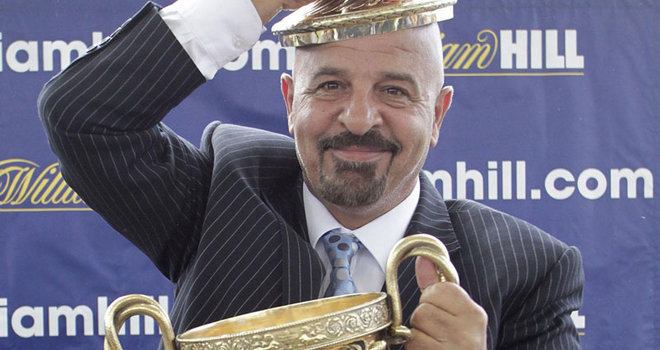
Dr. Marwan Koukash

Dr. Marwan Koukash

The BBC are reporting that the wealthy owner of Super League side Salford Reds, Dr Marwan Koukash, is looking to take over a football club.  Dr Koukash refuses to be drawn on the identity of the club he’s looking at, but describes it as “a huge club previously” which “just needs that little bit of extra investment to take it to the next level.”  Dr Koukash goes on to say “By bringing in the personnel that were previously associated with the club at its heyday and bringing people in who are genuine club supporters it will excite the fans.  Once I get the football club I will definitely have my own TV channel which will cover my three sports; racing, rugby and football.”

There is plenty there to encourage speculation, and in the knowledge that the current owners of Leeds United seem not averse to selling a controlling interest in the club, many Leeds fans will sit up and take notice when a wealthy Kuwaiti speaks of acquiring “a huge club previously”.  More intriguing still is the mention of personnel previously associated with the club “at its heyday”.  Leeds United supporters might ask “which heyday” as the nineties were an era of comparative success and prosperity, though not to be compared to the truly great era of the sixties and seventies when Don Revie created a global force in the hitherto humble location of Elland Road.  Some “previous personnel” might be welcomed back with open arms; others decidedly not.

It would appear that Marwan Koukash is looking at Championship level for his entry into the world of football; he admits that he almost bought a second tier club before he became involved in racing.  This begs the question of which other Championship club might fit the Koukash blueprint.  There are a number of sleeping giants in this league, as well as a few who are perhaps just big lads having a snooze.  Most neutral onlookers though would concede that Leeds United is by far the biggest name outside the Premier League, and it is this fact that makes Leeds at least as likely as any other club in the Championship to be scrutinised by a man who is willing and able to make the kind of investment which could elevate the club back to its accustomed spot in the top flight.

The time scale mentioned by Dr Koukash is “within the next month or so”.  If true, then some club is going to see big changes before Christmas, and whether this will prove a galvanising force to the new season, or more of a disruptive factor that could explode carefully-laid plans is a matter of some uncertainty.  Takeovers can be very, very good for a club, and they can be just the opposite.  Watch this space.

Murdoch to Hammer Another Nail Into Football’s Coffin?

Uncle Rupert

Uncle Rupert

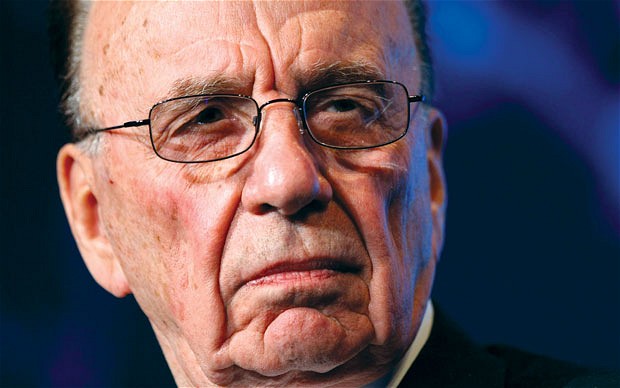
News is emerging that Rupert Murdoch may be about to unveil a “Summer Super League” plan for football, whereby 16 “elite” clubs would compete in a league-type competition throughout the traditional European close season.  Matches would be played in cities around the world in a transparent move to open up new markets and further popularise the Sky/Murdoch brand before an international audience possibly running to billions.

The drawbacks to such a plan spring readily to mind.  There is an obvious issue around the physical and mental demands upon players who might now be called upon to perform without a break in the whole calendar year.  That is, assuming that the players involved would be the senior players of the “elite” clubs envisaged as making up this league; but that does seem a fair assumption.  It is hardly likely that a project like this would have the necessary appeal and marketability if the competing teams were to field development squads – stars would be a pre-requisite for success.

What, then would be the impact on existing competitions?  It would be easy to imagine that the effect on, say, domestic cups could be quite shattering.  We’ve already had the precedent of Man U withdrawing from the FA Cup one season for some money-making prestige junket to South America where they competed for a version of the World Club Championship, and predictably sank without trace.  If the likes of Man U, Man City, Chelsea and Arsenal were to be invited (as they most certainly would be) to compete in Murdoch’s latest commercial fandango, then we could quite probably predict that – at the very least – the FA Cup, and certainly the League Cup would slide yet further down the priority list for these in-demand clubs.  Already we see shadow squads competing for the League Cup, it wouldn’t be a surprise to see withdrawals from that competition, and the treatment of the FA Cup as a proving ground for promising younger players.  It would be the eager crowds in the Far East, Australia, the USA and the Middle East who would have the pleasure of seeing the Premier League’s major talents performing in the flesh.

The question also arises: what of the World Cup, and the slightly lesser competitions held on individual continents?  Would FIFA be prepared to take on Murdoch and his increasingly omnipresent empire?  The days when domestic cup competitions caused a thrill of excitement and a sense of occasion are already receding into golden memory.  Will the same happen to the four-yearly cycle of the greatest international tournament of them all?  It’s not impossible; and if it were to happen, we’d know what to blame – the three M’s.  Murdoch, Money and Markets.

The time is fast approaching when Football as we know it will be in sore need of rescue by seemingly the only people left who actually care enough to want to preserve its proud history and tradition: the fans.  Obviously, I mean those of us who are old enough to remember the game’s great days, before Murdoch got his talons on it; when you stood on a packed terrace and sampled an incomparable atmosphere as you cheered on your favourites for under a pound and moaned mightily when that went up to £1.50.  When the only games shown live on the box were really big ones, Cup Finals, major International games, European nights and maybe the odd smattering of League games here and there.  Those were the days when you would have laughed out loud at any suggestion that one day you might be asked to fork out £60 a month for “entertainment” which might include Norwich v Wigan on a Monday evening.

That’s the reality we have now, and it’s scary to look ahead and see how much more our game might change now that Uncle Rupert has had this spiffy new idea.  He’ll want to make sure his audiences have their entertainment in a way that doesn’t put undue strain on their attention-spans, and allows enough time to sell, sell, sell in those commercial breaks.  Didn’t someone once have a great idea about playing four quarters instead of two halves?  What about time-outs?  Why bother with boring draws, can’t we have an exciting shoot-out?

If you doubt things might actually go down that road – just cast your mind back 25 years, and see if you could have imagined then the kind of game we have to watch today, and ask yourself: couldn’t it maybe happen?  Aren’t we in real danger of losing the last vestiges of the game we used to know and love?  And isn’t it maybe time to think just what the hell we can do about it?

Leeds United Needs a New Vinnie

Sir Vincent Jones

Sir Vincent Jones

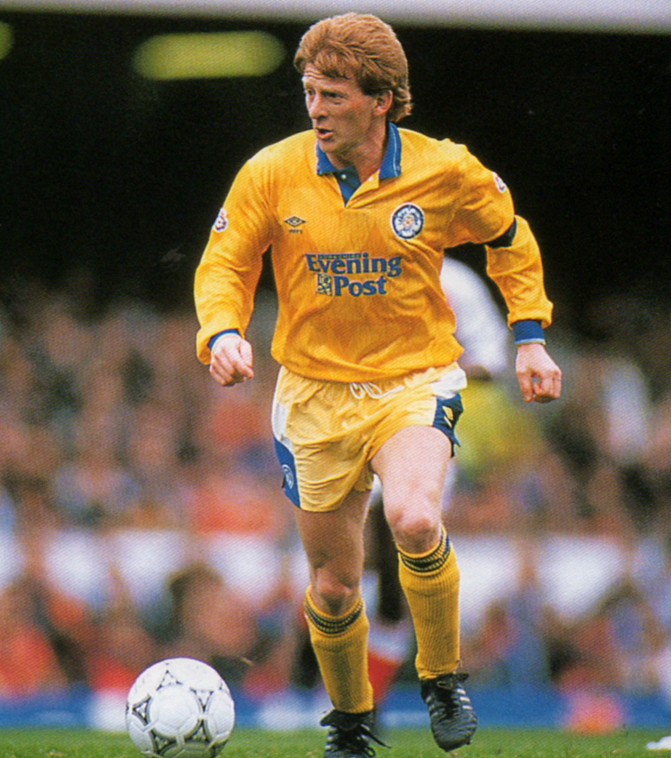
The men who took Leeds United back into the top-flight the last time it happened in 1990 are, of course, legends now.  They rank alongside some of the Revie boys because they rescued the club from eight years in the wilderness and restored us to the big time.  We had our own diminutive red-haired midfielder as a sort of latter-day homage to Billy Bremner – wee Gordon Strachan, who played a mighty part in the renaissance of Leeds with his leadership and goals.  It was a team effort though, and it was as a team that they succeeded – Strachan apart there was no major star, but the guts and drive of the collective effort eclipsed all rivals by the end of that fantastic season when we were crowned Second Division Champions in sun-drenched and strife-torn Bournemouth.  And nobody in the whole club at that time epitomised guts and drive, as well as sheer fist-clenched, vein-throbbing commitment and fight, better than Mr Vincent Peter “Vinnie” Jones.

I’d been aware of Vinnie, of course – who hadn’t?  His Crazy Gang antics were legendary and he’d lifted the FA Cup, but he was regarded as a bit of a maverick – still more hod-carrier than footballer.  So never in my wildest dreams did I imagine him as a signing for Leeds United, where stirrings had been going on ever since Sergeant Wilko marched in and started shaking the place up.  The “marquee signing” – you didn’t actually hear that phrase in those days – was Strachan, plucked from under the nose of his old Man U mentor Ron Atkinson at Sheffield Wednesday to provide the quality at the heart of the Leeds engine room.  Now that was the sort of signing I’d hoped and prayed for, and with the likes of Chris Fairclough joining Gordon at Elland Road it seemed to bode well for a real challenge as the close season wore on and 1989-90 loomed closer.

I was in a caravan on the east coast when I heard on the radio that Vinnie was signing for Leeds for around £650,000.  I frankly didn’t believe it, but when the reality sank in, my reaction was to think – bloody hell, Wilko, what are you playing at?  The signings of John Hendrie and Mel Sterland reassured me somewhat, but I was having trouble seeing what the Jones Boy would bring to the United table.  The early signs were not encouraging.  Strachan tells of an incident in a pre-season game against Anderlecht, where he saw an opposing player go down with his nose spread halfway across his face and blood greatly in evidence.  Vinnie had casually “done” him en passant before sidling off looking innocent, and Strach recalls thinking: my God – what have we signed here?  Vinnie himself remembers his early days at the club, and being moved to violence by the negative attitudes of some of the players being edged out as Wilko’s new broom started to sweep clean.  Among this disaffected few was John Sheridan, something of a Leeds legend – but Jones stood for no nonsense, and there were punches thrown and people seized by the scruff of the neck as he explained his views on solidarity and team spirit.  Vinnie was obviously going to be a kill or cure measure – there were signs he might have much to contribute to the collective effort, but equally that he might turn out a loose cannon which could blow up in all our faces.  Yet Wilko had a magic touch in those early years, and generally it was proved that he knew what he was doing.

In the event, and despite an uncertain beginning, Vinnie played a massive part in our promotion that year.  The fans took to him from the start – the sight of him coming on as a sub in the first home game against Middlesbrough will live long in my memory.  I can see him now, in the middle of the park with the game poised at 1-1, shouting and screaming as he conveyed encouragement and instruction in equal measure, arms pumping in an ungainly, baboon-like way, team-mates and opponents alike staring at him aghast.  And then he frightened a Boro’ defender into scoring a late, fluky own-goal and we had won, setting us on our way after a disastrous opening-day defeat at Newcastle.

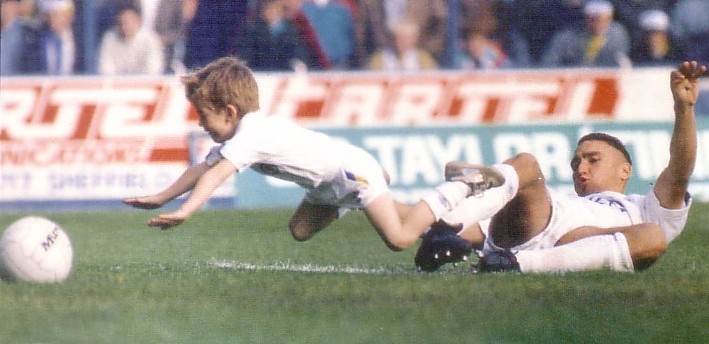
Vinnie just carried on making a difference.  He worked and worked, encouraged and exhorted, fought for the cause and put the fear of God up the enemy wherever he encountered them.  He scored spectacular goals, important goals.  He showed flashes of genuine ability and some of his passing was sublime.  He avoided disciplinary trouble to an amazing degree, given his lurid past.  He sold himself to no less a judge than Strachan as an honest performer who could “play a bit”.   He created a rapport with the crowd I’ve rarely seen before or since, chilling and joking with the wheelchair-users at the front of the West Stand before games, and smoking imaginary cigars as he took the plaudits of the adoring masses after finding the net.  In the warm-up before the Wolves match at Elland Road, he provided one of the great moments of humour in a tense campaign, bringing down 5 year-old mascot Robert Kelly in the area with a signature sliding tackle, much to the delight of the Kop.  Vinnie loved Leeds, the players and fans loved Vinnie and the partnership proved fruitful.  Up we went, and when Vincent Jones finally took his leave for the humbler surroundings of Bramall Lane and Stamford Bridge, it was with a “LUFC Division 2 Champions” tattoo proudly inked onto his expensive leg, a partner for the “Wimbledon FA Cup Winners” one on the other limb.  He was a Leeds United legend in only a little over a year at the club, a larger-than-life personality of massive ebullience and impact – and he is held in the highest of esteem in LS11 even to this day, when he mixes effortlessly in the rarefied, glitzy atmosphere of Hollywood.

So what do we need more right now than another Vinne type, as we hope to embark on another long-overdue return to the top table?  Those Jonesy ingredients of passion and power, guts and gumption, are just as important in this league today as they were in those far-off times as the eighties became the nineties.  Who could possibly fulfil that role now?  I’m really not too sure – Joey Barton maybe?  Even he could hardly be a greater culture shock than Vinnie was 25 years ago, but Barton is likely to be far beyond our purse – and to be frank I think he lacks Vinnie’s essential honesty and sheer bad-boy charm.  It’s difficult to say who if anyone we might secure to play the Vinnie part – but if it were possible, in advance of the season before us, to distil essence of Jones, or to clone him right from his bloodstained boots and tattooed ankles up to his fearsomely-shaven head, then I’d do it, and I’d present the result gift-wrapped for Brian McDermott to deploy as he saw fit.

A man in the mould of Vinnie Jones would be just the shot in the arm our club needs right at this point in time, just the incentive for the crowd to roll up its sleeves and get behind the team for a series of battles in a 46 game-long war of attrition.  If only we could have our Vinnie back now.
Shaker Aamer: Prisoner 239 and the Ongoing Scandal of Guantánamo Bay

Shaker Aamer's children in 2009

Shaker Aamer’s children in 2009

On 14th February 2002 Shaker Aamer became a father for the fourth time, his British wife Zin Siddique bearing him a son, Faris. On the same day, Aamer was incarcerated in Guantánamo Bay detention camp, where he has remained ever since. He has never met his youngest son, now aged 11. There has been no trial. He has never been convicted of, nor even charged with, any crime.

Shaker Aamer had been working for an Islamic charity in Afghanistan in 2001 when he was captured in Jalalabad and handed over to US officials. He was interrogated and then transported to Guantánamo Bay. Based on the evidence of a fellow detainee, Aamer was believed to have been working as a “recruiter, financier, and facilitator” for al-Qaeda. He has consistently denied all such allegations, and it was argued on his behalf by Clive Stafford Smith of Reprieve that the evidence against him was unsafe, being inherently incredible and the product of false promises and even torture.

The Bush administration acknowledged that it had no evidence against Aamer and cleared him for release in 2007. The Obama administration cleared him for release in 2009. Four years on and Shaker Aamer continues to languish in the detention camp at Guantánamo Bay, no charges preferred against him, no apparent bar to his release, his physical and mental health declining as he maintains a hunger strike – a glaring example of the most scandalous abuse of natural justice it is possible to imagine.

It has been speculated that Aamer “knows too much” about the goings-on inside the detention camp; allegations of torture have been made over the years, and Aamer himself has referred to instances where he has had his head beaten against a wall, and on one occasion waking from a severe beating to find a pistol on the table in his cell. It may be felt by some that it is the potential embarrassment to the authorities, consequent upon Aamer being free to speak out, that is the reason behind his continuing imprisonment – not any outstanding issue of national security.

Aamer is a charismatic and eloquent man, sometimes described as the “unofficial spokesman of the detainees”, so it may well be that there is something for some people to fear in what he might have to say when he is fully at liberty to speak. Clive Stafford Smith again: “I have known Shaker for some time; because he is so eloquent and outspoken about the injustices of Guantánamo he is very definitely viewed as a threat by the US. Not in the sense of being an extremist but in the sense of being someone who can rather eloquently criticise the nightmare that happened there.” Whatever the reason, there can be no excuse. The governments of the UK and the US agree that Aamer should be released: there is no charge against him; there is no evidence against him. And yet there he remains having already served longer, and in the harshest of prison regimes, than many a convicted murderer.

The US stands accused in the light of this scandalous situation of behaviour it would roundly condemn if perpetrated by a regime in a third-world country. The UK in its ineffectual stance over efforts to release Aamer, stands complicit in such a charge. Neither country emerges with any credit intact over such a blatant injustice, maintained over such a long period of time. The situation demeans both nations, and casts into a dubious light their mantra of “freedom over fundamentalism, democracy over dictatorship”. In allowing the incarceration of Shaker Aamer to continue, along with that of his fellow detainees who are also imprisoned without charge or trial, the leading lights of the western world are in danger of having their credibility shredded by their failure to act where the dictates of justice and the principles of democracy clearly indicate that urgent action is required.

The viewpoint of some of the public in this country, hearing of Shaker Aamed’s plight on national radio, is perhaps predictable in the climate since 9/11 and particularly this past week since the Woolwich atrocity. But it is nevertheless cause for head-shaking despair at the ease with which people are hoodwinked into ignorant bigotry. “Why are you running this item?” demanded one irate texter. “I am white, British and proud.” Others cited pearls of wisdom such as: “no smoke without fire”, or “well he’s not even a British citizen.” Yet this is a human being, acknowledged by successive political leaders of the nation that has deprived him of liberty and family life for eleven years as “clear to be freed”. That has been his status for the last five years. And yet still he rots away in his prison cell, subjected to daily humiliation and ill-treatment, missing his family growing up. It’s difficult to imagine a more appalling Human Rights abuse, and yet this is being condoned and allowed to continue by the self-styled “Leader of the Free World”. And there are people who applaud this, and recoil in apparent disgust at attempts to stand up for the rights of those detained without trial. It’s almost too depressing for words.

It’s not just the US either. Up to 90 Afghans are held without charge at Camp Bastion by UK forces, allegedly “for their own safety”. This has been described as a “mini Guantánamo Bay” – and when the name of a detention camp is used as a byword for all that is wrong with the legal process and principles behind such imprisonment, you know that there is something fundamentally wrong. Guantánamo Bay may not have the genocidally evil resonance of Auschwitz, Dachau or Belsen, but the metaphorical application is not a million miles away.

Shaker Aamer’s family now live in Battersea in South London. His wife has been ill since he was incarcerated eleven years ago; she has suffered from depression and other episodes of mental health disorder. Aamer himself is worried about how things will be when he finally is released, a prospect he views with touching confidence that it will actually happen; yet with some trepidation too. “I may find it difficult to respond to being called Dad,” he says. “Maybe my kids will have to call me Prisoner 239”. In January 2010, his 12-year-old daughter Johina wrote a letter to then UK Premier Gordon Brown asking for his release. This was three years after President Bush cleared him for freedom and one year after Obama did the same thing. In 2011, Aamer’s father-in-law Saeed Siddique commented, “When he was captured, Shaker offered to let my daughter divorce him, but she said, ‘No, I will wait for you.’ She is still waiting.”

Leeds United Such a Massive Pull in the Blogosphere: Just Ask West Ham

Dr. Weevil Of West Ham - Obsessed With LUFC

Dr. Weevil Of West Ham – Obsessed With LUFC

“We’re not famous any more” sing the Leeds fans, showing a neat grasp of irony in a medium too often dominated by the literal and the just plain crass.  The point is, of course, that we still are famous.  Hugely so.  Our fans scattered all over the globe mean that wherever you go, you’re likely to see a visiting Leeds United shirt to provide a welcome relief from all the tedious Man U rags sported by the clueless locals.  Listen to any Sky Live broadcast from the Theatre of Hollow Myths, and you’ll hear those wurzelly Devon accents mixing in with the nasal cockney whine as the Man U faithful describe how they “all ‘ate Leeds scam, innit”.

And the evidence is there in the ether too, as the web buzzes with references to our beloved Whites, ensuring that even the most facile and puerile of blogs can guarantee itself hits aplenty merely by mentioning those magic words “Leeds United”.  Some have taken it to such lengths that their Leeds-related output has shoved the more mundane stuff about their own desperately anonymous favourites way into the background, which is peculiar, but hey – you have to provide your readers with what they want to read, apparently – and if possible you have to try to attract some of football’s most fanatical fans by being “controversial” – or as we might more accurately describe it: by talking bollocks.

The leading contender for “biggest culprit” in these dubious and unprofessional tactics is a poorly-constructed and ill-written blog, ostensibly concerned with minor London club West Ham United, and entitled “The Game’s Gone Crazy”, which has a specially-created page to allow it to burble on about matters which are, frankly, none of its concern.  The Leeds United content of this page is out of all proportion to the interest you might expect the ‘Appy ‘Ammers to take in our beloved club, and of course it tends to paint the goings-on down at LS11 in the most negative light possible.  He’s been at it again today, capitalising on the 24th anniversary of Don Revie’s death to write another “controversial” article which – naturally – consists of second-hand lies and rumours recycled from various down-market tabloids, some successfully sued by former Leeds United personalities in the past.

Now, it must be said that a cursory examination of the contents of this upstart site (I’d caution you, gentle reader, not to waste too many of your valuable minutes on it) will reveal that the site-owner’s tactics are a hell of a lot sounder than his less-than-impressive literary ability.  He manages to attract a lot of comment and abuse from outraged fans of other clubs, with Leeds obviously prominent among their number.  The simple process of writing about Leeds, writing often and writing groundless rubbish, generates a lot of traffic for this site, traffic that its ‘Ammers stuff could not possibly hope to generate.  So, from that point of view, the author is running a successful operation, but one which owes little to the merits of his creation – which are appallingly few.  The sly Bubble-blower has fastened onto the global appeal of Leeds United to his advantage, and we should perhaps praise his acumen; it certainly far outstrips his ability to string enough sentences together for a decent piece of writing.

As you might expect, a number of his West Ham-oriented readership are a bit embarrassed about this craven behaviour – but their criticism falls on deaf ears by and large.  It’s quite obvious that “Dr. Evil”, as he is referred to by himself (and we presume he fondly hopes that others so refer to him as well), is preoccupied by getting as many reads as possible for his site and – only too well aware that his meagre talent is not going to get him far down that road – has opted instead for setting up as an irritant that will attract opprobrium and attention in equal measures.

It’s a back-handed compliment of course – the world knows that Leeds United is still big news out there, and any LUFC tag will pretty much guarantee a readership made up of Leeds fanatics (many thousands of us) and those who detest the very mention of our great club’s name (positively millions in the Devon/Cornwall hotbed of Man U support alone.)  So we should perhaps be flattered by the attention – it’s better than the dreadful and depressing anonymity suffered by West Ham and other such small fry.  And viewing it like that – not taking it too seriously and dismissing it as the unsubtle attempt to drag in readers that it undoubtedly is – we can smile ruefully and reflect on how much quieter a place the internet would be if Leeds United didn’t exist.  What would they all talk about then?  And where would the hapless and not-terribly-good Dr. Weevil find his victims… ahem… readers??

Dortmund Über Alles

Image

The Germans are marching on Wembley with the aim of conquering Europe. It’s going to be Totally Teutonic, an island of internecine rivalry in North London. Some of the Little Englander persuasion, always ready to laugh when Germany lose in the World Cup (having recovered from England’s own earlier exit) or even when they get “keine Punkte” in the Eurovision song contest, will declare they have no interest in the result beyond a wistful longing to see them both lose. Others will aver that it’s really none of our business, and we should just play the genial hosts to a world-class event and stand ready to clap the winners on the back, whoever they might be, and say “Jolly well done, chaps”. Wrong, wrong, wrong. This result matters – well it does if you’re a Leeds United fan.

Firstly, let’s not forget that the city of Dortmund is actually twinned with Leeds, so we have those ready-made links which can be dressed up as brotherhood should the occasion require. This occasion does so require. We Leeds fans should stand four-square behind our European partners and wish them all success against Bayern Munich on Saturday evening. It’s only right and proper – after all, what are twinned cities expected to do other than support each other? But there’s another, far more compelling reason for wishing Bayern misery at Wembley. In fact, there are two.

Rewind firstly to 1999 and the culmination of the jammiest season an English club has ever had. Everything went right for Man U that year, and they walked off with a highly fortunate treble, after a series of unlikely comebacks and distinctly fluky wins in various competitions. At the death, they were one down in the Champions League final in Barcelona, having been outplayed by a massively superior Bayern side who had been thwarted by the woodwork on at least two occasions. Then – as we know – they scored twice late on, the usual jammy bounces and ricochets, and we’ve all had to live with the memory of Ferguson’s smug “Football, eh? Bloody hell” quote ever since. Bayern let us down that night, and they should not be forgiven.

And further back even than that – all the way back to 1975 and the night Leeds United became Champions of Europe in all but name, a moral status we have defiantly hailed loud and proud ever since. That we don’t have the trophy on our sideboard is an open sore that festers still and will never heal – as great an injustice as that perpetrated in Salonika two years previously. Penalty claims, really clear-cut, but turned down flat. Beckenbauer, der Kaiser, the guilty man. Bayern totally out-played by a Leeds side pursuing their last hurrah, committed heart and soul to winning it for The Don who was watching on from the commentary box in the Parc des Princes. A goal for Leeds, struck powerfully and true by Lorimer on the volley, Maier beaten all ends up, the very least our superiority deserved. Then, der Kaiser persuades the referee – damn him for all eternity – to speak to his linesman and see if there wasn’t maybe some way this inconvenient goal could be disallowed. And of course that is what happened. Thrown, deflated, outraged, the Leeds United side were hit by two late sucker punches, and Bayern were the most undeserving Champions of Europe ever – even more so than those spawny gits of ’99.

Those two Finals – the win for Bayern and the loss for Bayern – are a thorn in the side of every Leeds fan who can bear a grudge as a Leeds fan should. If the two results had been reversed – if they’d lost (as they should have) in 1975, and won (as they should have) in 1999, then we might well now be abandoning our civic links with the good Burghers of Dortmund, and saying a sentimental prayer for Munich. We’d probably have shouted for them last year against those fancy dans from Stamford Bridge. But justice prevailed on neither occasion, and Bayern Munich is a name inscribed forever on the Leeds United wall of hate.

So come on Dortmund. Get into them and make ’em have it. Let’s hope it’s another atonement and – as with last year at the hands of Chelsea – Bayern end up with nowt to show for their showpiece appearance and crying into their beer. Fingers crossed.

Shameful: BBC Spit on Don Revie’s Grave

Don Revie OBE:  The Greatest

Don Revie OBE: The Greatest

History, they say, is written by the winners.  In last night’s “Match of the Day”, the BBC provided ample evidence to show that it is also rewritten by hypocritical sycophants who should know better.

The events of the afternoon had not panned out as the scriptwriters would have wished, though all looked well ten short minutes from the end of Man U’s match at West Brom, S’ralex’s last game as manager.  The Plastic Champions were 5-2 ahead, and John Motson had purred, gasped and chuckled his way through 80 minutes of exhibition football, punctuated by comical home defending, and it looked very much as though another team was going to roll over meekly for the men from Salford.

Then S’ralex brought on Paul Scholes for the Ginger Minger’s own last appearance before his latest retirement.  The cameras prepared to adjust to soft focus, Motson drew in another breath preparatory to more shudderingly orgasmic tributes as he was consumed by an ecstasy of highly marketable sentimentality.  The stage was set for the Govan Guv’nor to stump off into the sunset, his purple-blotched features lacerated by a parody of a smile.

Then it all went wrong.  West Brom struck three times in the last ten minutes, Ferguson’s smile dropped to the floor quicker than a Gareth Bale dive and the mighty Man U were holding on at the end to avoid saying goodbye in the face of a last blast from a defeated Hairdryer.  5-5 it finished, and the BBC were denied their expected valedictory stroll in the sun; the Baggies had pooped the Corporation’s party.

Maybe it was this that prompted the spite and small-minded pettiness of the montage which prefaced the Match of the Day highlights late last night.  More likely though that it was always going to be yet another calculated slap in the face to the memory of a great man, a man whose boots the assembled hacks and ex-pros on the MOTD couch are not fit to lick, a true great of the game that the Establishment seem determined to pretend was never there.  Ferguson was painted in admiring and rose-hued tones, to a background of his many achievements as compared to the other “managerial greats.”  Bob Paisley, Brian Clough, Jock Stein, Bobby Robson, Ron Greenwood, Bill Shankly, Matt Busby, Bill Nicholson; all these legends were held up as examples of managerial excellence to be rightly lauded for their achievements and the mark they left on the game.

But no mention of the greatest of them all: Donald George Revie OBE.

This was no mere oversight.  It’s been going on for years, and it’s a premeditated and vicious attempt at the excision from public memory of football’s greatest manager, a cowardly and shameful act of malice aforethought.  It reflects ill on the researchers who put these things together; aren’t they aware of their history, we in the know might wonder.  Don’t they have access to Google?  But they know all about the Don, they know he transformed a tired old joke of a football club into the most feared and respected force in Europe; they know he did it without massive financial backing and without paying obscene wages; they know how he did it all to the dubious background of an initially apathetic support, fans who had only ever known mediocrity at best, and expected nothing else.  Out of all this, Don Revie wrought a miracle – a team that respected judges of the game have described as the finest club side in English football history.

The accidental omission of Revie’s name for any TV item concerning itself with managerial greatness would be unforgivably slipshod; the act of a clueless nincompoop.  But this was much, much worse than that.  It was an exposition of hypocrisy underpinned by malice and the bile of fifty years’ accumulated resentment.  It was a crass attempt at revisionism, a blunderingly clumsy try at pretending Don Revie never existed.  It was wishful thinking in its bitterest and most destructive form, a playground insult to a giant of the game.  The BBC cowards and toadies have exposed themselves as classless fools, deserving only of contempt and ridicule.

“And Leeds will go mad.  And they’ve every right to go mad!” – as Barry Davies memorably put it back in the day, in more realistic times before the game turned plastic, when everybody knew who the heroes were and we weren’t fed a diet of pap and lies.  And Leeds should go mad again.  The city, the club, the fans – none of them should continue to lie down and accept this disgraceful treatment, this attempted erasure of an iconic figure whom we all worship as “Simply The Best.”  There should be a loud outcry, a vehement protest.  This is my small contribution, but the fans as a body have form for hitting back at media and establishment when they feel one of their own wronged.

In 1994, the FA handed down a mandate that all clubs should observe a minute’s silence in respect for the late Matt Busby.  They did this because it’s what you do when a respected figure dies – except of course they’re not consistent.  They failed to mark the death of Don Revie, a tragic and cruel end from Motor Neurone Disease.  They failed even to send a representative to his funeral, although – to his eternal credit – Alex Ferguson was there, and Denis Law, as well as most of the Leeds United greats and other proper football men.  But none of the hypocrites in suits from the game’s ruling authorities saw fit to get off their backsides and pay tribute.  Revie was dead; let them get on with pretending he never existed.  So in 1994, when they were supposed to lapse into a respectful silence, the Leeds fans at Blackburn Rovers’ ground exploded in a raucous and repeated cry of “One Don Revie!  There’s only one Don Revie!!”  The great and the good of the sport were scandalised.  People pursed their lips and shook their heads sadly.  How dare these yobboes ruin our tribute to our Chosen One?  But I’m so, so glad that it happened.  We should not knuckle under to the official view; we should never bow down before such blatant hypocrisy.

They’re getting wise to rebellion now.  There tends to be a minute’s applause these days, lest any disrespectful mob should see fit to assert their unwanted point of view the next time some officially-beloved figure keels over.  But the fans will be heard, believe me.  And if the media – typified by these contemptible fools in charge of the increasingly poodle-like Match of the Day – continue so determinedly to ignore and try to obliterate the legacy of The Don, then I hope that defiant cry will be heard again, loud and proud.  While ever Leeds United fans are prepared to stand up and be counted, happy to raise their arms and voices and be heard – then Don Revie will never be forgotten, whatever the wishes of the pompous suits and deluded TV types.

Don Revie, “The Don” (1927 – 1989)  A true legend and a great of the game.  Whatever you might think of him – and God knows, I’m no fan – just ask S’ralex.

The Pride of “The Damned United”

Image

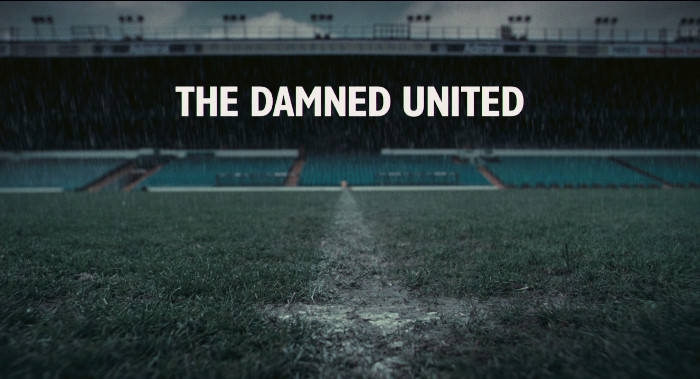
Was ever another phrase so obviously coined with one intention, only to be taken up and brandished with pride to the completely opposite effect? Author David Peace – a Huddersfield Town fan – has described his book “The Damned United” as “an occult history of Leeds United.” The word “history” in this connection is somewhat optimistic – the book is decidedly fictionalised, and the point of view is the imagined perspective of Brian Clough as he struggled through his 44 days in what could fairly be described as enemy territory. The book was a success, met by a measure of critical acclaim. The film it spawned was of more dubious quality, famous for the lengthy list of goofs on its Internet Movie Database page, and widely regarded as particularly one-eyed in its depiction of personalities and events, none of which bears much resemblance to actuality.

It is the tag though – that Damned United tag – which seems set fair to achieve iconic status, and not with the intended pejorative effect. With a typical sense of gallows humour, devotees of the Elland Road club have taken the label and made of it a badge of honour, waving it under the nose of the millions who despise Leeds United as a symbol of inverted defiance. We Are The Damned United, they say – do your worst. The tiresome recycling of allegations about Don Revie, the endless litany of “Dirty Leeds” myths and the omnipresent attitude that the West Yorkshire club exemplify all that is shady about football, all of this is held up to ridicule as those who love the club glory in the new name. Sod the lot of you. We are Dirty Leeds, The Damned United, and we are proud. It’s a unifying message, the foundations of a siege complex that can rally support behind any popularly-hated institution. It’s an assertion of individuality, of a refusal to conform to the cosy standards beloved of media and Establishment. It takes gritty character to be a Leeds fan in the face of such universal hatred, and those of sufficient character know they’re part of something unique and special. We Are The Damned United.

It’s also had the welcome effect of reclaiming a measure of ownership and identification with that word “United”. It’s highly doubtful that Town fan Peace could have foreseen or desired that effect, but there it undoubtedly is. For decades, the press, the football establishment in the UK and elsewhere – and of course Man U themselves – have been unrelenting in their efforts to corner the term “United” exclusively for the Salford-based franchise. It’s been an important marketing tool, a vital part of the attempt to sell the myth of The Biggest Club In The World™ (Copyright © The Gutter Press since the late 50’s) to children of all ages from Devon to Singapore. It’s seeped into the public consciousness like the subliminally insidious selling technique it is, and of course the tat-consuming, replica-shirt-buying, Sky-subscribing suckers have fallen for it in their millions. But now there is The Damned United, inextricably linked with Dirty Leeds, and suddenly that formerly football-related suffix isn’t quite so exclusively Man U any more.

Dirty Leeds The Damned United

The contrasting psyches of the Leeds United and Man U support is an apt illustration of how the two sets of fans have embraced such polar-opposites in terms of club and image. The Man U fans desperately want that monopoly of terminology, they need to believe the press-powered fairy-tale that there’s “only one United”. The motivation for being identified with what they are always being told is the “biggest and best” has a Freudian compulsion at the back of it, a sense that there is an inadequacy which yearns to be compensated for, an insecurity which needs bolstering. There are people like that everywhere, victims of society, and so you find Man U fans all over the place, as common and undiscriminating as flies. Leeds fans, on the other hand, tend to support their team – where the connection isn’t simply local and tribal – for reasons of perverse pride. It’s a manifestation of defiance and a refusal to be categorised as a commercial target group. The pride is palpable, and the negative image of the club feeds this. Sod you lot. We Are The Damned United. The emergence of such a potentially iconic label was not good news for Man U-inclined inhabitants of armchairs everywhere, and again, this is not an effect the author would have counted as one of his aims in producing his work.

Thanks, Mr Peace. You could hardly have aided our cause any more effectively, and Dirty Leeds have gained from the exposure in popular culture. The book may have been an attempted exposition of Clough’s state of mind as that complex character negotiated his time in purgatory; the film may have been an amusing romp through the mythical hinterland that borders but rarely intrudes on the territory of actual fact. But the label will probably out-live the pair of them, and will flutter bravely and proudly in the vanguard of the Leeds United juggernaut as it – eventually – thunders its way back to The Top.

Beckham To Retire At Last

Beckham: Hanging Up Boots

Beckham: Hanging Up Boots

So, the day has arrived at last.  An icon is to depart the game.  England’s “Goldenballs”, the man with the most famous metatarsal the world has ever seen, he of the sculpted facial furniture with chiseled jaw and cheekbones to die for, David Robert Joseph Beckham OBE is finally to quit the game he has – more or less – adorned since 1995.  Everybody is sitting up and taking notice at what is the end of an era.  Leyton Orient have felt it necessary to remind the world in a timely tweet that the Coiffed One is to make his last appearance against French side Lorient – NOT the English League One denizens L.Orient.  Thanks for clearing that up, lads.

 My first memory of David Beckham is necessarily hazy – I was quite intoxicated, and stood high up in the away end at The Theatre of Hollow Myths as Leeds United’s all-conquering youth side trampled the budding superstars of Man U into the turf on their way to an eventual 4-1 aggregate FA Youth Cup win.  That was in 1993, and it was some small measure of compensation for the transition from our status of Last Real Champions to that of Man U as first holders of the Premier League Plastic Trophy.  As the new era dawned, an epic career was off to an inglorious start, but it was destined to contrast starkly with the doomed efforts of that night’s winners.

Since then, even so jaundiced an observer as I must admit that Beckham has scaled Olympian Heights, and on one foot, too.  No less a footballing authority than the late, grating George Best described him in less than glowing terms: “He cannot kick with his left foot, he cannot head a ball, he cannot tackle and he doesn’t score many goals. Apart from that he’s all right.”  Not that he was bitter or anything – but maybe the fact that Beckham’s earnings in any given calendar month eclipsed the entire career earnings of the self-styled “Greatest Ever” had touched a raw nerve or two.  Whatever Bestie might have thought of the shortcomings of Becks talent-wise, the London boy could surely have taught him a thing or two about application, dedication and – crucially – not being caught with his pants down before important semi-final matches.

That ability to dedicate himself and make it big, on the back of a less-than-completely full box of tricks, certainly redounds to Beckham’s credit.  His habit of creating the most spectacular results with one swing of that cultured right foot did him no harm either.  On loan at Preston as a youngster, he created a stir by scoring direct from a corner, and not too long afterwards, establishing himself in the Man U first team, he looked up from just inside his own half at Selhurst Park, and lobbed the ball mightily over the back-pedaling ‘keeper Neil Sullivan to score an outrageously long-range goal against long-ball merchants Wimbledon.  The most famous exponent of this type of effort up to that time had been a chap called Pele, who tried it in the World Cup; but Pele had missed.

The path to World Superstardom was not, however, always strewn with rose petals.  Attitude problems surfaced, petulance would be a problem throughout most of his career (not an uncommon problem among graduates of the Man U finishing school), there were run-ins with his irascible mentor Ferguson, and he could be impulsive too.  He saw a young lass on a pop video, and he decided on the spot to marry her.  His judgement on that occasion at least was reasonably sound, or so it seems; the marriage is still going strong and from tacky beginnings with a wedding that would have figured large in any style guru’s nightmares, the couple have built a family with their weirdly-named brood and two large fortunes securing a stable future for all concerned.

So how will Beckham best be remembered?  Some will say as the archetypal Man U fan – he was born and raised in London after all, which is a headline qualification for that status.  Others will remember his flirtation with the extreme edges of fashion – his famous experiment with girly clothing as he sported a sarong, for instance.  But whatever he did, whatever style he either aped or created, there were millions queuing up to follow his every footstep.  He had the knack of capturing the hearts of a whole generation with the totality of the Beckham package – the talent, the looks, the style, the pop-star wife.  Some of it was grossly kitsch, Beckingham Palace was the venue for many sins against the Manual of Good Taste.  Some of it took your breath away with the sheer, daring nerve of it – the revelation that his son Brooklyn was named after the site of his conception had people offering up prayers of thanks that the tender moment hadn’t taken place in Peckham.  Subsequent male children were named Romeo and Cruz and then a girl arrived to be lumbered with the curiously android-like Harper Seven.  There is, after all, no accounting for taste.

Some will remember the iconic free-kicks for England, the most famous of which secured his country’s automatic World Cup 2002 qualification.  What people forget is that, had we been doomed to the play-offs, we might have taken Germany’s easier route to the Final – but who ever knows what fate might hold?  In the end, England and Beckham, together with his famously bust metatarsal, appeared in the global tournament, but for once Beckham wasn’t really up to it, and it was his half-hearted, half-baked, half-fit attempt at a tackle which let Brazil in for the equaliser at the quarter-final stage, the Samba Stars going on to eliminate England 2-1.

But whatever you might think of Beckham, my fondest memories of him will be in that England shirt – not for his flashes of temper, leading to notorious dismissals, but for the massively evident pride with which he wore the Three Lions over his heart, the utter commitment and dedication with which he put himself about the pitch in the England cause, be it merely as a star player, or eventually as captain of his country.  Nobody set a better example of leadership than David Beckham when he had that international shirt on, and nobody could ever doubt on those occasions that everything else – the endorsements, the mansions, the publicity stunts, the lurid tales of his off-field life – all of that was secondary to his intense, burning patriotism.  If that alone had been enough, England may well have had three winners’ stars to embroider above the Three Lions on the Shirt, instead of that solitary one.

So it’s farewell, Goldenballs.  He was a player of his times, a man who would be a superstar  among superstars, someone who would attract fan fervour and inspire adulation and hero-worship out of all proportion to his essentially modest character – and some would say disproportionately to his talent too.  Be that as it may, it’s unlikely we will see such a phenomenon again, unless the ingredients are coming together even as we speak, and yet another cockney Man U fan is bubbling under up Salford way.  You just never know.