The idea of a “Memory Match” series of articles is hardly original, but it can be fun, particularly when the present doesn’t offer us much to shout about – and let’s face it, there are loads of games in the Leeds United back-catalogue well worth recalling, and savouring anew.
Despite the encouraging win over Blackpool, it’s probably fair to say that this season is in danger of petering out, leaving us looking forward to a whole new campaign for our hopes of a fresh start post-Bates (who shall be known as President Irrelevant next season.) Things have been so dire at times, that the recollection even of a defeat can be preferable to gloomily contemplating our current prospects – as long as that defeat was a really special one, with gloriously redeeming aspects to it.
Such a match, such a defeat, was the home game with Liverpool in front of a 31460 crowd during our first Sergeant Wilko-flavoured top-flight season of 1990-91. It had been a good season – we were nicely established back at the right end of the top table. We’d had some tasty results and the name of Leeds United was well and truly back on the agenda, despite the slightly grudging attitude of the southern-based media.
I’d been anticipating the Liverpool game above most others. There was that satisfying all-White versus all-Red thing, against the green backdrop of the turf, which appealed to the eye of the beholder. But also, I had a real problem with Liverpool FC. They’d been the opposition in my first ever game at Elland Road, a traditional 3 pm Saturday kick-off in April 1975. I’d gone into the ground with my Dad and brother, all wide-eyed and expectant, and Elland Road blew me away, so much more vivid than it had ever been on the telly. I knew straight away that this was love, and that it would be for life. Then Liverpool callously spoiled my debut, beating us 2-0. The following season, they did it again, 3-0 this time. I didn’t even see us score against the Reds until Daisy McNiven’s late equaliser in 1977. By the time we got relegated, in 1982, it had got to the point where I expected nothing but a hiding from Liverpool games, and that’s invariably what I got. I hated Liverpool.
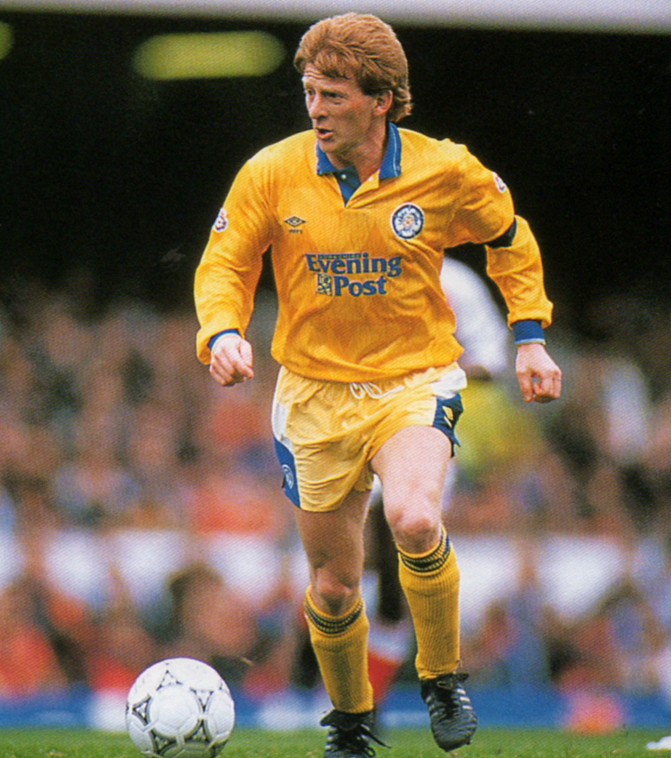
So, in that first post-promotion season, when we’d looked like a seriously top team again, I was all vengeful and ready for the Reds, who had recently been stunned by the resignation of Manager Kenny Dalglish, and I trusted the lads to be at least as committed as I was. And to be fair, they did look right at it, early on. Carl Shutt burst through down the right to sting the hands of their ‘keeper. Mel Sterland planted a free header wide from around the penalty spot, wee Gordon Strachan was buzzing about to good effect in midfield, Leeds were playing well. Then, the sky fell in.
 John Barnes, Liverpool’s lithe, lissom winger, chose that day to really turn it on – just as we’d all wished he would for England ever since his legendary goal against Brazil in the Maracanã – but his virtuosity for his club on this day was bad news for Leeds United. First, he dinked a dipping ball to the far post at the Kop End, and the roof of our net billowed as Ray Houghton finished. Next, he was involved in the award of a clear penalty, struck past John Lukic with power and precision by Liverpool’s wardrobe-shaped Danish scouser, Jan Molby.
Leeds had been well in the game, but Liverpool had carved out and taken their chances, and my familiar Red nightmare was playing itself out yet again. Now, David Speedie – that unlikeliest of Liverpool players for their era of success – forced himself in on the act, first having a goal disallowed, then scoring at the far post after more good work from Barnes on the left. Leeds were ragged and despondent, and it was no surprise when Barnes again, after a nifty one-two near the halfway line, scorched clear to clip a fourth past a helpless Lukic, and leave me sitting drained and woeful on the terrace steps throughout half-time, head in hands, despairing at the four goal gap and fearing what might yet be to come. I’m sure too that this was the first time I ever heard Monty Python’s “Always Look on the Bright Side of Life” played over the tannoy – and taken up by a stunned home crowd who were even yet able to indulge in a bit of gallows humour.
When the second half started, I saw the Liverpool reserve ‘keeper Mike Hooper running towards us. Hooper had been standing in for a few games for the regular No. 1, Bruce Grobbelaar, and I was more than a little disappointed. I’d had this recurring wish-fulfilment dream about sneaking down off the Kop while play was up the other end and, with a hitherto concealed pair of scissors, neatly snipping off Bruce’s annoying little pony-tail. It was probably just as well that temptation had been moved out of my way, but I doubt I’d have really done it – ex-guerrilla Grobbelaar would have killed me anyway, and I’d most likely have got arrested, too.
Hooper was under pressure immediately, as Leeds had rediscovered their vim, and forced Liverpool back. The breakthrough came when the keeper could only push out a scuffed Gary MacAllister shot, and Lee Chapman was there to bundle the ball unconvincingly  home off the crossbar. Then Chappers challenged for a high ball at the near post, and in it went – only for the ref to disallow it, his dismissive reaction to Chapman’s protests further enraging the hyped-up hordes on the Gelderd End. Hopes revived though as the ball sailed over a clearly-fouled Chapman from the left and landed in the area at the feet of Shutt, who swivelled to score competently. 2-4 now, and maybe an unlikely comeback was in the offing. But almost immediately, Ian Rush mugged Chris Whyte just outside our box, and back heeled into the path of Barnes who took it on and scored a brilliant fifth, to renewed home despair.
Leeds seemed to know that they had to hit back hard and swiftly, and the best goal of the game arrived when Dave Batty struck a wonderful bending, scything cross from deep on the right, and Chapman hurtled through mid-air to meet it with a bullet-header, beating the startled Hooper all ends up. Two behind now, and Liverpool looked as if they were just holding on, the pressure from a stoked-up Leeds incessant.
The match had become a breathless spectacle, surreal in its ebb and flow, more like some sort of high-class park game than your archetypal tight, defensively-sound First Division grapple. Leeds seemed always on the brink of total annihilation, and yet Liverpool, seasoned top-league campaigners, couldn’t quite manage to shake off these upstart newcomers, who kept on snapping relentlessly at their coat-tails like eager pups. Strachan typified the defiance and endeavour, popping up everywhere, probing and passing. Now he received the ball on the right corner of the Liverpool penalty area, and set off on one of those scampering little runs where he didn’t so much beat defenders for pace, as manoeuvre adroitly around them, like some pesky little tug in among ponderous oil-tankers. He did this now, beating two or three Liverpool defenders inside a few square yards, and then clipping a delightful ball to the far post, where Chapman towered to complete his hat-trick, the arrears reduced to one.
And that, gentle reader, is as good as it got. Try though they might, the gallant battlers in white could force no further concessions from a Liverpool team who had looked like running away with the game at half-time, but who were virtually on their knees by the final whistle. It was a defeat – glorious, inspiring even, but bringing with it the zero points haul of any other defeat. On the day though, the crowd weren’t counting league table points, and the buzz as the throng left the stadium was of a fantastic comeback against a top, top team – pride was in the air, loud and throaty and no-one was bemoaning the loss. As one person loudly declaimed emerging, from the Kop exit, “we gave ‘em a four goal start, then hammered ‘em 4-1!” Well, quite. It had been, by far, my best-ever Liverpool game, better even than the last-gasp draw we’d salvaged in 1977. It also told us all we needed to know about the battling qualities of Wilko’s Leeds United; an injection of quality the following year would garner the Champion’s crown for us, and also along the way, my long-awaited first victory over the Anfield Reds.
For that, the wait would prove worthwhile. But on this April day in 1991, those of us who had suffered through the wilderness years could see promising signs, even in defeat. United were most decidedly back.
Next: Memory Match No. 2: January 1992 – Sheffield Wednesday 1, Leeds United 6. Tune in for another Chappers hat-trick, and “The Worst Dive Ever”.
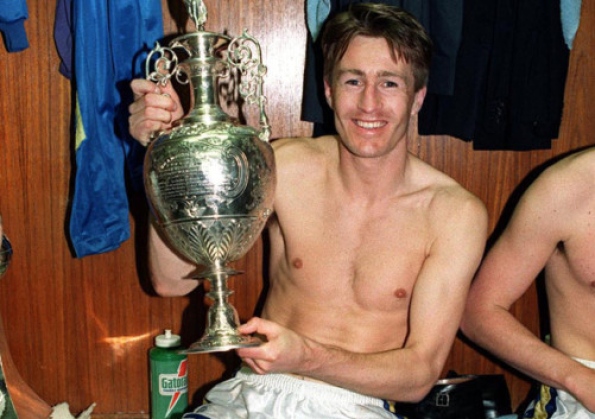 “Leee” Chapman, Whites Legend and Last Champion[/caption]











 Life, Leeds United, the Universe & Everything