Tag Archives: retirement

Where’s That Sick-bag?

A Sickeningly Solemn Moment

A Sickeningly Solemn Moment

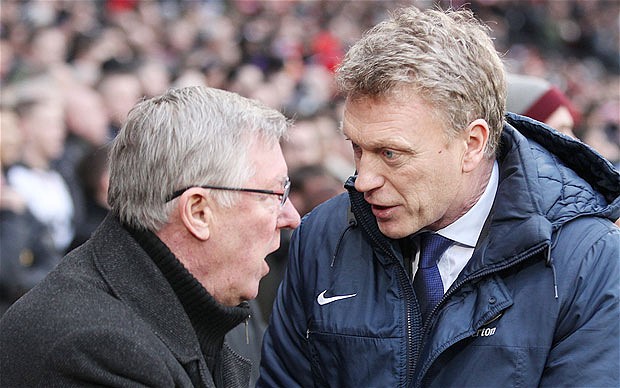
Ladies and gentlemen, if you have sick-bags to fill, prepare to fill them now.  If sugary treacle and soft-sawder syrup is your thing, get ready to drown in the stuff.  “Sir” Alex Ferguson is departing the stage, and there won’t be a dry seat in the house.  Sky TV are preparing for an extended weepathon as their hero who hated them, their idol who despised them, climbs down unsteadily from his throne of purchased glory and totters off upstairs to chew gum and glower balefully down at his hapless successor David Moyes.

This afternoon’s live TV offering has a delicately-scripted path to follow.  There will be a soft-focus montage of many of the Purple-Nosed One’s finest moments – Steve Bruce’s 98th minute winner against Sheffield Wednesday to a background of Martin Tyler’s shrieking climax as Man U all but clinched their first plastic Title.  Giggsy-Wiggsy’s finest FA Cup goal of all time as the Arsenal defence parted like the Red Sea and we were treated to an unsolicited view of the Husband of the Year’s chest-rug.  A selection of van Persie’s catalogue of sublime finishes from the Dutchman’s “One Man Title-Winning Season” collection.  It is doubtful however that Eric Cantona’s exposition of martial-arts skills from his South London Show of 1995 will make the cut.

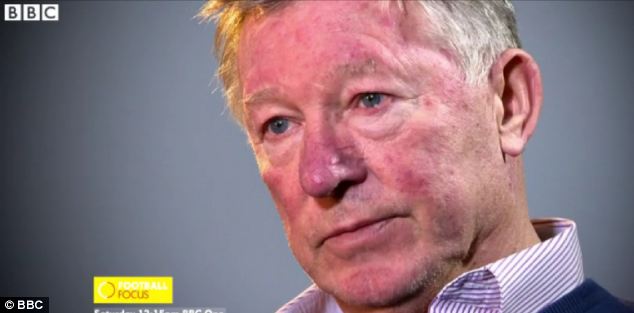
After the moonlight and roses video softener has set the correct ambiance, and armchairs all over Devon and Cornwall are already bedewed with manly tears, we may have an actual interview with the dearly-lamented Departing One.  Subtitles will be provided for this section of proceedings, and yet it won’t so much be what He says, but more the way He says it.  As an example, if you hear a glottal noise along the lines of “Thiznaequayshtyunabootthaaaaat” it means that S’ralex is saying something he wishes you to accept as undisputed fact.  This happens a lot.  But those craggy and broken-veined features of pasty pink splotched with purple may at some point break into a grimace not unadjacent to a smile, and this will be the cue for the suits in the Sky Studio to howl with unrestrained emotion as the tears flow anew.  It’s going to be a harrowing afternoon, and we’re nowhere near kick-off yet.

At some point we will have testimony from a group of the usual suspects as to the essential saintliness and unmatchable achievements of the man.  Lou Macari, Paddy Crerand, Peter Schmeichel, Steve Bruce, Bryan Robson and other such neutral witnesses will speak their lines to camera with all the sincerity and conviction of a tailor’s dummy. Ron Atkinson and Tommy Docherty may even appear if time permits, and attempt to mask their burning resentment at being consigned to the dustbin of history with a few clamp-jawed soundbites of faux admiration, before shambling off, clutching Mr Murdoch’s fat cheque.

And then, the game.  It has been thoughtfully arranged that the final day opponents at the Theatre of Hollow Myths should be a footballing side of attacking ambitions.  The script will call for them to make pretty patterns in midfield whilst offering no great threat to Man U’s rocky defence, where Phil Jones will be frantically gurning in an attempt to frighten off any Swansea attacker who dares venture too close.  At regular intervals, an uncharacteristically misplaced pass from the away team bit-part players will gift possession to Man U, who will then – according to the stage directions – “swoop to score another magnificent goal for the Champions.”  Ecstasy will ensue in the stands and the commentary box, and flowers will be thrown at the feet of the gum-chewing Govan Guv’nor as he performs that annoying little staggery old man’s dance from under the dug-out canopy, champing away in a Wrigley’s rictus of triumph.  It is an image that will be burned on the retinas of a whole football-supporting generation.

After the match – whatever time that might be depending upon how long it takes Man U to score The Winner – we shall have post-game interviews, more video footage to the accompaniment of weeping strings and synth, rambling reminiscence from the assembled sycophants – and maybe a final word from the abdicating Emperor himself, who will remind us, via an interpreter, that there’s “aye anither game tae go yet, by the waaaaay.”  And the crowds will sigh and depart for all points south, the lights will go out at the Theatre of Hollow Myths and the scene will gradually darken as a rainy Salford day fades into the night, as we all must sooner or later.  All that has been missing is the trademark Lone Piper, but he is reserved for even more solemn occasions, and his time is not yet.

And so it will be over.  It will be time for the Sky suits to heave a gigantic, shuddering sigh signifying end-of-an-era grief and regret, and then they must reluctantly move on.  A new hero awaits, and he’s sadly lacking as yet in the trappings of success and the aura that the commercially-aware would wish for him.  A project is to hand now that S’ralex has faded into the sunset, and that project is the reinvention of an Honest Pro into a Demigod, the Greatest Manager Of All, for such is the requirement of the twinned Hyperbole Departments of Sky and Man U for the unsuspecting Mr Moyes.  It’s a work in progress even now, but the momentum will gather as the new season approaches and the threat of upstarts such as Chelsea. Arsenal, Man City and even Liverpool, which has to be repelled for another year.  It will need to be business as usual, even without the Blessed Fergie. Life goes on, and today was merely the schmaltzy climax to the long-running soap-opera which was Man U under S’ralex.  It’s time to dry the tears and count the money.

Now where IS that sick-bag?

Moyes? A Strangely Unambitious Choice

"Eh - by the waaaaay, Ah'll no' be leavin' ma whisky, wee Moyesy"

“Eh – by the waaaaay, Ah’ll no’ be leavin’ ma whisky, wee Moyesy”

David Moyes swiftly emerged yesterday as a heavily odds-on favourite to replace Alex Ferguson as boss at the Theatre of Hollow Myths.  On the face of it, there’s an obviousness about this solution; Moyes has performed solidly for over a decade in the top flight at Goodison Park on a budget that, if not exactly shoestring, certainly lacked the munificence of the chests of bullion in other parts of the North West.  He has failed to win a trophy in that time but that is not in itself a criticism of any coach in an era when the silverware tends to go to the highest bidder.  The best coach around, M. Wenger, has been potless since 2007, after all.  Moyes has the appearance of a “safe pair of hands” option – someone who will come in and instigate evolution rather than revolution, a guy who can be relied upon not to depart too suddenly or drastically from the blueprint laid down by the man whose brooding presence upstairs will be a palpable influence on any new boy, whoever he might be.

This acceptance by Man U that Fergie will still be kicking about the place is tinged with danger; the lesson of history taught by the hanging-on post retirement of Matt Busby seems not to have been heeded.  The legacy of Fergie is more akin to a poisoned chalice than an inspirational example; the new coach on the block will have to set off on his hoped-for marathon at 400 metre pace.  There will be little chance or latitude afforded for any cosy bedding-in period at a club with a constitutional, almost Freudian need to be the biggest and the best.  A large proportion of their support has been conceived, weaned and nurtured on this propaganda and the last thing that any of them will want to feel is the chill blast of reality as the likes of City, Chelsea and Arsenal walk off with next season’s honours.  So Moyes (most likely) or whoever else it might be will simply have to hit the ground running, compete effectively at the highest level, placate a squad of big egos who are used to a very particular type of regime and solve the immediate Rooney wantaway (or wantanewcontract) problem.  All of this under the basilisk glare of elder statesman Fergie, glowering from a handy balcony over his former empire, hairdryer silenced but still handy.

The immediately noticeable thing about Moyes is his relative lack of European experience, and Man U is a club that sees itself as a European force despite the threadbare achievements on the continent under Fergie.  The other burning question that has to be asked then is: what would other European “giants” have done after losing a quarter-century institution as Man U have just done? Would they have plumped for Joe Bloggs from down the road, or would they instead have scoured the continent and beyond for a stellar personage of massive achievement elsewhere, someone whose CV is festooned with honours and who would breeze in expecting to maintain the winning habit?

It’s irresistible to feel that the latter would be the preferred option for your Barcas and your Real Madrids, your Bayern Munichs and – yes – your Chelseas, too.  In the immediate aftermath of the announcement that Fergie would be chewing his gum in the directors’ box next term, hopeful noises were emanating from the Man U-friendly press that The Purple-Nosed One might possibly be succeeded by The Special One, maybe even with one C. Ronaldo in tow.  It may yet be that Christiano brings his balletic skills with double-pike and twist back to Man U, but any prospect of Jose heading to Salford appears remote in the extreme – he is far more likely to be strolling down the Kings Road this summer.  Other ideally-qualified coaches have scrambled over each other in their haste not to queue up for the Man U job.  The poisoned chalice image appears to have lodged within the minds of Europe’s coaching elite.

So it is likely to be Moyes – not for his own sweet self, but more for the lack of any realistic alternatives.  It is this paucity of choice for a club like Man U – who were supposedly aware of Fergie’s retirement decision as far back as February – that is rather baffling.  Perhaps they expected Fergie would soldier on for a few years yet.  Perhaps also they weren’t expecting the grumpy Govanite to give up so easily on his ambition to overhaul Liverpool’s European Cup record.  But the emergence of crack teams from Germany as well as the still-formidable forces from Spain and elsewhere in England appear to have been a reality check for “S’ralex”, who must in his more coherent moments have realised that climbing the European summit again in the foreseeable future is a dimly remote prospect. It may well be that a “safe” appointment such as Moyes will serve to dilute expectations just enough to cure these fanciful notions that Man U could possibly break into the Continental elite.  Perhaps an FA Cup run and top four in the Premier League will suffice next season, and save Moyes from the fate of Wilf McGuinness back in the day.  But I frankly doubt it.

The King is dead.  Long live the King – but who, and for just how long?

Thatcher & Fergie – Unlikely Bedfellows

Two Media Darlings

Two Media Darlings

It’s been an awkwardly stomach-churning day for any self-respecting Man U-hater with anything but the most robust of digestive systems.  The output of Sky TV and BBC Radio Five Live in the wake of the Govan Guv’nor’s resignation as Supremo at the Theatre of Hollow Myths has been wall-to-wall, sickly sweet revisionist nonsense.  It was perhaps predictable – Man U seem to attract this kind of attention quite regularly.  They hypocritically call Liverpool the “City of Pity” and “Shrine Worshipers”, and yet there was the cloying sentimentality of the Lone Piper at Old Trafford when Busby died, and of course there is the nauseatingly poorly-written “Flowers of Manchester” doggerel recycled every February 6th when the Man U Marketing Machine gears itself up for the annual “Let’s Make More Money Out of Munich” event.  The treatment of Man U in the media has a lot in common with the ingestion of a copious draught of heavily-salted water.  Both are pretty much guaranteed to make you sick.

For some of us, it’s only been a couple of short weeks recovery time since the last bilious attack brought on by an onslaught of gushing praise for a much-hated public figure.  To listen to the BBC’s output in the wake of Maggie Thatcher’s death, you’d think she was universally acknowledged as a saint who personally saved our country from the hordes of infidel savagery, instead of a humourless and uncaring woman who presided over the decimation of manufacturing industry and created an underclass of unemployed dole fodder.

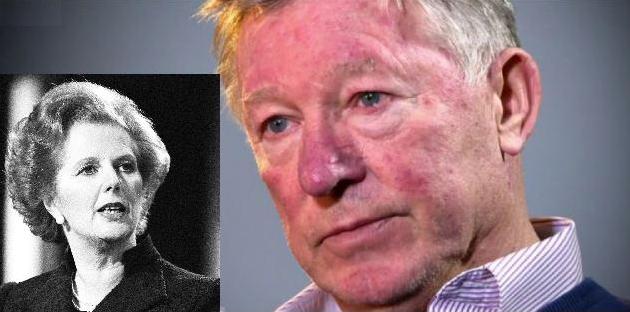
Ironically, that assessment of Thatcher – the realistic one, not the BBC’s rose-tinted, soft-focus blarney – would almost certainly strike a chord with Ferguson, a man who has always made much of his Socialist roots.  And yet the fulsomely worshipful bilge poured all over her death and funeral has been rivalled today both in flavour and quantity as various media outlets have sought to paint a picture of “Fergie the Greatest”, conveniently ignoring the essential character of the man, which is that of a coarse bully and a ruthlessly competitive control-freak who would brook no opposition and practiced suppression of dissenting voices on a grand scale as well as nepotism, intimidation and other deeply unattractive tactics.  Ferguson and Thatcher operated in vastly different spheres, and pursued their objectives in vastly different ways, although the objectionable single-mindedness and refusal to acknowledge any other point of view was common to both.

It is arguable too that both shared a similarly dislikeable personal character and yet that both represented vested interests which have caused a complaisant media and establishment to bend over backwards in their efforts to hide these unfortunate facts.  However difficult they both were to handle at different times – Ferguson famously “banned” the BBC from his personal airspace for an extended period, claiming in a juvenile fit of petulance that the Corporation was “pro-Liverpool”, and objecting to their focus on the activities of his shady agent son Jason – the media still fall over themselves to praise both to the skies.  Powerful interests are at work here, rigid agendas are being pursued.

Ferguson will not relish any comparison with the Iron Lady, and yet such comparisons are irresistible.  Nepotism, for instance.  Thatcher was accused in many quarters of using her influence to smooth the path to riches of her not-outstandingly-bright son Mark, a man who would seem to have difficulty finding his way out of an open box.  Ferguson allegedly pushed the services of Agent Jason on young players at Man U and reacted with fury if the lad in question went elsewhere.  When his fledgling manager son Darren was sacked by his employers after his latest relegation, Fergie senior reacted by recalling two young Man U players who had been at that club on loan.  The similarities in modus operandi for Fergie and Thatch abound.

It is for the gross and over-the-top way in which both have been virtually canonised by the media in the wake of their exit from the stage that really sticks in the throat, however.  The tasteless extent of it, the gushing, nauseatingly deferential tone of the ubiquitous tributes, strike a remarkably similar tone in either instance.  In Thatcher’s case, the masses thus appeased were the blue-rinse brigade and their Colonel Blimp husbands, Tories to their last cell, and voraciously hungry for any news coverage to confirm their view that la Thatch was the greatest since Churchill, the greatest peacetime leader ever.  The claims of Clement Attlee, the authentic greatest PM ever, were callously overlooked, as was the fact that his funeral in 1967 was a quiet and dignified affair.  In the case of Ferguson, the masses are of course the legions of Man U fans all over the world and in Torquay and Milton Keynes in particular, who have been fed the myth of Man U being the greatest club in the world (Arf!) and who now wish to hear Fergie being called the greatest, against the claims of true greats like Busby, Revie, Shankly and the rest, proper managers who had to do it all on a level playing field and not the Sky-weighted Man U-centric environment we have now.

Radio Five Live are still at it, as I listen.  We go “back to Old Trafford” on a regular basis, to listen to the hushed tones of a reverential reporter, laying it on thick for the benefit of the thick.  It’s all so remarkably similar to the nonsense we all suffered in the wake of Thatcher’s passing.  Perhaps, for Ferguson, that is the unkindest cut of all.

Alex Ferguson – A Tribute

Purty, Ain't He?

Purty, Ain’t He?

The football-related media is in a frenzy of mourning today after the announcement that Sir Alex Taggart has decided to step down as Supreme Dictator of the FA Premier League.  Who will follow him, they ask, tearing their hair and wringing their hands in distress.  Chelsea fans may be surprised to hear that Bridge-bound Jose Mourinho is being mentioned as inheritor of the poisoned chalice that is the hot-seat at the Theatre of Hollow Myths.  But Jose is surely too fly and savvy  to “do a McGuinness” as the task of following a long-serving Man U manager is known in the game.  Everton fans too may be wondering whether David Moyes will be offered the chance to step into the role of “Premier League’s Token Grumpy Scotch Git.”  Whoever ends up in Mr Ferguson’s gout-adapted tartan slippers has a job on his hands alright, and will need urgently to review the manual on “How To Bully and Intimidate For Personal and Professional Gain”.

The loss for the media will be acute.  Hacks as a breed dearly love the cosy familiarity of a tyrant at the top of the game, someone who is an outlet for all of their natural tendency to fawning sycophancy, a figurehead over whom they can compete to praise in the most glowing terms whilst neatly overlooking the glaring flaws of a man who has been a study in coarseness and choleric wrath when things even threaten to go other than as he would like.  The newspaper journos will miss “S’ralex” – he represented continuity for them, an opportunity to trot out well-worn cliches and perpetuate comfortable myths.  Now they may even have to think before starting another Man U piece – it will be a shock to be so brutally jolted out of a 26 year comfort zone.

Ferguson has his place in the history of the game.  He will serve as the biggest negative example of how to ruin the previously positive image of a historically-respected football club, making of them a byword for arrogance and the tendency to ride roughshod over the rules and conventions of the game.  He is there as a useful comparator for the true greats of football and how they went about their business, with humour, humility and a sense of their own fallibility.  The likes of Busby, Shankly, Revie, Stein, Nicholson et al are all part of the rich fabric of the game, all lost to us now, but all clearly capable of favourable assessment in the light of the Ferguson legacy; none will suffer in comparison with the man from Govan.

People will point to his record of success – and sycophants and revisionists will hastily gloss over his difficult early years at Man U when the home crowd called for his head and despaired of ever being able to aspire to the levels of Liverpool and Everton, great clubs run properly.  The re-organisation of the game and its finances when the Premier League came in was highly opportune for Ferguson, and he certainly made hay while the sun shone; it shone for him for the bulk of the remaining 20 years of his career.  Ferguson suddenly found himself in charge of a racehorse competing in a donkey derby, the interests of consumers suddenly paramount, the need to sell satellite dishes and replica shirts in hotbeds of Man U support like Devon and Milton Keynes emphasising the commercial importance of a successful Man U team.

All of a sudden, the top players wanted to go to Salford, all of a sudden the statistics of the game tilted heavily in Ferguson’s favour.  Penalties against them had never been plentiful, now they were as rare as a rosebush in the desert.  Ferguson’s natural personality came to the fore; his tendency to bully and to rant began to produce real results in terms of the attitude of the media and of the game’s officials, both on the field in the shape of cowed and terrified referees, and off it with the administrators unwilling to court commercial unpopularity by waving the rule book under that purple nose.  The most familiar sound-bite emanating from Lancaster Gate was suddenly “The FA can confirm that Alex Ferguson will face no disciplinary action for (insert example of blatant disregard for the rules here.)”

Referees became aware of the fact that those of their number who made a decision not to the liking of Ferguson tended to wait a very long time before selection for another fixture involving Man U.  These are high profile games, and referees increasingly had to look to their own career prospects as their role assumed more of a professional profile.  So they tended to knuckle under, perhaps only subconsciously, but the effect over many years has been enough bizarrely ridiculous decisions in favour of Man U to spoil the digestion of many a football fan who remembers fairer days pre-Murdoch, pre-Man U dominance.

Given this decided slope of the playing field in Man U’s favour, the wonder of it all is that they haven’t won more.  There have been years when the Title has gone elsewhere; remarkable this, in a game of fine margins where one study exposed as fact that 88% of all 50-50 decisions went the way of the Salford Franchise.  This is the measure of Ferguson’s failure; a manager who was also a good coach would surely have cleaned up in such a very favourable environment.

So what now for Man U?  To be honest, I can see their domination continuing.  It’s likely that the public image of the club will be enhanced under a manager who does not represent quite so many of the negative personality traits exhibited by Ferguson.    It will certainly be interesting to see if a world-renowned coach – if appointed – can improve on their patchy record in Europe, where Ferguson’s habit of intimidating refs has not been such a marked advantage to them.  Two somewhat lucky Champions League wins is a poor return for twenty years of almost unlimited opportunity, and a better man in charge might perhaps improve on this and finally give Man U more justification for their laughable claims that they have “knocked Liverpool (Five European Cups) off their perch.”

The question will be asked next season “Who’s the greatest manager in football now?”  The answer will be the same as this season: choose any one from Mourinho, Wenger and Hitzfeld.  All the propaganda in the world cannot make a silk purse out of a sow’s ear.