Tag Archives: Scotland

The Day We Lost Billy Bremner, a Superstar to Eclipse Any Today – by Rob Atkinson

The more I see of football these days, with all of its allegedly “world class” stars, the more I think of the guy who scored the first goal I ever saw Leeds United score – in the flesh, so to speak. His hair was red and fuzzy and his body black and blue, and his name was Billy Bremner. God alone knows what he’d be worth today – sadly, he hasn’t been around since that awful time, 21 years ago exactly, when football was deprived of a legend and Leeds United began to come to terms with the loss of a man who embodied everything that the Last Champions were all about, at their very, very best.

On the 7th December 1997, two days short of his 55th birthday, our greatest captain Billy Bremner died following a heart attack after a bout of pneumonia. The Leeds United world was plunged into shock and mourning at the death of a true hero, and the game’s great and good attended his funeral in Edlington. The tiny church, packed to the rafters with household names, was resounding testimony to the respect in which the wee man was held by all who knew the legend. Old comrades and old foes alike were there to say goodbye to an icon who had left us tragically young, but who had emblazoned his name across an era not wanting for stars.
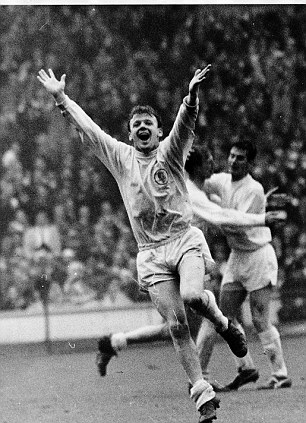
Image Scoring for Leeds

Billy Bremner was quite simply a phenomenon. From the earliest days of his Leeds United career, once he had recovered from a bout of home-sickness for his native Stirling in Scotland, he was an automatic selection for the first team, unless injury or suspension ruled him out. He was a warrior, despite his diminutive size, but he was blessed with all the other attributes needed for a central midfielder on the battlegrounds of the English First Division. Skill, courage, “workrate” – as it’s known these days – were combined with sheer guts, tenacity, will to win – and that indefinable x-factor that ultimately set him apart from other gifted performers. A ball-winner, a talented user of the ball once won, a relentless harrier of the opposition for the full ninety minutes plus of each gruelling game – and a scorer of great goals too. Bremner was a big occasion man, a serial winner of semi-finals (Man U being his favourite victims), a man who unfailingly stepped up to the mark when his team-mates and fans needed him. He was utterly self-effacing in the interests of what was best for the team. Side before self, every time was his motto, and he lived up to those words for as long as he was involved in football.

Some called him dirty. And he was as capable as most other combative central midfielders of a bit of feisty skullduggery – but to define him by his occasional sins would be short-sighted in the extreme and would display, moreover, a lack of awareness of exactly what his game was all about. A consummate passer of the ball – with the neat reverse pass a speciality, flummoxing and wrong-footing many an international-class opponent – Bremner was the epitome of Don Revie‘s Leeds United, a team who said “If you want to play, we’ll out-play you; if you want to battle, we’ll out-battle you.” They usually out-thought and out-psyched the opposition as well. Many a visiting player was artfully allowed a glimpse as they passed by of the sign on the home team dressing room wall at Elland Road. “Keep Fighting”, it said – which was what Leeds United, guided by Don Revie off the field and Billy Bremner on it, did – and they did it better than just about anybody else.
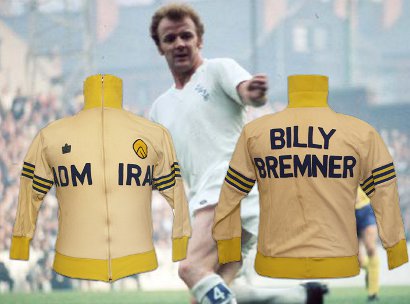
Image Leeds United hero

The Sunday Times perhaps summed-up Billy Bremner as well and as succinctly as anyone. “Ten stone of barbed wire” they called him – the image of a spiky, perilous bundle of energy conjured up in five telling words. I saw an old clip on YouTube recently, grainy black and white footage of some or other game back in the day, and there had been an incident that set the players en masse at each other’s throats. Bremner – unusually – must have been some way off when the flashpoint occurred, for he was nowhere to be seen with the melée already well established. And then, from the right-hand margin of the screen, came this white-clad, unmistakable figure, tiny but fierce, hurtling towards the centre of the conflict with the desire to weigh in on behalf of the team writ large in every line of his being. He was a frenetic mixture of Yosemite Sam and the Tasmanian Devil, plunging into the fray like some one-man whirlwind, wreaking his own inimitable brand of havoc. Bremner was famous, even notorious, for this – for his battle-cry of “cut one of us, and we all bleed.” Billy shed blood in the United cause – usually, it must be said, not his own. But a thug he was not, and any team, any time, anywhere in the world would break the bank to have a Billy Bremner in his prime among their number. Fortunately for Leeds United, he loved the club and served it for sixteen years, becoming synonymous with the famous Whites of Elland Road. As Leeds fans, we could nominate no better candidate for the honorific title of “Mr. Leeds United”. Only the great John Charles, operating in a much less successful era at Leeds and destined to win his medals on foreign fields, could come anywhere near.

My second match as a Leeds United supporter was the European Cup semi-final, first leg against CF Barcelona, Johann Cruyff, Johann Neeskens and all. Those two Dutch masters, with all the other glitterati of the Catalans’ world-class line-up were expected to have too much for a United side on the cusp of just dipping over the hill.  The previous Saturday, I’d made my first visit to Elland Road and had seen us lose to Liverpool. I was all agog at the atmosphere, and didn’t really care about the result – I just wanted more.

BBC Commentary, Leeds Utd v Barcelona 9.4.75

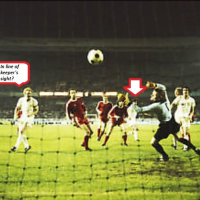
So it was that my first ever Leeds United goal came to be scored by Billy Bremner himself, the greatest player in the greatest team United ever had. A long ball from Johnny Giles, headed down by Joe Jordan, found King Billy in enough space on the edge of the area at the South Stand end. He measured the situation, took aim and rifled the ball superbly, well wide of the helpless keeper, into the top left-hand corner. The din was deafening, like nothing I’d ever heard before, and rarely since. “Elland Road erupts” intoned David Coleman for the BBC, when he could make himself heard. The image of the small, red-headed giant belting that ball home will live with me to my last day. I’ve always been proud that my first goal was scored by King Billy. I feel as though, in a funny way, I own that goal.
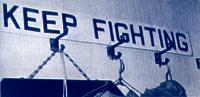
Image of the significance of the occasion. “Nine men and Billy….we’ve got nine men and Billy!“, they sang, loud, proud and raucous. “Billy Bremner’s barmy army” got many a refrain as well. The fans had said farewell to the Captain of the Crew in a manner hugely identifiable with the man himself and with the fighting traditions of the great side he led with such distinction. As far as these things can be, it was deeply fitting, and those who remembered Billy gave a knowing nod of appreciation.

RIP  Billy Bremner. Departed far too soon, and greatly missed still. It’s unlikely we’ll ever have another quite like you.

Celtic, Rangers and The Old Firm: the Enlightenment of a Leeds Fan – by Rob Atkinson

Old Firm - healthy rivalry?

Old Firm – healthy rivalry?

Following on from yesterday’s Old Firm piece which was provoked by an advert placed by Celtic fans in the Scottish Sunday Herald, I find myself one day on having taken quite a lot on board. I’m somewhat bewildered by the strength of feeling on both sides of the argument, considerably better informed as to the legal position insofar as it defines the status and existence of Glasgow Rangers FC – and not one whit persuaded away from my original position that trying to wish or argue a rival football club out of existence is just plain wrong.

I’ve been accused of many things by those outraged over yesterday’s piece. Some of these people have been Leeds fans – the very last people I would expect to support the idea of football fans wishing the worst that can happen to rivals – to lose their very history. One Leeds guy asked me why I was speaking up for the Rangers end of things “as Leeds have far more links with Celtic”. It’s difficult to know whether to take people seriously at times. Am I really to be guided by the irrelevant fact of which clubs are closest or more nearly linked to my own team?

I should say yet again that I am not a Rangers fan. I’ve never really been able to decide who to back in Old Firm games, but I’ve always watched them for the sheer spectacle. So I’ve tended to hope that whichever team seems currently to be playing the better and more attractive should prevail. I’ve generally enjoyed the blood and thunder of these fixtures. From now on, though, I’ll probably be hoping (vainly, I’m sure, on Sunday) for Rangers success whenever these two meet. I’ve just been so shocked and horrified by the sheer spite and malicious venom displayed by the majority of Celtic fans who responded.

The thing is, I know what it is truly to hate another football club. I find it hard to describe the depths of my loathing for Manchester United. I despise them and all they stand for – I feel they’ve been instrumental in bending our game completely out of shape this past two decades. But wish them out of existence? No, not at all. I want that rivalry, I want them there so that I can carry on hating them. I’ve published articles decrying their debatable achievements since Murdoch bought the game and skewed it in their favour – but I wouldn’t want to be without them. They’re the gift that keeps on giving for someone who relishes a bit of sporting hatred.

So the attitude of so many Celtic fans simply baffles me, as well as leaving me a bit cold. I can’t relate to such dog-in-the-manger lack of empathy with fellow fans, it is alien to me – and I hope to most proper fans of the game. I’m also persuaded by a lot of what I’ve read in an extensive comments thread that not only do Rangers have a tradition and history case for claiming to have survived as a club – this appears to be the legal position too – despite the wishful thinking clung to, against all logic and precedent, by so many Celtic fans.

I hope the Old Firm game tomorrow is a good one. I expect Celtic to win – and it will be interesting to see the fans’ reaction when they score, against what they are claiming is a new club with no history and no tradition of rivalry with the Celts. And yet I’m willing to bet there’s not a ticket to be had with a sold-out Celtic allocation – and that they’ll celebrate with joyful abandon any goals scored against a team they now deny makes up the Old Firm of glorious tradition.

Hypocrisy, a lack of feeling for the game and what it means to be a fan – and rank, vicious hatred not just for Rangers FC, but for their history and the fact that they have out-performed Celtic over the century-plus of the Scottish League. That sums up what I’ve gleaned of the green and white psyche this past twelve hours or so. It’s not something I’d have thought anyone could be proud of – whereas everything I’ve heard from Rangers fans has rung with pride and passion – despite their long fall and slow climb back.

Enjoy the match tomorrow, may the best team win. And may we have many more Old Firm games in the future.

Referendum Result Confirmed: England Still Own Scotland – by Rob Atkinson

Sorry boys - you were OWNED

Sorry boys – you were OWNED

For your average Leeds United fanatic – or even for an iconic one such as myself – the sight of a club legend in Gordon Strachan having his nose well and truly rubbed in it can rarely be pleasant viewing. Equally, for a devotee of all things righteously White, to behold the over-rated and grossly over-hyped Mr Wayne “Shrek” Rooney filling his boots at the expense of said legend would normally be an uncomfortable not to say painful experience. But last night at Celtic Park, both circumstances came to pass – and yet it was an evening of unalloyed pleasure for any England fan who grew up to a background of Auld Enemy rivalry.

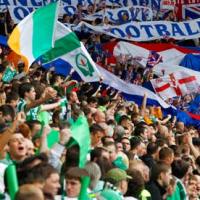
Back in the day, the England versus Scotland mini-war was an annual fixture, alternating between Hampden Park in Glasgow and Wembley, the latter drenched in Tartan every other year as the unwashed made the pilgrimage south. It was the perpetuation of the original and best International Football rivalry; the very first ever match between two countries was Scotland v England on 30 November 1872. 4,000 people saw a 0-0 draw on that occasion – the great days of this fixture were still to come.

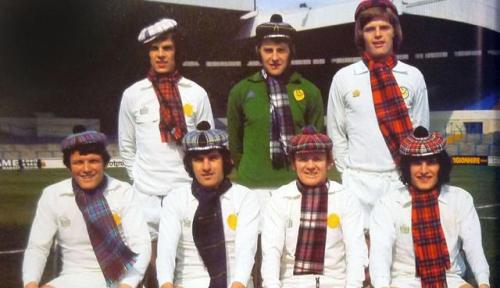
The great days of Leeds United also lay far in the future – and in that era of Revie’s Super Leeds, the club boasted a cadre of fine Scottish international players (see picture above) who I and thousands of other United fans worshipped as footballing Gods. But once a year, when England met Scotland, they were The Enemy – and I for one wanted nothing more than to see the likes of Alan Ball, Mike Channon and Kevin Keegan stamp the Sweaties into the turf, North or South of the border. Sometimes it happened, sometimes we were disappointed. I remember regarding Gordon McQueen with a particularly baleful eye after his two goals sank England at Wembley, on a day when the Scots appropriated the crossbars as souvenirs of a memorable win.

Over the years, the two nations battled nip and tuck for historical supremacy, each having periods of dominance. In the almost 142 years since that first fixture, England have edged it. Last night’s victory by 3-1 was the Three Lions’ 47th such triumph, with Scotland trailing in at 41. This latest success must have been one of the most convincing by England, certainly in recent times. Scotland had a job done on them, big time. England’s performance was emphatic, conclusive, and the boys in blue had no answer to the white tide which engulfed them.

This tone had been set right from the first minute with Woy’s Warriors setting a pattern of dominance in the early stages they would maintain throughout. The breakthrough was half an hour coming and somewhat overdue when Oxlade-Chamberlain, somewhat lacking in delivery with the ball at his feet, found a sublime headed touch from Wilshere’s laser-accurate deep cross, finding the corner of the Scottish net. So it remained at the interval but, despite the narrowness of the margin, Scotland had been on the end of a footballing lesson.

The consensus of agreement among the half-time pundits was that the hosts could not afford to go two down if they were to salvage anything from the encounter. This, however, they proceeded to do a mere 90 seconds into the second half as England took a vice-like grip on proceedings. The origin of what proved to be a killer goal was in a crude and stupid foul from Mulgrew who cynically took out the stampeding Ox as the Arsenal youngster raced down the right. Mulgrew was a little fortunate to escape with a mere yellow, but the fallout was to prove fatal for the Tartan Army. From the free kick, the ball was half-cleared and then bobbled about in the Scottish area before sitting up for Rooney to flex his neck and direct a fine header past helpless sub goalkeeper Gordon.

True to the intense rivalry of this fixture, Scotland did appear to fight their way back into the match with a goal after good work between Robertson and Russell ended with the former squeezing the ball between Forster and his near post. England, rather than quailing and succumbing to late nerves, simply appeared to be provoked into further action. The ball was played down the right from the restart and, from a throw in, the visitors contrived a spell of consummate possession under pressure on the Scottish left flank, before Lallana was released into the area to set up a sitter for Rooney’s second of the night.

3-1 and finis. England were probably worth a goal or two more; despite the creditable battling of the Scots, they had in truth been completely outclassed and outplayed. The most jarring note of the whole night was struck by England coach Roy Hodgson in his post-match remarks, when he saw fit to apologise for any offence caused to anyone who might have had their feelings hurt by some anti-IRA chanting from the England support. Things have come to a pretty pass, surely, when a football man in the afterglow of a fine victory should seek to soothe the wounded sensibilities of those negatively affected by anti-terrorism sentiments. It was an odd end to a fine night for England. Scotland, fresh from a run in which results and performances have been positively encouraging, will have a new awareness this morning of their actual place in the scheme of things.

Proud to be a Leeds Fan, Marching On Together – by Rob Atkinson

Image

Sometimes it’s really tough to be a Leeds fan.  Today is a good example when – despite a much-improved performance against Leicester City and some regained pride, it’s still the case that we’ve lost again.  Cue the mickey-takers from lesser clubs, delighted at our discomfiture, parading their lack of class by airing all the tired old jibes we’ve all heard and got sick of long ago.  It’s all part of the Leeds-supporting experience, the perennial fact that there’s a lot of idiots out there who hate us, without really knowing why.  It’s also how we distinguish ourselves from the mundane pack of everyday clubs – if you hate Leeds United, have a go.  And they do their poor best – but it’s usually distressingly feeble stuff, as witness today’s collection of social media misfits retailing their horribly unfunny shafts of “wit”.  We just have to put up with it and move on, serene in the knowledge that We Are Leeds.  I’ve been Leeds for most of my life – never really had any choice about it.  And for this, I give thanks daily.

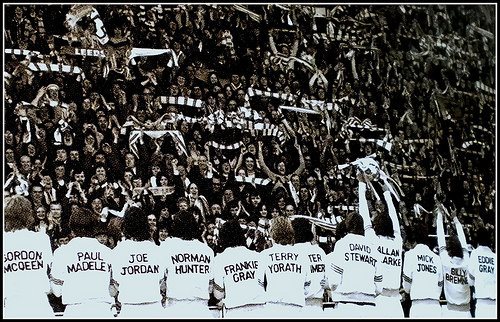
Leeds United was just something that happened to me on the way to adulthood. By an accident of birth and timing, I found myself living 13 miles away from LS11 and the greatest club side in Europe (see above), just around the time I became seriously interested in football.  I’d misguidedly spent my pre-teenage years with my nose stuck in a succession of classic Sci-Fi novels, so the Glory Years mostly passed me by.  My Dad had been a life-long supporter though, and everyone at school was Leeds apart from the odd much-bullied Man U fan – so it was impossible not to go with the flow, and once I’d been introduced to that Elland Road experience, I was hooked for life.  The timing was particularly unfortunate however.  Unlike my golden-boy git of a brother, who’d waxed smug on the successes of the late 60s and early 70s, I started going to the match in the first post-Revie season, and my time supporting Leeds has been one of a long and heartbreaking decline, punctuated by the brief joy of the Wilko reign, and to a lesser extent, that of O’Leary.  So it’s been tough.  But it could have been so much worse.

I could, for instance, have been a Newcastle fan.  Imagine that.  My Dad is 86 now, bless him. Newcastle’s last title was won in the year he was born, 1927.  Alfred Hitchcock released his first film that year.  Communists were fighting bloody street battles with Nazis in Berlin. Charles Lindbergh became the first man to fly solo across the Atlantic.  In brief, it’s a long, long time for an allegedly big club to go without a League Title. Newcastle fans are famous for their blind devotion to “the Toon”, and it’s hard to imagine such fanaticism being so little rewarded over such a long period – although I do recall a crowd of 7,000 at St James Park after one of their frequent relegations had been confirmed.  It’s now the best part of fifty years since they won anything at all, and yet still the love affair goes on, fueled largely, it must be said, by a pathological hatred of near neighbours Sunderland.  Thousands of Newcastle fans know nothing but failure and empty-handed season upon season.  How awful must that be.  Still, they’re the biggest club in the North-East – which is a bit like being the tallest mountain in Holland.  At least Leeds fans have the history and knowledge of success, so that our expectations, whilst unrealistic, at least remain alive and kicking.  Newcastle’s are long, long dead.

Or I could have been a Celtic fan.  God – even worse.  Sure, they’ve won loads of trophies, but with one sparkling exception those have been gathered in the face of opposition that would shame the English second tier.  At best, they’ve usually come first or second in a two horse race, and now even that other horse has gone lame, as Rangers tread a perilous path back from financial ruin via the muck and nettles of Scottish lower leagues.  Celtic did of course become the first British club to win the European Cup in 1967 – and they did it, what’s more, with a team of local lads under the legendary Jock Stein.  But that one fantastic achievement is poor reward for having to witness year upon year of procession football as Celtic trudged on, one of two out-of-place whales in a tiny fishpond.  Who would be a Celtic fan now?  It’s not sport up there, it’s lambs to the slaughter with about as much entertainment value as watching Farsley Celtic reserves on a wet November night.  Scottish football remains a laughing-stock, and Celtic must take much of the blame for that with their perennial failure to make a mark on the continent, despite routine Champions League qualification.

At the end of the day, I wouldn’t change a thing about my years of supporting Leeds.  We have the history, the fan-base (still), the notoriety as “The Damned United”, and little of the Sky-era false glitz and glamour of the current crop of Premier League pretenders. You still see Leeds fans wherever you might trot around the globe, and no-one could call those lads and lasses glory-hunters – but they do have the pride of an honour-laden history which is denied to all but the most feeble and elderly Newcastle fans – and Leeds fans also have the serene knowledge that the honours and the history have been won in the white heat of intense competition, not by near-default as those worthless baubles up in Scotland have been soullessly accrued.

Marching On Together.  We Are Leeds.  Thanks, Dad, for bringing me up to be Leeds, and for saving me from some pretty pallid alternatives.

Darren Fletcher of Man Utd a Positive Role Model for the Chronically Ill – by Rob Atkinson

For a Leeds United fan, yesterday’s news that Man U had won 3-0 at their perennial rabbit team Aston Villa was hardly welcome or, in itself, inspiring. The two Uniteds from either side of the Pennines share a mutual loathing that has become legendary and transcends geographical proximity or considerations of direct rivalry, the normal prerequisites for a healthy hate-hate relationship. The fact that Leeds and the club I fondly refer to as the Pride of Devon are miles apart both in location and in status has not affected the poisonous depths of the antipathy between the two.  We sing about them in terms of extreme dislike, they reciprocate in tones of mixed cockney and that characteristic West country burr. Neither set of fans would cross the road to save one of the enemy, by means of micturition, from a death by conflagration.  It’s been like that for years.

However, some things are more important than football’s strife and conflict, on or off the field.  The other news to emerge from Villa’s capitulation was without doubt positive, welcome and a thing to be celebrated by anyone who loves football – indeed by anyone at all. It is the story of a young athlete with a glittering career before him who was struck down by a chronic and debilitating medical condition, yet who has overcome that awful setback to regain a place among his team-mates playing a highly demanding game at the top level.

Image

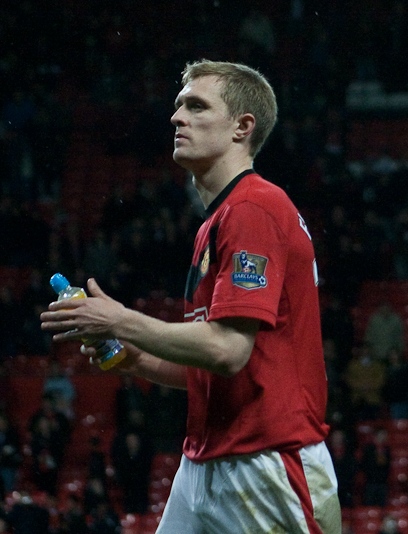
Fletcher – back from the brink

Darren Fletcher made his senior bow for Man U in 2002 and performed with versatility and industry in midfield and defensive roles, depending on the requirements of his club, up until 2011 when he was finally struck down by the bowel condition ulcerative colitis, something he had been coping with whilst playing on – but which now necessitated rest and treatment.  It was announced that Fletcher would take an extended break from football to address his problems and, obviously, there were fears in some quarters about whether he would be able to return to such a demanding way of making his living.  Yet return he did, in September 2012, only to be then ruled out for the remainder of last season after undergoing an operation to lessen the effects of a condition which can have life-altering consequences depending on its severity and treatment. Last Saturday at Villa was Fletcher’s second comeback – but this time it seems that the problem may have been overcome for the longer term.

Fletcher himself certainly believes that he is back to stay, having beaten his health problems.  “This is it, I’m back for good,” he told MUTV, the club’s in house TV channel. “This (the Villa game) is hopefully the game which means I’m back now.

“I seem to have come through the setbacks and health issues and I’m thankful for that. It’s onwards and upwards now.  I always believed I would come back, I kept that mind-set. I think other people around me were trying to make me think otherwise, but I stayed strong and believed I would get back.”

All football fans should be wishing Fletcher the best and hoping earnestly that he is right to be optimistic about the future.  At 29, he still has a good part of his career ahead of him and, having shown the character and courage to overcome such a potentially demoralising and energy-sapping condition, he surely has much to give for club and also his country.  As the captain of Scotland, his will be an example of determination and courage in adversity that many will look up to, especially those stricken with this or similar conditions at an early age as Fletcher was – and many who are suffering at much younger ages.

Fletcher appears to have fought his fight and won – something that will give hope to many thousands of people who might otherwise be tempted to succumb to a belief that their health problems will stop them from achieving their life goals. Darren Fletcher looks set fair to achieve much more in his career, adding to what is already a glittering trophy and medal haul.  That he can do this despite such a serious setback is greatly to be admired.  The positive example he might set to others is difficult to over-state, and to call him a role-model is no exaggeration. Good luck to him as he regains full fitness and resumes a career that must at one point have been in doubt.  That is something which Darren Fletcher – to his eternal credit –  has clearly never accepted.

Happy Birthday “Lash” Lorimer, Leeds United Legend 67 Today – by Rob Atkinson

Image

Lorimer in action for Leeds United

One of the younger members of the Revie Glory Boys legends celebrates today – still three years away from his seventies, Lorimer was the tenderfoot of the team, making a League debut while still 15 years of age in September 1962.  Apparently, his parents had been offered £5,000 as a hefty cash inducement (almost £75,000 in today’s money) to have the young Peter sign for an unscrupulous club based just outside Manchester, but Lorimer preferred Leeds and went on to enjoy a long and successful career at Elland Road, encompassing two spells with the club.

Despite his early start, Lorimer had to wait until 1966 to become a regular in Revie’s fine team.  By the time he had become established, the young Scot had made a name for himself with his ferociously powerful shooting, the supposed velocity of his shot leading to the adoption of a terrace anthem especially for Lorimer “Ninety Miles an Hour”.  It was said that one penalty kick actually registered a startling 107 mph, giving the goalkeeper dangerously little time to get out of the way.

In the 1967 FA Cup semi final against Chelsea, Lorimer had the misfortune to have a late equaliser chalked off by the referee, when it was decided that the Chelsea wall was not back the full distance before the United winger struck a cannonball free-kick into the Blues’ net.  This was one of several bizarre refereeing decisions over the years which would conspire to label Leeds a “nearly club” – always the bridesmaids, never the bride.  In fact, Lorimer and Leeds won every honour in the domestic game in a decade of dominance that saw them generally acknowledged as the finest English club side of all time.  They picked up two Fairs Cups as well, and were never far out of the running for all competitions during that ten years at the top.

Lorimer won 21 caps for Scotland, appearing in the 1974 World Cup finals in West Germany where he scored in a group game against Zaire.  In 1975, he played in the pinnacle game of World club football, the European Cup Final against Bayern Munich at the Parc des Princes in Paris.  He scored a tremendous volley which appeared to put Leeds ahead, but the goal was dubiously disallowed after the referee consulted Bayern captain Franz Beckenbauer as well as his linesman.  United went on to lose, controversially, 2-0.

Lorimer left Leeds to join Vancouver Whitecaps after a spell at York City in 1979, but returned to Elland Road to be the on-field leader for a young United side in the early eighties second division.  During this second spell, Lorimer scored enough goals to surpass the record of John Charles, becoming the all-time record goal-scorer for Leeds United ending up with 238 goals from 676 appearances.

After retiring as a player, Lorimer suffered some comparatively hard times, but has bounced back to forge a career as a speaker, and also an ambassador for the club.  His role in the Ken Bates administration led to him receiving some criticism from a section of support who felt that his views as expressed made him a mouthpiece for the then-owner – but Lorimer remains involved at Leeds after the Bates era has ended, frequently contributing to local media with his views on the club’s direction and the make-up and performance of the squad.

Lorimer is a man who has filled many positions in and around Leeds United, but it will be for his superb performances in the the great Leeds United team of the sixties and seventies that he will be remembered – especially that lethal shot.  Happy birthday to Peter Lorimer – still a Leeds legend.

McCormack Exposes Strachan’s Lack of Four-sight as Leeds Romp to Victory – by Rob Atkinson

Image

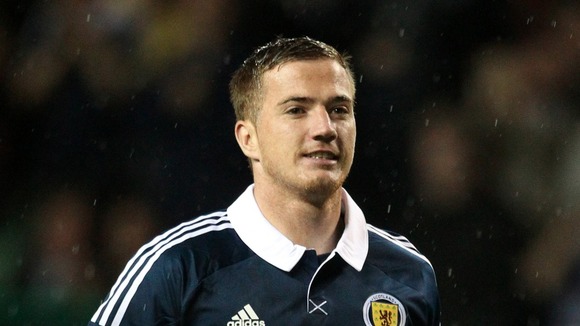
Ross McCormack – surplus Scot

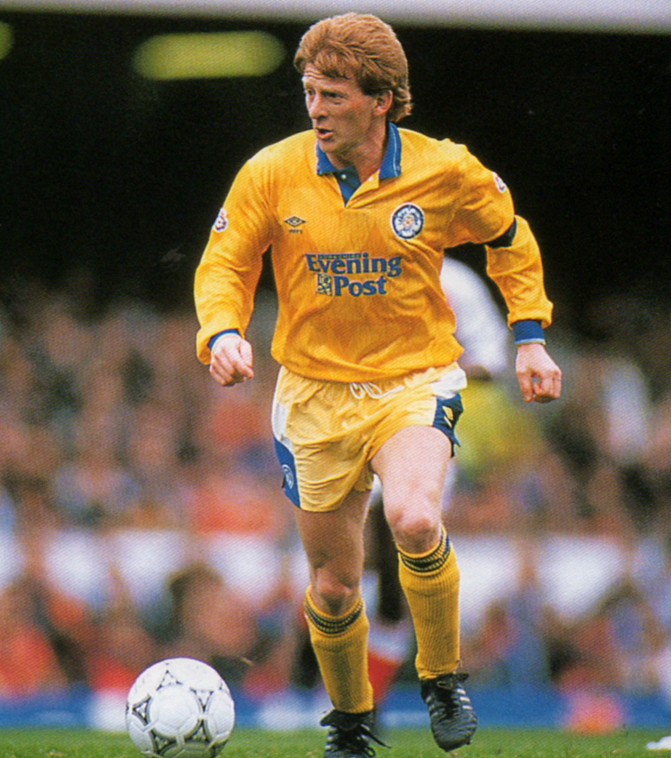
Gordon Strachan has always been good value, whether plying his trade as Leeds United’s traditional diminutive ginger midfield maestro, or later as a manager with a penchant for the apposite quote, frequently a venom-tipped barb delivered with his own brand of waspish humour.  He’s not been somebody noted for getting things wrong all that often. There was a dressing-room tantrum in the early days at Elland Road, when it took Jim Beglin to calm him down – politely but firmly.  And there was the famous own-goal near the end of the Charity Shield match against Liverpool at Wembley in 1992 – but that didn’t matter as Leeds won in the end.  Other than those two minor blips, he’s normally got most things right.  But Leeds fans will have been queuing up to tell him that he dropped a right clanger this week.

Somehow, by some convolution of his venerable grey matter, Scotland manager Strach has managed to select for his next international squad NINE players from the Championship – and yet omit Ross McCormack.  I’d be very hard-pressed to name one Scottish player in the Championship better than Rossco, and yet wee Gordie somehow managed to find these nine.  It’s to be hoped they do well – they’ll have to if they’re going to prove their worth ahead of a man who has been excellent for Leeds United this season, a man who wears his heart and his commitment to the cause on his sleeve, a man, moreover, who has scored 6 goals in his last two outings whilst threatening to stage a one-man goal of the month competition.  Strachan did concede that McCormack had been “unlucky”, thereby adding to his considerable reputation for dry understatement.

At the time of this unlucky omission, Ross McCormack could point to just the two goals in his most recent game; now he’s trebled that output in one further game as if to emphasise just how bloody unlucky he really has been.  This approach of letting his boots do the talking instead of whinging in the press – and Ross can be quite vocal at times as his Twitter followers will confirm – is highly laudable of course, and something that Leeds fans will appreciate.  Those fans might rather, anyway, that Ross should be putting his feet up for a couple of weeks and doing the odd bit of training at Thorp Arch, instead of gadding about Europe with the Sweaties.  That way, the Leeds faithful will figure, he’ll be rested and ready to poke a few more goals in, a fortnight hence, against his persistent summer suitors Middlesbrough.  So even if we feel a bit bruised and crestfallen on McCormack’s behalf – there are compensations for Leeds supporters in what seems an inexplicable decision to deny the lad some more international experience.  Ross will be wondering what, exactly, he has to do in order to merit selection.

Some more of what he served up today certainly wouldn’t go amiss.  McCormack was hailed by both managers after Charlton versus Leeds as “the difference”.  On a disgraceful bog of a pitch reminiscent of some of the marshlands at Derby and elsewhere in the 70’s, Leeds managed to overcome a determined Charlton side, one that hadn’t conceded a solitary goal in over seven hours of football.  The home side had made the brighter start, but Leeds scored with their first real chance, as McCormack fastened onto Blackstock’s neat flick to dink the ball over Charlton’s onrushing keeper.  United then survived a penalty appeal and a shot against their woodwork before conceding the equaliser just before half-time to one of those “worldies” we see fly into our net all too often.  This time it was Cameron Stewart blasting a twenty-yard volley past a helpless Paddy Kenny, and Leeds were on the back foot for the remaining couple of minutes before the break, grateful in the end to go in level.

After the interval, the match swiftly swung back Leeds’ way.  A penalty was claimed and awarded when Danny Pugh – back after a long time in the doldrums and playing well – was tripped by Charlton’s Harriott, and McCormack leathered the spot-kick fiercely into the roof of the net.  Charlton were still full of fight and saw Kenny make one great save to deny the penalty villain Harriott, whilst squandering at least one other decent opening, before they finally levelled the match at 2-2 in the 70th minute.  Simon Church carved out the chance with a low cross, converted by Johnnie Jackson.  This is the sort of scenario that makes the Leeds faithful groan in collective pain and pessimism; normally, having been pegged back, we expect further disaster to ensue.  The three thousand plus United followers in the Jimmy Seed stand must therefore have been anticipating the worst, but glory be – the best was yet to come.

It came quickly, too.  Barely three minutes had elapsed since Charlton’s second equaliser when McCormack, again benefiting from an assist from loanee Blackstock, smashed home a close-range volley from a tight angle.  There hadn’t even been time to sink fully into the default Leeds state of pessimism and now all was joy and rapture again as the travelling faithful bellowed their appreciation. Surely, Leeds would hang on now.  And hang on they did, defending resolutely enough for the remaining seventeen minutes, at the end of which Rudy Austin was fouled just outside the area by Rhoys Wiggins. McCormack sized it up, took aim, and curled a beautiful free kick past Hamer to end the home side’s hopes.

It was the first time a United player had scored four in a game since Brian Deane made QPR suffer at Elland Road in the noughties. Heaven only knows when a Leeds player last grabbed four away from home.  That might be something for Strachan to contemplate, with his Elland Road connections, as he watches the highlights of this performance. Chances are, though, he’ll have a lot more to think about than that.