Tag Archives: vulnerability

Fulham 0, Leeds United 3; The Worries Behind the Win   –   by Rob Atkinson

Three kinds of lies

Three kinds of lies

A wise man once told us: “There are three kinds of lies. There are lies; there are damned lies – and there are statistics.

The point he was making, of course, was that the bare numbers rarely tell the whole tale; they can be twisted and manipulated to support a variety of points of view, depending upon the user’s level of dishonesty. Ask George Osborne about that – but don’t expect anything like the truth…

It was Mark Twain who popularised the quote; the identity of the originator is sadly lost to us. But, whoever it was, if he had been present at Craven Cottage last night to watch Leeds United seemingly cruise to a routine 3-0 victory over Fulham, then he might have found reasons both to praise and damn those pesky stats.

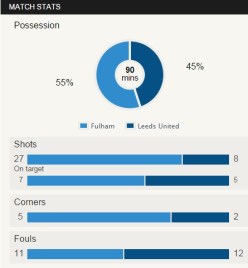
The main statistic of course, as Sky TV hacks are always expressing it, is “that little one in the top left hand corner of your screen”. The scoreline is the Alpha & Omega of statistics; a 3-0 win is a 3-0 win, decisive and indisputable. So mote it be. And yet, the other statistics in a game of football frequently bear critical examination. This is particularly so when that bare scoreline on its own might just lead us to false assumptions about form and performance. And the human element can also act so as to skew the outcome against all the logic provided by the facts and figures of a match. Last night at Fulham, if it hadn’t been for the frankly superhuman performance of Leeds keeper Marco Silvestri in all its elastically bendy brilliance, then the trend of the game’s shots on goal figures may well radically have changed the final scoreline.
Those damned match stats

Those damned match stats (Thanks to BBC Sport)

So, to get to the meat of the matter, the fact is that watching last night’s highlights is a fairly sobering experience for any Leeds fan, and tends to cure even those glass-half-full types of any excessive post-victory euphoria. The evidence of your eyes is that Leeds United were under considerable pressure for much of the evening; this continued to be the case even after Fulham defender Kostas Stafylidis‘ two mad moments which saw him dismissed for back-to-back yellow cards. There were too many times when Leeds were cut apart; too many occasions on which heroic custodian Silvestri had to fling himself into the breach. He had a very successful evening, our Marco – but it’s fair to say that you don’t ideally want to see your ‘keeper given quite so many chances to shine. Those statistics confirm for us what we could quite plainly see; Fulham’s creation of clear-cut opportunities was right up there and on another night might well have been reflected in a different result. A combination of poor finishing (a nervous and too-eager-to-succeed Matt Smith must hold his hand up here), excellent shot-stopping and the kindness of the woodwork saw Fulham fail to score, when they could easily have had half a dozen. That’s really no exaggeration.

After the match, United coach Neil Redfearn was understandably keen to highlight the fact that Leeds could have had half a dozen of their own. And it’s fair to say that it’s not Redders’ job to spread alarm and despondency among the troops. But equally it’s important that the weaknesses inherent in a performance that afforded the opposition so many chances, should be recognised and addressed. This is the big worry that the scoreline, excellent though it undoubtedly is, tends to conceal.

The fact of the matter is that, in the medium to long term – or perhaps as soon as the next game – we will get found out if these kind of statistics keep cropping up. Numbers can be interpreted or manipulated or crunched until the cows come home – but in their raw form, they still have their own undeniable message. Conceding a large majority of possession is a worry; it’s tiring to play and chase without the ball. Shots both on and off target against your own goal – that’s another worry. If you buy enough tickets, you’re going to win a raffle sooner or later; the woodwork and an inspired goalkeeper can only do so much. The numbers suggest that Leeds were cut open by an average Championship attack on far too many occasions. The conclusion has to be that Silvestri is insufficiently protected, and that can have only one outcome over time – we’ll be conceding too many again, and results will suffer accordingly.

This is not intended to be a whinge, or in any way to detract from yet another good result on the road. We should rejoice in that; the recent run has hauled us well clear of danger at the bottom and we now have the breathing space to think about next season – a significant luxury before we’ve even reached Easter. But the planning for a new campaign in August must surely address the concerns revealed by last night’s lop-sided possession and attempts on goal stats – otherwise, eventually, we’ll pay for soft-centred characteristics.

Perhaps the root of the problem is a lack of bite in midfield when Rudy Austin isn’t present. On the other side last night, Scott Parker gave an object lesson, even in defeat, of the difference an all-action, tigerish midfield presence can make. A lot of Fulham’s good stuff came through him, and – let’s not forget – there was plenty of good stuff from them last night. That we didn’t suffer by it was an eccentricity of the occasion, with so many chances fluffed, wasted or thwarted by Silvestri. But we can’t rely upon there being too many nights or days like that.

Fulham may yet fall through the trapdoor into League One, just a season after sinking out of the Premier League. If that were to happen then – once we had dried the tears of mirth from our eyes at the way Ross McCormack‘s dream had gone sour on him – we might well wish to look at the availability of Mr Parker who, on last night’s evidence, would be an asset to many a Championship team. I’m sure we could get him for a lot less than £11 million, just to pluck a figure out of thin air. Scott Parker was, more than anyone else in a Fulham shirt, rather unlucky to be on the losing side last night, and it’s clear as day to me that he would improve our midfield options.

Pie in the sky, of course – there are currently far too many variables, including the distinct possibility of yet another TOMA scenario this summer, to speculate on the direction of Leeds’ recruitment policy. That’s even assuming that we’re going to be out of embargo. But if there was even a chance of securing a Scott Parker type for the White shirt, then surely we’d reap massive benefit from that kind of all-action, committed presence. And, maybe then, we’d see a few of those damned statistics turning the way of our beloved Damned United.

Kenyan Man U Fan’s Suicide Harks Back to Famous Shankly Quote – by Rob Atkinson

Image

Shanks – didn’t really mean it

There are many famous sayings attributed to the late, great Bill Shankly that are still quoted to this day.  Some of them, he even actually said.  The one in the image above seems likely to have been genuine, actually uttered by the great man.  But wherever you hear it quoted, you’ll usually hear a hastily-added qualification too: “He didn’t actually mean it, of course.  It was part of his football-daft image…”  Quite so.  Shankly was football-daft – many are the anecdotes to illustrate this, and again, some of them are based on fact. But Shanks wasn’t daft in the wider sense and, certainly, if he did utter the words above, they’ll have been uttered with tongue firmly in cheek.

All of which sheds awfully little light on the baffling and tragic death in Kenya of local Man U fan John Jimmy Macharia, 23 or 28 (depending on which report you read), who plunged to his death from a multi-storey apartment block in Nairobi after David Moyes’ men suffered a second home defeat in four days, further denting the champions’ chance of retaining the Premier League title. “Macharia jumped from the seventh floor of an apartment at Pipeline Estate after realising that his team Manchester United lost 1-0 to Newcastle at Old Trafford and committed suicide,” Nairobi’s County Police Commander Benson Kibui told Reuters.

Commander Kibui went on to bemoan the role of the English game in this and at least one other suspected suicide in Kenya over the past few years. “All witness accounts suggest he committed suicide because the team lost but officers are still talking to those who were with him as part of the investigations into the incident”, he said. “It is not the first time we are losing a young man because of the football in England, which is far away from us. The football fans should enjoy the matches… but they need to know that is just a game and they should not commit suicide, since life is very precious.”  Undeniably true.

The fact that even one fan, anywhere in the world, could actually be moved to take his own life on the back of a pair of home defeats for a team thousands of miles away, seems mind-boggling.  It seems also to give an uncomfortable resonance to Shanks’ famous quote – but a soundbite nearly fifty years old can have little to do with what is an extreme phenomenon, born of a different type of football support to that tribal devotion typical of Shankly’s day.

As I wrote yesterday, this newish, different type of support has grown apace in the past decade or so.  Some call it “glory-hunting”, some merely refer to “global fanbases”.  But at its extreme margins, where tragedies of this sort are liable to occur – however infrequently – the motivations behind choosing to support a “megaclub” stand some examination.  Why, exactly do far-flung people choose to do this?  I believe that the answer to that depends on the type of club involved – but by far and away the most common reason is the wish to be identified with some perceived example of size, power and success.  This is “gloryhunting” in the raw, where a person of questionable self-esteem, lacking any other readily-apparent avenues for self-aggrandisement, will latch on to an institution regularly “bigged-up”  by the media, held up and put on a pedestal by such media as an example of success, something to be worshiped and revered, an institution which will reflect honour and glory onto its adherents, wherever they might come from.

There is seen to be some social cachet, therefore, in being recognised as a supporter of, say, Man U.  The opportunity is seemingly there for the otherwise pallid and ill-defined individual to bask in some reflected glory. For certain people of a perhaps less robust personality, this represents a relief from the humdrum routine of unregarded anonymity – it provides an escape route from their own feelings of inadequacy.  In extreme cases though, the pedestal that such a needy person builds for him or herself is more like a house of cards that can too easily come tumbling down, bringing with it the hapless fan who has pinned so much carefully-nurtured self-esteem on a seemingly invincible team that turns out, after all, to be fallible. The shock of this will be too much for some to bear; as they witness the downfall of their heroes, icons they had thought utterly reliable, what are they left with?  For the tragic few – seized upon as merchandising fodder by a voracious world game…and then let down with a bump – the answer would seem to be: nothing.

Better then, by far, to use football as a channel, not for some hopeless yearning for a boost in self-esteem, but rather for the kind of grisly defiance and bloody-mindedness that characterises – for instance – Leeds United fans. If there’s one thing you can be tolerably certain of, it is that, by and large, Leeds fans need to be made of stern stuff.  Not for them the lure of glory and triumph, not for them the warm glow of media hype and approval, or widespread cultural adoration.  The Leeds fan – especially the Leeds fan from far afield – has different motivations of an earthier and more non-conformist character.  Why else would so many travel literally thousands of miles per season, pay Premier League prices for what has been decidedly indifferent fare this past decade – and all of this to a background of contempt, disapproval, even hate?  It’s a conundrum – but some answers may well lie in some of the illuminating responses I received to yesterday’s article.

Whatever the reasons – and on the evidence of those replies, I would venture to suggest that most of them have to do with a desire to kick-out against the Establishment, the accepted way of things – the requirements to be a Leeds fan include a thick skin, strong shoulders, a philosophical personality and – above all – an unshakeable inner conviction that, against all visible evidence, they are right and the rest of the world is wrong.  Thus equipped, the Leeds United fan is able to roll with the punches, go with the flow and still feel able to hold their head up high and proclaim “We are Leeds and we are proud.  Marching On Together.”  This is not the stuff of which potential suicides are made – or at least not for such mundane reasons as a football result.

It’s the kind of inner serenity that fans of many clubs might well wish they could trade for a trophy or two.  It’s a state of mind, and not one that can simply be assumed.  It’s often said that fans don’t pick clubs – rather clubs tend to select fans of the mettle required to be worthy of supporting them. The media have a role to play in all of this, and it’s by no means a blameless one.  In their decades-long campaign of advancing the interests of one club – Man U – above all others, they have inflicted a certain amount of collateral damage, whilst at the same time strengthening the sinews of those already sinewy individuals who dare to swim against the tide and aspire to be Leeds United fans, or followers of other similarly proud but unregarded, unhyped clubs.

The damage done by the media to the weaker vessels who have opted to cling to the coat-tails of the mighty Man U has not been done intentionally. But suggestibility and the capacity to be brain-washed are functions of the strength, or lack thereof, of the human personality, the human ego.  It is the weaker ones who will be vacuumed up, wholesale by such a leviathan as Man U, with their publicity operatives in the press and media acting as recruitment agents.  Only the strong of character can resist such a siren call, only the willfully-defiant will survive the propaganda and tempting blandishments to be seen and read everywhere.  From these ranks – the ranks of the strong and the pugnacious – will emerge the Leeds United fans from every corner of the globe.  These are not people who will launch themselves off a high building after a couple of home defeats.  And fortunately so, as otherwise there might by now be sadly few of us left.

The tragic young man in Kenya who died last weekend can be seen as an extreme example of a victim of the myth that has grown up around the likes of Man U – and they are not alone.  A few years back, another Kenyan fan, this time of Arsenal, also took his life after a poor result, in the Champions League – ironically against Man U.  Never can the essential wrongness of that famously ironic Shankly quote have been more vividly illustrated than in these two wasteful and needless deaths, precipitated – almost certainly – by the meaningless outcome of mere games of football on foreign fields that neither victim would ever have visited.  This is when you start to question the degree to which football is hyped, when at bottom it remains mere sport, paling into insignificance besides the great issues of today or any other age.  It’s a pastime, a preoccupation – something to talk about or argue over in a bar or on a tea-break.  It beguiles many an idle hour, but it’s not – of itself – all that important.

Of course, there is always a place for pride in football, and even for people to use it as a vent for emotions that can’t find an outlet elsewhere.  But we must retain a sense of proportion, which is what that bemused police chief in Kenya was saying.  Passion and commitment must be tempered by realism and a sense of proportion.  The media should be playing a leading part in this, instead of grossly exaggerating over long periods the significance of games and competitions, or the standing and supposed invincibility of certain favoured clubs.  To perpetuate these hollow myths is to act irresponsibly, as there will always be fragile personalities that cannot define for themselves a sense of proportion, and to whom, ultimately, something as silly as a game of football might actually become as important as life or death itself – all at the behest of irresponsible journalists selling a commercially-motivated fairy-tale.  And when the ultimate tragedy happens, we’re all of us the poorer for it, even though it’s likely to affect fans directly only at that over-hyped and ridiculously puffed-up elite end of the world game.

As Bill Shankly would doubtless have been the first to admit, the whole institution of football everywhere on the planet is not worth even a fraction of one life.  It’s time that those responsible, in media and megaclub marketing departments, for pushing the hype, the hard-sell and the lies, got real, got back to what the game used to be all about and got back to reporting what happens instead of trying to lead the game by the nose in the direction of success and glory for the few and Devil take the hindmost.

Because when all is said and done – it’s only a game.