Daily Archives: 08/05/2013

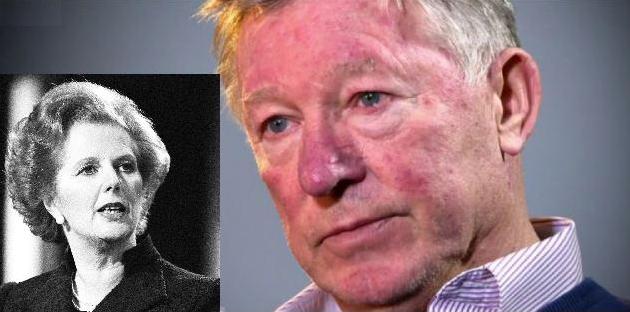
Thatcher & Fergie – Unlikely Bedfellows

Two Media Darlings

Two Media Darlings

It’s been an awkwardly stomach-churning day for any self-respecting Man U-hater with anything but the most robust of digestive systems.  The output of Sky TV and BBC Radio Five Live in the wake of the Govan Guv’nor’s resignation as Supremo at the Theatre of Hollow Myths has been wall-to-wall, sickly sweet revisionist nonsense.  It was perhaps predictable – Man U seem to attract this kind of attention quite regularly.  They hypocritically call Liverpool the “City of Pity” and “Shrine Worshipers”, and yet there was the cloying sentimentality of the Lone Piper at Old Trafford when Busby died, and of course there is the nauseatingly poorly-written “Flowers of Manchester” doggerel recycled every February 6th when the Man U Marketing Machine gears itself up for the annual “Let’s Make More Money Out of Munich” event.  The treatment of Man U in the media has a lot in common with the ingestion of a copious draught of heavily-salted water.  Both are pretty much guaranteed to make you sick.

For some of us, it’s only been a couple of short weeks recovery time since the last bilious attack brought on by an onslaught of gushing praise for a much-hated public figure.  To listen to the BBC’s output in the wake of Maggie Thatcher’s death, you’d think she was universally acknowledged as a saint who personally saved our country from the hordes of infidel savagery, instead of a humourless and uncaring woman who presided over the decimation of manufacturing industry and created an underclass of unemployed dole fodder.

Ironically, that assessment of Thatcher – the realistic one, not the BBC’s rose-tinted, soft-focus blarney – would almost certainly strike a chord with Ferguson, a man who has always made much of his Socialist roots.  And yet the fulsomely worshipful bilge poured all over her death and funeral has been rivalled today both in flavour and quantity as various media outlets have sought to paint a picture of “Fergie the Greatest”, conveniently ignoring the essential character of the man, which is that of a coarse bully and a ruthlessly competitive control-freak who would brook no opposition and practiced suppression of dissenting voices on a grand scale as well as nepotism, intimidation and other deeply unattractive tactics.  Ferguson and Thatcher operated in vastly different spheres, and pursued their objectives in vastly different ways, although the objectionable single-mindedness and refusal to acknowledge any other point of view was common to both.

It is arguable too that both shared a similarly dislikeable personal character and yet that both represented vested interests which have caused a complaisant media and establishment to bend over backwards in their efforts to hide these unfortunate facts.  However difficult they both were to handle at different times – Ferguson famously “banned” the BBC from his personal airspace for an extended period, claiming in a juvenile fit of petulance that the Corporation was “pro-Liverpool”, and objecting to their focus on the activities of his shady agent son Jason – the media still fall over themselves to praise both to the skies.  Powerful interests are at work here, rigid agendas are being pursued.

Ferguson will not relish any comparison with the Iron Lady, and yet such comparisons are irresistible.  Nepotism, for instance.  Thatcher was accused in many quarters of using her influence to smooth the path to riches of her not-outstandingly-bright son Mark, a man who would seem to have difficulty finding his way out of an open box.  Ferguson allegedly pushed the services of Agent Jason on young players at Man U and reacted with fury if the lad in question went elsewhere.  When his fledgling manager son Darren was sacked by his employers after his latest relegation, Fergie senior reacted by recalling two young Man U players who had been at that club on loan.  The similarities in modus operandi for Fergie and Thatch abound.

It is for the gross and over-the-top way in which both have been virtually canonised by the media in the wake of their exit from the stage that really sticks in the throat, however.  The tasteless extent of it, the gushing, nauseatingly deferential tone of the ubiquitous tributes, strike a remarkably similar tone in either instance.  In Thatcher’s case, the masses thus appeased were the blue-rinse brigade and their Colonel Blimp husbands, Tories to their last cell, and voraciously hungry for any news coverage to confirm their view that la Thatch was the greatest since Churchill, the greatest peacetime leader ever.  The claims of Clement Attlee, the authentic greatest PM ever, were callously overlooked, as was the fact that his funeral in 1967 was a quiet and dignified affair.  In the case of Ferguson, the masses are of course the legions of Man U fans all over the world and in Torquay and Milton Keynes in particular, who have been fed the myth of Man U being the greatest club in the world (Arf!) and who now wish to hear Fergie being called the greatest, against the claims of true greats like Busby, Revie, Shankly and the rest, proper managers who had to do it all on a level playing field and not the Sky-weighted Man U-centric environment we have now.

Radio Five Live are still at it, as I listen.  We go “back to Old Trafford” on a regular basis, to listen to the hushed tones of a reverential reporter, laying it on thick for the benefit of the thick.  It’s all so remarkably similar to the nonsense we all suffered in the wake of Thatcher’s passing.  Perhaps, for Ferguson, that is the unkindest cut of all.

Alex Ferguson – A Tribute

Purty, Ain't He?

Purty, Ain’t He?

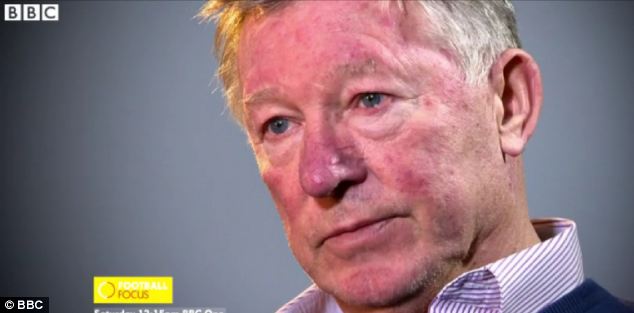
The football-related media is in a frenzy of mourning today after the announcement that Sir Alex Taggart has decided to step down as Supreme Dictator of the FA Premier League.  Who will follow him, they ask, tearing their hair and wringing their hands in distress.  Chelsea fans may be surprised to hear that Bridge-bound Jose Mourinho is being mentioned as inheritor of the poisoned chalice that is the hot-seat at the Theatre of Hollow Myths.  But Jose is surely too fly and savvy  to “do a McGuinness” as the task of following a long-serving Man U manager is known in the game.  Everton fans too may be wondering whether David Moyes will be offered the chance to step into the role of “Premier League’s Token Grumpy Scotch Git.”  Whoever ends up in Mr Ferguson’s gout-adapted tartan slippers has a job on his hands alright, and will need urgently to review the manual on “How To Bully and Intimidate For Personal and Professional Gain”.

The loss for the media will be acute.  Hacks as a breed dearly love the cosy familiarity of a tyrant at the top of the game, someone who is an outlet for all of their natural tendency to fawning sycophancy, a figurehead over whom they can compete to praise in the most glowing terms whilst neatly overlooking the glaring flaws of a man who has been a study in coarseness and choleric wrath when things even threaten to go other than as he would like.  The newspaper journos will miss “S’ralex” – he represented continuity for them, an opportunity to trot out well-worn cliches and perpetuate comfortable myths.  Now they may even have to think before starting another Man U piece – it will be a shock to be so brutally jolted out of a 26 year comfort zone.

Ferguson has his place in the history of the game.  He will serve as the biggest negative example of how to ruin the previously positive image of a historically-respected football club, making of them a byword for arrogance and the tendency to ride roughshod over the rules and conventions of the game.  He is there as a useful comparator for the true greats of football and how they went about their business, with humour, humility and a sense of their own fallibility.  The likes of Busby, Shankly, Revie, Stein, Nicholson et al are all part of the rich fabric of the game, all lost to us now, but all clearly capable of favourable assessment in the light of the Ferguson legacy; none will suffer in comparison with the man from Govan.

People will point to his record of success – and sycophants and revisionists will hastily gloss over his difficult early years at Man U when the home crowd called for his head and despaired of ever being able to aspire to the levels of Liverpool and Everton, great clubs run properly.  The re-organisation of the game and its finances when the Premier League came in was highly opportune for Ferguson, and he certainly made hay while the sun shone; it shone for him for the bulk of the remaining 20 years of his career.  Ferguson suddenly found himself in charge of a racehorse competing in a donkey derby, the interests of consumers suddenly paramount, the need to sell satellite dishes and replica shirts in hotbeds of Man U support like Devon and Milton Keynes emphasising the commercial importance of a successful Man U team.

All of a sudden, the top players wanted to go to Salford, all of a sudden the statistics of the game tilted heavily in Ferguson’s favour.  Penalties against them had never been plentiful, now they were as rare as a rosebush in the desert.  Ferguson’s natural personality came to the fore; his tendency to bully and to rant began to produce real results in terms of the attitude of the media and of the game’s officials, both on the field in the shape of cowed and terrified referees, and off it with the administrators unwilling to court commercial unpopularity by waving the rule book under that purple nose.  The most familiar sound-bite emanating from Lancaster Gate was suddenly “The FA can confirm that Alex Ferguson will face no disciplinary action for (insert example of blatant disregard for the rules here.)”

Referees became aware of the fact that those of their number who made a decision not to the liking of Ferguson tended to wait a very long time before selection for another fixture involving Man U.  These are high profile games, and referees increasingly had to look to their own career prospects as their role assumed more of a professional profile.  So they tended to knuckle under, perhaps only subconsciously, but the effect over many years has been enough bizarrely ridiculous decisions in favour of Man U to spoil the digestion of many a football fan who remembers fairer days pre-Murdoch, pre-Man U dominance.

Given this decided slope of the playing field in Man U’s favour, the wonder of it all is that they haven’t won more.  There have been years when the Title has gone elsewhere; remarkable this, in a game of fine margins where one study exposed as fact that 88% of all 50-50 decisions went the way of the Salford Franchise.  This is the measure of Ferguson’s failure; a manager who was also a good coach would surely have cleaned up in such a very favourable environment.

So what now for Man U?  To be honest, I can see their domination continuing.  It’s likely that the public image of the club will be enhanced under a manager who does not represent quite so many of the negative personality traits exhibited by Ferguson.    It will certainly be interesting to see if a world-renowned coach – if appointed – can improve on their patchy record in Europe, where Ferguson’s habit of intimidating refs has not been such a marked advantage to them.  Two somewhat lucky Champions League wins is a poor return for twenty years of almost unlimited opportunity, and a better man in charge might perhaps improve on this and finally give Man U more justification for their laughable claims that they have “knocked Liverpool (Five European Cups) off their perch.”

The question will be asked next season “Who’s the greatest manager in football now?”  The answer will be the same as this season: choose any one from Mourinho, Wenger and Hitzfeld.  All the propaganda in the world cannot make a silk purse out of a sow’s ear.