Category Archives: Television

Evra Out-Chomps Suarez in the Bad Taste Stakes

Stupid Boy

Stupid Boy

It was predictable, I suppose, that Man U would find time in celebrating their hollow title triumph to have a pop at the enemy down the other end of the East Lancs road. It’s in their DNA to crow instead of celebrating with dignity as truly great clubs do – and so inevitably the evening couldn’t go by without some reference to the latest glitch from Liverpool’s Luis Suarez.  Liverpool are a problem for Man U.  They oozed class to utterly out-perform all the competition back when that competition was a lot broader-based than it is today.  They’ve still got more European Cups.  For a club so obsessed with size and success, so insecure in the face of genuine rivalry, it stings the Trafford-based giants that a relatively close neighbour has been so historically successful.  Man U don’t take that sort of thing kindly, and Ferguson’s poisonous hatred of Liverpool has trickled down like escaping acid through the fabric of his club, leaving the suppurating sores of bitter envy at all levels.

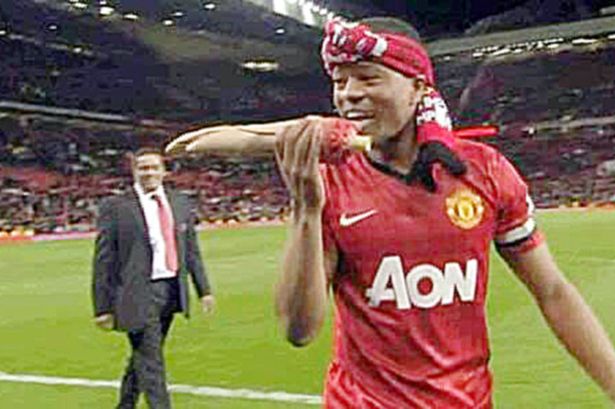
Even given this long-standing hatred of Liverpool, born of the envy and insecurity that riddles Old Trafford, the display on Monday evening of the not-exactly-admirable defender Evra was pushing hard at the far boundaries of decency and good taste.  A joke “severed limb” was thrown onto the pitch from the jubilant home fans – this is the kind of thing Man U fans are rather prone to, with a record of similar perversions of class and comportment many times in the past.  They tend to squeal loud and long though if anyone offers them like treatment; such is the one-way street of the Man U supporters’ moral code.

So there’s this silly toy on the pitch and – no doubt seeking to please and impress his adoring fans, Evra had to pick it up and mime having a bite out of it.  It’s not a particularly edifying image, but of course Evra and Suarez are not exactly bosom buddies.  Be that as it may, such a very unsubtle reference to the hot-headed and idiotic actions of the Uruguayan a couple of days previously at Anfield was – to say the least – unhelpful and unwelcome.  Suarez has stupidly offered himself as a target yet again for a press and public that has been eager to condemn him ever since his dispute with Evra, a situation in which the Frenchman shared a lot of any blame going.  But Suarez has been hunted ever since, any slip highlighted, most of the praise that his sparkling play deserves only grudgingly meted out.

The point of all this is, of course, that the actions of Suarez, stupid and needless though they may be, ARE invariably taken in the heat of the moment, when he is in the middle of some competitive vortex on the field.  Evra, on the other hand was relaxed and celebrating, high on the moment of triumph no doubt, but not caught up in the white heat of conflict.  And yet he still chose to do this tasteless thing, in cold blood, and subject us all to the spectacle of his gloating mug on the back pages, glorying in the opportunity to heap further ridicule on a fellow professional.  An unpleasant and despicable individual, as well as being not one tenth the player that Suarez undeniably is, as he’s always proving.

It always seems to be Man U that are highlighted indulging in unpleasant schoolboy skits like this.  They used to have a reputation for class and impeccable conduct, even under the slightly shady rule of the Edwards family.  That good reputation is long gone.  The modern tendency to revel in the misfortunes and dilemmas of others seems bred into them by their coarse and choleric manager, a man who values the siege complex and nurtures this out of the hate his teams’ conduct inspires.  Suarez has – probably rightly – copped a long ban for his daft action, which gained him nothing and certainly reflected ill on the game.  His conduct was inexcusable, but for a hothead like Suarez there are always reasons, and it seems that every now and again, he will simply run out of self-control.  It’s in his temperamental and hot-blooded nature for this to be so, and sadly that runs against the grain in a colder country than his native Uruguay.

But what’s worse – this instinctive tendency of the Liverpool striker to get carried away in the moment and either lash out or bite off more than he can chew?  Or the sly and nasty, calculated and measured breach of taste perpetrated by Evra, a man usually more sinning than sinned against, and whose actions appear inexplicably to draw nothing more than a fond smile from the Man U-centric media?

I know what I think.  Silly lad, Suarez.  Nasty git, Evra.

Memory Match No. 7: Blackburn Rovers 3, Leeds United 4 – 14.9.1997

Image

George Graham’s Opinion of the Back Four

1997-98 had got off to a stuttering start as a raft of new signings settled into the club. The first two games had been encouraging; a draw at home to an Arsenal side which would eventually win a deserved Title, and a comfortable success away to Sheffield Wednesday. But three defeats followed to Crystal Palace, Liverpool and Aston Villa, and in none of those games did Leeds United manage so much as a goal. George was not a happy man.

As the teams walked out before a 21956 crowd and live Sky cameras at Ewood Park, we wondered if this was going to be another hapless, goalless performance which would see the season drifting towards under-achievement again – or would Leeds bounce back and rekindle our faith? In a roller-coaster of a game, an archetypal game of two halves, that question was answered emphatically.

I always enjoy watching football at Ewood Park, whether live from the stands, or even on TV. Something about the ground appeals; there’s a faintly Hovis-advert atmosphere outside, an air of cobblestones and tripe. Inside, the changes wrought by Jack Walker’s legacy were apparent to those of us who remembered clashes here before rickety old stands in the 80’s. There’s a spacious feeling to the stadium compared to the cramped impression you get at some grounds. On the telly too, the aspect is pleasing, whether it’s because of a good high camera position or some other trick of the environment, there seems to be lots of room; you can see the pattern of play and appreciate what the teams are up to.

In this game, both teams seemed to be up to the old game of OK, let’s abandon all pretence of a tactical battle here, let’s just score more bloody goals than the other lot and get the points – or at least that was the script until half-time, when two harassed managers got to grips with their too-generous defences and raised the drawbridge. But, oh – that first half.

Leeds were off to an absolute flyer, two goals to the good after a mere six minutes and apparently well and truly over their barren run in front of goal. After only three minutes had elapsed, Gunnar Halle played a great diagonal ball from wide right just inside the Blackburn half, finding Jimmy Floyd Hasselbaink on the left wing. Jimmy controlled and crossed in the same movement, so it seemed, standing the ball up at the far post where young Harry Kewell directed a firm header towards goal and Rod Wallace was there to scramble the ball over the line.

Usually, an early goal away from home was the cue for nail-biting among the Leeds fans as our heroes sat back and invited the home team to attack, inevitably conceding when they might have gone on to build a clear advantage. But on this occasion, Leeds did strike again, before Blackburn had even come to terms with being one behind. A corner on the right from Gary Kelly dropped around the penalty spot where Robert Molenaar, in acres of space, met the ball as sweetly as you could wish and directed a firm side-foot volley into the net past a startled Tim Flowers. 2-0 after six minutes, and everything was coming up roses.

However, this was Leeds – and just when you think things are going well, they remind you that’s not how it’s supposed to be. Two minutes further into the game, and the lethal Kevin Gallacher won the ball thirty yards out, glanced up and delivered a thunderous shot into the far corner with Nigel Martyn helpless. Now we looked at each other and grimaced, because a 2-0 lead reduced to 2-1 is a dangerous situation for our beloved club; suddenly you can smell the fear and you suspect that there will be tears before bedtime. Referees tend to be the villains of the piece when we do let leads slip, and Mr Dunn of Bristol hardly covered himself with glory by awarding Blackburn a penalty in what was still only the 16th minute. Martin Dahlin tried to turn Molenaar in the area, there was a “coming together” which ended up with the Swede on the floor and the Dutchman looking innocently bewildered as the ref almost spat out his whistle in his eagerness to blow for a penalty. It was a soft decision of the type we have seen many times over the years – the kind of penalty Man U get loads of and concede none of. THAT kind of penalty. Even Alan Parry seemed surprised. Chris Sutton unceremoniously blasted the ball down the middle and we were level again at 2-2, right back where we started. Despair. Would we now go on to capitulate? Blackburn had been riding high in the league under new manager Woy Hodgson (whatever happened to him?) and they now seemed set to continue their good form by finishing us off.

Happily, it was not to be. Instead of sulking at perceived injustice, Leeds rolled up their sleeves and set about restoring an advantage. A delicious turn in midfield – sort of Cruyff and Dalglish combined – saw the quicksilver Kewell sprinting clear towards the Rovers penalty box where he slipped the ball to Wallace on the left corner of the area. Little Rod controlled the ball and then set off on a jinky dribble across the eighteen yard line, holding off opponents, looking for that fraction of space. As soon as he found it, he wrapped his right foot around the ball and sent it hurtling into the top right hand corner of Flowers’ goal for a sensational and finely-crafted goal. Cue pandemonium in the Leeds end as they watched the Leeds players celebrate in front of the disconsolate home fans. Then, another miracle – what seemed a far clearer call for a Blackburn penalty was ignored by the ref, who may just have been feeling slightly uncomfortable about his earlier award, and so compounded the impression of incompetence by evening things up. It looked blatant and Halle looked guilty, but were we complaining?

And then more joy, as Leeds restored a two goal cushion. Fine play on the left between Wallace and Hasselbaink saw Jimmy showing pace and determination as he surged into the penalty area, then checked back to roll a tempting pass into the path of the onrushing David Hopkin. Hopkin snapped up the chance eagerly, one touch to control and then a slide-rule finish just inside the far post. 4-2 for the Whites. SIX goals by the 23rd minute, and FOUR of them for us. What a great away day – where would it end?

In fact, the end was already in sight. There was still time before the interval for the ref, bless him, to ignore another decent penalty shout for Blackburn as Molenaar appeared to barge into Dahlin in the box. Three penalty decisions, and most probably Mr Dunn got all three wrong, but for once Leeds were on the positive side of the equation. And then, as if to prove our team don’t like us to have it too easy, we managed to get pegged back to 4-3 just after the half-hour, Dahlin turning past a challenge inside the Leeds penalty area and finishing with a smart angled shot. A crazy 33 minutes had seen seven goals, and by half-time just about everyone in the stadium was breathless with the nuttiness of it all.

The second half was an inevitable case of “after the Lord Mayor’s Show” – both teams had clearly been told in no uncertain terms to sort out the defensive shambles, and the game settled back into a battle of give-and-take – still highly competitive, and even quite entertaining, but no match for that riotous first period. No further goals were scored, and Leeds had emerged with a highly creditable victory, to leave George purring about his dearly-valued “comeraderie” which – if it truly is a hybrid of comedy and camaraderie – seemed to fit the bill precisely. It was a victory that set Leeds off towards a decent season ending in European qualification, when defeat might so easily have started us worrying about the other end of the table.

George meanwhile was doubtless unamused at the tendency to let goals in when leading comfortably – a sin perpetrated twice in this match – but he was committed to a more attacking approach this year than last, and we would reap the benefits in other glorious goal-fests as the months went by. 1997-98 is a season I remember fondly for that, a time when the future looked bright under George and you wondered if he could build at Leeds what he had so successfully at Arsenal. Sadly, it wasn’t to be, but there are some very happy memories, and this fun in the sun day at Blackburn is one of the best.

Next: Memory Match No. 8: Sheffield Utd 2, Leeds United 3. On the 21st anniversary of our League Championship triumph, a look back to the crazy, gale and Gayle-affected match at Beautiful Downtown Bramall Lane which paved the way for Sgt Wilko’s Barmy Army to call themselves the best in the land.

Another Hollow Triumph for Money, Murdoch and Man United

Image

We deserve the Title! We DO!!! Waaaahh!!!

More than likely they’ll be tenaciously cavorting away in dutiful triumph tonight at The Theatre of Hollow Myths, as Man United celebrate another processional title triumph, brushing aside what I expect to be feeble resistance from Aston Villa..

Since Murdoch bought the game, the Trafford-based club have been on easy street. Better-placed than the rest – given their global fan-base – to capitalise on a league based on glitz and merchandise, their fortunes have been linked inextricably with the fortunes of Murdoch’s Sky TV empire as it has tightened its grip on what used to be our national game.

In 1967, Manchester United won the Football League Championship.  Brief flickering highlights were shown in grainy black and white as the champions paraded the famous old trophy.  England were World Cup holders, Harold Wilson was Prime Minister and a pint of bitter cost about 8p.  It would be two years before Man set foot on the moon and Jimmy Greaves had hair.  It was that long ago.  Matt Busby and his team celebrated another trophy, but their era of success was coming to an end.  Man U would never win the Football League Championship again.

Fast forward 25 years, and Man U came as close as they had ever come to regaining the Holy Grail, only to see it snatched from their sight forever as Leeds United took the prize in 1992 by four clear points, becoming the last ever proper League Champions.  But things were about to change, and not before time.  It had been a clear quarter of a century since the media’s favourite team had won the league; that most marketable of clubs had failed, utterly, to rise to the top of the game where their profit potential could best be realised.  The money men in their grey suits were frustrated.  This could not be allowed to go on.

And so the Premier League was born, in a blitz of fireworks, tickertape and dancing girls, complete with cheesy music, the hirsute Richard Keys, a league title trophy modelled on the lines of Thunderbird One and all the bells and whistles an Australian entrepreneur could dream of.  Behind the window-dressing, bigger changes were afoot.  The money would be channelled upwards, in defiance of gravity and the previous trickle-down economics of the game which had afforded some protection to the relative paupers.  The big and the rich would get progressively bigger and richer; the days of the League Title being won mainly on merit were done.

From now on, the destiny of the title would be decided largely on the basis of pre-season balance sheets.  From a situation where he who dared, won – we would now see an era where he who spends biggest stands the best chance.  One club above all others stood to benefit from this Brave New World – Man U, heralded as the Biggest Club In The World (to a background of incredulous giggles in Milan, Barcelona and Madrid) had built up a worldwide following with their relentless harking-back to the legacy of the Busby Babes and the Munich disaster.  Their history had made them everyone’s second-favourite club; now Murdoch’s revolution put them in pole position to capitalise on that, and reap a harvest of trophies from the seeds they’d sown in flogging Man U tat to a globe-full of eager and undiscriminating consumers.

Resistance became sporadic; almost futile (were Man U the sporting equivalent of Star Trek’s Borg?)  Man U won the first two “Premiership” titles before a cash-rich Blackburn out-spent and out-fought them in 1995.  After that the procession continued, the titles piled up at the Theatre of Myths, only Arsenal, Chelsea and Man City have interrupted the monotonous toll of the bell signalling more success for the most effective franchise in football.

Tonight will see the 20th “Title” for the club that used to be loved by many outside of their immediate support, but are now regarded with a dull hatred by proper football fans.  This is put down to jealousy of course; but every fan has a choice, and jealousy is an unnecessary emotion.  Tonight’s latest success will see the appearance of more Man U acolytes everywhere, as the need to be identified with size and success sucks in those of questionable character and inadequate self-esteem.  More Man U shirts in Torquay and Milton Keynes, more tacky memorabilia sold in Stoke and Londonderry.

The 20th title then – but there remains a clear demarcation.  7 titles in their history up to 1967.  13 in the 20 years since 1993.  Is this just a coincidence?  Of course it’s not; if anything it’s an indictment of Man U’s failure.  Somehow, in seven of those years, they’ve failed to win the league, despite the financial and psychological disadvantages of their rivals, they’ve let it slip away.

The fact is that the titles won since 1993 are devalued by the steep slope in Man U’s favour of the playing field on which all have to compete.  Liverpool were dominant in an even competition for the best part of two decades up to the 90’s; it is now 23 years since they were Champions, but their overall record remains formidable.  Whatever Man U might want to make of it as they crow about 20 titles to 18, they know in their heart of hearts that the baubles won in the Murdoch era are of a lesser water than the diamonds Liverpool gathered to them.  The exchange rate is against them; their achievements are relatively less.  If they maintained their current rate of success for another twenty years (and who knows, they might – but it would kill the game), then maybe they could be compared to Liverpool, the acknowledged masters at the time Murdoch’s coup took place.

But for the moment, I say – as a devoted fan of Leeds United – Liverpool are still The Greatest.

Boston Marathon Atrocity

I couldn’t take this in when I first heard.  I was at a play rehearsal, and when my mate told me – may the Higher Powers forgive me – I thought he was telling me some sick joke.  He said he didn’t joke about things like that and I thought, no, of course you don’t, who does?   Who that’s in any way human could make something like this up?  Then again, who actually perpetrates a horror like this?  But it’s a fact, somebody has most likely planned and compassed the death and maiming of people who were just out to take part in a joyous event, innocent people who have done no harm, random victims of someone’s cowardly determination to inflict pain suffering and death on fellow human beings.  It defies comprehension.

I say “most likely” because – as I write – there remains a shred of possibility that this wasn’t a terrorist attack.  But it seems almost certain that a terrorist attack it will have been, that yet again shadowy figures have decided to take human life to make some esoteric point.

There’s no point calling these people animals.  Animals don’t do this; it’s the sort of uncivilised behaviour confined to – supposedly – the most civilised species on the planet. Only “intelligent”, “cultured”, “civilised” Man does this.  Only Man has the tools; only Man has the urge to slaughter his fellow beings on such a gross scale, for reasons that don’t stack up against the primal need to eat and survive.  Man is a predator, like so many other animals.  But Man alone kills for reasons of sport, culture, ideology.  It’s a sickness not shared by other predators, and that means that a tiger or a lion or anything else that kills to eat has a nobility that we sometimes call savage, but is in reality a whole hell of a lot more noble and understandable than the base and repulsive urges that drive members or our species to visit these horrors upon each other.  Go figure.  Really, we owe the rest of the Animal Kingdom a massive apology for every time any of us has ever called some depraved human killer “an animal”.  It’s the most ironically insulting and groundless snub we could deliver to other species who conduct themselves in a far more admirable manner than we “civilised humans” do.

Sorry, I’m rambling on because I’m shocked, disgusted and ashamed.  Who knows what we will find out in the next few days as this situation develops, but it seems certain that lives have been lost, and other lives will be changed irrevocably; and no-one affected was given any choice in the matter, nor any chance to escape the fate wished upon them by anonymous cowards.

No cause is worth this.  No religion is worth this.  Nothing is worth the tiniest fraction of the suffering that has been caused.  We need to get over ourselves as a species.  We’re all here for a short span only, and nothing is more important than being alive, and making the most of every moment we’re here.  For all we know, this is our only existence, at any time in the vast span of Creation; we’ve waited billions of years to be alive, and we’ll be gone after a century, give or take, and then there’ll be billions more years when we’re not here.  And yet people regard this rare and precious phenomenon of life so cheaply, so casually, that they presume to deprive others of it, for some pathetic creed or notion that they wish to impose on others, and devil take the hindmost.  The arrogance and ignorance of that just beats the hell out of me.

I know I’ll dream tonight about the pictures I’ve seen.  I know that I feel guiltily glad it’s someone else torn and tattered, or dead – and not me or anybody I love.  I don’t want it to happen to anybody, but Hell, I don’t want it to happen to me or mine.  That’s my human selfishness, and I can’t deny it – but how much more selfish do you have to be to actually plot and do something like this?  My mind is boggling at that.

I wish the dead peace, the injured the best recovery they can have, the bereaved what comfort and support they can get.  And I wish the rescue and medical services the strength and resolve they will need.  For those who did it – I wish some sense of perspective so that they can see how awful is the thing they’ve done, instead of living in some cloud-cuckoo mindset where they feel it’s in any way justified.  Don’t call them animals.  They’re nothing so dignified.  They’re the most despicable, wretched kind of human being, and you can’t say worse than that.

Manchester United – They’re Just Not All That Good

Image

Accuser and Accused

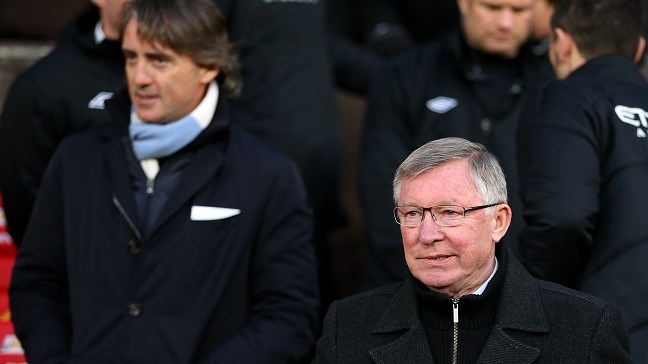
At last, a Premier League football manager has gone public and given voice to a dark suspicion that thousands of us fans have harboured for a long time now. Roberto Mancini, may his name be blessed, says that teams facing the Mighty Manchester United are infected with a fatal lack of belief which amounts a lot of the time to actual fear. This, says Mancini, explains a large proportion of the Red Devils’ domestic dominance. It’s not that they’re that good, he argues; rather it’s that a lot of the opposition simply fail to mount a robust challenge and end up meekly relinquishing league points that nobody really expects them to gain.

Predictably, Man U’s long-serving manager Alex Ferguson is having none of this, accusing the Italian coach of Manchester City of seeking “self-sympathy” – whatever that might be. But the Mancini case is quite persuasive, particularly for anyone whose second-favourite team is whoever the Champions-elect happen to be playing on any given occasion. For those people (and I am proud to count myself among their number) the ongoing spectacle is one of a succession of teams turning up to face Ferguson’s side, and doing very little apart from that – spineless capitulations being the industry standard or so it seems. Very unedifying for those with Manchester United’s worst interests at heart but also, I would strongly suggest, pretty bad for the game as a whole.

So what is the evidence for this alleged collective lack of bottle and professional application? And if it’s true, where does the fear come from? Whence, the lack of self-belief?

Let’s initially get down to cases. As I mentioned earlier, I am a steadfast watcher of the televised games of Manchester United (of which, courtesy of Mr Murdoch, a man who knows his markets, there are many.) I don’t watch with any real expectation of enjoyment; that outcome will only come about if Man U slips to an unexpected defeat or, rarely and joyfully, a real hammering. Much more often though, I sit there in an increasingly foul frame of mind as the latest feeble challengers to the Mighty Reds roll over to have their bellies tickled prior to succumbing politely, without much of a fight at all. All too often this process is aided by the dodgy decisions which famously tend to fall the way of Mr Ferguson’s men, or maybe by copious amounts of what has become known as “Fergie Time”, the perceived need for which varies according to whether his charges are winning or losing. However it happens, it’s all the more depressing because of this pitiful lack of resistance displayed by all too many opponents. You feel frustrated – on your own behalf because you want “Them” to lose – but also on behalf of all those who switch on just hoping to see a good competitive game, with both sides giving their all. That just doesn’t happen often enough, and you sit there and wonder why.

A big factor at play here could well be the psychological gap hinted at by Mancini. What exactly are teams up against Man Utd facing? Not merely eleven chaps clad in red, or whichever of their numerous other kits they might be sporting. In professional competition, especially at the very top level, at least half the battle is in the head; that’s well-established fact. Do these opposing players believe they can win, or do they enter the arena as lambs to the slaughter? Do they feel any real pressure to win from their fans, or do they suspect those fans will quite understand and accept a defeat? Not very much of this type of thinking is required to take that psychological edge off performance.

The particularly annoying thing is that this Man Utd team really aren’t all that good. They got found out twice in Europe last season, latterly by Atletico Bilbao, a team who finished well out of the running in La Liga, but who gave the Mancs the most terrible seeing-to in both legs of an extremely one-sided tie. They’ve been beaten by Chelsea – a side who are themselves in transition – in both domestic Cups this season, and chucked out of Europe this time around by a Real Madrid side who hardly let them have the ball at all.

The European element is of particular interest as it may well be significant that, outside of this country, opposing players aren’t subjected to the constant drip, drip, drip of Man U media adulation that is visited upon domestic foes. Everywhere a player might turn in this country, there’s another article or broadcast or pundit, invariably churning out copious praise of “United”, with emetic results for those of us who don’t buy into the popular legend. What is the cumulative effect of all this? Another dulling of that psychological edge, that’s what.

The media love to talk about Ferguson’s “mind games”, but they’ve never really been anything other than the ramblings of an ever older gentleman, notorious for his inability to see more than one point of view – his own. Greater and wiser exponents of psychological warfare exist in Mourinho, Wenger and Mancini himself – all continental chaps, significantly enough. The edge given to Man U in the battle of wits and wills tends to be provided by a complaisant media and that, I believe, is precisely what the astute Mancini is getting at.

Maybe this is why Ferguson felt the need to come out with such an immediate if not altogether fluent rebuttal. Other clubs have caught up with and perhaps surpassed his own in terms of talent on the field and punch in the transfer market. Ferguson is not likely to want to see any narrowing of the psychological advantage afforded to him by his yes-men in the Fourth Estate. If the Premier League were to be transformed – by such a relieving of the mental barrage – into a level playing field with some willingness on the part of current also-rans to compete and believe, then the current gulf at the top would be a heck of a lot smaller. And then, perhaps, we’d see Champions on merit; not merely winners by default as we will get this season, who have had almost literally nothing to beat for a large portion of the time.

Now that’s the kind of Premier League I’d like to see. Well said, Signor Mancini. Keep the pressure on.

Memory Match No. 6: West Ham 1, Leeds United 5 – 1.5.1999

It’s about time this Memory Match series featured loveable, chirpy cockneys West Ham United, usually obliging victims for Leeds teams of most eras, and notable as lenders of a helping hand towards the end of the title run-in of 1992 when they defeated Man U in a game that turned Alex Ferguson the deepest shade of exasperated purple I’ve ever seen. It’s fitting that I should write a little about the ‘Appy ‘Ammers; at least one irritatingly chirpy blog which claims to support them spends most of its time obsessing over our own beloved United, so perhaps here I can redress the balance a little.

Image

Jimmy Floyd Hasselbaink

This Mayday fixture in front of a packed Boleyn Ground crowd of 25997 found Leeds United in a rich run of form, ten games unbeaten since an early February reverse to Newcastle at Elland Road, after which they had reeled off seven consecutive league victories followed by three draws on the trot. The Whites’ determination to get back to winning ways after those six dropped points was exemplified by the fastest possible start. A mere twenty seconds had ticked by when the ball nestled in the West Ham net, put there emphatically by the ebullient Jimmy Floyd Hasselbaink who ran at a retreating Neil Ruddock before finishing neatly with a left-foot shot past Shaka Hislop.

And then the game went ever so slightly mad.

Jimmy’s goal apart, the opening sallies had seen both sides engaging in tackles which verged on the thuggish side of enthusiastic. West Ham’s Eyal Berkovic was a victim early on, and Lee Bowyer was on the end of a clattering as the home side sought revenge. Then Ian Wright, no stranger to controversy and the disciplinary attentions of referees, led with his elbow when challenging for a high ball, and copped for a yellow card that looked a lot more justified than the second yellow he got after only 15 minutes, following an altercation with Ian Harte, Harte, Harte. So Wright was on his way back to the stand after a mere quarter of an hour, loudly protesting the injustice of the case and hell-bent, as it turned out, on venting his frustrations on the décor of the ref’s room.

For the next half-hour, leading up to the interval, Leeds proceeded to make a one man advantage look anything but as West Ham pressed them back, causing panic in the away defence as the promptings of Berkovic and Paolo di Canio created some decent chances to possibly level the game. Leeds had managed to be distinctly the poorer side in that first half, and yet – as if to prove once again what a daft game football can be – they hit West Ham with a sucker punch in stoppage time. David Batty appeared to have committed a foul in midfield which might well have justified a booking had the ref not totally ignored it and waved for play to continue. Harry Kewell obliged, picking the ball up wide on the left and mesmerising the overstretched Hammers defence before cutting the ball back from the by-line for Alan Smith to convert gleefully. 2-0 at half time and – for once – it had pretty much all gone Leeds’ way. They had been outplayed for most of the first forty-five minutes, but were somehow two goals and one man to the good; courtesy, it has to be said, of some not exactly even-handed refereeing.

The second half began much as most of the first had been spent, with Leeds on the back foot and defending precariously. Straight away, the dangerous Berkovic bamboozled Jonathan Woodgate, turning him inside out before supplying di Canio with the perfect chance to pull a goal back. 2-1 to the visitors then, but the balance of the play had been with West Ham, and maybe now the momentum was theirs too. None of us could feel over-confident despite a man and a goal advantage, because all of us could recall Leeds blowing such enviable positions many times in the past. This time, for once, we were not to be let down. A rare defensive slip just after the hour from the otherwise excellent Marc-Vivien Foé saw Hasselbaink sprint clear to round Hislop, who then brought him down. Penalty to Leeds and, despite the presence of defensive cover, Hislop was sent off. It was a slightly unfortunate second red card for West Ham, who felt compelled to replace star man Berkovic with reserve keeper Craig Forrest as the calamities mounted for the home team. Forrest’s first act was to pick Harte’s penalty out of the back of the net, and Leeds were 3-1 up and cruising against 9 men. Foé, we will remember, sadly died four years later at the tragically young age of 28, from an unsuspected heart condition whilst representing his country in the FIFA Confederations Cup.

Image

Alf-Inge Haaland

Now at last Leeds started to dominate as a two-man advantage would suggest they should. The best goal of the game arrived on 78 minutes, Bowyer hitting an unstoppable right-footed shot from twenty-five yards, which curved slightly as it found the corner of Forrest’s net. Just a minute later, Alf-Inge Haaland sprinted on to a Hasselbaink pass into a massive amount of space on the right hand side. Unchallenged, he was able to advance into the penalty area and beat Forrest with an accurate shot just inside the far post.

The eight outfield players in claret and blue were clearly finding the pace too hot, and suddenly there was room aplenty all over the pitch for Leeds to exploit, and exploit it they did. Aided by the fact that the Hammers – to their eternal credit – were still trying to attack Leeds in spite of their depleted resources, our heroes were granted the licence to ping the ball about as they pleased, always able to find a man or two in space, making the tired home players work overtime to chase possession as the Upton Park faithful bayed their hate at the referee. Truth to tell, we could easily empathise with the ‘Arrassed ‘Ammers; far too many times down the years had we been in their shoes, watching impotently enraged as some git of a ref casually destroyed our afternoon. It was somewhat bizarre to watch the situation unfold in reverse – but what the hell. We made hay while the sun was shining, and happily the team was doing the same.

The game had long been over as a contest and, at 5-1 up with no credible opposition to deal with, Leeds seemed intent solely on playing out time. Smith still managed to miss a passable chance to make it 6-1 and Clyde Wijnhard contrived to get himself booked, eliciting gleefully ironic chants of “Who’s the bastard in the black” from the jubilant Leeds fans, displaying a gallows humour not altogether appreciated by the home supporters. Finally, hothead Irons defender Steve Lomas allowed his mounting frustration to get the better of him, launching an agricultural challenge in the direction of Harte and duly collecting his marching orders to reduce the hapless, helpless Hammers to eight at the death.

Image

Dirty Den

It had been a strange game, a romp for the Whites on the face of it – judging by the lop-sided score line anyway. But it had never been quite like that; not that our awareness of having been outplayed for long stretches diluted our joy one tiny bit. 5-1 away wins do not come along every day, and we enjoyed this one to the full. We enjoyed it for the whole of the slightly perilous walk back to the tube station, and we were still enjoying it when we beheld the distinctly pissed-off figure of Leslie Grantham heading down the stairway to the platform where we were celebrating noisily. Leslie Grantham, soap-opera legend as Eastenders’ Dirty Den, Leslie Grantham who had done time for killing a German taxi-driver, Leslie Grantham, Hammers fanatic, who – despite being accompanied by his two young boys – bore a grim aspect which looked rather as if he wouldn’t mind adding a couple of Leeds fans to that record.

Tactful and understanding to the last of private grief, we wisely kept our distance and refrained from seeking autographs. It had been a memorably bizarre day for Leeds United and an equally happy summer evening awaited us in the sinful fleshpots of London, crap cockney beer and semi-hostile natives notwithstanding. Dirty Den 1, Dirty Leeds 5.

Next: Memory Match No. 7: Blackburn Rovers 3, Leeds United 4. Another game to give the lie to those who insist that George Graham’s reign at Elland Road was dour and colourless. This televised match at Ewood Park was a real roller-coaster affair, punctuated with some great goals.

Please Support This Blog and Get The Truth Out There

I’d like to invite and entreat any WordPress users who feel that the current government of the United Kingdom are acting in a callous manner towards the poor and vulnerable in society to read, follow, share and otherwise support this blog.  I ask this respectfully, but in the hope of gaining your support, because I need your help – or I’m just whistling in the dark.  I believe that, from small beginnings, I can help to make a difference – but not on my own.

In among all the Leeds United and other light-hearted football rubbish within these pages, I’m trying to get a serious message out there as to what this despicable Tory-led Coalition government is doing to people who are being unjustly targeted, and are extremely ill-equipped to fight back.

I’m talking about people driven to suicide by vicious cuts to what is already poverty-level income.  People in extreme stages of ill-health being found fit for work, and dying mere days afterwards.  People who are almost blind, suffering from paralysis, multiple amputations, cancer, cardiac failure and other distressing, limiting and life-threatening conditions, being told that they’re fit for work, being accused – in effect – of shirking.

Meanwhile, the lucky ones earning in excess of £1 million a year will shortly benefit from a £100,000 a year tax-cut – an amount EXTRA for each of them every year that might otherwise fund four newly-qualified teacher posts – or more nurses, better healthcare, less child poverty.  But no, these vast amounts of money are going straight into the back pockets of those who are already fat cats, creaming off the resources so desperately needed elsewhere.

Do you think this is right?

Do you think this is fair?

Do you think this is just?

Or do you think that the truth about our government’s policies should be told, and then spread as far and wide as possible, so that people sit up and take notice of what’s actually going on?  Sharing a blog is the modern-day equivalent of shouting from the rooftops.  So – let’s shout a little.  Please.

It will be June at least before I can hope to gain endorsement by the News Now platform, and so gain a wider audience. In the meantime it would be extremely helpful if WordPress readers/users could help me to expand my readership, with a view to spreading that truth where currently we seem to see mostly lies and malicious propaganda. You may well, if you’re the type of person I’m aiming at, who hates injustice and stands up for the disadvantaged, find some stuff that you can agree with!

Please take a minute to have a read, and then share with your like-minded contacts.

Thank you in advance.

Gideon’s Bible – The Budget 2013

Imagine you’re a talented young TV screenwriter, looking for a smart new idea for a satirical comedy lampooning incompetent and uncaring politicians.  You’re looking for a main character, ideally in high office and making decisions on a daily basis that shape policy.  You’re probably going to make him a Tory because – let’s face it – that’s where the laughs are at when it comes to making fun of MPs for their comic nastiness value.  The best comedy contains a kernel of truth too, so you need to be careful about such matters as your character’s political affiliation, personal background, appearance and history; all of these are potentially rich sources of laughter, whilst at the same time making your audience nod knowingly and say “Yes, I know that guy.”  But beware: don’t make your creation too similar to, or identifiable with, any real-life public figure.  That’s overkill; and anyway you’re probably better off going for an amalgam of several well-known public figures – more versatility of character there, and so more potential for laughs.

Image

Gideon Oliver Osborne

Until relatively recently, you could have done a lot worse than adopt the following pattern: your fictional man is pictured (right) – note the superficial resemblance to Rowan Atkinson’s “Mr Bean” character; the rubber-faced grin, the eyes that appear to betray barely a glimmer of intelligence.  Perfect.  This would not be a cuddly, genial chap though – he’d be an heir to some minor aristocratic title and the beneficiary of inherited wealth.  He’d have been born with a silly name, which he’d later change for something he felt sounded more straightforward.  His socialist mother would agree with him about this, if not about much else.  Educated at a public school, he’d have progressed to Oxford, and followed the well-trodden path to power familiar to many Tories born to privilege and destined to inherit a fortune through no effort on their own part.  Despite these advantages he would be an outspoken critic of what, with no apparent sense of irony, he’d term “a something for nothing culture”.  On being handed control of the country’s purse strings, he’d set about tackling national debt by cutting everything in sight that benefits the poor and vulnerable, whilst ensuring that his banker mates in the City should continue to enjoy seven-figure bonuses and a reduced rate of tax for the highest earners.  Lots and lots of scope for poking fun at clueless, selfish, old-school-tie politicians there.

Well – forget it.  Think again.  Back to the drawing board.  Your ideal, fictional, made-up Tory Twit is a non-starter – because sadly he’s all too real.  And really, it was looking so good – the model outlined above seems too stereo-typically an example of Tory Boy grown up and wreaking havoc for there to be any real risk of him actually existing.  But step forward Gideon Oliver Osborne, who decided at the age of 13 to be George after his war-hero grandfather.  Whether he considered ridding himself of the initials GOO is not recorded, but in keeping with its stance on authenticity and veracity, this blog will refer to Mr O. as Gideon – besides which, he just looks like a Gideon – there’s not any real bluff, honest George quality there.

Gideon is due to present his latest budget tomorrow and you can bet any last few coins you might have left – if you’re a victim of Tory/Coalition policies since 2010 – that there won’t be any good news for those of us “all in it together” at the bottom of the economic pile.  On the other hand, you might like to wager a goodly chunk of your forthcoming £100,000 a year tax-cut – if you’re one of those “all in it together” in the million-a-year bracket – that you and your kind will be protected from the chill wind of austerity blowing through the real-life parts of our nation.

Gideon’s actions might confuse those who expect their politicians to practice what they preach (i.e. “The Gullible”).  He stands four-square behind his opposition to those who have to live on benefit having a spare bedroom – even if, for reasons of disability, there are sound reasons why two adults might not be able to share a room.  Gideon feels that this is an unfair burden on the tax purse, and he displays a characteristic insouciance about the bulk of evidence which points to devastating effects on the lives of those affected.  Yet strangely, his attitude to his own housing situation displays rather less regard for the nation’s tax-payers than it does for the wealth and comfort of one Gideon Oliver Osborne Esq.  His actions in respect of “flipping” his second home allowance onto a constituency property with an increased mortgage attracted some criticism, which must have been very hurtful for not-so-poor Gideon.  This property was later sold for an estimated £400,000 profit.  Very nice, squire, very nice indeed.

Gideon may not look too clever in his picture, but he’s certainly managed to do alright for himself since leaving Oxford.  There were brief forays into the world of employment during which he acted as a data entry clerk, putting the details of the recently-deceased onto an NHS database, and he also worked for a week at Selfridges, during which he was responsible for folding some towels.  Perhaps the seeds of future greatness were sown at the NHS, and indeed Gideon has continued to make his contribution to death statistics via his enlightened policies in respect of public expenditure cuts.  Some say that it was in his towel-folding retail days that he truly found his métier, there being comparatively little scope for screwing up.  For someone who has recently been reported as telling colleagues that his main aim is “to avoid fucking up the Budget”, towel-folding would seem a comparatively safe occupation – for himself and, indeed, for the rest of us.

So, what is my final advice to you, the aspirant TV writer?  Well, I’d be tempted to wait a while yet, and see what else Gideon gets up to before putting pen to paper.  It’d be a pity after all to fall prey to criticism that the fiction has failed to live up to the fact, and there may well be depths of ridiculous and callous policy-making that our esteemed Chancellor has yet to plumb whilst continuing, somehow, to make sure that his own inherited nest remains nicely feathered.

Watch this space.

Man United – Why Always Them?

Former Manchester City maverick Mario Balotelli will be remembered in the English game for many things, but prominent among those various goals, skills and misdemeanours will be his famous celebration after scoring against Manchester United at Old Trafford last season in City’s 6-1 eclipsing of their local rivals.  Balotelli slotted the ball home calmly at the Stretford End, turned away with no sign of emotion on his face, and lifted his City shirt to reveal a t-shirt on which was printed the heartfelt plea “Why Always Me?”.  The message, after a series of incidents culminating in a row with the emergency services when he set off a firework in his bathroom at home, clearly indicated a feeling that he was being scapegoated to a certain extent.  To add insult to his perceived injury, he was booked for the t-shirt display.

Recent events, on top of a long history of prominent stories figuring the controversy and fuss that attend one football club above all others, might lead us to ask a somewhat wider version of the same question.

Why is it always Manchester United?

The furore surrounding their Champions League exit on the 5th March is fairly typical of the controversy the Champions-elect seem to attract, like flies to a bad piece of meat, on such a regular basis that you tend to wonder whether it’s just coincidence or a Machiavellian form of press-management.  So “enraged” was manager Alex Ferguson after their defeat, which turned on the dismissal of Nani for what might charitably be termed a high tackle; that he refused to appear before the assembled press after the game.  He was “too distraught” apparently, to fulfil his mandatory duties in that regard.  To the media of course, a story about a no-show from Ferguson is a much bigger scoop than anything most managers might say in adhering to their agreed obligations.  But Manchester United and controversy have gone together like port and nuts for a long, long time now.

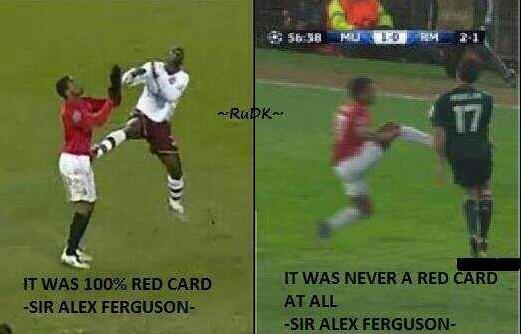
ImageCloser examination of the incident in focus this time reveals a worrying lack of consistency in Ferguson’s emotional reactions over remarkably comparable incidents.  Nani’s liver-high tackle was described dogmatically as “definitely not a red card”, paving the way for Man Utd claims of ill-treatment and bias.  A virtually identical tackle some time before, by Arsenal’s Eboue on Ferguson’s own player Evra, was also punished by a red card, but that one drew praise from the choleric Scot, who stated that the decision was “100% correct”.  This apparent self-contradiction is nothing new in the world of Alex Ferguson, or indeed in the wider manifestations of the club who like to brand themselves “The Greatest in the World”.

At the end of the Real Madrid match, enraged home defender Rio Ferdinand saw fit to get up close and personal with the referee who had dared dismiss Nani, sarcastically applauding him at point-blank range.   This is a widely-recognised form of dissent, and would normally merit a yellow card.  The referee did nothing, and UEFA have since confirmed that no action will be taken against Ferdinand.  It would be tempting to ask what sort of message this sends out to aspiring young players, if the answer were not so glaringly obvious.  That message is, as ever:  Man Utd can basically do just as they like, the game’s ruling authorities being so much in thrall to the club’s global profile – and the markets dependent upon its prosperity – that they will often turn a Nelsonian blind eye to such flouting of the rules, in the fond hope that nobody will notice when other clubs are dealt with more severely for like offences.

It has been said, with some justification, that one of the more hackneyed clichés in today’s game is the regular statement from the Football Association along the lines of “We have looked into (insert name of misdemeanour perpetrated by the Man Utd club or employee here), and can confirm that no further action will be taken.”

This sort of thing has been going on for many years, and while most clubs might shy away from such regular media attention of a not entirely positive nature, Man Utd as an entity appear to subscribe to the old maxim that there’s simply no such thing as bad publicity.  They have displayed a talent for remaining newsworthy, certainly on the back pages and not infrequently on the front as well, more or less continually, and dating back to well before their current era of success.  The incidents are many, and mostly quite unsavoury – Rooney elbowing a Wigan player and getting off scot-free, dodgy penalties too many to number, the legendary difficulty of seeing a penalty awarded against them and so on and so forth – and yet the default press position remains that the club are pre-eminent in the game for reasons of skill, charisma and courage, an apparent myth lapped up eagerly by the global fan-base, most of whom have never seen the team play in the flesh.

We hear far too much also of Ferguson’s so-called “mind-games”, a phenomenon particularly beloved of the media in this country, but one which appears to consist largely of an elderly gentleman having great difficulty sticking to the path of veracity at those press-conferences he deigns to attend.  Madrid manager Jose Mourinho is one who prospers in these psychological duels – in Ferguson’s petulant absence after the game last Tuesday, he stated that “the better team lost”, and walked off, content at having fanned the flames of the Man Utd manager’s fury.

It seems though that UEFA are after all to look into Ferguson’s failure to turn up for the press after this latest controversial occasion.  Presumably they will investigate fully, and a technical charge of “Sulking” might just possibly ensue.  But it would be unwise to place too much money on such an outcome; it may well be that we’ll yet again hear those old, familiar words “no further action will be taken”.

Memory Match No. 3: Leeds United 3, Man U 1. 24.12.1995

1995-96 was the last full season of Sergeant Wilko’s eventful reign at Elland Road. His influence over the club was crumbling amid rumours of money problems, takeovers and dressing-room discontent, a tale that would doubtless strike a chord with Messrs. Grayson and Warnock of more recent vintage. This was a season that had started off with a flurry of Tony Yeboah thunderbolts and some impressive results and performances which appeared to promise much. Sadly though, it would peter out in a shocking late-season run following a League Cup Final humiliation at Wembley, courtesy of Aston Villa. Howard Wilkinson was a dead man walking from that time on.

Worrying signs of defensive frailty and general ineptitude had been all too obvious just the previous week at Hillsborough. United had succumbed spinelessly to a 6-2 defeat at the hands of an unremarkable Sheffield Wednesday side and – all bravado aside – there wasn’t much optimism in the hearts of the faithful as this fixture against the arch-enemy loomed.

It was certainly a different Christmas Eve for me. I hadn’t exactly led a sheltered life up to that point, but this was the first time – and the last, to date – I’d ever risen the day before Christmas to bacon sandwiches at 6 am, closely followed by numerous Budweisers with the Sunday papers in a fan-friendly pub, as we waited for our “Scum Match Special” mini-bus. The queasy feeling before any match against “Them” was therefore multiplied by unaccustomed early-morning grease and alcohol, and I was feeling several shades of not-too-good as we set off for Elland Road. It was an 11:30 kick-off, live on Sky, and it promised either to make or break the whole of Christmas for us fans, and for our hopeful families.

The situation between the Uniteds of Leeds and Salford is one of a legendary mutual animosity, even at the best of times. Let’s not mince words here, the two sets of fans hate loathe and detest each other, and open warfare is the norm. Revisionist football pundits would have us believe that this is strictly a one-way affair, but you only have to tune into one of Sky’s glitzy live TV love-ins for a Man U match, and whoever they are playing, our Home-Counties friends are in full voice with their “We all hate Leeds scum”. Even Alex Ferguson, the Red Devils’ not-altogether-likeable manager, makes no bones about it; some of his more coherent sound bites feature his opinion that Elland Road is “the most intimidating arena in Europe”. He’s also stated that going to Liverpool is nowhere near as bad as going to Leeds; clearly, he’s never been for a late-night pint in Old Swan or Dodge City.

So, Yuletide or not, the usual poisonous atmosphere was in evidence as the two teams walked out before a 39801 crowd that overcast morning. Just as Leeds were smarting from their Hillsborough debacle, so Man U were struggling to emerge from a poor run, winless for a month and dispatched by Liverpool the previous week. This seasonal fixture was a chance of redemption for both sides.
Image

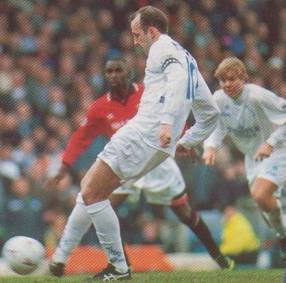
Macca slots the penalty home

By kick-off time, I was starting to feel properly ill, and in dire need of a pick-me-up. This arrived in a most unlikely form after a mere five minutes, when a Leeds corner swung over from the right. Richard Jobson rose on the edge of the area to head towards goal, where David Wetherall, lethal against Man U in the past, was challenging for a decisive touch. But that touch came instead from the upraised, red-sleeved arm of Nicky Butt – and referee Dermot Gallagher’s whistle sounded for a penalty.

Peering from the Kop at the other end of the ground, through an alcoholic fug, I could hardly believe my eyes. Leeds just didn’t get penalties against “Them”. It would happen the other way around alright, too often, and even from three yards outside the area but this was unprecedented, since our Title-winning year anyway. Steve Bruce evidently thought it was just too much to bear, and screamed his violent protests into Gallagher’s face, having to be restrained by Gary MacAllister, who appeared to be trying to explain the rules to the furious defender. The guilty look on Butt’s face, though, spoke volumes. MacAllister placed the ball on the spot, and sent it sweetly into the top right corner for 1-0, giving Peter Schmeichel not even the ghost of a chance. The celebrations were raucous and deafening as the Elland Road cauldron exploded with joy – and inside my skull, the trip-hammer of a beer-fuelled headache pounded away anew, utterly failing though to banish my smile of delight.

Leeds had the bit between their teeth now, and Brian Deane was suddenly clear for an instant outside the right corner of the Man U penalty area, played in by a cute pass from Carlton Palmer. Schmeichel was out swiftly to smother the chance, but Deane managed to dink the ball over him, only for it to clip the crossbar and bounce away to safety. A two-goal lead at that stage would have felt unlikely yet deserved, as Leeds United had been on the front foot right from the off. Soon, though, a lesson was to be delivered about what happens when you miss chances against this lot.

The unlikely culprit as Leeds were pegged back was Gary Speed. Receiving the ball in the left-back position, he tried to beat Butt instead of clearing long, and was robbed of possession. Butt looked up, and placed a neat pass inside to Andy Cole, whose efficient first-time finish levelled the match. Suddenly, my headache was even worse, and I was starting to wonder about the fate of my breakfast too. Time for another reviving injection of optimism as Leeds surged forward, and Speed so nearly made up for his defensive error, playing a one-two with Tomas Brolin which gave him space to put in a right-foot shot that went narrowly wide.
Image

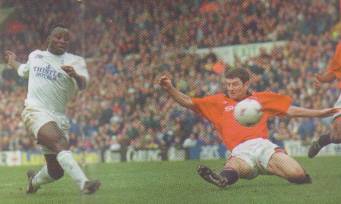
Yeboah beats Schmeichel for the second goal

The game had settled down by this time, and both sides were showing enough ambition to feel that they were in with a chance of victory. Leeds though had thrown off their Sheffield blues, and attacked with verve and purpose. Now, a defensive position was coolly handled by Gary Kelly, finding the time and space to launch a long clearance forward, where Brolin headed on. The ball was loose, and surely meat and drink for Man U’s international defender Paul Parker – but he inexplicably let it bounce over his foot. Yeboah pounced on it like a hound on a rat, and he was away, surging towards goal with ex-Leeds defender Denis Irwin backing off. Yeboah in this mood was usually irresistible, and sure enough none of Irwin’s careful jockeying could prevent him from finding that vital half-yard of space. The gap appeared, Schmeichel came out to block, and Yeboah clipped the ball sumptuously just out of the Danish ‘keeper’s reach, up and over to nestle in the far corner of the South Stand net.

Again, that explosion of noise and joy, again my fragile system was assailed by the rough-and-tumble of riotous celebration. 2-1 up against the team we loved to hate; the cockneys at the far end were suddenly silent and morose. “You’re not singing anymore!” we blasted at them, and indeed, little would be heard from the away fans for the rest of the game.
Image

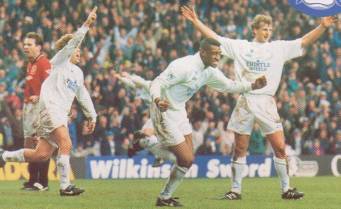
Brian Deane makes it 3

The second half was another tale of give and take, both sides able to cause trouble up front, but both seemingly capable of dealing with all that was thrown at them. The onus was on Man U to retrieve a losing situation, but Leeds were rarely in great trouble, and as the game entered its final quarter there was unprecedented optimism that we could close this one out, and enter Christmas on a real high. Leeds weren’t simply sitting back and absorbing pressure – and the maxim of attack being the best form of defence was to serve them well. On 73 minutes, Jobson made a foray down the left, and was fouled by Cole chasing back. The resulting free-kick was played to MacAllister in space in the middle of the park, and he swiftly moved it out to the right wing. Brolin picked up possession, and then slipped the ball to the overlapping Palmer, who surged into the box, and then turned past Irwin to set up Brolin again on the edge of the area. The much-maligned Swede, making the contribution I best remember him for, chipped the ball sweetly first-time, standing it up just around the penalty spot, where Deane’s exemplary movement had won him the space to rise and plant a firm header past a helpless Schmeichel into the net. 3-1 and finis.

After the game, and before the Yuletide celebrations could begin in earnest, other traditions had to be observed. Ferguson, naturally, had to moan about the penalty. “It was a very surprising decision, given in circumstances that were beyond me.” whinged the Purple-nosed One, in evident ignorance of the deliberate handball provisions – but perhaps aiming to justify Bruce’s undignified and almost psychotic protest at the time. And the massed ranks of the Kop Choir had to regale the departing Man U fans with victory taunts as they sulked away, silent and crestfallen, headed for all points south.

I can’t remember the journey home, or even how spectacularly ill I was when I got there, although I’m told I was the picture of ecstatic yet grossly hung-over ebullience. I just know it was my happiest Christmas Eve ever, ensuring a deliriously festive spirit for the whole holiday, much to the delight of my long-suffering wife and two-year-old daughter.

Merry Christmas, everybody! And God bless us, every one. Except Them, from There.

Next: Memory Match No. 4: Leeds United 4, Derby County 3. 1997-98 included a purple patch for Leeds United, and a series of “comeback wins”. Perhaps the best was this recovery from 3-0 down at Elland Road against the Rams.