West Ham Farewell Party Confirms the Love For Elland Road   –   by Rob Atkinson

Elland Road

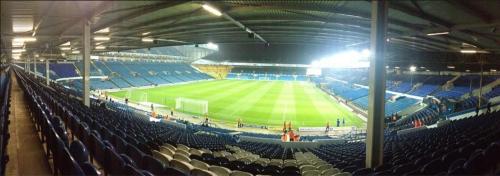
Elland Road, THE place of worship for thousands

Just nine days short of 480 years since another Boleyn met her end, on a Tower Green scaffold one sad Tudor morning, the curtain finally fell on West Ham United’s Boleyn Ground last night. It was the climax of 112 years of East End football history, fittingly topped off with a thrilling late victory and then the obligatory lasers and fireworks – spectacular high jinks, warming the cockles before the cold reality of the bulldozers moving in to do their grim work. 

Poor little Queen Anne was snuffed out by a French swordsman imported specially for the occasion by her kindly husband King Henry VIII. One swing of that fine blade left la Boleyn shorter by a head – and it was deadly twin thrusts from another Frenchman that could have cut short the farewell celebrations at the Boleyn Ground. West Ham had taken an early lead, but two goals from French prodigy Martial threatened rudely to poop the Hammers’ party. Fortunately, not least for this hardly unbiased viewer, the Irons roared back with two late goals to secure victory and put the Champions League hopes of Manchester’s finest back in their own hands. What a game, what a night. But then, chillingly, comes the bleak reality of the following day.

Watching such a thrilling match and then such an emotional farewell event had me wondering how those Hammers fans were feeling as the night and the occasion went by. There must surely have been a slightly unreal air about the place. Is this really the last time? Is this familiar old place really going to be torn down pitilessly, along with all the memories of good times and bad? Those questions must inevitably have gone through thousands of baffled, barely believing cockney minds. 

I have my own recollections of the Boleyn Ground – or Upton Park, as it was also known. Only a few, but marked each time by a Leeds United win, which obviously makes for good memories. And enough of those memories to make the place quite familiar to me. So even I can hardly credit the fact that, so soon, it will all be gone. But if I had to guess, based on my own forty-odd years of football fandom, just how those West Ham fans were feeling last night, I’d wager there was a lot of sadness and a sea of tears after the jubilation of victory, as the loss of a beloved place of worship started to sink in. And, I ask you, how on earth must they be feeling this morning?

It’s a bit hard to put myself in their shoes. The nearest comparison I can make is that last occasion, before the suits brought in the seats, standing on the Kop terraces against the Wendies. That was emotional enough. I literally can hardly imagine how I would feel if Elland Road itself – my second and spiritual home since 1975 – was condemned to be rased to the ground. Words would not be able to express the awful emptiness I would feel, the nightmare sensation of being cast out of my comfort zone, never to return. It came close enough – too close for comfort – to actually happening, with a firm proposal to relocate put to the vote in the 90s. For me, it didn’t really hit home or seem real at that time. I truly know that now.

I know it, because of what I saw in the coverage of the Boleyn’s last game. Because it’s a stadium I’m familiar with, I was suddenly forced to contemplate the same grisly fate befalling Elland Road. It’s a simply horrible thought. It certainly gave me nightmares and, this morning, I really feel for those displaced, dispossessed Hammers fans. 

Some will point to the grandeur of their new surroundings at the Olympic Stadium. Well, whatever floats your boat. And there’s the small matter of 52,000 season tickets sold already ahead of the next campaign. The Hammers are moving up to a different level, it’s a whole new ball game now. So it may well be. But is it worth it? Well, you could rebuild the Bernebeu or the Camp Nou in Roundhay Park and, for me, the answer would still be no.

It’s a bit different for us. We’ve been the best, on more than one occasion, and we’ve sustained that excellence at a fortress called Elland Road. So much of what Leeds United have achieved is part of the concrete, the steel, even the hallowed turf of that venerable old stadium. Maybe it would have been harder for us than it’s turning out to be for those Hammers who said “goodbye” last night. But honestly, I doubt it. I think it’s going to be very hard indeed on those fans, once the dust has settled. 

All I can say for myself is that last night reinforced for me the emotional pull of Elland Road, the fundamental attachment I so strongly feel for the place. I’m quite certain that the same is true for thousands of other Leeds fans. Perhaps it takes being a spectator at an event like last night to really bring home what being at home is actually all about. And what losing that home would heart-breakingly mean.

Hammers fans still have their memories; they’ll still be able to replay the mind’s eye video of countless great matches and famous victories. But the place where all those things happened will soon be dust, and there’s an awful finality to that. When the place is gone, the memories will be harder to put into their proper setting. Even ghosts need a place to float around in.

Every time I see Elland Road, a thousand precious memories become real again for me – some pretty bad ones too, make no mistake. But they’re all part of that fund of recollection any football fan builds up, and they’re inextricably linked with that loveable ramshackle old stadium, with its incongruously shiny newer bits. Even they’ve been with us over a quarter of the club’s lifetime. I love every inch of the place, down to the last rivet and the smallest blade of grass. Part of my life would be gone, if I had to go through what the Hammers fans went through last night. What they’re only starting to get used to this morning. 

Congratulations to West Ham, on a fine victory and a fitting way to mark the end of an era. I’m really pleased for you – and yet I’m sorry for you too. God knows I’d love the experience again, of beating that lot and reducing them to misery. I’ve always loved that. But – at the cost of a large chunk of my soul? I think not. I really think not. 

As West Ham Say Goodbye to Upton Park, Memories of a Leeds Fan – by Rob Atkinson

wright hammer

Two Wrongs Don’t Make a Happy Wright

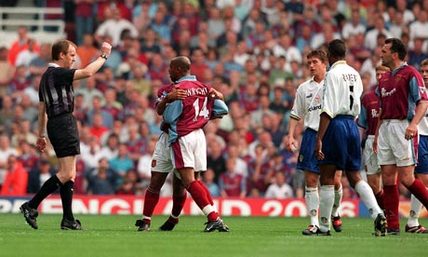
Tonight we bid a sad farewell to Upton Park, or the Boleyn Ground, long-time home of Olympic Stadium-bound West Ham United. The ‘Ammers, as they’re known locally, have usually been obliging victims for Leeds United teams of most eras, and were particularly notable as lenders of a helping hand towards the end of our title run-in of 1992, when they defeated Man U in a game that turned Alex Ferguson the deepest shade of exasperated purple I’ve ever seen. So it’s fitting, as another proper London football ground bites the dust, that I should write a little about the ‘Appy ‘Ammers; some of my fondest memories are of victories there, particularly this MayDay romp in 1999.

It was an encounter, played out in front of a packed Boleyn Ground crowd of 25997, that found Leeds United in a rich run of form; ten games unbeaten since an early February reverse to Newcastle at Elland Road, after which they had reeled off seven consecutive league victories followed by three draws on the trot. The Whites’ determination to get back to winning ways after those six dropped points was exemplified by the fastest possible start.  A mere twenty seconds had ticked by when the ball nestled in the West Ham net, put there emphatically by the ebullient Jimmy Floyd Hasselbaink who ran at a retreating Neil Ruddock before finishing neatly with a left-foot shot past Shaka Hislop. And then the game went ever so slightly mad.

Jimmy’s goal apart, the first quarter of an hour had seen both sides engaging in tackles which tended on the thuggish side of enthusiastic. West Ham’s Eyal Berkovic was a victim early on, and Lee Bowyer was on the end of a clattering as the home side sought revenge. Then Ian Wright, no stranger to controversy and the disciplinary attentions of referees, led with his elbow when challenging for a high ball, and copped for a yellow card that looked a lot more justified than the second yellow he got after only 15 minutes, following an altercation with Ian Harte, Harte, Harte. So Wright was on his way back to the stand after a mere quarter of an hour, loudly protesting the injustice of the case and hell-bent, as it turned out, on venting his frustrations on the décor in the ref’s room. 

For the next half-hour, leading up to the interval, Leeds proceeded to make a one man advantage look anything but as West Ham pressed them back, causing panic in the away defence as the promptings of Berkovic and Paolo di Canio created some decent chances to possibly level the game. Leeds had managed to be distinctly the poorer side in that opening 45 minutes, and yet – as if to prove once again what a daft game football can be – they hit West Ham with a sucker punch in first half stoppage time. David Batty appeared to have committed a foul in midfield which might well have justified a booking had the ref not totally ignored it and waved for play to continue. Harry Kewell duly obliged, picking the ball up wide on the left and mesmerising the overstretched Hammers defence before cutting the ball back from the by-line for Alan Smith to convert gleefully.

2-0 then at half time and – for once – it had pretty much all gone Leeds’ way. We had been outplayed for most of the game so far, but were somehow two goals and one man to the good; courtesy, it has to be said, of some not exactly even-handed refereeing.

The second half began much as most of the first had been spent, with Leeds on the back foot and defending precariously. Straight away, the dangerous Berkovic bamboozled Jonathan Woodgate, turning him inside out before supplying di Canio with the perfect chance to pull a goal back. 2-1 to the visitors then, but the balance of the play had been with West Ham, and maybe now the momentum was theirs too. None of us could feel over-confident despite a man and a goal advantage, because all of us could recall Leeds blowing such enviable positions many times in the past.

This time, though – for once – we were not to be let down. A rare defensive slip just after the hour from the otherwise excellent Marc-Vivien Foé saw Hasselbaink sprint clear to round Hislop, who then brought him down. Penalty to Leeds and, despite the presence of defensive cover, Hislop was sent off. It was a slightly unfortunate second red card for West Ham, who felt compelled to replace Berkovic with reserve keeper Craig Forrest as the calamities mounted for the home team. Forrest’s first act was to pick Harte’s penalty out of the back of the net, and Leeds were 3-1 up and cruising against 9 men. Foé, we will remember, sadly died four years later at the tragically young age of 28, from an unsuspected heart condition whilst representing his country in the FIFA Confederations Cup.

Now at last Leeds started to dominate as a two-man advantage would suggest they should. The best goal of the game arrived on 78 minutes, Bowyer hitting an unstoppable right-footed shot from twenty-five yards, which curved slightly as it found the corner of Forrest’s net.  Just a minute later, Alf-Inge Haaland sprinted on to a Hasselbaink pass into a massive amount of space on the right hand side. Unchallenged, he was able to advance into the penalty area and beat Forrest with an accurate shot just inside the far post.

The eight outfield players in claret and blue were clearly finding the pace too hot, and suddenly there was room aplenty all over the pitch for Leeds to exploit, and exploit it they did.  Aided by the fact that the Hammers – to their eternal credit – were still trying to attack Leeds in spite of their depleted resources, Leeds were granted the licence to ping the ball about, always able to find a man or two in space, making the tired home players work overtime to chase possession as the Upton Park faithful bayed their hate at the referee. Truth to tell, we could easily empathise with the ‘Arrassed ‘Ammers; far too many times down the years we’d been in their shoes, watching impotently enraged as some git of a ref casually destroyed our afternoon. It was somewhat bizarre to watch the situation unfold in reverse – but what the hell. We made hay while the sun was shining, and happily the team was doing the same.

The game had long been over as a contest and, at 5-1 up with no credible opposition to deal with, Leeds seemed intent solely on playing out time. Smith still managed to miss a passable chance to make it 6-1 and Clyde Wijnhard contrived to get himself booked, eliciting maliciously ironic chants of “Who’s the bastard in the black” from the jubilant Leeds fans, who displayed an ironic gallows humour not altogether appreciated by the home supporters. Finally, hothead Irons defender Steve Lomas allowed his mounting frustration to get the better of him, launching an agricultural challenge in the direction of Harte and duly collecting his marching orders to reduce the hapless, helpless Hammers to eight at the death.

It had been a strange game, a romp for the Whites on the face of it – judging by the lop-sided score line anyway. But it had never been quite like that; not that our awareness of having been outplayed for long stretches diluted our joy one tiny bit. It’s a sad fact that 5-1 away wins do not come along very often, and we enjoyed this one to the full. We enjoyed it for the whole of the slightly perilous walk back to the tube station, and we were still enjoying it when we beheld the distinctly pissed-off figure of Leslie Grantham heading down the stairway to the platform where we were celebrating noisily. Leslie Grantham, soap-opera legend as Eastenders arch-villain Dirty Den; Leslie Grantham who had done serious time for killing a German taxi-driver; Leslie Grantham, Hammers fanatic, who – despite being accompanied by his two young boys – bore a grim aspect which looked rather as if he wouldn’t mind adding a couple of Leeds fans to that record.

Tactful and understanding to the last of private grief, we wisely kept our distance and refrained from seeking autographs. It had been a memorably bizarre day for Leeds United and an equally happy summer evening awaited us in the sinful fleshpots of London, crap, watery cockney beer and semi-hostile natives notwithstanding.

Dirty Den 1, Dirty Leeds 5.

Massimo Cellino Looking for Ideal Man as Leeds United Manager   –   by Rob Atkinson


Further to the forthcoming callous betrayal of the incumbent Leeds United manager, a vacancy for Head Coach, or whatever, is about to arise at Elland Road. We will require a biddable yes-man to take responsibility for the failure of a morale-sapped collection of second-tier footballers. This is a vital position; somebody very special is needed to massage the President‘s ego.

You must have a proven track record of obsequious fawning to superiors and to their families. You should also have a concrete record of professional achievement in football, yet somehow also be lacking in pride, self-esteem and any ambition to work on your own initiative. You may be required to clean out dressing rooms and to testify on the club’s behalf when inevitable discrimination cases are brought by discarded former employees. A casual relationship with the truth would be a distinct advantage.

Media savvy, you will hold of first importance the necessity of using the phrase “the President is giving me his full backing”, at every opportunity. You may also use other forms of praise for the President; you may not IN ANY CIRCUMSTANCES seek to be more popular with the supporters than the President. Use of what is known as “the Leeds Salute” is also BANNED in any circumstances. After any victory, you will acknowledge the role and inestimable contribution of The President. After draws or defeats, you will make grateful references to the President‘s benign patience, and you will explain the mistakes you have made and how, with the President‘s guidance, you intend to avoid such mistakes in future. You will appreciate the importance of not “bigging yourself up” – there’s only one star in this show, and it ain’t you*.

You will have vital input into player recruitment. You will outline to the President the type, character and identity of players you feel the club should acquire, with full reasons. You will then undertake to get the best out of the quite different players the club actually does acquire, even though these players will almost certainly not be ones you would identify as good enough. The names you have identified will be for the sole use of the President, who, when things go wrong, will point to them as the players he really wanted to sign.

You will also have vital input into team selection. You shall personally write out the team sheet in the presence of the President, as per his dictation. Shorthand skills are not necessary. The President will speak slowly and clearly, for the benefit of those who can’t understand plain Italian.

Applications should be addressed, for reasons of security, to “il Duce, Elland Road”. Your remuneration package shall relate directly to your age, experience and subservient attitude. Length of contract shall be decided one week prior to your dismissal by mutual agreement with the President, whose word is law; you shall be debarred from talking to the press for a period of (to be agreed unilaterally).

This is a golden opportunity for the right man to enjoy a spell struggling against impossible odds, in the full glare of the media spotlight, before disappearing into obscurity with a shredded reputation. If you think that YOU could be this man, you’re probably stupid and lacking in any professional qualities or indeed the common sense to realise you’ll be just another patsy; The President would warmly welcome your application.

*It’s the President.

LEEDS UNITED AFC IS AN EQUAL OPPORTUNITIES EMPLOYER. NO, REALLY. WHO’S THAT LAUGHING AT THE BACK THERE? HAVE THAT MAN REMOVED IMMEDIATELY.

Give Evans the Chance to Lead From the Front and Build From the Back   –   by Rob Atkinson


Steve Evans has served his big-time apprenticeship at Leeds United – and he’s shown beyond reasonable doubt that he deserves a proper crack at the biggest job outside the Premier League. As every United fan knows, it’s a bigger job, and a hotter seat, than most in the top division too. But, while his physical frame has shrunk in size during his time at Elland Road, Evans has grown into the job, displaying determination, commitment and more dignity than is to be found elsewhere in the club. To let him go now would be the act of a fool. 

Evans has been around Leeds long enough to know the place, strengths, weaknesses and all. He has been in football long enough, and has earned success enough, to come up with the right prescription for next season – given the chance. To go back to square one, with a new coaching staff, is surely not what is now required.

The nature of the building job for a new campaign must be – initially – the provision of solid foundations for a team that has forgotten how to keep clean sheets. Building from the back, prioritising solid and reliable defence, is the long-standing recipe for football success. Once established, a mean and uncompromising defence, with cover by some grit and industry in midfield, allows for licence to create and accumulate further forward. Evans, like many a coach, knows this. But Evans is in a uniquely advantageous position when it comes to knowing how to apply such knowledge to the situation that pertains at Elland Road.

The man himself seems suddenly pessimistic about his chances of carrying on in a job he relishes. Tears will be shed, he tells us, if time is called on his United career. Indeed, anyone with the interests of United at heart might feel slightly moist about the optics if Leeds once more upset their own applecart. What then lies ahead but more uncertainty, more blind stabs in the dark of the budget end of the transfer market? 

Leeds have the chance of starting next season’s business in an unaccustomed atmosphere of stability. They must seize that chance. Evans knows the club and he knows the way forward. He’s done better than any other manager in the club’s recent, chequered history. He backs himself to succeed, knowing the price of failure. 

Now, Leeds United must back him too. 

Crystal Palace Shouldn’t Have to Face Man Utd’s ‘Spanish Archer’ at Wembley   –   by Rob Atkinson

Fellaini

Fellaini – dangerous and premeditated

Louis van Gaal, the current manager of Manchester United, is a confusing figure. Frequently disarming and able to display a self-deprecating humour, he’s occasionally also abrasive and blinkered. Sometimes, he’s just downright weird, a facet of his personality that came to the fore after the most recent act of thuggery from one of his least admirable players, a certain Monsieur Fellaini.

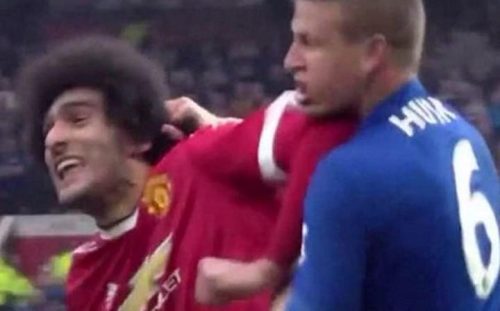
The occasion was the potential title-decider when Champions-elect Leicester City came to Old Trafford needing three points to clinch a miraculous Premier League crown. It was a compelling game, with Leicester going behind early and then showing their character to claw their way back and claim a valuable point towards eventual success. But all was not sweetness and light, as might almost be expected in such a tense tussle. One of the penalty area challenges between Leicester’s Robert Huth and Marouane Fellaini of Man Utd turned decidedly nasty and could easily have seen the dismissal of both, if the referee had only seen it. There was grappling, there was pushing and shoving, there was even the seizing and pulling of part of Fellaini’s impressive coiffure. And, sad to say, there was yet another example of the old “Spanish Archer” (el Bow) from serial offender Fellaini. It’s all there in not-so-glorious slow motion: a malicious, premeditated extension of Fellaini’s left arm in front of him, for it to be drawn back viciously into the head/neck area of the opponent behind him.

This is where van Gaal becomes rather difficult to defend. In interviews afterwards, he leant back further and more perilously than a limbo dancer in futile efforts to justify his player’s reprehensible action. It should have been a penalty for Huth’s silly hair-pulling, he said (No, it shouldn’t). Fellaini’s actions were justifiable on the grounds of provocation, he said (No, they weren’t). Hair-pulling was, he claimed, the sort of kinky perversion that belongs in “sex masochism” (Speechless). Louis van Gaal even playfully tugged at a reporter’s hair and asked him how he liked it. That the reporter then refrained from elbowing van Gaal in the throat rather detracted from the Manchester United manager’s attempt to justify, on the grounds of reasonableness and inevitability, Fellaini’s assault on Huth.

A careful study of the incident – something the F.A. must certainly have done, many times and painstakingly – reveals a couple of interesting points. Firstly, Fellaini’s elbowing action had started well before Huth made contact with the Man Utd player’s hairdo. The arm was extended forward and was well on its premeditated way back to catch Huth under his jawbone – before hand touched hair. That disposes of the penalty clause; Fellaini was the first offender. Secondly, Fellaini swiped backwards not once, but twice. The second was a weakish slap, catching Huth somewhere around the temple. That was the response to the hair-pulling. But the first elbowing action stood alone, and it was a dangerous act with a clear intent to cause damage, simply because an opponent had the temerity to challenge him closely, that could easily have been serious. For that alone, Fellaini deserves the most serious of punishment.

Having dealt with van Gaal’s attempts to defend his player, we should move on to consider Fellaini’s previous. And there’s plenty of it; you only have to listen to some of the Belgian’s old opponents and even his former teammates. Fellaini, we hear, does this sort of thing most games. Several examples have been caught by TV cameras, most notably at Anfield in a Europa League cup tie against Liverpool. Fellaini was bang to rights there, just as he was against Leicester – but he got away with the Anfield elbow. This time, he’s got a three game league ban – but is it enough?

Ladies and gentlemen of the jury, I submit that it is not. The F.A. in another case, this one arising out of the Chelsea v Spurs match on Monday, have made it clear that some cases deserve more severe punishment. It seems likely that Tottenham’s Mousa Dembele will face a six game ban for his blatant eye-gouging offence. Now that’s nasty stuff – but is it really that much more serious than a back-flung elbow that could easily crush an opponent’s tracheal cartilage and leave him literally breathless as a result? The two cases are comparable, the two punishments should, therefore, be appropriately similar.
Crystal Palace will face Manchester United – including Fellaini, in all likelihood – in what is still a showpiece occasion, the F.A. Cup Final at Wembley on the 21st May. Palace should not have to face this serial offender, this reckless distributor of flying elbows, this accident waiting to happen. If Dembele can be taken out of action for six matches due to the disgusting nature of his offence, then so should Fellaini, for an assault no less culpable, no less disgusting, no less dangerous. And Fellaini has demonstrated that, left unchecked, he will simply continue this casual close-contact variety of GBH. He has shown no sign of reforming his ways and, while the F.A. treat him with kid gloves and his manager bleats in his defence, he will simply carry on carrying on – alarmingly.

If this season’s F.A. Cup Final spectacle is besmirched by the spectacle of some hapless player left sprawling with a crushed adam’s apple, a broken jaw, a smashed nose – or worse – then it is fair odds that one M. Fellaini will be the name on the charge sheet. But he will not be alone in the dock – for if the worst does come to the worst at Wembley, then the faint hearts and soft-sawder merchants at the F.A. will be just as guilty as a Belgian who can neither keep his temper nor control his aggression.

For all of those reasons, as well as consideration for the Crystal Palace players – whose big Cup Final day should not be sullied by common assault – Marouane Fellaini should face a good long ban that will see him out of action until the early part of the next League campaign. Most assuredly, he should not be playing at Wembley – neither in the F.A Cup Final nor, should the case arise, in the Community Shield. If he does, it sends out a wrong and dangerous message, to teammates, to opponents, to others who might be disposed to act thuggishly and – not least – to the errant and foolish Fellaini himself.

Leicester City, the Example That Puts Cellino’s Leeds Utd to Shame   –   by Rob Atkinson

Today or tomorrow, this week or next week, sometime soon, anyway – Leicester City will become Champions of England. Premier League Title winners and Champions League top seeds. Read, mark and inwardly digest. It could have been, perhaps should have been Leeds United.

Leicester’s fantastic achievement is the explosion of the theory of an “Elite Cartel”. They’ve simply ripped up the rule book and imposed themselves irresistibly on a League that regarded them merely as cannon fodder. What the Foxes are doing self-evidently could be done by any club of reasonable size and support, properly run and adequately funded. There is no better proof that something can be done, than going out there and doing it.

All of which begs the question: why have Leeds United so shamefully under-achieved in the six years since escaping League One? The Whites’ track record in that time pales in comparison, not only to champions-elect Leicester, but also Southampton and Swansea City (who, as I write, are taking Liverpool to the cleaners). This trinity of clubs, reborn and reinfused with competitive vigour, are all considerably smaller than Leeds and lack anything like a comparable tradition or pedigree. All of them were fellow strugglers along with us in our third-tier lowest ebb. All are living proof of United’s utter and culpable failure since 2010. 

That’s the significant year, really. Prior to that, we’d been almost a decade in intensive care, a chronically ill football club doing its best to regain some sort of health. That was achieved, despite the dodgiest of ownerships – and the FA Cup victory over Man U, together with a scrambled promotion back to the second level, could and should have created a platform from which to build a bright future. That it didn’t is our tragedy, but there are no excuses. Again, look at where three smaller clubs are now, clubs that shared our League One doldrums with us. Their example puts Leeds United to shame.

Whatever the Cellino apologists might say – and they’re as stubborn a bunch as I’ve ever come across outside of a field of donkeys – it’s very difficult, surely, for them to argue he’s been any sort of success when you see what’s been achievable elsewhere, and at clubs with far less potential. Perhaps – just perhaps – making and breaking promises, serially hiring and firing managers, interfering in team affairs, insulting the support base, treating staff abominably with sexist attitudes and a desire to humiliate professional football people by making them clean up around the place – perhaps all of this isn’t the way to carry on after all? It’s just a thought.

Maybe this is at the root of why we’re where we currently are while our former League One rivals are comfortably established in the Premier League – with one of them poised to become Champions. It could so easily have been us – and that’s not just glib wishful thinking. Hard work, a professional setup, enlightened ownership – all that old-fashioned stuff – they’re why Leicester are now on the edge of a miracle of historic proportions. Instead of which, the day after we lost at home to a team already relegated from the Championship, we have to look upwards and crane our necks to see the success of others.

Good luck to Leicester City, I’m genuinely pleased for them. I have my memories of 24 years ago, and I know – as so many of us will – exactly how those Foxes fans will be feeling right now. But I just can’t help wishing that it was us again; with the frustration kicking in hard when it’s so clear that it could – and perhaps should – have been.

For Liverpool FC, The 96, The Families and the Friends   –   by Rob Atkinson

Hillsborough

Hillsborough: Justice at Last

The bodies laid out on the hard wooden floor
Motionless all, side by side
Robbed of their lives and let down by the law
Give us justice, they silently cried

They came for the football, their heroes in red
Part of a jubilant tide
Who knew such a day could end up with them dead?
Give us justice, they silently cried

In loud expectation, with glory the goal
They’d sung and they’d shouted their pride
Now shrouded in silence, each newly-fled soul
Give us justice, they silently cried

Betrayed by their guardians, those officers high
While the hacks and the suits squirmed and lied
With family and friends left to ask how and why
Give us justice, they silently cried

Inquest proceedings, foul slurs in the press
The guilty with so much to hide
These innocent victims with naught to confess
Give us justice, they silently cried

And what of the mothers and dads left behind
The sisters and brothers beside
As months and years passed they were not left resigned
Give us justice! they angrily cried

Through decades of struggle, they kept up the fight
Their arguments oft undermined
Yet they never lost hope nor extinguished the light
Give us justice! they angrily cried

Pouring scorn on the tabloids, exposing the Sun
Sharing the Truth far and wide
Politicians and journos and chiefs on the run
Give us justice! they angrily cried

Banners and flags on the Kop all these years
Venting the fury inside
Pressing the point through the veil of their tears
Give us justice! they angrily cried

At last the truth spoken, the guilty revealed
The living and dead unified
In one voice as they ask for their scars to be healed
Give us justice! they angrily cried

Seven and twenty the years that have passed
A lifetime of justice denied
The ones who were lost can be peaceful at last
And the families, who stood by their side.

RIP – You’ll Never Walk Alone

Rob Atkinson

Spurs as Champions? It Would Have Seemed Silly   –   by Rob Atkinson

Spuds

Spurs – still no Title pedigree

If Tottenham Hotspur finish this season in a Champions League qualification place and – more importantly, in the eyes of many of their fans – above loathed North London rivals Arsenal, then this season will be deemed by the vast majority of those fans to have been a resounding success. This, despite the fact that they will have failed to have taken their most realistic chance in over half a century to finish as Champions of England. This is why Spurs, despite their superficial glamour and appeal, cannot be regarded as a big club.
 
This might sound strange coming from a fan of 21st Century also-rans Leeds United. But, for all their recent woes and the chaos that characterises life at Elland Road under Bates, GFH and Cellino, Leeds remain a big club. The expectations are still there, the voracious hunger and imperious demand to be up there with the best. At some point, those demands will be met – because the expectations and desire of the fans are what, ultimately, define the size and potential of a football club. Leeds have all that – Tottenham simply don’t. A cursory scan of their Twitter feed, since Spurs capitulated against West Brom on Monday, is ample illustration of this. 

I was really expecting to find anger, dismay and deep, deep hurt among the Spurs Twitteratti, at the careless throwing away of a once in a lifetime chance. It wasn’t there. I thought too – equally erroneously – that there would be angst and an abiding sense of betrayal. I based this on an empathetic knowledge of how I or most other Leeds supporters would feel – how it would leave us bereft and fuming to see such a rare opportunity passed up. But then – we’re Leeds, and these people were merely Spurs. There’s a big difference.

Last time Leeds joined the big time, back in 1990 – and the time before that, in 1964 – the Whites wasted no time merely admiring their surroundings or being overawed by their new peers. They took a brief, almost scornful look around, allowed themselves the barest of minimum settling-in periods, won their opening fixture back at this new, rarefied level – and proceeded to dominate proceedings thenceforth. Don Revie‘s wonders went within a whisker of the double first time out, and were the best team in Europe within five years. Sergeant Wilko‘s Warriors were Champions inside twenty months. This is the mettle and appetite of a big club. There is no fear and mighty little respect in the staff and players. There is an abounding self-belief and naked ambition among the fans. So it was with Leeds United. So it will be again. 

There is none of this with Spurs. Despite the excellence of their squad, they lack the inner conviction and the aspirations of Champions. At its heart, the club is effete and decadent, content to play pretty football while perceived lesser mortals – the Leicester Citys of this world – scrap and fight, working hard, giving no quarter, exerting every fibre of their being in the pursuit of victory. In a game of fine margins, it is this muck and bullets approach that can close the quality gap and make the difference when the prizes are handed out. 

On the evidence of social media reaction since West Brom killed off their hopes, the Spurs fans are as much to blame as the soft centre of their club. It’ll be nice to finish second, they trill. We’d have snatched your hands off for the chance of finishing higher than Arsenal. We’ll be favourites next year, they croon, hopefully. But next year never comes – not when the real big boys, the Citys, the Arsenals, the Chelseas and the Liverpools, will be waking up from their one season slumber. 

Thinking back to the early nineties, when Leeds were the hungry new kids on the block – we hoped and craved for a chance to be the best again. Whether we really expected it to come along so soon is a moot point. But we were raucously demanding of it. And when that chance presented itself – especially at the expense of our most hated foes – there was no suggestion of “well, it’d be nice, but second wouldn’t be too bad either”. We’d have been gutted to the depths of our very souls, if our heroes in White hadn’t seized the day. It would have been impossible to express the wretchedness we would have felt. The Spurs fans this week, with their mealy-mouthed acceptance of failure and honeyed words of congratulations to conquerors Leicester, have betrayed their club and shown themselves, as well as Tottenham Hotspur, unworthy of being regarded as champion material. 

In the end, any league gets the champions it deserves and, barring last-gasp miracles or calamity, it’ll be no different this year. Spurs will have shown why they haven’t been The Best since 1961, when JFK was president, the Beatles were playing beery dives in Hamburg and I was only just seeing the light of day. Leicester, with their indomitable self-belief and determination to make the most of every opportunity under the brilliant guidance of one-time “Tinkerman” Claudio Ranieri, will thoroughly have deserved their Premier League Title. They will be Champions every bit as deserving, and more, than the Leeds United tyros of 1992. 

Leicester City, Champions of England. It has a ring of authenticity to it that’s been hard fought for and deeply merited. Whereas “Champions Spurs” – well, it just doesn’t sound right. It sounds instead like cheap fiction; and, as long as the club and the fans retain their current losers’ mindset, that’s just how it will remain. 

The Hillsborough Disaster Warnings That Weren’t Heeded – by Rob Atkinson

Hillsborough - an Anfield tribute

Hillsborough – an Anfield tribute

Incredibly, 27 years have flashed past already, since that awful spring day in 1989, when 96 football fans turned up to follow their team towards Wembley – and never came home again. I was one of a paltry 14,915 at Elland Road that day, watching Leeds United eke out a 1-0 home win over Brighton as Sgt. Wilko’s first half-season meandered to an uneventful close. When the news filtered through that there had been “trouble” in the semi-final between Liverpool and Nottingham Forest, the initial reaction was as predictable as it was wide of the mark: “the scousers are at it again.” Heysel was still fresh in the memory, English clubs were still banned from Europe – and nobody judges football fans quite like other football fans (or, at least, so we thought until the Sun got going). We were tolerably certain, as a bunch of Leeds supporters, that the Liverpool fans had caused more bother, and we glumly predicted another indiscriminate backlash that would envelop us all.

As we were on our way out of Elland Road, though, the full, awful impact started to hit home. There were deaths – people had actually died at an English football stadium – something that hadn’t happened on anything like this scale before. Apart from the Bradford fire – a very different disaster – the only comparable event in England had been the Burnden Park tragedy at Bolton, when 33 had lost their lives in a crush at a hopelessly inadequate ground with over 85,000 attending an FA Cup quarter final. That had been well over a generation before, in 1946. Surely, it couldn’t really be happening again, on an even greater scale, in the shiny bright late eighties?

But as we looked on in horror, the TV and radio news brought increasingly sombre statistics while the death toll steadily mounted – and later the sheer ghastliness of the event would be magnified as the tale of criminal incompetence and official negligence was revealed – and as the filthy end of the press, abetted by weaselling functionaries in Government and the Civil Service, jumped on the “blame the fans” bandwagon that other football supporters had vacated as soon as the scale and nature of the catastrophe became apparent.

If you were a Leeds United fan, a chill ran through you when you thought about what had happened; when you realised that this had, indeed, been a disaster waiting to happen. The Hillsborough Stadium was so oriented that the organising authorities found it easier, more convenient, to allocate stands to the fans of opposing semi-finalists based on where the bulk of those fans were travelling from. So, in 1989, Forest got the large Kop End, while the much larger Liverpool contingent were shovelled into the Leppings Lane End behind the opposite goal. It was the same the year before, when the same two teams contested the 1988 semi-final. And, similarly, in 1987, when Coventry of the Midlands faced Leeds United of the North, the greater Leeds numbers found themselves packed tight in Leppings Lane, while the smaller Coventry band enjoyed the wide open spaces on the Hillsborough Kop.

So two years prior to the Hillsborough Disaster, I and thousands of others were packed into the smaller Leppings Lane End on that April the 12th of 1987. The atmosphere was electric; it was United’s first FA Cup semi for ten years and Billy Bremner‘s men had been in terrific form as they challenged for a double of the Cup and promotion to the old Division One. We were jammed in like sardines on that terrace; looking up you could see fans climbing out of the back of the crowd, up over the wall and into the upper tier of the stand where space was more freely available.

Down on the packed terrace, it was swaying, singing fever pitch from before the kick-off right through to the heart-breaking climax of extra time. You weren’t an individual, you were part of a seething mass that moved as one, shouted and sang as one and breathed – when it could – as one. When Leeds scored their two goals, it was mayhem in there – you couldn’t move, you couldn’t breathe, you just bobbed about like a cork on stormy waters, battered by the ecstasy of the crowd, loving it and, at the same time, just a bit worried about where your next gulp of oxygen was coming from. Leeds took the lead early, David Rennie scoring down at the far end. That shattering celebration was topped when, having gone 2-1 behind, Leeds clawed it back right in front of us as Keith Edwards headed an equaliser and the United army exploded with joy. It was the single most jubilant and yet terrifying moment of my life to that point.

Later, after the match was over, as we trailed away despondently from the scene of an heroic defeat, there was time to reflect on what had been an afternoon of highs and lows, with the physical reaction of that epic few hours inside a pressure cooker swiftly setting in. With the benefit of twenty-twenty hindsight, it’s easy enough now to look back over twenty-nine years and think: “Yes, we were lucky.” Lucky that the incompetence threshold wasn’t passed that day when we were there. Lucky that enough of the terrace fans got into the upper tier to relieve the pressure ever so slightly – was that a factor?  So lucky that it wasn’t us, when it easily could have been. Lucky, ultimately, to be alive and kicking still. The warning signs were there – they just weren’t perceived by those of us – the fans – for whom it had just been another somewhat uncomfortable but thrilling spectator experience. That those signs weren’t recognised or heeded by the people responsible for public safety is a far more damning fact.

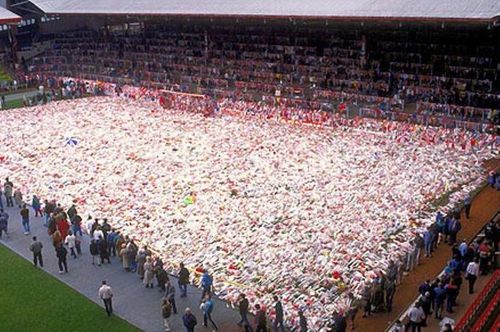
Poignantly enough, the luck we’d had that day wasn’t shared by 96 Liverpool supporters two years later. They set off happily, to support their heroes – and, tragically, they never returned. Twenty-seven years on, the wait for justice has been torturous for all concerned. The families and friends left behind, veterans of over a quarter of a century of grief and loss, have never given up their courageous fight, despite cover-ups and official brick walls, despite scurrilous press coverage which reached an obscene and disgusting low point with the Sun – that vanguard of the gutter press – and its sickening lies. 

Now, there is an inquest verdict at last. We have the official findings of unlawful killing and, surely there is finally justice for The 96. And indeed for all of the friends and family they left behind. Yet, even now, with the South Yorkshire Police Force unreservedly accepting the inquest findings, we still have the likes of Thatcher aide Bernard Ingham refusing to apologise for his own scandalous remarks in the wake of the disaster, now utterly discredited as he himself has been. There is no remorse or regret from Ingham, who stands as a symbol of official ignorance and deceit. All he is good for now, this bitter, bigoted old man, is sitting at home and growing his comedy eyebrows.

Twenty-seven years is far too long for anyone bereaved of their loved ones to wait – but justice is worth waiting for, if only so that the dead can sleep more peacefully and the living can have closure of a sort – and move on with the business of being alive. And – as a footnote – how appropriate it would now be if Liverpool FC could go on to win the Europa League after that thrilling victory over Borussia Dortmund – just for the families, the friends and those that were lost on that fateful day and in its aftermath..

There could be no finer or more fitting tribute to The 96, surely, than this long-awaited justice that has been served today – and the return of the Champions League football to Anfield.

Let it be.

How Will Cellino Try to Justify the Sacking of Steve Evans?   –   by Rob Atkinson

cellino-crotch

Cellino’s chopper seems to be ready to swing again

As our promised “beautiful season” drags its weary way to a mid-table close, amid a welter of unexpectedly good results, the burning issue now at hand is what we will be told when loco owner Massimo Cellino scratches that itch and sacks yet another manager.

The revolving door at Elland Road will surely also need replacing soon. It must be on its last legs after the unprecedented number of staff arrivals and departures over the last few years, as Cellino continues to feed his voracious ego. The only truly secure position at Leeds United appears to be that of Il Duce himself – and that’s only by the grace of the unusually tolerant football authorities. They have Cellino taped for what he is and yet, unaccountably, they fail to act. By his own admission, Cellino has been a dire failure at Leeds. Get rid of me if we’re not back in the Premier League by 2016, he trumpeted on arrival. There was also some stuff about repurchasing Elland Road. None of it has happened, of course – yet still Cellino is here, hiring and firing like there’s no tomorrow.

That process seems certain to continue in the near future; Steve Evans has been doing a miraculous job in circumstances that would be unbearable for less determined and self-assured men. But nevertheless, he is likely to go soon; the writing has been on the wall for a while now. Cellino’s modus operandi is a wearily familiar one: undermine and publicly rebuke your victim-in-waiting, tell him to keep quiet while you hog the headlines yourself, aim to stir up the negative feelings and prejudices of the gutter end of the United support. This campaign is in full swing against Evans, but there’s one niggling problem. The dratted man has done better in post than any of his predecessors since promotion-winner Simon Grayson. How inconvenient for Cellino is that?

How, indeed, will Cellino set about justifying the imminent betrayal of yet another solid football pro? It’s undeniable that Evans has made something of a silk purse out of what was definitely a sow’s ear when he arrived. Yes, he’s vocal at times, and has a tendency to proclaim his successes and his favoured managerial techniques. But are these really bad things? With the axe hovering above our heads as it has been for Evans, wouldn’t any of us point out as often as possible that we’re actually doing a decent job? Lifelong Celtic fan Steve Evans could, it is said, stroll into Celtic Park and occupy the manager’s chair if he so desired. But he wants to stay at Leeds. Shouldn’t we admire and relate to that?

What’s more, shouldn’t Cellino display some passing regard for a man who has overseen what looks like being our best finish for a good long time? But that would be out of character for someone who is far more at home sniping and griping at those who are trying to do their jobs under his crazy stewardship. Even Cellino, though, probably recognises that this sacking will be even harder to explain away than the others. The results have been OK, some of the displays haven’t been too bad – and we cannot now finish lower than our recently-favoured final position of fifteenth or so. Still, it’s likely that Evans will be gone, a Scot fired because Cellino says he can’t get on with English managers. That’s Massimo logic for you.

What have we to look forward to, then? Cellino appears to have put his money where his mouth is with a “season ticket part refund” undertaking if and when we fail to make at least the play-offs next season. That’s a big gamble, and there have to be concerns about the financial state of the club going into season 2017/18 if season-ticket holders have to be refunded up to half the cost of next year’s outlay. Still, that’s a promise conveniently far away. And it’s not as if Cellino has felt bound by his word in the past – is it?

And so the lunatic merry-go-round carries on apace. The next few weeks should be very interesting, though probably not in a good way, as we wait to see which direction Cellino’s grasshopper mind will jump next. The only thing that seems certain, based on the Italian’s record so far, is that stability – a commodity badly needed at Elland Road – will be as elusive as ever when il Duce once again clears the decks on the foundering ship that is Leeds United.