Tag Archives: Gordon Strachan

25 Years Today Since Gordon Strachan Signed for Leeds – by Rob Atkinson

"Have you ever seen a better goal?  Have you ever seen one better timed??" John Helm, YTV

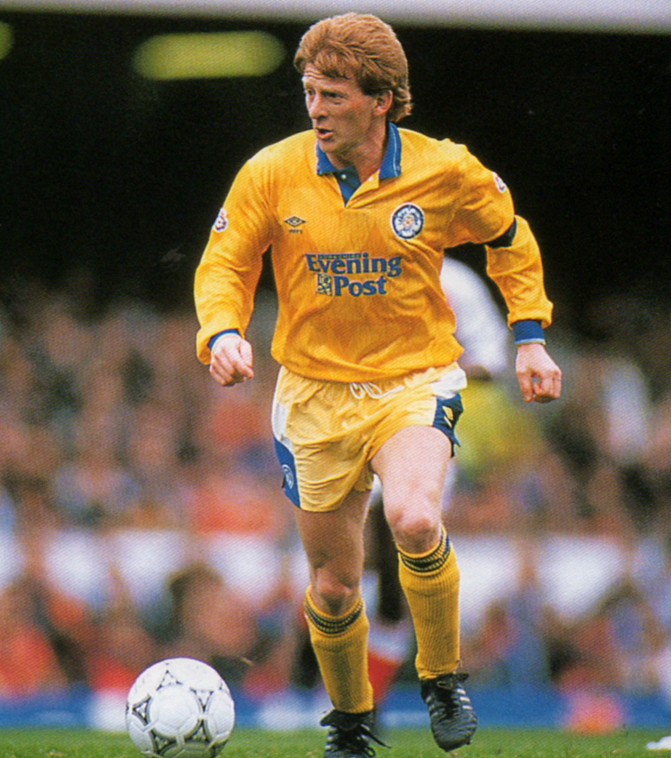
Amazingly, for those of us who remember the breaking of the news so well, it’s a quarter of a century today since Leeds United made the historic signing of Gordon Strachan from a minor club over the Pennines.  Over the next seven seasons as the Whites skipper, there were many, many memorable occasions for United’s second-most famous ginger Scottish captain.  Not least among these, of course, was hoisting the last ever Football League Championship Trophy, as well as scoring the first goal in the Stuttgart play-off at the Nou Camp in 1992.

But, as I’ve done before, I thought I’d look back to the famous Leicester City game in 1990 and what was probably Strachan’s defining moment as the man who did more than just about anyone to reinvent Leeds as a post-Revie force in English football.  It had been a long time coming since Don’s Glory Boys dispersed to pastures new and a Golden Era faded into the dim haze of memory.  We had been eight years in the second division doldrums and had almost forgotten what it was like to be a top team.  But – finally! – it looked as though the nightmare was ending as Sergeant Wilko and Captain Strachan were set to lead United back to the Promised Land at long last.  A home fixture against Leicester City was the penultimate hurdle to overcome, and expectations were soaring at Elland Road.

Twelve days before the Leicester game, United had appeared to strike a decisive blow, battering closest rivals Sheffield United 4-0 at Elland Road. But any hope that promotion could be clinched early was dashed over the next two fixtures, a draw at Brighton where the lead was squandered to sacrifice two points, and then a home defeat to a relegation-threatened Barnsley who even then had the ability to put one over on us with an inferior team.  So the nerves were jangling for this home date with the Foxes.

Leicester breezed into town with no pressure on them at all as they bobbed about serenely in mid-table, but Leeds just had to win. A victory could possibly clinch promotion; anything else and we would be relying on others to give us that final leg-up – not an attractive prospect. The atmosphere at Elland Road that day was something to behold as 32,597 packed the stands and terraces, the Kop a seething mass of bodies, a solid wall of sound. If the weight of support counted for anything, then it seemed Leicester might just as well turn around and go home – but to their eternal credit they fought the good fight and played their part in a memorable afternoon.

It all started well. Leeds pressed hard, this had been their preferred approach all season long. No opponent was allowed the luxury of untroubled possession as Leeds snapped at ankles and harried the enemy, hungry for the ball and well able to use it productively. At their best, United had proved a match for any team in the Division; as ever though it was the off days that had let us down. On this particular occasion, attacking the Kop End in the first half, the forward momentum seemed irresistible. Before long, the overlapping Mel Sterland fastened on to a ball at the right corner of the penalty area and fired low and hard into the net to open the scoring. The overwhelming relief was as evident as the unconfined joy around the packed stadium; surely now United would go on to consolidate their advantage and seal the promotion we’d wanted for so long.

It was not to be. Despite further pressure, Leeds failed to make another breakthrough before half-time and Leicester – relaxed and pressure-free – were looking more and more ominously like potential party-poopers. These fears solidified in the second half as the away side pressed an increasingly nervous Leeds back, and eventually – inevitably – they drew level. The blow when it came was struck by a rumoured transfer target for Leeds, promising young Scot Gary McAllister. He proved that he packed some punch by belting a fine strike past veteran Mervyn Day to shock the Kop rigid and momentarily silence Elland Road. Worse was so nearly to follow as McAllister almost did it again, another superb shot coming within an ace of giving Leicester the lead, something which would doubtless have produced the unedifying spectacle of grown men crying in their thousands. It may well be that McAllister sealed his move to Leeds with this performance and those two efforts, but I could have seen him far enough from LS11 that day. Leeds were rocking, looking at each other, scratching heads and clenching fists in the time-honoured “come on, let’s bloody sort this out” gesture. Slowly, by sheer force of will, the lads in White regained the initiative and it looked at least as though the danger of further damage was receding. The football was still nerve-shredding stuff, all urgency and little fluency, a desperate battle to eke out the extra two points that would make promotion so much more likely.

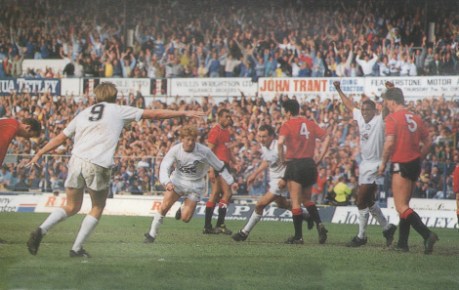
Time was ebbing away fast now, as Leeds hurled themselves time and again into the defensive barrier of red Leicester away shirts. Panic was setting in, the biggest enemy of constructive football. It was looking like a draw, which would not be enough. Then, a throw halfway inside the Leicester half in front of the West Stand, under the eyes of a bleakly worried Wilko. Sterland gathered himself and hurled a massively long throw deep into the away penalty area, only for it to be headed out from around the near post. McAllister attempted to complete the clearance with an overhead effort to get rid, but the ball hit Gordon Strachan to bounce back into the box. And there was Gary Speed to lay that ball back instantly to the still-lurking Strachan who simply lashed it, left-footed, into the net. The ball had gone in like a bullet; Strachan – too tired to control it and try to work a yard of space to dink one of those cute little far-post crosses as he might normally – settled instead for catching the ball right on the sweet spot and it arrowed home to a positive explosion of noise from all around Elland Road – the sudden release of what had been unbearable tension produced a massive roar to buffet the ear drums of innocent bystanders miles away.

It was one of those occasions when several things seem to happen at once. The crowd behind the goal at the South Stand end seemed to boil with passion and relief, a maelstrom of delighted celebration which was echoed across the whole stadium. Strachan himself ran to the byline, face contorted, weary limbs pumping in triumphant exultation as he took the plaudits of the faithful. A lone copper is visible on the TV footage between Strach and the cavorting hordes, a grin on his face as he moves to quell any ambitious pitch-invaders. In the commentary box, John Helm unwittingly propelled himself into immortality, not for the last time that afternoon. “Have you ever seen a better goal?” he demanded. “And have you ever seen one better timed?” It was a good question, and right then, right there, I doubt you’d have found a Leeds fan to answer “yes” to either part of it. The rest was a blur; Leeds held out, and we had won – and seemingly gained promotion. Rumours were flying around that Newcastle had failed to win, sending us up. But John Helm was at it again, more iconic words: “Is that confirmed…?” When the confirmation arrived, it was of a late Toon win; we still had it all to do at Bournemouth the following week. But Strachan’s late cracker had kept us in a race that we were ultimately destined to win.

My final memory of that day is of walking down off the Kop and onto the pitch as the masses there were starting to disperse. We crossed the sacred turf from goal-line to goal-line, eventually exiting the ground into Elland Road at the south-west corner, where the Jumbotron big screen now stands. I can still remember the heady scent of stud-holed mud and trodden turf, my head was still buzzing as I walked over the spot where wee Gordon had made that perfect half-volley contact to send us all into delirium. It had been an atmosphere the like of which I have rarely seen before or since, only the mayhem at Bramall Lane when Gayle scored that own-goal title-clincher coming anywhere near, or maybe that ankle-busting semi-riot of a celebration when Dave Batty broke his long goal drought against Man City in 1991.

For the sheer relief of it however – the absolute nerve-shredding, tension-breaking release of it – this was definitely THE one. Without Strachan’s sublime strike, we could well have missed out on automatic promotion, and we all know only too well that there’s a law against us succeeding in the play-offs. Gordon’s Golden Goal had kept the dream alive and made possible all that followed up to the League Championship triumph two years later. Make no mistake – it was THAT important. Thank you, wee man – 25 years on, Leeds United have yet to make another signing so vital and important in the history of a great club. Chances are, they never will.

Cristiano Ronaldo to Sweep Board in Fifa’s ‘Narcissist of the Year’ Awards – by Rob Atkinson

Image

A tender moment between CR7 and his biggest hero

Sometimes, you catch sight of a headline and, as you feel your eyebrows heading for your hairline, you wonder to yourself: “Did I really read that right?” Such a headline caught my notice the other day. “Cristiano Ronaldo opens a museum in his own honour in Madeira, Portugal“, it read. My eyebrows still haven’t returned to their default position – if fact I may well have pulled a couple of muscles there.

The thing is, the story in itself is not that surprising or earth-shattering. The impact is more of a jolt of self-affirmation – having a deep-rooted prejudice confirmed, right out of the blue like that.  You just think – well, I was right about that lad.  You see, I’ve long felt that Senhor Ronaldo has a touch of the Narcissus Complex about him. Many was the time when some noted Man U mouthpiece such as S’ralex Ferguson would say, with no evident sense of irony “Cristiano is the archetypal Man U player” or some such platitude. And I’d just nod, thinking to myself: isn’t he just. As was Royston Keane, pretend tough guy, for his blithe belief that the rules of the game were for lesser mortals. Cantona too, for his strutting, turned-up-collar arrogance – noticeably absent in his time at Leeds United where the likes of Strachan and Batty would have beaten it out of him.

So, despite Ronaldo’s much-publicised yearning to head off for pastures Iberian, I was actually quite surprised when he left the Theatre of Hollow Myths a couple of years back. He just seemed like a perfect fit for that particular club, an apt representative of the puffed-up, self-regarding Pride of Devon. Since arriving in Madrid, a constant theme has been his desire to be regarded in the same light he regards himself – if such a thing were only possible. Because, alongside his undoubted brilliance as a player and his lavish habit of scoring goals at an unprecedented rate for a winger, there has always been this “look at me” air about him.

This particular manifestation of narcissism is at its most apparent when he’s playing in a high-profile match, at the World Cup finals, for instance. There, the games are played in stadia equipped with those flying cams which zip about aerially, capturing close-ups of players from a position, seemingly, just above their heads. So whenever Ronaldo misses a goal or protests to the referee (he does this a lot), you’ll see him in a match like this, glancing at the nearest robot camera, then maybe checking out his magnified image on the inevitable big screen, admiring the pose even as he’s striking it.  He has a special “poised to take a free kick” pose as well – you’ve probably noticed.  He loves this one – legs akimbo, stock still, seemingly waiting for the crowd to subside to an awed hush. He sneaks little sidelong glances at the big screen then too, checking himself out.  It’s really quite funny and a little bit pitiful. There’s no denying that he’s a very good-looking lad, and yet this too-evident, overpowering self-adoration is curiously unattractive, casting a patina of ugliness onto features usually apt to set hearts, not all of them female, a-flutter.

It’s a character trait that makes it impossible to define Ronaldo simply in terms of his technical ability, his genius with a football at his feet, or even his extravagant goalscoring record. In this way, the narcissistic flaw in his make-up serves to keep him out of the Pantheon of True Greats, players – many of lesser ability – who combined admirable qualities such as humility, modesty, self-restraint on and off the field – things like that – with their obvious talent. Marks of maturity and character all, and reminders that talent alone, even genius, is not enough. Ronaldo’s flaws are less extreme than, say, Georgie Best‘s – and he’s certainly a much better pro – but just as was the case with Best, those flaws threaten to have him remembered at least as much for the negative parts of his persona as the positive aspects of his game.

Ronaldo is simply unable to restrain this tendency to sound overtly, overweeningly in love with himself. As many know, when somebody is in love, they’re totally unable to comprehend how anyone would be able to resist loving the object of their adoration. It’s a type of tunnel vision – the lover cannot see anything but good about the loved. This would appear to be precisely the nature of Cristiano Ronaldo’s intensely passionate relationship with himself. If he ever needed a motto, he could do a lot worse than to open his Bible and paraphrase John 15:13, summing himself up with “Greater love hath no man than I for me”. By comparison, Narcissus himself comes over as having slight self-esteem issues. Ronaldo loves Ronaldo, and you get the feeling that he honestly can’t understand why the world at large can’t share in his joy.

The opening of the CR7 Museum, by the adored CR7 himself, in honour of the said adored CR7, sums all of this up quite neatly. It provides independent verification of mine and others’ long-standing summing-up of Cristiano Ronaldo, and as such it’s really more to be wryly laughed at than fumed over. But it is a pity, in its way: a footballer’s life as an active player is, after all, relatively brief. After retirement, and as the glittering career fades ever further into the past, history can take a more jaundiced view of the former star than those who were there in the instant, cheering and applauding as a virtuoso performer plied his genius trade. The later view of the legend, the “warts and all” version, can even come to focus more on the warts than on much else worthy of admiration.

If Ronaldo wants the eye of history to gaze benignly upon him (and you can bet your last penny he does), then a little humility, a little less obvious awareness of his own talent and gorgeousness would have been a big help. But it’s late in the day for that; even now he’s seen as someone in whom human virtues epitomised by the likes of John Charles or Bobby Moore are sadly absent. In the meantime though, why would Cristiano care? He is playing for one of the biggest clubs on the planet, he has won and will win many medals and trophies – his life is one grand, sweet song.

It’s just that he appears to have been blighted by a crucial part of his development; that few years spent at Man U which can have an unfortunate effect upon an impressionable young man, especially one with a certain arrogance about him, the air of a braggart. It can have him believing in his own publicity and the rightness of everything he does or thinks, an impression reinforced by a complaisant media. Other, similar examples of this type have emerged from the club, other flawed characters who would have benefited from formative years spent in a less privileged and less insular environment. It manifests itself differently in Beckham, Keane, Cantona and a few more who spring to mind – but all of these players have emerged from Man U with character issues to confront, something they’re doing with varying degrees of determination and success. It does have to be said that not everyone is carried away on such a perilous tide; Paul Scholes for instance remained firmly detached from all the hype, to his eternal credit – and simply got on with his job. Andrei Kanchelskis was another such.

Cristiano Ronaldo is simply the most obvious example of the kind of young man who in many ways summed up the character of a club like Man U, but in many more ways was in sore need of being taken down a peg or two when the time was still ripe for his character to develop along more attractive lines. The moral is, I suppose: If you have a talented youth who thinks he’s the bees’ knees – send him to Barnsley where he’ll learn the rudiments and have the more offensive edges knocked off him. You won’t produce quite such a polished player that way, it must be admitted. But you would end up with a much better all-round bloke; one who would perhaps guffaw derisively at the thought of opening a museum in his own honour.

McCormack Exposes Strachan’s Lack of Four-sight as Leeds Romp to Victory – by Rob Atkinson

Image

Ross McCormack – surplus Scot

Gordon Strachan has always been good value, whether plying his trade as Leeds United’s traditional diminutive ginger midfield maestro, or later as a manager with a penchant for the apposite quote, frequently a venom-tipped barb delivered with his own brand of waspish humour.  He’s not been somebody noted for getting things wrong all that often. There was a dressing-room tantrum in the early days at Elland Road, when it took Jim Beglin to calm him down – politely but firmly.  And there was the famous own-goal near the end of the Charity Shield match against Liverpool at Wembley in 1992 – but that didn’t matter as Leeds won in the end.  Other than those two minor blips, he’s normally got most things right.  But Leeds fans will have been queuing up to tell him that he dropped a right clanger this week.

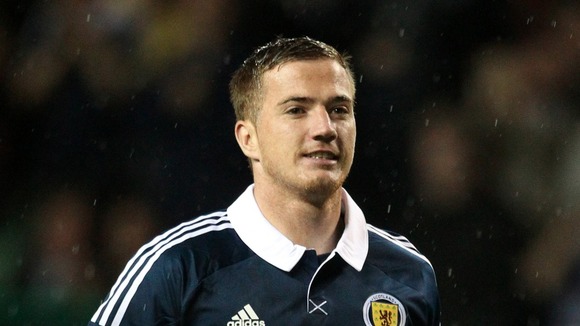
Somehow, by some convolution of his venerable grey matter, Scotland manager Strach has managed to select for his next international squad NINE players from the Championship – and yet omit Ross McCormack.  I’d be very hard-pressed to name one Scottish player in the Championship better than Rossco, and yet wee Gordie somehow managed to find these nine.  It’s to be hoped they do well – they’ll have to if they’re going to prove their worth ahead of a man who has been excellent for Leeds United this season, a man who wears his heart and his commitment to the cause on his sleeve, a man, moreover, who has scored 6 goals in his last two outings whilst threatening to stage a one-man goal of the month competition.  Strachan did concede that McCormack had been “unlucky”, thereby adding to his considerable reputation for dry understatement.

At the time of this unlucky omission, Ross McCormack could point to just the two goals in his most recent game; now he’s trebled that output in one further game as if to emphasise just how bloody unlucky he really has been.  This approach of letting his boots do the talking instead of whinging in the press – and Ross can be quite vocal at times as his Twitter followers will confirm – is highly laudable of course, and something that Leeds fans will appreciate.  Those fans might rather, anyway, that Ross should be putting his feet up for a couple of weeks and doing the odd bit of training at Thorp Arch, instead of gadding about Europe with the Sweaties.  That way, the Leeds faithful will figure, he’ll be rested and ready to poke a few more goals in, a fortnight hence, against his persistent summer suitors Middlesbrough.  So even if we feel a bit bruised and crestfallen on McCormack’s behalf – there are compensations for Leeds supporters in what seems an inexplicable decision to deny the lad some more international experience.  Ross will be wondering what, exactly, he has to do in order to merit selection.

Some more of what he served up today certainly wouldn’t go amiss.  McCormack was hailed by both managers after Charlton versus Leeds as “the difference”.  On a disgraceful bog of a pitch reminiscent of some of the marshlands at Derby and elsewhere in the 70’s, Leeds managed to overcome a determined Charlton side, one that hadn’t conceded a solitary goal in over seven hours of football.  The home side had made the brighter start, but Leeds scored with their first real chance, as McCormack fastened onto Blackstock’s neat flick to dink the ball over Charlton’s onrushing keeper.  United then survived a penalty appeal and a shot against their woodwork before conceding the equaliser just before half-time to one of those “worldies” we see fly into our net all too often.  This time it was Cameron Stewart blasting a twenty-yard volley past a helpless Paddy Kenny, and Leeds were on the back foot for the remaining couple of minutes before the break, grateful in the end to go in level.

After the interval, the match swiftly swung back Leeds’ way.  A penalty was claimed and awarded when Danny Pugh – back after a long time in the doldrums and playing well – was tripped by Charlton’s Harriott, and McCormack leathered the spot-kick fiercely into the roof of the net.  Charlton were still full of fight and saw Kenny make one great save to deny the penalty villain Harriott, whilst squandering at least one other decent opening, before they finally levelled the match at 2-2 in the 70th minute.  Simon Church carved out the chance with a low cross, converted by Johnnie Jackson.  This is the sort of scenario that makes the Leeds faithful groan in collective pain and pessimism; normally, having been pegged back, we expect further disaster to ensue.  The three thousand plus United followers in the Jimmy Seed stand must therefore have been anticipating the worst, but glory be – the best was yet to come.

It came quickly, too.  Barely three minutes had elapsed since Charlton’s second equaliser when McCormack, again benefiting from an assist from loanee Blackstock, smashed home a close-range volley from a tight angle.  There hadn’t even been time to sink fully into the default Leeds state of pessimism and now all was joy and rapture again as the travelling faithful bellowed their appreciation. Surely, Leeds would hang on now.  And hang on they did, defending resolutely enough for the remaining seventeen minutes, at the end of which Rudy Austin was fouled just outside the area by Rhoys Wiggins. McCormack sized it up, took aim, and curled a beautiful free kick past Hamer to end the home side’s hopes.

It was the first time a United player had scored four in a game since Brian Deane made QPR suffer at Elland Road in the noughties. Heaven only knows when a Leeds player last grabbed four away from home.  That might be something for Strachan to contemplate, with his Elland Road connections, as he watches the highlights of this performance. Chances are, though, he’ll have a lot more to think about than that.

Scott Wootton Can Become the Latest to Leave Man United For “The Damned United” – and Find Success

Image

This week’s signing of young defender Scott Wootton has reminded us all that the transfer history between the two Uniteds of Leeds and Manchester is notable mainly for its scarcity – understandably so, considering the bitterness of the rivalry between the two clubs.  A mutual antipathy still festers among the fans on either side despite the rarity of actual meetings of the respective Reds and Whites on the field of play.  Anyone who has witnessed the poisonous atmosphere which prevails at such meetings will appreciate the difficulties which can arise for players who have sought to serve both clubs.  Accusations of betrayal are far more common than warm welcomes back when a player swaps one shirt for the other.

Revisionists who count their history from the founding of the Premier League might not appreciate that, in the comparatively few direct deals between Elland Road and Old Trafford, Leeds have come out not at all badly.  Two transfers in particular can be said to have sparked the Whites’ greatest historical successes, but the focus in more recent years has been on the move of a certain iconic Frenchman, and the kick-start that appeared to give to Man United, a club that had starved for title success for over a quarter of a century.

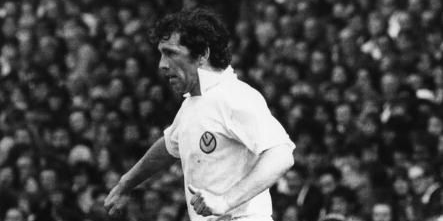
The fact remains, however, that Leeds can thank the management at Old Trafford for their generosity – or misjudgement – in two different eras, firstly when John Giles (pictured above) made the move to Elland Road in the sixties, sparking the Glory Years of Don Revie’s reign, a transfer later described by Revie as “robbery with violence”.  Gordon Strachan then arrived in LS11 to complete the renaissance of Leeds under Howard Wilkinson in the late 80’s and early 90’s, cementing their position as the Last Real Champions by finishing the pre-Sky era at the pinnacle of the domestic game.

Enfant terrible Eric Cantona did much to redress the balance of transfer success between the two clubs, but there are strong grounds for suspecting that Man U’s era of domination would have happened anyway, so favourable were the conditions for a global franchise in the Murdoch-funded Premier League.  Giles and Strachan, then, stand out as the two most influential transfers between the two clubs, and there are also a few memorable if slightly lesser transfers worthy of mention: Joe Jordan and Gordon McQueen left Leeds for Man U in the 70’s, but found limited success, as did Arthur Graham a few years later; while Brian Greenhoff and Danny Pugh were journeyman additions to the Leeds squad from the also-rans of the Man U gene pool.  The less said about Lee Sharpe, “Plug” Ferdinand and Alan Smith, the better.

It’s asking a lot of youngster Wootton to turn his career at Elland Road into anything like the glorious impact of a Strachan or a Giles, but there are grounds for supposing that he may have a significant contribution to make and maybe – just maybe – cause the fans of Man U to regret his departure.  Already there are wistful noises emanating from the hotbeds of support in Milton Keynes and Torquay.  One fan remarked that Wootton might have developed into “another Johnny Evans” – surely a case of being damned by faint praise. Another stated that if Wootton was to be denied his chance at Old Trafford, he might as well play for a proper club, which seems quite a generous attitude in the circumstances. Leeds fans don’t appear to hold the boy’s past against him – he seems to be regarded as a prospect rich in potential, and after all he’s made a career choice of which we can all heartily approve.

Above all, we have to respect Brian McDermott’s increasingly acute eye for a player, especially of the young, there-to-be-coached-and-improved variety.  Like it or not, Man U deal in an entirely different transfer sphere to Leeds, and it’s much more difficult for a rough diamond to be polished up for the first team there, when so many crown jewels are bought in every season.  They are bound to lose the odd star-to-be, and on this occasion we at Leeds may just be the beneficiaries of this kind of overspill.   We can certainly hope so, and hope also that this latest cross-Pennine import enjoys a long and successful career at Elland Road, returning frequently to Old Trafford to haunt those who have seen fit to let him go this week.  With our vivid memories of Gilesy and Wee Gordon, we’re certainly entitled to such a dream.

Memory Match No. 1: Leeds United 4, Liverpool 5 (13.4.91)

The idea of a “Memory Match” series of articles is hardly original, but it can be fun, particularly when the present doesn’t offer us much to shout about – and let’s face it, there are loads of games in the Leeds United back-catalogue well worth recalling, and savouring anew.

Despite the encouraging win over Blackpool, it’s probably fair to say that this season is in danger of petering out, leaving us looking forward to a whole new campaign for our hopes of a fresh start post-Bates (who shall be known as President Irrelevant next season.) Things have been so dire at times, that the recollection even of a defeat can be preferable to gloomily contemplating our current prospects – as long as that defeat was a really special one, with gloriously redeeming aspects to it.

Such a match, such a defeat, was the home game with Liverpool in front of a 31460 crowd during our first Sergeant Wilko-flavoured top-flight season of 1990-91. It had been a good season – we were nicely established back at the right end of the top table. We’d had some tasty results and the name of Leeds United was well and truly back on the agenda, despite the slightly grudging attitude of the southern-based media.

I’d been anticipating the Liverpool game above most others. There was that satisfying all-White versus all-Red thing, against the green backdrop of the turf, which appealed to the eye of the beholder. But also, I had a real problem with Liverpool FC. They’d been the opposition in my first ever game at Elland Road, a traditional 3 pm Saturday kick-off in April 1975. I’d gone into the ground with my Dad and brother, all wide-eyed and expectant, and Elland Road blew me away, so much more vivid than it had ever been on the telly. I knew straight away that this was love, and that it would be for life. Then Liverpool callously spoiled my debut, beating us 2-0. The following season, they did it again, 3-0 this time. I didn’t even see us score against the Reds until Daisy McNiven’s late equaliser in 1977. By the time we got relegated, in 1982, it had got to the point where I expected nothing but a hiding from Liverpool games, and that’s invariably what I got. I hated Liverpool.

So, in that first post-promotion season, when we’d looked like a seriously top team again, I was all vengeful and ready for the Reds, who had recently been stunned by the resignation of Manager Kenny Dalglish, and I trusted the lads to be at least as committed as I was. And to be fair, they did look right at it, early on. Carl Shutt burst through down the right to sting the hands of their ‘keeper. Mel Sterland planted a free header wide from around the penalty spot, wee Gordon Strachan was buzzing about to good effect in midfield, Leeds were playing well. Then, the sky fell in.

John Barnes, Liverpool’s lithe, lissom winger, chose that day to really turn it on – just as we’d all wished he would for England ever since his legendary goal against Brazil in the Maracanã – but his virtuosity for his club on this day was bad news for Leeds United. First, he dinked a dipping ball to the far post at the Kop End, and the roof of our net billowed as Ray Houghton finished. Next, he was involved in the award of a clear penalty, struck past John Lukic with power and precision by Liverpool’s wardrobe-shaped Danish scouser, Jan Molby.

Leeds had been well in the game, but Liverpool had carved out and taken their chances, and my familiar Red nightmare was playing itself out yet again. Now, David Speedie – that unlikeliest of Liverpool players for their era of success – forced himself in on the act, first having a goal disallowed, then scoring at the far post after more good work from Barnes on the left. Leeds were ragged and despondent, and it was no surprise when Barnes again, after a nifty one-two near the halfway line, scorched clear to clip a fourth past a helpless Lukic, and leave me sitting drained and woeful on the terrace steps throughout half-time, head in hands, despairing at the four goal gap and fearing what might yet be to come. I’m sure too that this was the first time I ever heard Monty Python’s “Always Look on the Bright Side of Life” played over the tannoy – and taken up by a stunned home crowd who were even yet able to indulge in a bit of gallows humour.

When the second half started, I saw the Liverpool reserve ‘keeper Mike Hooper running towards us. Hooper had been standing in for a few games for the regular No. 1, Bruce Grobbelaar, and I was more than a little disappointed. I’d had this recurring wish-fulfilment dream about sneaking down off the Kop while play was up the other end and, with a hitherto concealed pair of scissors, neatly snipping off Bruce’s annoying little pony-tail. It was probably just as well that temptation had been moved out of my way, but I doubt I’d have really done it – ex-guerrilla Grobbelaar would have killed me anyway, and I’d most likely have got arrested, too.

Hooper was under pressure immediately, as Leeds had rediscovered their vim, and forced Liverpool back. The breakthrough came when the keeper could only push out a scuffed Gary MacAllister shot, and Lee Chapman was there to bundle the ball unconvincingly home off the crossbar. Then Chappers challenged for a high ball at the near post, and in it went – only for the ref to disallow it, his dismissive reaction to Chapman’s protests further enraging the hyped-up hordes on the Gelderd End. Hopes revived though as the ball sailed over a clearly-fouled Chapman from the left and landed in the area at the feet of Shutt, who swivelled to score competently. 2-4 now, and maybe an unlikely comeback was in the offing. But almost immediately, Ian Rush mugged Chris Whyte just outside our box, and back heeled into the path of Barnes who took it on and scored a brilliant fifth, to renewed home despair.

Leeds seemed to know that they had to hit back hard and swiftly, and the best goal of the game arrived when Dave Batty struck a wonderful bending, scything cross from deep on the right, and Chapman hurtled through mid-air to meet it with a bullet-header, beating the startled Hooper all ends up. Two behind now, and Liverpool looked as if they were just holding on, the pressure from a stoked-up Leeds incessant.

The match had become a breathless spectacle, surreal in its ebb and flow, more like some sort of high-class park game than your archetypal tight, defensively-sound First Division grapple. Leeds seemed always on the brink of total annihilation, and yet Liverpool, seasoned top-league campaigners, couldn’t quite manage to shake off these upstart newcomers, who kept on snapping relentlessly at their coat-tails like eager pups. Strachan typified the defiance and endeavour, popping up everywhere, probing and passing. Now he received the ball on the right corner of the Liverpool penalty area, and set off on one of those scampering little runs where he didn’t so much beat defenders for pace, as manoeuvre adroitly around them, like some pesky little tug in among ponderous oil-tankers. He did this now, beating two or three Liverpool defenders inside a few square yards, and then clipping a delightful ball to the far post, where Chapman towered to complete his hat-trick, the arrears reduced to one.

And that, gentle reader, is as good as it got. Try though they might, the gallant battlers in white could force no further concessions from a Liverpool team who had looked like running away with the game at half-time, but who were virtually on their knees by the final whistle. It was a defeat – glorious, inspiring even, but bringing with it the zero points haul of any other defeat. On the day though, the crowd weren’t counting league table points, and the buzz as the throng left the stadium was of a fantastic comeback against a top, top team – pride was in the air, loud and throaty and no-one was bemoaning the loss. As one person loudly declaimed emerging, from the Kop exit, “we gave ‘em a four goal start, then hammered ‘em 4-1!” Well, quite. It had been, by far, my best-ever Liverpool game, better even than the last-gasp draw we’d salvaged in 1977. It also told us all we needed to know about the battling qualities of Wilko’s Leeds United; an injection of quality the following year would garner the Champion’s crown for us, and also along the way, my long-awaited first victory over the Anfield Reds.

For that, the wait would prove worthwhile. But on this April day in 1991, those of us who had suffered through the wilderness years could see promising signs, even in defeat. United were most decidedly back.

Next: Memory Match No. 2: January 1992 – Sheffield Wednesday 1, Leeds United 6. Tune in for another Chappers hat-trick, and “The Worst Dive Ever”.