Tag Archives: media

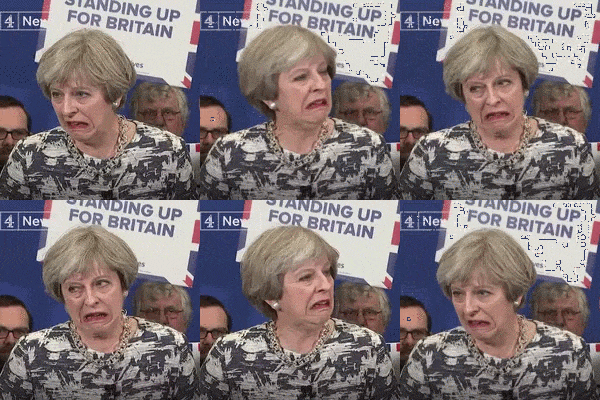
Where’s That Sick-bag?

A Sickeningly Solemn Moment

A Sickeningly Solemn Moment

Ladies and gentlemen, if you have sick-bags to fill, prepare to fill them now.  If sugary treacle and soft-sawder syrup is your thing, get ready to drown in the stuff.  “Sir” Alex Ferguson is departing the stage, and there won’t be a dry seat in the house.  Sky TV are preparing for an extended weepathon as their hero who hated them, their idol who despised them, climbs down unsteadily from his throne of purchased glory and totters off upstairs to chew gum and glower balefully down at his hapless successor David Moyes.

This afternoon’s live TV offering has a delicately-scripted path to follow.  There will be a soft-focus montage of many of the Purple-Nosed One’s finest moments – Steve Bruce’s 98th minute winner against Sheffield Wednesday to a background of Martin Tyler’s shrieking climax as Man U all but clinched their first plastic Title.  Giggsy-Wiggsy’s finest FA Cup goal of all time as the Arsenal defence parted like the Red Sea and we were treated to an unsolicited view of the Husband of the Year’s chest-rug.  A selection of van Persie’s catalogue of sublime finishes from the Dutchman’s “One Man Title-Winning Season” collection.  It is doubtful however that Eric Cantona’s exposition of martial-arts skills from his South London Show of 1995 will make the cut.

After the moonlight and roses video softener has set the correct ambiance, and armchairs all over Devon and Cornwall are already bedewed with manly tears, we may have an actual interview with the dearly-lamented Departing One.  Subtitles will be provided for this section of proceedings, and yet it won’t so much be what He says, but more the way He says it.  As an example, if you hear a glottal noise along the lines of “Thiznaequayshtyunabootthaaaaat” it means that S’ralex is saying something he wishes you to accept as undisputed fact.  This happens a lot.  But those craggy and broken-veined features of pasty pink splotched with purple may at some point break into a grimace not unadjacent to a smile, and this will be the cue for the suits in the Sky Studio to howl with unrestrained emotion as the tears flow anew.  It’s going to be a harrowing afternoon, and we’re nowhere near kick-off yet.

At some point we will have testimony from a group of the usual suspects as to the essential saintliness and unmatchable achievements of the man.  Lou Macari, Paddy Crerand, Peter Schmeichel, Steve Bruce, Bryan Robson and other such neutral witnesses will speak their lines to camera with all the sincerity and conviction of a tailor’s dummy. Ron Atkinson and Tommy Docherty may even appear if time permits, and attempt to mask their burning resentment at being consigned to the dustbin of history with a few clamp-jawed soundbites of faux admiration, before shambling off, clutching Mr Murdoch’s fat cheque.

And then, the game.  It has been thoughtfully arranged that the final day opponents at the Theatre of Hollow Myths should be a footballing side of attacking ambitions.  The script will call for them to make pretty patterns in midfield whilst offering no great threat to Man U’s rocky defence, where Phil Jones will be frantically gurning in an attempt to frighten off any Swansea attacker who dares venture too close.  At regular intervals, an uncharacteristically misplaced pass from the away team bit-part players will gift possession to Man U, who will then – according to the stage directions – “swoop to score another magnificent goal for the Champions.”  Ecstasy will ensue in the stands and the commentary box, and flowers will be thrown at the feet of the gum-chewing Govan Guv’nor as he performs that annoying little staggery old man’s dance from under the dug-out canopy, champing away in a Wrigley’s rictus of triumph.  It is an image that will be burned on the retinas of a whole football-supporting generation.

After the match – whatever time that might be depending upon how long it takes Man U to score The Winner – we shall have post-game interviews, more video footage to the accompaniment of weeping strings and synth, rambling reminiscence from the assembled sycophants – and maybe a final word from the abdicating Emperor himself, who will remind us, via an interpreter, that there’s “aye anither game tae go yet, by the waaaaay.”  And the crowds will sigh and depart for all points south, the lights will go out at the Theatre of Hollow Myths and the scene will gradually darken as a rainy Salford day fades into the night, as we all must sooner or later.  All that has been missing is the trademark Lone Piper, but he is reserved for even more solemn occasions, and his time is not yet.

And so it will be over.  It will be time for the Sky suits to heave a gigantic, shuddering sigh signifying end-of-an-era grief and regret, and then they must reluctantly move on.  A new hero awaits, and he’s sadly lacking as yet in the trappings of success and the aura that the commercially-aware would wish for him.  A project is to hand now that S’ralex has faded into the sunset, and that project is the reinvention of an Honest Pro into a Demigod, the Greatest Manager Of All, for such is the requirement of the twinned Hyperbole Departments of Sky and Man U for the unsuspecting Mr Moyes.  It’s a work in progress even now, but the momentum will gather as the new season approaches and the threat of upstarts such as Chelsea. Arsenal, Man City and even Liverpool, which has to be repelled for another year.  It will need to be business as usual, even without the Blessed Fergie. Life goes on, and today was merely the schmaltzy climax to the long-running soap-opera which was Man U under S’ralex.  It’s time to dry the tears and count the money.

Now where IS that sick-bag?

Stand Up, If You Hate Man U – And Think It Might Be TV’s Fault

Hate Man U

On Saturday 8th January 2005, Manchester United played Exeter City in the 3rd round of the F.A. Cup. It was something of a mismatch on paper, but surprisingly a plucky Exeter team held out for a 0-0 draw, and took the holders to a replay. A significant achievement for the minnows, but this game was noteworthy for another reason; to date it remains the last F.A. Cup tie involving Manchester United not to have been shown live on TV.

Even on the face of it, this is a remarkable statistic. Particularly in the earlier rounds, there are many matches from which TV companies can take their pick, and traditionally the perceived likelihood of an upset is a big draw. Given the perennial dominance of Manchester United, it’s usually difficult to see much chance of a giant-killing, and the interest in games involving them, you might think, will be mainly for those occasions when they’re drawn against a Chelsea, or a Liverpool, or maybe even a Manchester City or an Arsenal.

Looking at the list of games included in this amazing run of uninterrupted TV spotlight, some of them really do make you wonder what the companies concerned hoped to achieve, with the chances of an embarrassingly one-sided contest surely outweighing by far any prospect of a surprise. It begs the question of whether broadcasters are putting too high a priority on audience over entertainment value. There may be a certain piquant charm in seeing the likes of Burton Albion gazing wide-eyed at the immensity of Old Trafford, but some of the ties televised have lacked even this saving grace. Middlesbrough or Reading at home? Hardly sets the pulse racing, does it?

Any hint of complaint about Manchester United will, naturally, bring anguished howls of protest from the direction of London and Devon, as hard-core Reds, some of whom may even have visited Old Trafford, loudly complain about this latest manifestation of “jealousy”. It’s become rather a knee-jerk reaction, but there’s really not a lot of foundation for it. Anyone truly motivated by envy (jealousy means something different, chaps, look it up) has a simple solution at hand – simply jump aboard the bandwagon. The prevalence of the Old Trafford club on our TV screens will certainly garner them increased “support” from those who just want to be identified with such a vulgar example of a club gorging on success. It is the more negative effect of blanket coverage that should be worrying, not so much for Manchester United, but for the sport itself.

For there is a danger here that the media have not only created a monster, but that they are actively encouraging that monster to eclipse all their rivals. The basis of any sport must be healthy competition, but there is disquieting evidence that the playing field has not been level for a long time now. It doesn’t take too much digging to unearth some unsettling trends. One study over a number of matches suggested that 88% of all marginal decisions went the way of Manchester United, and there was also a distinct lack of penalties awarded against them in league games at Old Trafford over a period of years. There have also been instances of referees who have displeased Alex Ferguson mysteriously disappearing for months from their fixtures. In a game of fine margins, as any game is at professional level, evidence that one club enjoys preferential treatment is a matter of concern. Such a trend, given the amount of money flowing into the game, could easily lead that one club into an unhealthy dominance, to the detriment, ultimately, of the spectacle as a whole. Fierce competition is so crucial to any healthy sport, that the importance of this principle is difficult to overstate.

Success, they say, is all about the steady accumulation of marginal gains. Manchester United as an institution appears fully to appreciate this, as any club should. But these days, the media are the game’s paymasters, particularly the TV companies – and when they start favouring one club above all others, then you have to fear for the ability of others to compete in the long term. It’s a matter of concern – and it could easily become a self-fulfilling prophecy, as more coverage (of an almost exclusively favourable nature) promotes more support ever further afield for “United” as the media love to call them. And the more support they gain, the more of a market there is which will feed on their success, so the more commercially desirable their success will become – and commercial pressure speaks volumes when knife-edge decisions are to be made.

It would be difficult to imagine that any other club should have such a long, unbroken run of live TV coverage in their F.A. Cup ties. In the 4th round of this year’s competition the other week, they figured in their 38th consecutive such event. The home game against Fulham followed its predictable, boring script – early penalty, spineless opposition, comfortable home win. Meanwhile, Brighton faced Arsenal, in what was, equally predictably, a much more exciting contest; two sides playing good football, and the prospect of a shock never far away. But this tie was not seen live. In the 5th round, Man U will face Reading at home, which will probably, let’s face it, be another Fulham-esque stroll. And, sure enough, yawn yawn, it’s live on the box again, despite the fact that there are murmurings of discontent now, from some sections of the press who evidently realise how boring it all is.

As a Leeds United supporter, I’ve had cause to bless the tendency of TV companies to cover even the games where “United” seem certain to roll over the opposition. On January 3rd 2010, Leeds, then of the third tier, triumphed at Old Trafford before a live ITV audience, sending the Champions spinning out of the Cup at the earliest possible stage. But satisfactory as this was, it’s the exception, not the rule – normally the colossus will trample the underdogs, and their millions of fans worldwide will be happy. But what about the rest of us? Are we to continue paying our satellite subscriptions, and buying our match tickets, for the privilege of watching Man U clean up as the stakes become higher, and the odds become ever more skewed in their favour?

At some point, worms will start turning and – at the risk of mixing metaphors – maybe the bubble will finally burst. Then, chill winds of reality will blast through the offices of the TV moguls. Don’t say you weren’t warned.