Tag Archives: soccer

Parachute Payments – Are They Really All That?

Saunders - Not Good Enough

Saunders – Not Good Enough

Every year, you hear the same thing about next season’s Championship division: “God, it’ll be tough to go up, look at the clubs coming down, all that money from Parachute Payments.”  Yeah, well.  Look at last year’s lot, Wolves, Blackburn and Bolton.  All dropped out of the top-flight and landed in the Championship with an almighty thump, weighed down by all that fools’ gold in their pockets.

In Wolves’ case, the fall was so heavy they’ve still not stopped, crashing through the floor of the Championship into the dank and unpleasant dungeon of League One.  This has been aided, it’s true, by spectacularly incompetent management right from the top.  The decision to get rid of Big Mick McCarthy – as a knee-jerk reaction to a derby-day thrashing by West Brom – is still haunting the Wanderers.  Terry Connor floundered in the deep end and sank without trace.  Dean Saunders has appeared to be clueless, his attempts at bluster unconvincing, even his saner moments lacking in any content or coherence.  McCarthy, meanwhile, prospers at Ipswich – a deeply impressive man and a highly competent manager at this level.

Blackburn, with management troubles and boardroom incompetence of their own, have been only a little better, but at least escaped a second successive relegation which appeared likely at one point.  Early in the season they spent £8 million on Jordan Rhodes, but then started messing about with the management structure and suffered accordingly.  Their failure has been at a price way beyond what the likes of Leeds could afford, and they will be looking ahead with some nervousness as Rhodes wonders whether his move was a wise one for a fledgling Scottish international.

Bolton too have flattered to deceive, failing to capitalise on a reasonable start, and pulling up no trees in a division with hardly a truly outstanding team, despite the seeming ease of Cardiff’s promotion.  The Trotters were still in with a chance of making the play-offs on the final day, but blew it by only drawing at home to Blackpool and thus letting in Crystal Palace at the last gasp – and the Bolton Premier League exile will last at least another year.

So what should we have to fear from next year’s lot?  QPR will need a radical overhaul after failing to recover from the cack-handed management of Mark Hughes, a man with one big fan he can see any time he likes in any handy mirror.  Reading could be a force, but they suffer from ownership who seem to feel that they have some football knowledge; usually a fatal ingredient.  There are rumours that some of Brian McDermott’s promotion-winning Class of ’12 would not be averse to a reunion with their old boss at Elland Road.

It remains to be seen who joins these two in the death-spiral downwards; the most likely is Wigan, who really do baffle me.  They are capable of wonderful football and will grace a Cup Final against Manchester City whatever the outcome of that occasion.  If the Latics could hang on to Roberto Martinez, they’d have to be regarded as challengers at the top end of next year’s Championship – assuming they do end up coming down.  Newcastle, Sunderland and Norwich will be nervously waiting to see if Wigan can pull off yet another last-ditch escape, as seems to be their perennial habit.

Obviously any relegated club will have the much-vaunted splodge of parachute wonga to cushion their fall, but they’d do well to look at the fate of last year’s Premier League jettison, and not assume that the ill-gotten gains will automatically ease their path back. Relegation can be habit-forming.  Just ask Wolves about that.

McDermott’s LUFC Promotion Formula

Image

Brian has said it himself: promotion next season is the expectation – nothing less will be good enough.  So how should he set about realising this desirable outcome?

Recruitment with a view to moulding a competitive and combative squad goes without saying.  We will all have our ideas about who needs to come in – from those who wish to see us reclaim our lost boys from the likes of Norwich and Leicester to the more forward-looking who would prefer hungry players, new to Leeds but maybe familiar to McDermott, your le Fondres and your Robson-Kanus and so on.

How else can Brian make a difference?  What have the problems been in the past?  One major drawback for a less-than-excellent United squad has been the difficulty of coping with the massive anti-Leeds chip on the collective shoulder of our rivals: the so-called “46 Cup Finals Syndrome”.  This is a crucial factor, but it is one that can be exploited by a real leader.  A certain charmless Scottish git over the Pennines in Salford is well-known for his preference for fostering what is known as a “siege complex” among the various teams he’s had There over the years.  He’s generally had a squad to compare with the best anyway, but there’s been that undeniable edge provided by the attitude of “They all hate us, lads, so let’s get stuck in and ram it back down their throats”.  The fact that Brian appears to be a mild and likeable guy, as opposed to the bile-choked monster in charge at the Theatre of Hollow Myths, is no impediment to the fostering of a “them against us” mindset.  It’s just good psychology, good man-management, and most of all, good for cohesion and team spirit.  There hasn’t been enough of that at Elland Road lately.

The hate comes mainly from opposition fans, particularly in Yorkshire where we will again play quite a few “Derbies” next season after Huddersfield’s and Barnsley’s mutually-collusive escape from relegation.  This fever of hate, eclipsing all other emotions, was adequately demonstrated when the cameras focused on a rabble of Barnsley fans in the very moment of relief after their last-ditch reprieve.  Were they applauding their team, or proclaiming their barely-salvaged Championship status?  No, their tiny, obsessed minds could find no room for anything but a tuneless chorus of “We All Hate Leeds Scum”, with the similarly brainless Huddersfield fans happily joining in. Clearly, fellow Whites, we are not famous any more.  If Brian does choose to utilise the hate of Leeds for positive gains in terms of team bonding and incentive to win, he will not find it in short supply.

Beyond this, we the fans have a massively important part to play.  But Leeds have usually been helped by terrific support; given the least encouragement, the fans will be like a 12th man out there.  We know from awed testimony in the past that playing at Elland Road can be an intimidating experience for the very best.  McDermott’s fostering of an atmosphere and team ethic comparable to that at Reading last season, where a squad not over-packed with stars pulled back an 18 point deficit to pip Southampton for the Championship Title, would not go amiss.  The fans would respond to the effort and togetherness of such a team, there is a parallel there with Wilko’s promotion side of 1990, who used to set about the opposition with voracious hunger and would usually wear them down before over-running them.  That kind of thing would certainly do; I remember Wilko’s Warriors very fondly, and they’re just the kind of team we all love down in LS11.

Once the business of Summer is done – and you sense that Brian wants to do his shopping early so that he can put his print on a super-fit squad – then the fine-tuning can start towards next season.  We hear that improvements are afoot at Thorp Arch – training pitches to match Elland Road dimensions, with equivalent watering systems; squad-numbered reserved parking spaces for the players.  Small enough improvements, but brought about in the name of increased professionalism.  It’s all good.

Give Brian the squad he wants, and let him turn them into lean, mean, motivated machines, ready to feed on hate and use it as fuel for a tank of a team which will grind the opposition into the turf, and we could be all set for a memorable season with the reward we all crave waiting at the end of it.

Spoilsports Leeds Sting Angry Hornets

ImageWatford 1, Leeds United 2

Leeds United, perennial party-poopers, did it again at Watford in a crazy game that sometimes bore more resemblance to an episode of Emergency Ward 10 than the blood-and-thunder Championship clash it was. Still smarting from a bizarre 1-6 defeat at Elland Road in the reverse fixture, Leeds were in no mood to stand idly by and watch their hosts stroll to the three points which – as it turned out – would have seen them gain automatic promotion. The Whites worked hard from the start, despite the early loss of injured Steve Morison, closing down space, snapping into tackles and pressing their opponents well up the field, denying them opportunities to create.

Sky co-commentator and one-time Man U flop Garry Birtles marred the viewing experience with his frequent inane interjections – his verdict on substitute Dominic Poleon’s part in the unfortunate injury to Jonathan Bond, Watford’s late replacement ‘keeper, being particularly obtuse. “He knew what he was doing alright,” spluttered the werewolf-faced ex Forest goal-hanger – apparently crediting our Dom with the skill to push a Watford defender in the back whilst running at full tilt and at precisely the correct angle to cause deliberate damage to the unlucky ‘keeper. But Birtles never was the sharpest tool in the box, and Sky would serve us all better if they provided a menu option to mute him.

Bond, only playing because of a warm-up injury to Manuel Almunia, seemed seriously hurt, but to suggest any deliberate intent to that effect was ridiculous and unjustified. After a lengthy break for treatment, the stricken ‘keeper was carried off to be replaced by a 19 year old rookie, Jack Bonham, for whom this would indeed be a baptism of fire. Shortly after entering the field Bonham was involved in a mix-up with one of his defenders as the ball headed into his penalty area. Poleon benefited from a fortuitous bounce to be able to sprint clear and tuck the ball home from an acute angle close in. Before the end of an extended first half – 16 minutes stoppage time – Watford were level with a finely constructed goal. Almen Abdi pounced on a lay-off at the edge of the Leeds area and curled a fine shot well out of Paddy Kenny’s reach into the top corner.

At this stage in the bigger picture, things were pretty much how they’d started – Hull City as Watford’s rivals for the remaining automatic promotion place were also level in their match at home to Cardiff. But then we heard Cardiff were ahead, meaning that Watford could go up with a draw. The situation would continue to change right to the end. As the delayed second half started at Vicarage Road, Hull had turned their own game around, leading 2-1. Watford now had to win whilst hoping Cardiff could draw level, and the urgency of their game was notched up accordingly. Troy Deeney, stupidly booked in the first period for kicking the ball away, now sailed into an ill-judged challenge on Michael Brown and was rightly booked again and dismissed. The expression of Gianfranco Zola’s face showed that he would possibly not be defending his striker’s actions.

The onus remained on Watford to win, just in case Hull let things slip at the KC Stadium. With ten against eleven, they pressed as hard as they could, drawing a couple of excellent saves from Paddy Kenny in the Leeds goal – and then the news came in, first that Hull had missed a penalty chance to secure their match at 3-1, next that Cardiff had gone straight down the other end and scored a penalty of their own to finish at 2-2. Now Watford were one goal from promotion, and their efforts became positively frantic as time ran out – time they only had because of the delays for injuries before half time. The Watford momentum built, waves of attack from the ten men were repulsed by a determined Leeds; something had to give. And, in time-honoured fashion, when it did give the result was a sucker punch to leave the Hornets stung and reeling. Ross McCormack seized on a clearance to advance on the young ‘keeper who was in no-man’s land off his line. McCormack tried a chip that looked just not quite good enough – but the debutant goalie could get only fingertips to the ball, which dropped over his head and behind him into an empty net. Tragedy for the young lad, sweet revenge for Leeds as they held on for three points to salve the wounds of their Elland Road battering and frustration for Zola’s fine Watford side who will now have to take their chances in the play-off lottery.

Leeds had successfully pooped another party, just as they had with Neil Warnock’s QPR two years previously – though Rangers had gone up anyway, despite that 2-1 away success for the Whites. There is some satisfaction in drenching the celebrations of others, but the onus is now on Brian McDermott and the club owners to plot a more positive outcome to next season – because whatever the buzz of Schadenfreude, the Leeds fans will not settle indefinitely for spoiling other folks’ parties. It’s high time we had one of our own.

Get Bates RIGHT OUT – That Would be Leeds United’s Fresh Start

Image

The back end of a season with nothing left but pride to play for is an eerily uninspiring time for any set of fans.  It’s much more the case for the long-suffering band of faithful supporters attached to the ailing giant that is Leeds United.  The last decade has been 90% nightmare, 5% unfulfilled hope and possibly 5% consolation-prize high spots.  You won’t run out of fingers counting up the good times.  A clutch of decent cup wins, including one spectacular success at The Theatre of Hollow Myths when we beat a Man U side in one of their champions incarnations.  We did it, what’s more, as a third tier side – and we should have had three as well.  Then there was promotion from that shameful third tier, secured with a glorious win over Bristol Rovers.  Read that again: “glorious win” in the same sentence as “over Bristol Rovers”.  That’s how far we had fallen.

Since returning to the Championship, the league fare has been meagre at best.  We have mostly flattered to deceive with an under-powered team lacking in quality; a clear product of the club’s inadequate approach to investment.  There have been some frankly dreadful low times, the kind of performances especially at one-time fortress Elland Road which would have the most committed Leeds nutter wondering if Saturday afternoon shopping with ‘er indoors might not be that bad after all.  4-1 up to Preston and lost 4-6.  An abysmal 3-7 tonking by the nauseatingly nicknamed Tricky Trees of Nottingham Forest.  1-6 at home to Watford’s take on the Italian “B” International side.  We’ve done OK at times, but nothing spectacular – and the general report would have to sum us up as “nowhere near good enough.”

Any Leeds fan worth his or her salt will have constructive opinions as to how progress may best be made towards the top end of this league, and they will likely have firm options identified for changes on and off the field.  I’m no different, and I strongly believe that the off-field scenario is still in as urgent need for revolution as is the patchy and ineffective first team squad.  The first thing I would do is give the whole place the air of a spring-clean, with added fumigation and fresh coat of paint.  This could be achieved in one fell swoop by telling Mr Kenneth Bates that his services are no longer required in any capacity; that he will not be retained in any position whereby he might be seen as representing Leeds United AFC, and that he should proceed – without passing “Go” or collecting £200 – to his Monaco tax haven, returning (if at all) only after purchasing a match-day ticket.

Ken Bates has had enough exposure on the back of Leeds United.  We’ve heard enough about how he’s “saved” us, a novel definition of that concept which includes taking us to the brink of ruin, costing us oodles of money in the funding of his endless court battles, presiding over relegation, administration and a points-deduction saga that was a complex and migraine-inducing mess.  Against this backdrop, you have the man himself, abrasive of personality, coarse in self-expression, using intimidation as his weapon of choice with threats of court action against anyone who upset him – and lastly but not leastly his endearing habit of summing up those loyal and faithful fans who happen not to agree with his philosophy on life as “morons.”

The fresh start that Leeds United require is only one official, Leeds United headed-stationery printed letter away:  Dear Ken, we regret to inform you…. etc.  The position of Life President is for a man of dignity, a man who has supported the club all his life, a man who is content to see his name on the official roll whilst keeping his own counsel unless asked for it.  A man like the late lamented Earl of Harewood, the quintessence of decency and class, a figurehead any club would love to carve for their own.  Ken Bates is to Earl Harewood as water is unto wine, and we should not have to put up with such a profound and precipitous drop in standards.

Get Ken out – RIGHT out – and it’s a start.  There would still be much to do, but it could be done in an improved atmosphere; many thousands of fans would feel instantly better about the club they love, a nasty taste would be gone from our collective mouths, a leaden weight from our tired shoulders.  We might at last be able to March On Together in the truest sense with this corrosive influence gone from the club.  Please – whoever has the power to bring this about – make it happen and make it happen SOON.   Then let’s get on with rebuilding our Leeds United.

Leeds United’s Roller-Coaster Ride to Mediocrity Must End Soon

Image

The Lifeblood of LUFC

At a time when, once again, there’s a bit of cautious optimism drifting around Elland Road it’s worth reflecting that we’ve been here before, several times in fact since the club returned to what should be its absolute minimum status as a second tier club. In those three seasons, we’ve ridden the traditional roller-coaster; great Cup performances against nominally superior foes at one end of the scale, awful, abysmal defeats against teams we should be easily out-matching at the other. The roller-coaster is a suitable analogy – you go up and down and there are thrills along the way, but ultimately you get nowhere, ending up back where you were and feeling slightly sick.

Is there any real difference this time? Well, maybe. The man we now have in charge is young(ish), undeniably hungry after what seemed an unfortunate dismissal at Reading, and able to point to a Championship record at his former club which is little short of remarkable. Brian McDermott operated on a tight budget at the Madejski Stadium, being forced to sell several of his better players (for a fat profit to the club), and bring through adequate replacements for a fraction of the sum coming in. Yet he oversaw a surge in the league last season from 18 points back to actually pip Southampton for the title, and that doesn’t happen by chance.

So there is possibly cause for optimism for our prospects next season – IF the owners get it right. McDermott has pointed out that he doesn’t want to hear talk of the club backing him – the club should be backing themselves, investing in their own future. He is simply right. His is a message of realism and genuine hope, something we should all appreciate after the confusing messages sent out by Neil Warnock over the past year or so. McDermott has been there and done it, as had Warnock before him. But Warnock’s appointment smacked of desperation and papering over the cracks that were widening as last summer’s takeover saga stretched out to a ridiculous length. McDermott has come in looking a better fit for the club, a round peg in a round hole. It looks very much, just now, as if Leeds United and Brian McDermott need each other almost equally.

Let’s face it, though. Leeds United isn’t going to feel quite right again until we’re back where most of us still feel we rightfully belong: in the top flight, and what is more – pushing towards the top end. Over the past 50 years, that has been the general profile of the club and even after going on for a decade at a lower status, it still looks wrong for that name – Leeds United – to figure outside of the elite. The last real high time we had was promotion from the third level, an escape from a truly shameful period in our history. Thanks, Simon Grayson, you did the job for us. The next peak should be elevation to the Premier League, and we will hope we can thank McDermott for that in the not-too-distant future. But what lies ahead afterwards?

The Premier League is now a big-money cartel, as it really goes without saying. Should we be in a position where promotion to that level appears likely, it will be time – well in advance of the actual confirmation of higher status – to think about exactly what direction Leeds United should be aspiring to. We simply cannot go into this with our eyes shut or blinkers on. Some clubs may be able to go up and budget for immediate relegation, rubbing their hands at the prospect of parachute money. Not Leeds, I would suggest. The weight of history hangs too heavy about our shoulders, the expectations of the fans and their collective pride – a throatily raw and raucous thing – should not encourage or even permit such a negative and unambitious mindset. We have to get there first, but once we do – we have to GO for it, because We Are Leeds. It’s as simple as that. We Are Leeds.

If the people at the top of the club really don’t recognise the import of those three words, then they are certainly not the right people. Mediocrity served Leeds United well for decades, and nothing more was expected of them, not even by died-in-the-wool supporters. Don Revie changed all that, changed it for good; so 24 years after his death, the legacy of the Don still dictates the expectations surrounding the club. However hard it may be to compete these days, in the vastly different game we have now compared to the one that we knew then, that will remain the case because of the worldwide name of Leeds United, and the pride of their followers around the globe, motivated not by glory or trophies, but by the fact that We Are Leeds.

With support like that, with pressure like that, mediocrity is never an option. Once we’re there, we have to go in to win.

Leeds: Promising Transfer Rumours as McDermott Ponders Options

ImageSome of the suggested targets of new United manager Brian McDermott will likely have Leeds fans sitting up and taking notice – as well as licking their lips in anticipation. It has been frustrating to see lesser clubs picking up gems in the market, while our own beloved Leeds have sat by and under-achieved. Now we understand that Brian is possibly of a mind to raid his old club Reading for Adam le Fondre, a man much linked with Elland Road when he was at Rotherham. From what I’ve seen of le Fondre this season he’s done well at Premier League level in a team that has always struggled – surely the sign of a man who would prosper in our league, with his instinctive fox-in-the-box movement and awareness. And what’s more, the talk is that, despite possible interest from middle-ranked top flight clubs, Adam would relish a move to Leeds and a reunion with the manager who gave him such a big chance in the big time.

Another striker often tipped to come to Leeds in the past is Billy Sharp, and this is one I’ve always thought would eventually end up on the strength sooner or later. Sharp is currently on loan at Forest, but his parent club Southampton will probably see a big turnover in the summer, and Billy could be making a permanent move away somewhere. Why not to Elland Road? It will, of course, all depend on the finances.

A less obviously popular signing could be Ian Harte, of whom we might think we know much to put us off. Looking at Hartey’s well-known plus points – he would certainly still present a threat around the opposition penalty area with that quality hammer of a left foot. It was often said though that – for a left back – he could be exposed by pace and that defending wasn’t his strong point. I think though that, for a lot of Harte’s time in his Elland Road career, he suffered from playing behind Harry Kewell, a notoriously lazy git when it came to tracking back and one who, when the going got tough, would frequently limp off. This was particularly noticeable in his Liverpool days, and the less said about his subsequent career, the better.

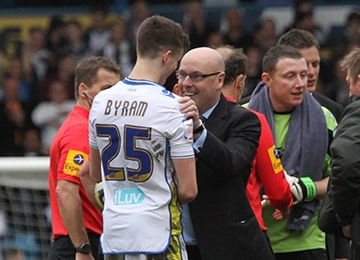
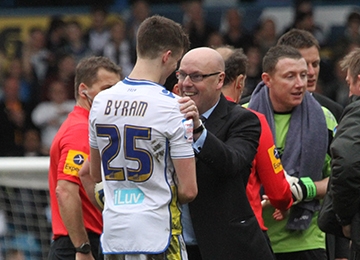
So maybe Hartey could still do a job at Leeds, operating behind a more industrious wide-left player? I’d be inclined to back McDerrmott’s judgement on that one, whatever it might be. Speaking of which, the question of who we keep is at least as important as that of who we sign. Please, Brian – let us hang onto Super Sam Byram.

There’s going to be many more names thrown up by various media as possible signings between now and the start of next season than the three mentioned above. Who we’ll end up with is anyone’s guess and there remains the worrying possibility that it could be yet another big let-down. But Brian seems to want to import some quality, and you get the feeling he’ll have made his wishes known where it counts. Let’s hope so, and let’s hope that the summer that’s a-coming in proves to be rather more exciting and inspiring than some of the fallow transfer windows of recent years.

Another Hollow Triumph for Money, Murdoch and Man United

Image

We deserve the Title! We DO!!! Waaaahh!!!

More than likely they’ll be tenaciously cavorting away in dutiful triumph tonight at The Theatre of Hollow Myths, as Man United celebrate another processional title triumph, brushing aside what I expect to be feeble resistance from Aston Villa..

Since Murdoch bought the game, the Trafford-based club have been on easy street. Better-placed than the rest – given their global fan-base – to capitalise on a league based on glitz and merchandise, their fortunes have been linked inextricably with the fortunes of Murdoch’s Sky TV empire as it has tightened its grip on what used to be our national game.

In 1967, Manchester United won the Football League Championship.  Brief flickering highlights were shown in grainy black and white as the champions paraded the famous old trophy.  England were World Cup holders, Harold Wilson was Prime Minister and a pint of bitter cost about 8p.  It would be two years before Man set foot on the moon and Jimmy Greaves had hair.  It was that long ago.  Matt Busby and his team celebrated another trophy, but their era of success was coming to an end.  Man U would never win the Football League Championship again.

Fast forward 25 years, and Man U came as close as they had ever come to regaining the Holy Grail, only to see it snatched from their sight forever as Leeds United took the prize in 1992 by four clear points, becoming the last ever proper League Champions.  But things were about to change, and not before time.  It had been a clear quarter of a century since the media’s favourite team had won the league; that most marketable of clubs had failed, utterly, to rise to the top of the game where their profit potential could best be realised.  The money men in their grey suits were frustrated.  This could not be allowed to go on.

And so the Premier League was born, in a blitz of fireworks, tickertape and dancing girls, complete with cheesy music, the hirsute Richard Keys, a league title trophy modelled on the lines of Thunderbird One and all the bells and whistles an Australian entrepreneur could dream of.  Behind the window-dressing, bigger changes were afoot.  The money would be channelled upwards, in defiance of gravity and the previous trickle-down economics of the game which had afforded some protection to the relative paupers.  The big and the rich would get progressively bigger and richer; the days of the League Title being won mainly on merit were done.

From now on, the destiny of the title would be decided largely on the basis of pre-season balance sheets.  From a situation where he who dared, won – we would now see an era where he who spends biggest stands the best chance.  One club above all others stood to benefit from this Brave New World – Man U, heralded as the Biggest Club In The World (to a background of incredulous giggles in Milan, Barcelona and Madrid) had built up a worldwide following with their relentless harking-back to the legacy of the Busby Babes and the Munich disaster.  Their history had made them everyone’s second-favourite club; now Murdoch’s revolution put them in pole position to capitalise on that, and reap a harvest of trophies from the seeds they’d sown in flogging Man U tat to a globe-full of eager and undiscriminating consumers.

Resistance became sporadic; almost futile (were Man U the sporting equivalent of Star Trek’s Borg?)  Man U won the first two “Premiership” titles before a cash-rich Blackburn out-spent and out-fought them in 1995.  After that the procession continued, the titles piled up at the Theatre of Myths, only Arsenal, Chelsea and Man City have interrupted the monotonous toll of the bell signalling more success for the most effective franchise in football.

Tonight will see the 20th “Title” for the club that used to be loved by many outside of their immediate support, but are now regarded with a dull hatred by proper football fans.  This is put down to jealousy of course; but every fan has a choice, and jealousy is an unnecessary emotion.  Tonight’s latest success will see the appearance of more Man U acolytes everywhere, as the need to be identified with size and success sucks in those of questionable character and inadequate self-esteem.  More Man U shirts in Torquay and Milton Keynes, more tacky memorabilia sold in Stoke and Londonderry.

The 20th title then – but there remains a clear demarcation.  7 titles in their history up to 1967.  13 in the 20 years since 1993.  Is this just a coincidence?  Of course it’s not; if anything it’s an indictment of Man U’s failure.  Somehow, in seven of those years, they’ve failed to win the league, despite the financial and psychological disadvantages of their rivals, they’ve let it slip away.

The fact is that the titles won since 1993 are devalued by the steep slope in Man U’s favour of the playing field on which all have to compete.  Liverpool were dominant in an even competition for the best part of two decades up to the 90’s; it is now 23 years since they were Champions, but their overall record remains formidable.  Whatever Man U might want to make of it as they crow about 20 titles to 18, they know in their heart of hearts that the baubles won in the Murdoch era are of a lesser water than the diamonds Liverpool gathered to them.  The exchange rate is against them; their achievements are relatively less.  If they maintained their current rate of success for another twenty years (and who knows, they might – but it would kill the game), then maybe they could be compared to Liverpool, the acknowledged masters at the time Murdoch’s coup took place.

But for the moment, I say – as a devoted fan of Leeds United – Liverpool are still The Greatest.

Ingenious Suggestions Invited

ImageSo, I’m writing this book.

It’s going to be about my team, Leeds United, and how the club have accompanied me on the highs and lows of my life, giving me misery when I’ve been at my happiest, and more misery when I’ve been down. It’s been done before, but every fan’s story stands alone and is unique in its way. Football affects us all differently, and we all react in an individual way to the slings and arrows of outrageous misfortune that the game visits upon us. I started relatively late watching Leeds, and it was all my dad’s fault when I finally got round to it. Thanks, Dad. I think.

Really, I wasted the first 13 years of my life farting about watching old films and reading Biggles and Billy Bunter books, when I could have been watching Revie’s heroes stomping all the opposition into submission, and winning the occasional pot along the way. Instead of seeing us win our solitary FA Cup, I was reading a poem out loud at a Music Festival in Ponte, finishing runner-up in true Leeds United style. Instead of watching us take two league titles, I was being a bookworm and dreaming of a career as an astronaut. Talk about a misspent youth.

I finally started watching Leeds in April 1975. Revie had gone to his ill-fated stint as England boss. Big Jack had gone. The great days had gone too, although that wasn’t apparent at the time. Leeds were on their way to the European Cup Final, and my first game was a 0-2 defeat to Liverpool four days before I saw us beat Barcelona 2-1 in the European Cup Semi, First Leg, Cruyff, Neeskens and all. So, fittingly it was Billy Bremner who gave me my first Leeds goal, rocketing a shot into the top left corner in front of the South Stand as I watched stood precariously on my milk crate in that weird shelfy bit halfway up the Lowfields Stand. I still have the commentary of that goal as a ringtone on my iPhone. Fantastic.

And the rest is history; my history and the downs and ups of Leeds United FC over the subsequent 38 years to date. I hope you’ll buy the book, when it appears, and read more of my memories, interspersed with various rants here and there about how the game was, is and (I’m afraid) will be.

The thing is – I really need a title. I’m a bit stuck there, call it sub-editors’ block. The actual book is coming along nicely, and I think a lot of Leeds fans will empathise with what’s contained between the dust-covers – but I’m damned if I can think of a title for the front. Hang on – “The Damned United”?? Hmmmm, ideal – but I have the feeling it’s been done.

I would really appreciate some suggestions. If I end up using one of them, I will happily credit the owner of the idea on the inside front cover, as you do with proper books. And I’ll furnish a complimentary copy also, so you don’t have to wait for it to appear in the bargain bins for 99p. Can’t say fairer than that.

Honestly, I’m fresh out of original, snappy titles. Please help. As Brian McDermott says, we need to sing Marching On Together, and really mean it, suiting actions to words – so your support and inspired suggestions would be right in line with that Leeds United MOT spirit.

I look forward to some brilliant ideas, thanks in advance.

Manchester United – They’re Just Not All That Good

Image

Accuser and Accused

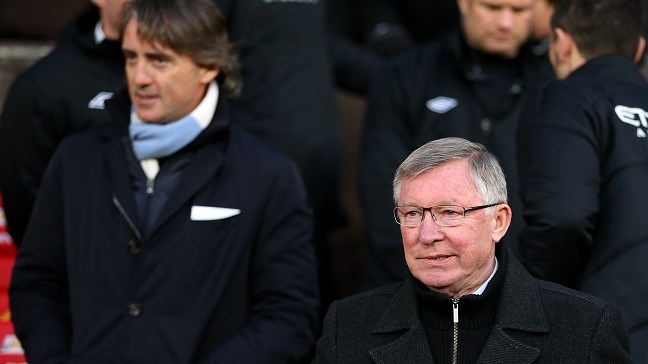
At last, a Premier League football manager has gone public and given voice to a dark suspicion that thousands of us fans have harboured for a long time now. Roberto Mancini, may his name be blessed, says that teams facing the Mighty Manchester United are infected with a fatal lack of belief which amounts a lot of the time to actual fear. This, says Mancini, explains a large proportion of the Red Devils’ domestic dominance. It’s not that they’re that good, he argues; rather it’s that a lot of the opposition simply fail to mount a robust challenge and end up meekly relinquishing league points that nobody really expects them to gain.

Predictably, Man U’s long-serving manager Alex Ferguson is having none of this, accusing the Italian coach of Manchester City of seeking “self-sympathy” – whatever that might be. But the Mancini case is quite persuasive, particularly for anyone whose second-favourite team is whoever the Champions-elect happen to be playing on any given occasion. For those people (and I am proud to count myself among their number) the ongoing spectacle is one of a succession of teams turning up to face Ferguson’s side, and doing very little apart from that – spineless capitulations being the industry standard or so it seems. Very unedifying for those with Manchester United’s worst interests at heart but also, I would strongly suggest, pretty bad for the game as a whole.

So what is the evidence for this alleged collective lack of bottle and professional application? And if it’s true, where does the fear come from? Whence, the lack of self-belief?

Let’s initially get down to cases. As I mentioned earlier, I am a steadfast watcher of the televised games of Manchester United (of which, courtesy of Mr Murdoch, a man who knows his markets, there are many.) I don’t watch with any real expectation of enjoyment; that outcome will only come about if Man U slips to an unexpected defeat or, rarely and joyfully, a real hammering. Much more often though, I sit there in an increasingly foul frame of mind as the latest feeble challengers to the Mighty Reds roll over to have their bellies tickled prior to succumbing politely, without much of a fight at all. All too often this process is aided by the dodgy decisions which famously tend to fall the way of Mr Ferguson’s men, or maybe by copious amounts of what has become known as “Fergie Time”, the perceived need for which varies according to whether his charges are winning or losing. However it happens, it’s all the more depressing because of this pitiful lack of resistance displayed by all too many opponents. You feel frustrated – on your own behalf because you want “Them” to lose – but also on behalf of all those who switch on just hoping to see a good competitive game, with both sides giving their all. That just doesn’t happen often enough, and you sit there and wonder why.

A big factor at play here could well be the psychological gap hinted at by Mancini. What exactly are teams up against Man Utd facing? Not merely eleven chaps clad in red, or whichever of their numerous other kits they might be sporting. In professional competition, especially at the very top level, at least half the battle is in the head; that’s well-established fact. Do these opposing players believe they can win, or do they enter the arena as lambs to the slaughter? Do they feel any real pressure to win from their fans, or do they suspect those fans will quite understand and accept a defeat? Not very much of this type of thinking is required to take that psychological edge off performance.

The particularly annoying thing is that this Man Utd team really aren’t all that good. They got found out twice in Europe last season, latterly by Atletico Bilbao, a team who finished well out of the running in La Liga, but who gave the Mancs the most terrible seeing-to in both legs of an extremely one-sided tie. They’ve been beaten by Chelsea – a side who are themselves in transition – in both domestic Cups this season, and chucked out of Europe this time around by a Real Madrid side who hardly let them have the ball at all.

The European element is of particular interest as it may well be significant that, outside of this country, opposing players aren’t subjected to the constant drip, drip, drip of Man U media adulation that is visited upon domestic foes. Everywhere a player might turn in this country, there’s another article or broadcast or pundit, invariably churning out copious praise of “United”, with emetic results for those of us who don’t buy into the popular legend. What is the cumulative effect of all this? Another dulling of that psychological edge, that’s what.

The media love to talk about Ferguson’s “mind games”, but they’ve never really been anything other than the ramblings of an ever older gentleman, notorious for his inability to see more than one point of view – his own. Greater and wiser exponents of psychological warfare exist in Mourinho, Wenger and Mancini himself – all continental chaps, significantly enough. The edge given to Man U in the battle of wits and wills tends to be provided by a complaisant media and that, I believe, is precisely what the astute Mancini is getting at.

Maybe this is why Ferguson felt the need to come out with such an immediate if not altogether fluent rebuttal. Other clubs have caught up with and perhaps surpassed his own in terms of talent on the field and punch in the transfer market. Ferguson is not likely to want to see any narrowing of the psychological advantage afforded to him by his yes-men in the Fourth Estate. If the Premier League were to be transformed – by such a relieving of the mental barrage – into a level playing field with some willingness on the part of current also-rans to compete and believe, then the current gulf at the top would be a heck of a lot smaller. And then, perhaps, we’d see Champions on merit; not merely winners by default as we will get this season, who have had almost literally nothing to beat for a large portion of the time.

Now that’s the kind of Premier League I’d like to see. Well said, Signor Mancini. Keep the pressure on.

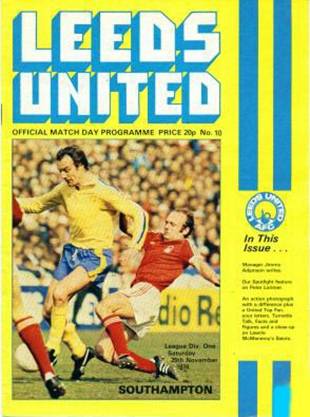
Memory Match No. 5: Leeds Utd 4, Southampton 0 (25.11.1978)

A journey further back in time for this week’s Memory Match, to the golden, hazy days of theImage late seventies. This was a post-glory era Leeds United, but not too bad a side for all that – especially during the early part of Jimmy Adamson’s Elland Road managership. These were the days when the famous old stadium was dominated from all four corners by the tallest floodlights in Britain, towering 260 feet into the Yorkshire sky, and illuminating proceedings with their distinctive diamond-shaped arrays of 220 lamps each. Genial Jim Callaghan was Old Labour’s last Prime Minister before Maggie Thatcher took charge for the Tories, we said goodbye to two long-running police drama series in Z-Cars and The Sweeney and songs from the soundtrack of hit musical Grease figured large in the singles charts along with the likes of Kate Bush, the Bee Gees and Boney M.
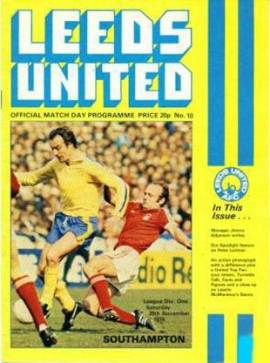
Leeds at this point were a club still trying to re-establish themselves as a success following a distinct decline from the greatness of Don Revie’s all-conquering United warriors. The previous two seasons had seen progress to both domestic semi-finals, but defeat to Man Utd in the FA Cup, and Brian Clough’s Nottingham Forest in the League Cup had blocked the path to Wembley on each occasion. Billy Bremner had moved on, Norman Hunter had gone – but the home crowd had a new favourite in Tony Currie, one of the few players who could genuinely live up to the sobriquet of “Midfield Maestro”. Currie had been signed from Sheffield United in the summer of 1976, and as the 78/79 season dawned he was surely in the prime of his career, shining for club and country alike, pulling the strings which controlled the team’s performance and frequently doing just as he pleased against helpless opponents.

This season had started with the surprise appointment of former Celtic manager Jock Stein to replace the sacked Jimmy Armfield. I still remember being on holiday in Spain, and my Dad chucking a hard-to-obtain English newspaper across at me with the headline “Stein For Leeds” on the back. I had been delighted, but sadly Big Jock’s stay at Elland Road was a mere 44 days before he left to take up his dream job as Scotland manager. So it was Adamson’s Army which greeted the teams on a bleak November afternoon as newly-promoted Southampton provided the opposition. Leeds’ home form had been reasonable, with a draw against West Brom and a narrow defeat to Arsenal in the previous five games, though Birmingham and Derby had both been convincingly beaten, and there had been a welcome 2-1 victory over Chelsea. Attendance levels though were relatively disappointing other than for the traditionally attractive matches against top teams, and a fairly sparse crowd of 23592 turned up for what was, on the face of it, a mundane fixture.

Leeds started as they preferred, attacking the South Stand end of the ground so as to save the Kop for a second-half assault, and they had the breakthrough after only fourteen minutes. Trevor Cherry, coming out of defence, played a probing ball up field where the burly Ray Hankin rose to head downwards to little Brian Flynn. United’s pocket dynamo was always adept at picking up possession in dangerous areas and making good use of the ball, and he was quick to scurry across the edge of the Saints penalty area towards the right, where he neatly slipped a pass to Arthur Graham. The Scottish winger was well-known for his ability to cut in from either wing, and once he got the ball in space on either foot, he could be quite lethal, as he proved now. Moving back infield, he easily evaded a defender before turning smartly to fire left-footed past former Halifax ‘keeper Terry Gennoe into the bottom right-hand corner. It was a clinical finish, giving the Southampton stopper no chance at all.

Eight minutes later, the lead was doubled, and this was a collectors’ item of a goal. Not since Boxing Day 1975 had Paul Madeley troubled the scorers, but here he was suddenly in what was nose-bleed territory for him, just outside the opposition area as Graham rolled in a pass from the right. United’s Rolls-Royce, as he had been dubbed, was a Mr Versatile of many years standing, having worn every outfield number for Leeds, but he was never exactly prolific in front of goal. Now though he seized on Graham’s pass and struck a left foot shot which took a cruel deflection, hopelessly wrong-footing Gennoe who could only watch as the ball bobbled into the net. 2-0 to United who were cruising at half-time, having been rather unluckily denied a third when John Hawley’s header thudded against an upright after a flowing move down the left.

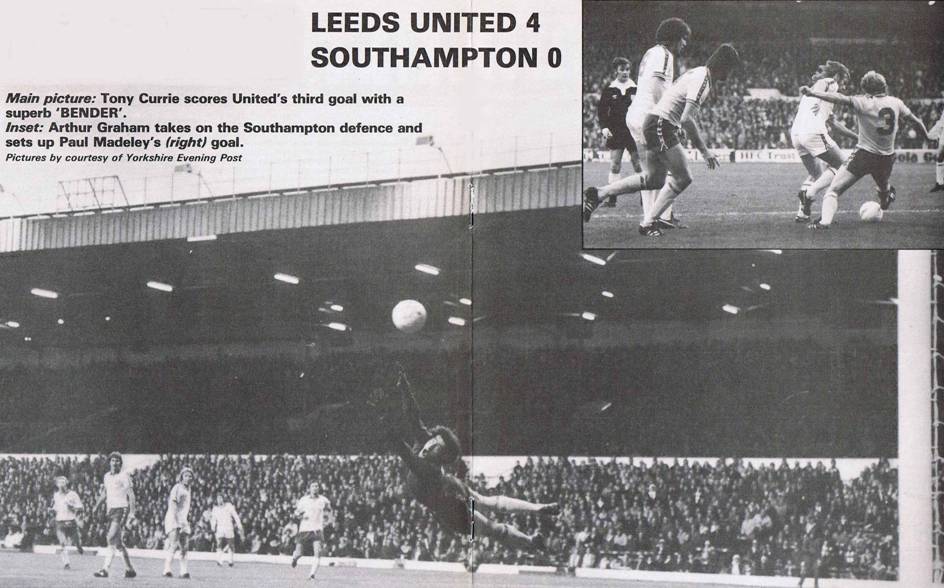
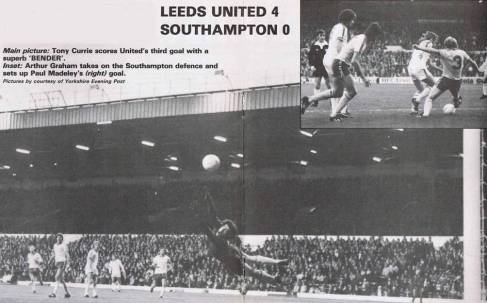
The second half was only ten or so minutes old when one of the most famous Leeds United goals in living memory drew rapturous applause from the fans massed behind the goal at the Gelderd End. Tony Currie had been in full-on matador mode all day, taunting opponents with his mastery of possession, effortless control, trademark step-over and change of pace. His range of passing on form like today’s was almost Giles-esque, and there really is no higher praise than that. It had always looked like being Currie’s match to dominate, and now he scored the goal that cemented his place in United folklore. Snatching possession midway inside the Saints half, Currie mastered a lively bouncing ball before advancing on a nervously retreating Chris Nicholl. Rather than doing anything so mundane as beating his man, Currie looked up and, using the Saints defender as a shield, he simply bent the ball around him on a beautiful, curving trajectory, past the diving Gennoe to nestle in the far right-hand corner of the goal.

“Oh, my goodness!” intoned an awestruck Martin Tyler commentating for Yorkshire TV, “…and Tony Currie milks the applause that is so deserved.”
Image

The rout of the Saints was complete on 65 minutes, when a Trevor Cherry cross from deep on the right caught the visitors’ defence hopelessly square, leaving Hankin in space and onside. Yugoslav defender Ivan Golac, who had never scored in English football until today, now broke his duck in the most undesirable fashion, chasing back nobly to dispossess Hankin who was casually weighing up his options, but tragically succeeding only in lifting the ball over his ‘keeper and into his own net for 4-0.

For much of the remaining 25 minutes, Leeds seemed to take their foot off the gas somewhat, and allowed a Southampton side – who had, in truth, battled well throughout – a number of pots at David Harvey’s goal. The Leeds ‘keeper though, unaccountably frozen out of a Scottish International side that could well have used his agility and experience, was equal to everything thrown at him, and preserved a clean sheet without being troubled unduly.

It hadn’t been a fantastic match, or indeed an especially memorable one, apart from two superlative goals from Graham and Currie. History shows, too, that Southampton would have the last laugh that season, coming back from trailing 2-0 against Leeds United in the first leg of the League Cup semi-final at Elland Road, to draw that game 2-2. They then completed the job with a 1-0 victory in the second leg at The Dell, going through to lose the Wembley final against Nottingham Forest.

But for United it was the season that saw us back into European competition for the first time since our ill-fated European Cup Final against Bayern four years previously, and the Saints win contributed its fair share to that achievement. Sadly though Tony Currie was soon to depart, his then wife apparently homesick for London. He duly joined QPR and eventually graced Wembley at club level himself as Rangers played Tottenham in the FA Cup Final of 1982, before injury drew a close to a flamboyant and entertaining career. Leeds without Currie were never quite the same force again, and we were now on the downward spiral to eventual relegation in the 1981-82 season.

In many ways then 1978-79 was United’s last hurrah in the top flight, our last decent stab at competing in the top league until Howard Wilkinson restored that status in 1990; and Tony Currie was certainly in my opinion the last real Leeds Legend of the immediate post-Revie era. For me, he was one of the greatest, and I mourned his departure more than most I have witnessed over the years. It felt like the end of an era when he went, and so it ultimately proved to be. But Currie left us with some magical memories, perhaps the greatest of which remains that terrific banana shot at the Kop End, a goal worthy of any superstar, and one fit to grace any occasion.

Next: Memory Match No. 6: West Ham Utd 1, Leeds United 5. Upton Park was frequently a happy hunting ground for Leeds, and the Whites’ cause was aided on this occasion by a couple of Hammers dismissals in a May 1999 game where – for once – we seemed to get the rub of the green where the ref was concerned.