Category Archives: Football

Man City Will Bounce Back

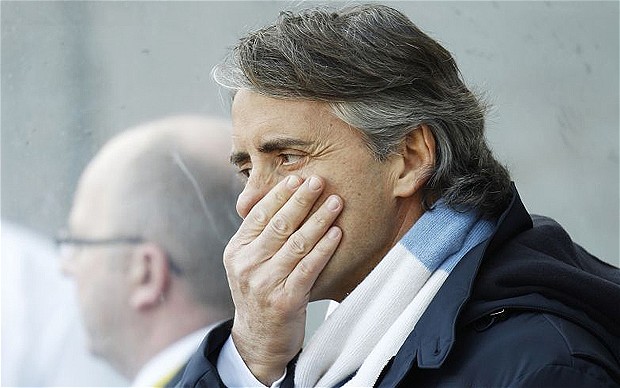
Mancini: Sacked

Mancini: Sacked

Events at Manchester City this last day or so were flagged up well in advance – the media screamed “Mancini Out!” from every outlet – and despite scornful denials by the man himself, and messages of support from the fans, you felt it would turn out to be a case of “no smoke without fire.”

Even so, the news when it arrived, poignantly on the very anniversary of that last-gasp Title triumph, was a shock of sorts.  The club moved swiftly to justify their action – Mancini had “failed to meet football targets”, it was said.  Criticism was made too of his inability or reluctance to communicate, of an aloof and arrogant attitude, of his lack of interest in club matters below first-team level; specifically an apathy where bringing youngsters through was concerned.  Clearly all was not sweetness and light on the good ship City, and the mystery of their rudderless run-in for the league campaign, and how they sank without trace in the second half of the FA Cup Final may not be such a mystery after all.

In the odd spare moment I’ve had this season to glance upwards towards the Premier League summit, and away from Leeds United’s mid-table Championship toilings, City have puzzled and frustrated me.  At the outset, they seemed well-equipped to mount a reasonable defence of their title.  There were clearly two sides to this equation.  On the one hand, the squad at The Etihad was, in my view, the best in the Premier League – rivalled only by that at Stamford Bridge.  On the other – Man U are notoriously capable at employing a siege complex in order to use resentment to fuel their fightback.  They are also, undeniably, helped in large measure by the number of weird decisions that seem to go in their favour.  The away game at Chelsea was a good example of this, when Torres was sent off for being fouled by a Man U defender already on a yellow, and then the Salford side scored a late and clearly offside winner. This sort of thing tends to pepper Man U’s most successful seasons, and it’s not an attractive facet of the Premier League.

I’ve never subscribed to this “van Persie made the difference” nonsense.  I’m sure he made A difference – but not that much.  It’s been a stroll for Man U in a league in which they should – by all considerations of relative quality – have struggled to finish third.  Chelsea have had their own problems.  The phrase “Interim Coach” needs nothing added to it for an explanation of their failure.  But Man City was a conundrum, and it is only now, in the wake of Mancini’s sacking, that we are perhaps gaining a more complete picture of what things were like behind the scenes.

Now a tell-tale tweet from former kit man Stephen Aziz may have shed some light on just how negative the atmosphere has been at Man City.  The phrase “arrogant, vain and self-centred” appeared briefly before the tweet was removed. And there was more: “no manners ignorant just some of the daily traits really made going into work a daily grind!! #karma”.  That’s all pretty damning stuff, and quite frankly at top professional level, it doesn’t take one tenth of that apparent level of unhappiness and discontent to derail a club’s bid for honours completely.  This, more than the failure to pick up a trophy, may well be what lies behind Mancini’s abrupt departure on the first anniversary of his finest hour.

Man City fans feel an understandable affection and loyalty to the man who has given them their finest moments in over thirty years.  I too recall the expression on his face as City hammered Man U 6-1 at The Theatre of Hollow Myths, and I remember thinking that here was a man who would end up as loved as Malcolm Allison in his late-sixties incarnation, or Colin Bell, or any one of City’s heroes you may care to name.  He had the opportunity to instill himself into the DNA of the club, but – inexplicably – it looks more and more as though he’s been too arrogant to see the need to treat people as they need to be treated, and has therefore lost his fledgling Legend status.  The City fans will always remember him, of course.  He delivered, albeit at the last gasp, and put an end to an aching void where they’d won nothing as their despised neighbours cleaned up.  Of course he will always have a place in the collective City heart.

The next appointment is vital, however.  If City get it right, the quality of this squad can carry all before them next season.  Man U have a rookie at the highest level, and must expect a bedding-in period.  This year has been bizarrely tilted away from the finest talent in the league.  Next year may well be very different.

Matt Mills £1m Leeds Target?

Mills:  Leeds-bound?

Mills: Leeds-bound?

The Swindon-born former Reading and Leicester defender has not been an outstanding success at Bolton Wanderers, his last start for them being against Huddersfield on December 8, when he injured a thigh and has managed only one substitute appearance since.  His time at Leicester City was hardly wonderful either, and Mills was a loan target for former United boss Neil Warnock early in his Elland Road tenure.  That failed to happen, and a rumoured £2m fee saw the defender link up with Bolton – but it seems likely his time there is now up, with an offer in the region of £1m being thought sufficient to secure his services.

The player himself – according to the familiar “sources close to…” – is keen on the chance to renew his working relationship with his old Reading boss Brian McDermott.  Central defence is on the list of positions needing to be strengthened at Elland Road, and it may just be that the Old Pals’ Act could secure a reliable performer for United. This optimistic assessment is certainly not based on recent form, but there have been many instances down the years of players in the doldrums being reinvigorated by a reunion with a former mentor.  McDermott’s success at the Madejski throws up a few names, some still at Reading, some that have since moved on – that could be identified as players who would relish another crack of the whip under an old boss at a club like Leeds – enough of a pull in its own right.

Mills has certainly waxed lyrical about his past service under McDermott and assistant Nigel Gibbs. “My first few months at Reading didn’t pan out as the move I expected and wanted, but that all changed when Brian got the job and Gibbo became assistant manager.” the ex-Royal has been quoted as saying. “They gave me a new lease of life, and the opportunity and coaching they gave me has honestly made me the player I am now.”  As fulsome tributes go, this is very much in “come and get me plea” territory, and it has been suggested that Mills is willing to reject overtures from elsewhere in favour of a switch to LS11.

My own view is that, at only 26, Mills has many miles left on the clock, and the class he has undoubtedly displayed in the past will not have deserted him permanently.  A happy player is more likely to be a top-performing player, and the fruitful coaching relationship between Brian, Gibbo and Matt at their former club seems to suggest that its a scenario which could unfold again, to the satisfaction of all parties.

Whether the powers that be are prepared to stump up £1million is of course another matter, and wages are always an issue as well.  But there is some pedigree here, and the chance to build on some good history too.  So I feel there may just be some legs in this rumour, and it’s a move I would love to see happen.  “Lees and Mills” could well be the central defensive partnership on everybody’s lips in the Championship next season.

Play-Off Karma Drama as Watford Sink Leicester to Book Wembley Berth

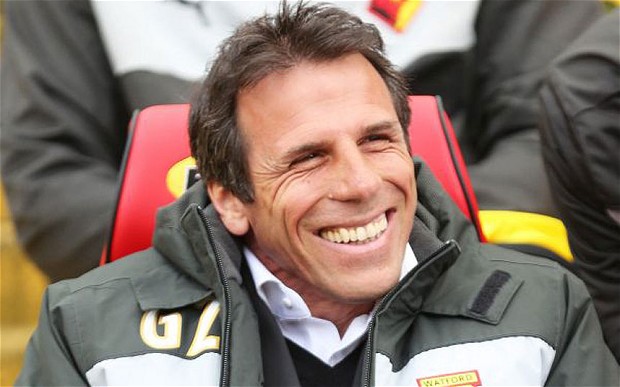
Happy Gianfranco Zola

Happy Gianfranco Zola

Given the incredible outcome of this game, it would be tempting to dismiss the first 94 of the 97 minutes as irrelevant. That would of course be the greatest injustice to a fine game which had already yielded three wonderful goals; first a brilliant finish from Matej Vydra as the ball dropped from behind him over his left shoulder for a terrific left-foot volley past the helpless Schmeichel. Then the reliable Nugent found space at the far post to rise and guide a great header just out of Almunia’s reach to level the match and put Leicester back ahead, 2-1 on aggregate. Half time, and it was “as you were” with City retaining the lead they’d gained in the first leg at the King Power Stadium.

As the second half progressed, Watford were hammering away and Leicester – although pressed back constantly – seemed to be coping relatively well. Home manager Gianfranco Zola knew he had to change things, and he acted to replace Lloyd Doyley with Fernando Forestieri. Within a matter of minutes, Watford produced a quite excellent team goal, Vydra playing an immaculate one-two with Troy Deeney to score his second from just inside the area. So, we were all square again, and the nearer the match edged to full-time, the more it looked as if an extra 30 minutes were inevitable.

The full ninety had already ticked by and the match was well into six minutes injury time when Anthony Knockaert made his fateful move down the Watford left flank. Showing trickery and strength, he shrugged off a foul challenge outside the box, but then as he progressed into the area, a much lighter touch felled him. As if in slow motion, referee Michael Oliver assessed the situation, failed to call it for the dive it was and pointed to the spot. Watford players were anguished and amazed, Zola on the touchline was clearly stunned, showing with every line of his being that he could see a whole season’s work going up in smoke right at the death. Knockaert placed the ball on the spot as Leicester’s travelling hordes prepared to celebrate Wembley, the penalty was hit low and down the middle but not with great force – and there was Almunia’s trailing foot to stop the ball. Still, Knockaert was closing in on the rebound, surely poised to hammer the ball into the net and finish the matter, but Almunia did it again, rising to his knees to flail an arm at the loose ball, deflecting it to a defender who gratefully belted it out of the area.

And now Lady Luck performed one of those graceful pirouettes for which she is rightly famed. As the Leicester players were still coming to terms with their failure to seal the tie, Watford showed no such distraction, playing the ball out to the right and flooding support into Leicester’s own penalty area. The ultimate end-to-end finale was playing out now, as the ball was crossed from near the right hand corner flag, beyond the far post where sub Jonathan Hogg beat Schmeichel in the air to head down precisely for the onrushing Deeney, who slammed the ball gleefully, unanswerably, into the Leicester net. 3-1 on the day, when it could so easily have been 2-2. 3-2 to Watford on aggregate, when that score had looked like being reversed in City’s favour. The Leicester players stood waiting for the restart as the pitch was cleared of jubilant Hornets fans, transfixed and disbelieving at the turn of events which had seen certain victory turn to catastrophic defeat. A few more seconds, and it was over.

Ironically, of course, if Knockaert had stayed honest and stayed on his feet instead of going down so easily, the game would probably have gone into extra time, and who knows what might then have happened. On such twists of fate are whole seasons decided, and karma had come to Knockaert in its cruellest form, landing the most clinical of knockout blows. He ended up in tears, wandering around the pitch after the whistle, uncomprehending as his desolate team-mates tried in vain to comfort him. Over the two games of this tie, it’s fair to say that Watford deserved to progress, so for once justice was done, and seen by millions to be done in the most dramatic and entertaining manner. But spare a thought for the hapless Anthony Knockaert, hero (albeit with feet of clay) to villain in the space of a few seconds as his world turned upside down. That’s life – and Leicester will continue their life in the Championship next season. Watford, meanwhile, march on con brio – full of confidence. They will now be optimistic of completing their Italian Job and winning promotion at Wembley.

Where’s That Sick-bag?

A Sickeningly Solemn Moment

A Sickeningly Solemn Moment

Ladies and gentlemen, if you have sick-bags to fill, prepare to fill them now.  If sugary treacle and soft-sawder syrup is your thing, get ready to drown in the stuff.  “Sir” Alex Ferguson is departing the stage, and there won’t be a dry seat in the house.  Sky TV are preparing for an extended weepathon as their hero who hated them, their idol who despised them, climbs down unsteadily from his throne of purchased glory and totters off upstairs to chew gum and glower balefully down at his hapless successor David Moyes.

This afternoon’s live TV offering has a delicately-scripted path to follow.  There will be a soft-focus montage of many of the Purple-Nosed One’s finest moments – Steve Bruce’s 98th minute winner against Sheffield Wednesday to a background of Martin Tyler’s shrieking climax as Man U all but clinched their first plastic Title.  Giggsy-Wiggsy’s finest FA Cup goal of all time as the Arsenal defence parted like the Red Sea and we were treated to an unsolicited view of the Husband of the Year’s chest-rug.  A selection of van Persie’s catalogue of sublime finishes from the Dutchman’s “One Man Title-Winning Season” collection.  It is doubtful however that Eric Cantona’s exposition of martial-arts skills from his South London Show of 1995 will make the cut.

After the moonlight and roses video softener has set the correct ambiance, and armchairs all over Devon and Cornwall are already bedewed with manly tears, we may have an actual interview with the dearly-lamented Departing One.  Subtitles will be provided for this section of proceedings, and yet it won’t so much be what He says, but more the way He says it.  As an example, if you hear a glottal noise along the lines of “Thiznaequayshtyunabootthaaaaat” it means that S’ralex is saying something he wishes you to accept as undisputed fact.  This happens a lot.  But those craggy and broken-veined features of pasty pink splotched with purple may at some point break into a grimace not unadjacent to a smile, and this will be the cue for the suits in the Sky Studio to howl with unrestrained emotion as the tears flow anew.  It’s going to be a harrowing afternoon, and we’re nowhere near kick-off yet.

At some point we will have testimony from a group of the usual suspects as to the essential saintliness and unmatchable achievements of the man.  Lou Macari, Paddy Crerand, Peter Schmeichel, Steve Bruce, Bryan Robson and other such neutral witnesses will speak their lines to camera with all the sincerity and conviction of a tailor’s dummy. Ron Atkinson and Tommy Docherty may even appear if time permits, and attempt to mask their burning resentment at being consigned to the dustbin of history with a few clamp-jawed soundbites of faux admiration, before shambling off, clutching Mr Murdoch’s fat cheque.

And then, the game.  It has been thoughtfully arranged that the final day opponents at the Theatre of Hollow Myths should be a footballing side of attacking ambitions.  The script will call for them to make pretty patterns in midfield whilst offering no great threat to Man U’s rocky defence, where Phil Jones will be frantically gurning in an attempt to frighten off any Swansea attacker who dares venture too close.  At regular intervals, an uncharacteristically misplaced pass from the away team bit-part players will gift possession to Man U, who will then – according to the stage directions – “swoop to score another magnificent goal for the Champions.”  Ecstasy will ensue in the stands and the commentary box, and flowers will be thrown at the feet of the gum-chewing Govan Guv’nor as he performs that annoying little staggery old man’s dance from under the dug-out canopy, champing away in a Wrigley’s rictus of triumph.  It is an image that will be burned on the retinas of a whole football-supporting generation.

After the match – whatever time that might be depending upon how long it takes Man U to score The Winner – we shall have post-game interviews, more video footage to the accompaniment of weeping strings and synth, rambling reminiscence from the assembled sycophants – and maybe a final word from the abdicating Emperor himself, who will remind us, via an interpreter, that there’s “aye anither game tae go yet, by the waaaaay.”  And the crowds will sigh and depart for all points south, the lights will go out at the Theatre of Hollow Myths and the scene will gradually darken as a rainy Salford day fades into the night, as we all must sooner or later.  All that has been missing is the trademark Lone Piper, but he is reserved for even more solemn occasions, and his time is not yet.

And so it will be over.  It will be time for the Sky suits to heave a gigantic, shuddering sigh signifying end-of-an-era grief and regret, and then they must reluctantly move on.  A new hero awaits, and he’s sadly lacking as yet in the trappings of success and the aura that the commercially-aware would wish for him.  A project is to hand now that S’ralex has faded into the sunset, and that project is the reinvention of an Honest Pro into a Demigod, the Greatest Manager Of All, for such is the requirement of the twinned Hyperbole Departments of Sky and Man U for the unsuspecting Mr Moyes.  It’s a work in progress even now, but the momentum will gather as the new season approaches and the threat of upstarts such as Chelsea. Arsenal, Man City and even Liverpool, which has to be repelled for another year.  It will need to be business as usual, even without the Blessed Fergie. Life goes on, and today was merely the schmaltzy climax to the long-running soap-opera which was Man U under S’ralex.  It’s time to dry the tears and count the money.

Now where IS that sick-bag?

Moyes? A Strangely Unambitious Choice

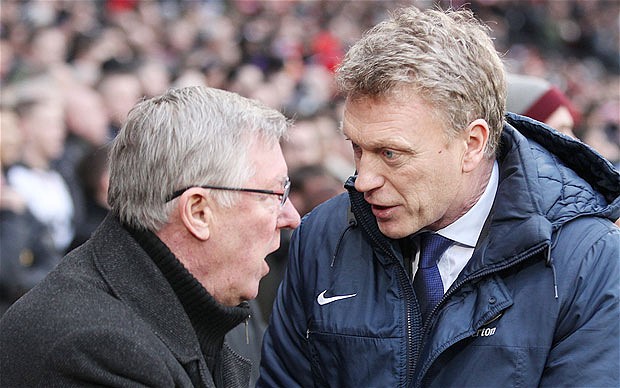
"Eh - by the waaaaay, Ah'll no' be leavin' ma whisky, wee Moyesy"

“Eh – by the waaaaay, Ah’ll no’ be leavin’ ma whisky, wee Moyesy”

David Moyes swiftly emerged yesterday as a heavily odds-on favourite to replace Alex Ferguson as boss at the Theatre of Hollow Myths.  On the face of it, there’s an obviousness about this solution; Moyes has performed solidly for over a decade in the top flight at Goodison Park on a budget that, if not exactly shoestring, certainly lacked the munificence of the chests of bullion in other parts of the North West.  He has failed to win a trophy in that time but that is not in itself a criticism of any coach in an era when the silverware tends to go to the highest bidder.  The best coach around, M. Wenger, has been potless since 2007, after all.  Moyes has the appearance of a “safe pair of hands” option – someone who will come in and instigate evolution rather than revolution, a guy who can be relied upon not to depart too suddenly or drastically from the blueprint laid down by the man whose brooding presence upstairs will be a palpable influence on any new boy, whoever he might be.

This acceptance by Man U that Fergie will still be kicking about the place is tinged with danger; the lesson of history taught by the hanging-on post retirement of Matt Busby seems not to have been heeded.  The legacy of Fergie is more akin to a poisoned chalice than an inspirational example; the new coach on the block will have to set off on his hoped-for marathon at 400 metre pace.  There will be little chance or latitude afforded for any cosy bedding-in period at a club with a constitutional, almost Freudian need to be the biggest and the best.  A large proportion of their support has been conceived, weaned and nurtured on this propaganda and the last thing that any of them will want to feel is the chill blast of reality as the likes of City, Chelsea and Arsenal walk off with next season’s honours.  So Moyes (most likely) or whoever else it might be will simply have to hit the ground running, compete effectively at the highest level, placate a squad of big egos who are used to a very particular type of regime and solve the immediate Rooney wantaway (or wantanewcontract) problem.  All of this under the basilisk glare of elder statesman Fergie, glowering from a handy balcony over his former empire, hairdryer silenced but still handy.

The immediately noticeable thing about Moyes is his relative lack of European experience, and Man U is a club that sees itself as a European force despite the threadbare achievements on the continent under Fergie.  The other burning question that has to be asked then is: what would other European “giants” have done after losing a quarter-century institution as Man U have just done? Would they have plumped for Joe Bloggs from down the road, or would they instead have scoured the continent and beyond for a stellar personage of massive achievement elsewhere, someone whose CV is festooned with honours and who would breeze in expecting to maintain the winning habit?

It’s irresistible to feel that the latter would be the preferred option for your Barcas and your Real Madrids, your Bayern Munichs and – yes – your Chelseas, too.  In the immediate aftermath of the announcement that Fergie would be chewing his gum in the directors’ box next term, hopeful noises were emanating from the Man U-friendly press that The Purple-Nosed One might possibly be succeeded by The Special One, maybe even with one C. Ronaldo in tow.  It may yet be that Christiano brings his balletic skills with double-pike and twist back to Man U, but any prospect of Jose heading to Salford appears remote in the extreme – he is far more likely to be strolling down the Kings Road this summer.  Other ideally-qualified coaches have scrambled over each other in their haste not to queue up for the Man U job.  The poisoned chalice image appears to have lodged within the minds of Europe’s coaching elite.

So it is likely to be Moyes – not for his own sweet self, but more for the lack of any realistic alternatives.  It is this paucity of choice for a club like Man U – who were supposedly aware of Fergie’s retirement decision as far back as February – that is rather baffling.  Perhaps they expected Fergie would soldier on for a few years yet.  Perhaps also they weren’t expecting the grumpy Govanite to give up so easily on his ambition to overhaul Liverpool’s European Cup record.  But the emergence of crack teams from Germany as well as the still-formidable forces from Spain and elsewhere in England appear to have been a reality check for “S’ralex”, who must in his more coherent moments have realised that climbing the European summit again in the foreseeable future is a dimly remote prospect. It may well be that a “safe” appointment such as Moyes will serve to dilute expectations just enough to cure these fanciful notions that Man U could possibly break into the Continental elite.  Perhaps an FA Cup run and top four in the Premier League will suffice next season, and save Moyes from the fate of Wilf McGuinness back in the day.  But I frankly doubt it.

The King is dead.  Long live the King – but who, and for just how long?

Thatcher & Fergie – Unlikely Bedfellows

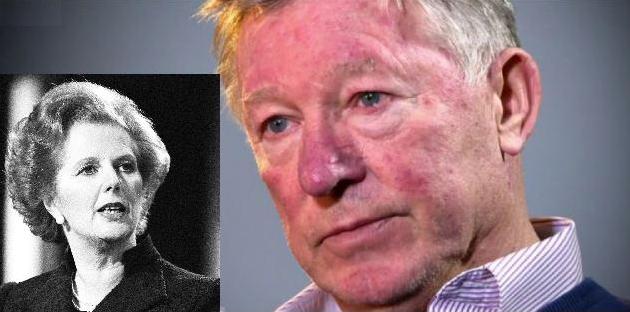
Two Media Darlings

Two Media Darlings

It’s been an awkwardly stomach-churning day for any self-respecting Man U-hater with anything but the most robust of digestive systems.  The output of Sky TV and BBC Radio Five Live in the wake of the Govan Guv’nor’s resignation as Supremo at the Theatre of Hollow Myths has been wall-to-wall, sickly sweet revisionist nonsense.  It was perhaps predictable – Man U seem to attract this kind of attention quite regularly.  They hypocritically call Liverpool the “City of Pity” and “Shrine Worshipers”, and yet there was the cloying sentimentality of the Lone Piper at Old Trafford when Busby died, and of course there is the nauseatingly poorly-written “Flowers of Manchester” doggerel recycled every February 6th when the Man U Marketing Machine gears itself up for the annual “Let’s Make More Money Out of Munich” event.  The treatment of Man U in the media has a lot in common with the ingestion of a copious draught of heavily-salted water.  Both are pretty much guaranteed to make you sick.

For some of us, it’s only been a couple of short weeks recovery time since the last bilious attack brought on by an onslaught of gushing praise for a much-hated public figure.  To listen to the BBC’s output in the wake of Maggie Thatcher’s death, you’d think she was universally acknowledged as a saint who personally saved our country from the hordes of infidel savagery, instead of a humourless and uncaring woman who presided over the decimation of manufacturing industry and created an underclass of unemployed dole fodder.

Ironically, that assessment of Thatcher – the realistic one, not the BBC’s rose-tinted, soft-focus blarney – would almost certainly strike a chord with Ferguson, a man who has always made much of his Socialist roots.  And yet the fulsomely worshipful bilge poured all over her death and funeral has been rivalled today both in flavour and quantity as various media outlets have sought to paint a picture of “Fergie the Greatest”, conveniently ignoring the essential character of the man, which is that of a coarse bully and a ruthlessly competitive control-freak who would brook no opposition and practiced suppression of dissenting voices on a grand scale as well as nepotism, intimidation and other deeply unattractive tactics.  Ferguson and Thatcher operated in vastly different spheres, and pursued their objectives in vastly different ways, although the objectionable single-mindedness and refusal to acknowledge any other point of view was common to both.

It is arguable too that both shared a similarly dislikeable personal character and yet that both represented vested interests which have caused a complaisant media and establishment to bend over backwards in their efforts to hide these unfortunate facts.  However difficult they both were to handle at different times – Ferguson famously “banned” the BBC from his personal airspace for an extended period, claiming in a juvenile fit of petulance that the Corporation was “pro-Liverpool”, and objecting to their focus on the activities of his shady agent son Jason – the media still fall over themselves to praise both to the skies.  Powerful interests are at work here, rigid agendas are being pursued.

Ferguson will not relish any comparison with the Iron Lady, and yet such comparisons are irresistible.  Nepotism, for instance.  Thatcher was accused in many quarters of using her influence to smooth the path to riches of her not-outstandingly-bright son Mark, a man who would seem to have difficulty finding his way out of an open box.  Ferguson allegedly pushed the services of Agent Jason on young players at Man U and reacted with fury if the lad in question went elsewhere.  When his fledgling manager son Darren was sacked by his employers after his latest relegation, Fergie senior reacted by recalling two young Man U players who had been at that club on loan.  The similarities in modus operandi for Fergie and Thatch abound.

It is for the gross and over-the-top way in which both have been virtually canonised by the media in the wake of their exit from the stage that really sticks in the throat, however.  The tasteless extent of it, the gushing, nauseatingly deferential tone of the ubiquitous tributes, strike a remarkably similar tone in either instance.  In Thatcher’s case, the masses thus appeased were the blue-rinse brigade and their Colonel Blimp husbands, Tories to their last cell, and voraciously hungry for any news coverage to confirm their view that la Thatch was the greatest since Churchill, the greatest peacetime leader ever.  The claims of Clement Attlee, the authentic greatest PM ever, were callously overlooked, as was the fact that his funeral in 1967 was a quiet and dignified affair.  In the case of Ferguson, the masses are of course the legions of Man U fans all over the world and in Torquay and Milton Keynes in particular, who have been fed the myth of Man U being the greatest club in the world (Arf!) and who now wish to hear Fergie being called the greatest, against the claims of true greats like Busby, Revie, Shankly and the rest, proper managers who had to do it all on a level playing field and not the Sky-weighted Man U-centric environment we have now.

Radio Five Live are still at it, as I listen.  We go “back to Old Trafford” on a regular basis, to listen to the hushed tones of a reverential reporter, laying it on thick for the benefit of the thick.  It’s all so remarkably similar to the nonsense we all suffered in the wake of Thatcher’s passing.  Perhaps, for Ferguson, that is the unkindest cut of all.

Alex Ferguson – A Tribute

Purty, Ain't He?

Purty, Ain’t He?

The football-related media is in a frenzy of mourning today after the announcement that Sir Alex Taggart has decided to step down as Supreme Dictator of the FA Premier League.  Who will follow him, they ask, tearing their hair and wringing their hands in distress.  Chelsea fans may be surprised to hear that Bridge-bound Jose Mourinho is being mentioned as inheritor of the poisoned chalice that is the hot-seat at the Theatre of Hollow Myths.  But Jose is surely too fly and savvy  to “do a McGuinness” as the task of following a long-serving Man U manager is known in the game.  Everton fans too may be wondering whether David Moyes will be offered the chance to step into the role of “Premier League’s Token Grumpy Scotch Git.”  Whoever ends up in Mr Ferguson’s gout-adapted tartan slippers has a job on his hands alright, and will need urgently to review the manual on “How To Bully and Intimidate For Personal and Professional Gain”.

The loss for the media will be acute.  Hacks as a breed dearly love the cosy familiarity of a tyrant at the top of the game, someone who is an outlet for all of their natural tendency to fawning sycophancy, a figurehead over whom they can compete to praise in the most glowing terms whilst neatly overlooking the glaring flaws of a man who has been a study in coarseness and choleric wrath when things even threaten to go other than as he would like.  The newspaper journos will miss “S’ralex” – he represented continuity for them, an opportunity to trot out well-worn cliches and perpetuate comfortable myths.  Now they may even have to think before starting another Man U piece – it will be a shock to be so brutally jolted out of a 26 year comfort zone.

Ferguson has his place in the history of the game.  He will serve as the biggest negative example of how to ruin the previously positive image of a historically-respected football club, making of them a byword for arrogance and the tendency to ride roughshod over the rules and conventions of the game.  He is there as a useful comparator for the true greats of football and how they went about their business, with humour, humility and a sense of their own fallibility.  The likes of Busby, Shankly, Revie, Stein, Nicholson et al are all part of the rich fabric of the game, all lost to us now, but all clearly capable of favourable assessment in the light of the Ferguson legacy; none will suffer in comparison with the man from Govan.

People will point to his record of success – and sycophants and revisionists will hastily gloss over his difficult early years at Man U when the home crowd called for his head and despaired of ever being able to aspire to the levels of Liverpool and Everton, great clubs run properly.  The re-organisation of the game and its finances when the Premier League came in was highly opportune for Ferguson, and he certainly made hay while the sun shone; it shone for him for the bulk of the remaining 20 years of his career.  Ferguson suddenly found himself in charge of a racehorse competing in a donkey derby, the interests of consumers suddenly paramount, the need to sell satellite dishes and replica shirts in hotbeds of Man U support like Devon and Milton Keynes emphasising the commercial importance of a successful Man U team.

All of a sudden, the top players wanted to go to Salford, all of a sudden the statistics of the game tilted heavily in Ferguson’s favour.  Penalties against them had never been plentiful, now they were as rare as a rosebush in the desert.  Ferguson’s natural personality came to the fore; his tendency to bully and to rant began to produce real results in terms of the attitude of the media and of the game’s officials, both on the field in the shape of cowed and terrified referees, and off it with the administrators unwilling to court commercial unpopularity by waving the rule book under that purple nose.  The most familiar sound-bite emanating from Lancaster Gate was suddenly “The FA can confirm that Alex Ferguson will face no disciplinary action for (insert example of blatant disregard for the rules here.)”

Referees became aware of the fact that those of their number who made a decision not to the liking of Ferguson tended to wait a very long time before selection for another fixture involving Man U.  These are high profile games, and referees increasingly had to look to their own career prospects as their role assumed more of a professional profile.  So they tended to knuckle under, perhaps only subconsciously, but the effect over many years has been enough bizarrely ridiculous decisions in favour of Man U to spoil the digestion of many a football fan who remembers fairer days pre-Murdoch, pre-Man U dominance.

Given this decided slope of the playing field in Man U’s favour, the wonder of it all is that they haven’t won more.  There have been years when the Title has gone elsewhere; remarkable this, in a game of fine margins where one study exposed as fact that 88% of all 50-50 decisions went the way of the Salford Franchise.  This is the measure of Ferguson’s failure; a manager who was also a good coach would surely have cleaned up in such a very favourable environment.

So what now for Man U?  To be honest, I can see their domination continuing.  It’s likely that the public image of the club will be enhanced under a manager who does not represent quite so many of the negative personality traits exhibited by Ferguson.    It will certainly be interesting to see if a world-renowned coach – if appointed – can improve on their patchy record in Europe, where Ferguson’s habit of intimidating refs has not been such a marked advantage to them.  Two somewhat lucky Champions League wins is a poor return for twenty years of almost unlimited opportunity, and a better man in charge might perhaps improve on this and finally give Man U more justification for their laughable claims that they have “knocked Liverpool (Five European Cups) off their perch.”

The question will be asked next season “Who’s the greatest manager in football now?”  The answer will be the same as this season: choose any one from Mourinho, Wenger and Hitzfeld.  All the propaganda in the world cannot make a silk purse out of a sow’s ear.

Parachute Payments – Are They Really All That?

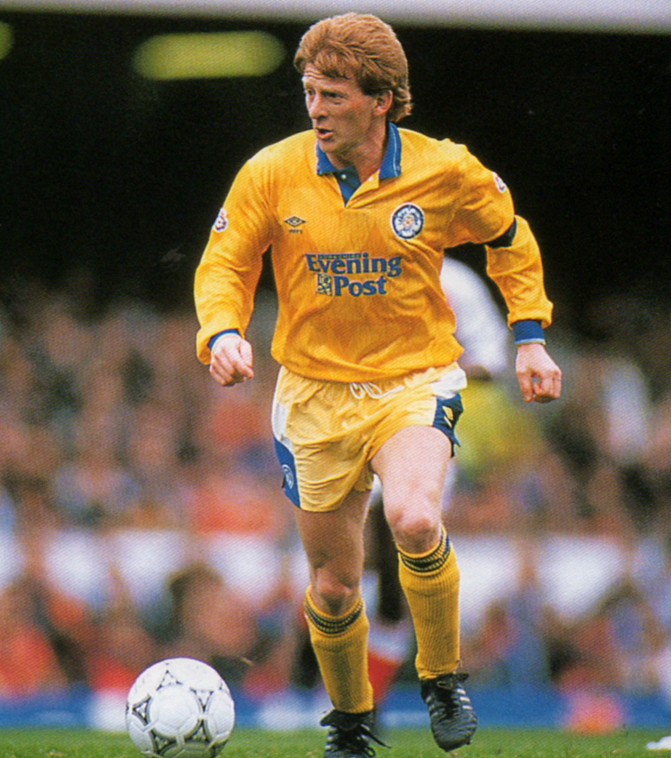
Saunders - Not Good Enough

Saunders – Not Good Enough

Every year, you hear the same thing about next season’s Championship division: “God, it’ll be tough to go up, look at the clubs coming down, all that money from Parachute Payments.”  Yeah, well.  Look at last year’s lot, Wolves, Blackburn and Bolton.  All dropped out of the top-flight and landed in the Championship with an almighty thump, weighed down by all that fools’ gold in their pockets.

In Wolves’ case, the fall was so heavy they’ve still not stopped, crashing through the floor of the Championship into the dank and unpleasant dungeon of League One.  This has been aided, it’s true, by spectacularly incompetent management right from the top.  The decision to get rid of Big Mick McCarthy – as a knee-jerk reaction to a derby-day thrashing by West Brom – is still haunting the Wanderers.  Terry Connor floundered in the deep end and sank without trace.  Dean Saunders has appeared to be clueless, his attempts at bluster unconvincing, even his saner moments lacking in any content or coherence.  McCarthy, meanwhile, prospers at Ipswich – a deeply impressive man and a highly competent manager at this level.

Blackburn, with management troubles and boardroom incompetence of their own, have been only a little better, but at least escaped a second successive relegation which appeared likely at one point.  Early in the season they spent £8 million on Jordan Rhodes, but then started messing about with the management structure and suffered accordingly.  Their failure has been at a price way beyond what the likes of Leeds could afford, and they will be looking ahead with some nervousness as Rhodes wonders whether his move was a wise one for a fledgling Scottish international.
Bolton too have flattered to deceive, failing to capitalise on a reasonable start, and pulling up no trees in a division with hardly a truly outstanding team, despite the seeming ease of Cardiff’s promotion.  The Trotters were still in with a chance of making the play-offs on the final day, but blew it by only drawing at home to Blackpool and thus letting in Crystal Palace at the last gasp – and the Bolton Premier League exile will last at least another year.

So what should we have to fear from next year’s lot?  QPR will need a radical overhaul after failing to recover from the cack-handed management of Mark Hughes, a man with one big fan he can see any time he likes in any handy mirror.  Reading could be a force, but they suffer from ownership who seem to feel that they have some football knowledge; usually a fatal ingredient.  There are rumours that some of Brian McDermott’s promotion-winning Class of ’12 would not be averse to a reunion with their old boss at Elland Road.

It remains to be seen who joins these two in the death-spiral downwards; the most likely is Wigan, who really do baffle me.  They are capable of wonderful football and will grace a Cup Final against Manchester City whatever the outcome of that occasion.  If the Latics could hang on to Roberto Martinez, they’d have to be regarded as challengers at the top end of next year’s Championship – assuming they do end up coming down.  Newcastle, Sunderland and Norwich will be nervously waiting to see if Wigan can pull off yet another last-ditch escape, as seems to be their perennial habit.

Obviously any relegated club will have the much-vaunted splodge of parachute wonga to cushion their fall, but they’d do well to look at the fate of last year’s Premier League jettison, and not assume that the ill-gotten gains will automatically ease their path back. Relegation can be habit-forming.  Just ask Wolves about that.

McDermott’s LUFC Promotion Formula

Image

Brian has said it himself: promotion next season is the expectation – nothing less will be good enough.  So how should he set about realising this desirable outcome?

Recruitment with a view to moulding a competitive and combative squad goes without saying.  We will all have our ideas about who needs to come in – from those who wish to see us reclaim our lost boys from the likes of Norwich and Leicester to the more forward-looking who would prefer hungry players, new to Leeds but maybe familiar to McDermott, your le Fondres and your Robson-Kanus and so on.

How else can Brian make a difference?  What have the problems been in the past?  One major drawback for a less-than-excellent United squad has been the difficulty of coping with the massive anti-Leeds chip on the collective shoulder of our rivals: the so-called “46 Cup Finals Syndrome”.  This is a crucial factor, but it is one that can be exploited by a real leader.  A certain charmless Scottish git over the Pennines in Salford is well-known for his preference for fostering what is known as a “siege complex” among the various teams he’s had There over the years.  He’s generally had a squad to compare with the best anyway, but there’s been that undeniable edge provided by the attitude of “They all hate us, lads, so let’s get stuck in and ram it back down their throats”.  The fact that Brian appears to be a mild and likeable guy, as opposed to the bile-choked monster in charge at the Theatre of Hollow Myths, is no impediment to the fostering of a “them against us” mindset.  It’s just good psychology, good man-management, and most of all, good for cohesion and team spirit.  There hasn’t been enough of that at Elland Road lately.

The hate comes mainly from opposition fans, particularly in Yorkshire where we will again play quite a few “Derbies” next season after Huddersfield’s and Barnsley’s mutually-collusive escape from relegation.  This fever of hate, eclipsing all other emotions, was adequately demonstrated when the cameras focused on a rabble of Barnsley fans in the very moment of relief after their last-ditch reprieve.  Were they applauding their team, or proclaiming their barely-salvaged Championship status?  No, their tiny, obsessed minds could find no room for anything but a tuneless chorus of “We All Hate Leeds Scum”, with the similarly brainless Huddersfield fans happily joining in. Clearly, fellow Whites, we are not famous any more.  If Brian does choose to utilise the hate of Leeds for positive gains in terms of team bonding and incentive to win, he will not find it in short supply.

Beyond this, we the fans have a massively important part to play.  But Leeds have usually been helped by terrific support; given the least encouragement, the fans will be like a 12th man out there.  We know from awed testimony in the past that playing at Elland Road can be an intimidating experience for the very best.  McDermott’s fostering of an atmosphere and team ethic comparable to that at Reading last season, where a squad not over-packed with stars pulled back an 18 point deficit to pip Southampton for the Championship Title, would not go amiss.  The fans would respond to the effort and togetherness of such a team, there is a parallel there with Wilko’s promotion side of 1990, who used to set about the opposition with voracious hunger and would usually wear them down before over-running them.  That kind of thing would certainly do; I remember Wilko’s Warriors very fondly, and they’re just the kind of team we all love down in LS11.

Once the business of Summer is done – and you sense that Brian wants to do his shopping early so that he can put his print on a super-fit squad – then the fine-tuning can start towards next season.  We hear that improvements are afoot at Thorp Arch – training pitches to match Elland Road dimensions, with equivalent watering systems; squad-numbered reserved parking spaces for the players.  Small enough improvements, but brought about in the name of increased professionalism.  It’s all good.

Give Brian the squad he wants, and let him turn them into lean, mean, motivated machines, ready to feed on hate and use it as fuel for a tank of a team which will grind the opposition into the turf, and we could be all set for a memorable season with the reward we all crave waiting at the end of it.

Spoilsports Leeds Sting Angry Hornets

ImageWatford 1, Leeds United 2

Leeds United, perennial party-poopers, did it again at Watford in a crazy game that sometimes bore more resemblance to an episode of Emergency Ward 10 than the blood-and-thunder Championship clash it was. Still smarting from a bizarre 1-6 defeat at Elland Road in the reverse fixture, Leeds were in no mood to stand idly by and watch their hosts stroll to the three points which – as it turned out – would have seen them gain automatic promotion. The Whites worked hard from the start, despite the early loss of injured Steve Morison, closing down space, snapping into tackles and pressing their opponents well up the field, denying them opportunities to create.

Sky co-commentator and one-time Man U flop Garry Birtles marred the viewing experience with his frequent inane interjections – his verdict on substitute Dominic Poleon’s part in the unfortunate injury to Jonathan Bond, Watford’s late replacement ‘keeper, being particularly obtuse. “He knew what he was doing alright,” spluttered the werewolf-faced ex Forest goal-hanger – apparently crediting our Dom with the skill to push a Watford defender in the back whilst running at full tilt and at precisely the correct angle to cause deliberate damage to the unlucky ‘keeper. But Birtles never was the sharpest tool in the box, and Sky would serve us all better if they provided a menu option to mute him.

Bond, only playing because of a warm-up injury to Manuel Almunia, seemed seriously hurt, but to suggest any deliberate intent to that effect was ridiculous and unjustified. After a lengthy break for treatment, the stricken ‘keeper was carried off to be replaced by a 19 year old rookie, Jack Bonham, for whom this would indeed be a baptism of fire. Shortly after entering the field Bonham was involved in a mix-up with one of his defenders as the ball headed into his penalty area. Poleon benefited from a fortuitous bounce to be able to sprint clear and tuck the ball home from an acute angle close in. Before the end of an extended first half – 16 minutes stoppage time – Watford were level with a finely constructed goal. Almen Abdi pounced on a lay-off at the edge of the Leeds area and curled a fine shot well out of Paddy Kenny’s reach into the top corner.

At this stage in the bigger picture, things were pretty much how they’d started – Hull City as Watford’s rivals for the remaining automatic promotion place were also level in their match at home to Cardiff. But then we heard Cardiff were ahead, meaning that Watford could go up with a draw. The situation would continue to change right to the end. As the delayed second half started at Vicarage Road, Hull had turned their own game around, leading 2-1. Watford now had to win whilst hoping Cardiff could draw level, and the urgency of their game was notched up accordingly. Troy Deeney, stupidly booked in the first period for kicking the ball away, now sailed into an ill-judged challenge on Michael Brown and was rightly booked again and dismissed. The expression of Gianfranco Zola’s face showed that he would possibly not be defending his striker’s actions.

The onus remained on Watford to win, just in case Hull let things slip at the KC Stadium. With ten against eleven, they pressed as hard as they could, drawing a couple of excellent saves from Paddy Kenny in the Leeds goal – and then the news came in, first that Hull had missed a penalty chance to secure their match at 3-1, next that Cardiff had gone straight down the other end and scored a penalty of their own to finish at 2-2. Now Watford were one goal from promotion, and their efforts became positively frantic as time ran out – time they only had because of the delays for injuries before half time. The Watford momentum built, waves of attack from the ten men were repulsed by a determined Leeds; something had to give. And, in time-honoured fashion, when it did give the result was a sucker punch to leave the Hornets stung and reeling. Ross McCormack seized on a clearance to advance on the young ‘keeper who was in no-man’s land off his line. McCormack tried a chip that looked just not quite good enough – but the debutant goalie could get only fingertips to the ball, which dropped over his head and behind him into an empty net. Tragedy for the young lad, sweet revenge for Leeds as they held on for three points to salve the wounds of their Elland Road battering and frustration for Zola’s fine Watford side who will now have to take their chances in the play-off lottery.

Leeds had successfully pooped another party, just as they had with Neil Warnock’s QPR two years previously – though Rangers had gone up anyway, despite that 2-1 away success for the Whites. There is some satisfaction in drenching the celebrations of others, but the onus is now on Brian McDermott and the club owners to plot a more positive outcome to next season – because whatever the buzz of Schadenfreude, the Leeds fans will not settle indefinitely for spoiling other folks’ parties. It’s high time we had one of our own.