Category Archives: Football

Man United – Why Always Them?

Former Manchester City maverick Mario Balotelli will be remembered in the English game for many things, but prominent among those various goals, skills and misdemeanours will be his famous celebration after scoring against Manchester United at Old Trafford last season in City’s 6-1 eclipsing of their local rivals.  Balotelli slotted the ball home calmly at the Stretford End, turned away with no sign of emotion on his face, and lifted his City shirt to reveal a t-shirt on which was printed the heartfelt plea “Why Always Me?”.  The message, after a series of incidents culminating in a row with the emergency services when he set off a firework in his bathroom at home, clearly indicated a feeling that he was being scapegoated to a certain extent.  To add insult to his perceived injury, he was booked for the t-shirt display.

Recent events, on top of a long history of prominent stories figuring the controversy and fuss that attend one football club above all others, might lead us to ask a somewhat wider version of the same question.

Why is it always Manchester United?

The furore surrounding their Champions League exit on the 5th March is fairly typical of the controversy the Champions-elect seem to attract, like flies to a bad piece of meat, on such a regular basis that you tend to wonder whether it’s just coincidence or a Machiavellian form of press-management.  So “enraged” was manager Alex Ferguson after their defeat, which turned on the dismissal of Nani for what might charitably be termed a high tackle; that he refused to appear before the assembled press after the game.  He was “too distraught” apparently, to fulfil his mandatory duties in that regard.  To the media of course, a story about a no-show from Ferguson is a much bigger scoop than anything most managers might say in adhering to their agreed obligations.  But Manchester United and controversy have gone together like port and nuts for a long, long time now.
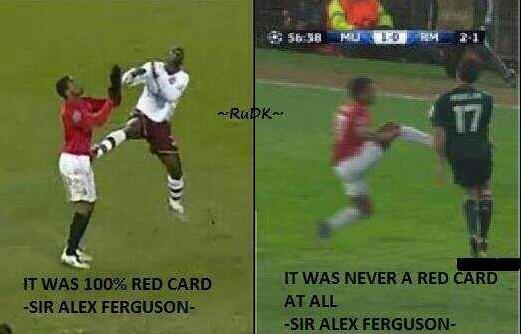
ImageCloser examination of the incident in focus this time reveals a worrying lack of consistency in Ferguson’s emotional reactions over remarkably comparable incidents.  Nani’s liver-high tackle was described dogmatically as “definitely not a red card”, paving the way for Man Utd claims of ill-treatment and bias.  A virtually identical tackle some time before, by Arsenal’s Eboue on Ferguson’s own player Evra, was also punished by a red card, but that one drew praise from the choleric Scot, who stated that the decision was “100% correct”.  This apparent self-contradiction is nothing new in the world of Alex Ferguson, or indeed in the wider manifestations of the club who like to brand themselves “The Greatest in the World”.

At the end of the Real Madrid match, enraged home defender Rio Ferdinand saw fit to get up close and personal with the referee who had dared dismiss Nani, sarcastically applauding him at point-blank range.   This is a widely-recognised form of dissent, and would normally merit a yellow card.  The referee did nothing, and UEFA have since confirmed that no action will be taken against Ferdinand.  It would be tempting to ask what sort of message this sends out to aspiring young players, if the answer were not so glaringly obvious.  That message is, as ever:  Man Utd can basically do just as they like, the game’s ruling authorities being so much in thrall to the club’s global profile – and the markets dependent upon its prosperity – that they will often turn a Nelsonian blind eye to such flouting of the rules, in the fond hope that nobody will notice when other clubs are dealt with more severely for like offences.

It has been said, with some justification, that one of the more hackneyed clichés in today’s game is the regular statement from the Football Association along the lines of “We have looked into (insert name of misdemeanour perpetrated by the Man Utd club or employee here), and can confirm that no further action will be taken.”

This sort of thing has been going on for many years, and while most clubs might shy away from such regular media attention of a not entirely positive nature, Man Utd as an entity appear to subscribe to the old maxim that there’s simply no such thing as bad publicity.  They have displayed a talent for remaining newsworthy, certainly on the back pages and not infrequently on the front as well, more or less continually, and dating back to well before their current era of success.  The incidents are many, and mostly quite unsavoury – Rooney elbowing a Wigan player and getting off scot-free, dodgy penalties too many to number, the legendary difficulty of seeing a penalty awarded against them and so on and so forth – and yet the default press position remains that the club are pre-eminent in the game for reasons of skill, charisma and courage, an apparent myth lapped up eagerly by the global fan-base, most of whom have never seen the team play in the flesh.

We hear far too much also of Ferguson’s so-called “mind-games”, a phenomenon particularly beloved of the media in this country, but one which appears to consist largely of an elderly gentleman having great difficulty sticking to the path of veracity at those press-conferences he deigns to attend.  Madrid manager Jose Mourinho is one who prospers in these psychological duels – in Ferguson’s petulant absence after the game last Tuesday, he stated that “the better team lost”, and walked off, content at having fanned the flames of the Man Utd manager’s fury.

It seems though that UEFA are after all to look into Ferguson’s failure to turn up for the press after this latest controversial occasion.  Presumably they will investigate fully, and a technical charge of “Sulking” might just possibly ensue.  But it would be unwise to place too much money on such an outcome; it may well be that we’ll yet again hear those old, familiar words “no further action will be taken”.

Memory Match No. 3: Leeds United 3, Man U 1. 24.12.1995

1995-96 was the last full season of Sergeant Wilko’s eventful reign at Elland Road. His influence over the club was crumbling amid rumours of money problems, takeovers and dressing-room discontent, a tale that would doubtless strike a chord with Messrs. Grayson and Warnock of more recent vintage. This was a season that had started off with a flurry of Tony Yeboah thunderbolts and some impressive results and performances which appeared to promise much. Sadly though, it would peter out in a shocking late-season run following a League Cup Final humiliation at Wembley, courtesy of Aston Villa. Howard Wilkinson was a dead man walking from that time on.

Worrying signs of defensive frailty and general ineptitude had been all too obvious just the previous week at Hillsborough. United had succumbed spinelessly to a 6-2 defeat at the hands of an unremarkable Sheffield Wednesday side and – all bravado aside – there wasn’t much optimism in the hearts of the faithful as this fixture against the arch-enemy loomed.

It was certainly a different Christmas Eve for me. I hadn’t exactly led a sheltered life up to that point, but this was the first time – and the last, to date – I’d ever risen the day before Christmas to bacon sandwiches at 6 am, closely followed by numerous Budweisers with the Sunday papers in a fan-friendly pub, as we waited for our “Scum Match Special” mini-bus. The queasy feeling before any match against “Them” was therefore multiplied by unaccustomed early-morning grease and alcohol, and I was feeling several shades of not-too-good as we set off for Elland Road. It was an 11:30 kick-off, live on Sky, and it promised either to make or break the whole of Christmas for us fans, and for our hopeful families.

The situation between the Uniteds of Leeds and Salford is one of a legendary mutual animosity, even at the best of times. Let’s not mince words here, the two sets of fans hate loathe and detest each other, and open warfare is the norm. Revisionist football pundits would have us believe that this is strictly a one-way affair, but you only have to tune into one of Sky’s glitzy live TV love-ins for a Man U match, and whoever they are playing, our Home-Counties friends are in full voice with their “We all hate Leeds scum”. Even Alex Ferguson, the Red Devils’ not-altogether-likeable manager, makes no bones about it; some of his more coherent sound bites feature his opinion that Elland Road is “the most intimidating arena in Europe”. He’s also stated that going to Liverpool is nowhere near as bad as going to Leeds; clearly, he’s never been for a late-night pint in Old Swan or Dodge City.

So, Yuletide or not, the usual poisonous atmosphere was in evidence as the two teams walked out before a 39801 crowd that overcast morning. Just as Leeds were smarting from their Hillsborough debacle, so Man U were struggling to emerge from a poor run, winless for a month and dispatched by Liverpool the previous week. This seasonal fixture was a chance of redemption for both sides.

Image

Macca slots the penalty home

By kick-off time, I was starting to feel properly ill, and in dire need of a pick-me-up. This arrived in a most unlikely form after a mere five minutes, when a Leeds corner swung over from the right. Richard Jobson rose on the edge of the area to head towards goal, where David Wetherall, lethal against Man U in the past, was challenging for a decisive touch. But that touch came instead from the upraised, red-sleeved arm of Nicky Butt – and referee Dermot Gallagher’s whistle sounded for a penalty.

Peering from the Kop at the other end of the ground, through an alcoholic fug, I could hardly believe my eyes. Leeds just didn’t get penalties against “Them”. It would happen the other way around alright, too often, and even from three yards outside the area but this was unprecedented, since our Title-winning year anyway. Steve Bruce evidently thought it was just too much to bear, and screamed his violent protests into Gallagher’s face, having to be restrained by Gary MacAllister, who appeared to be trying to explain the rules to the furious defender. The guilty look on Butt’s face, though, spoke volumes. MacAllister placed the ball on the spot, and sent it sweetly into the top right corner for 1-0, giving Peter Schmeichel not even the ghost of a chance. The celebrations were raucous and deafening as the Elland Road cauldron exploded with joy – and inside my skull, the trip-hammer of a beer-fuelled headache pounded away anew, utterly failing though to banish my smile of delight.

Leeds had the bit between their teeth now, and Brian Deane was suddenly clear for an instant outside the right corner of the Man U penalty area, played in by a cute pass from Carlton Palmer. Schmeichel was out swiftly to smother the chance, but Deane managed to dink the ball over him, only for it to clip the crossbar and bounce away to safety. A two-goal lead at that stage would have felt unlikely yet deserved, as Leeds United had been on the front foot right from the off. Soon, though, a lesson was to be delivered about what happens when you miss chances against this lot.

The unlikely culprit as Leeds were pegged back was Gary Speed. Receiving the ball in the left-back position, he tried to beat Butt instead of clearing long, and was robbed of possession. Butt looked up, and placed a neat pass inside to Andy Cole, whose efficient first-time finish levelled the match. Suddenly, my headache was even worse, and I was starting to wonder about the fate of my breakfast too. Time for another reviving injection of optimism as Leeds surged forward, and Speed so nearly made up for his defensive error, playing a one-two with Tomas Brolin which gave him space to put in a right-foot shot that went narrowly wide.

Image

Yeboah beats Schmeichel for the second goal

The game had settled down by this time, and both sides were showing enough ambition to feel that they were in with a chance of victory. Leeds though had thrown off their Sheffield blues, and attacked with verve and purpose. Now, a defensive position was coolly handled by Gary Kelly, finding the time and space to launch a long clearance forward, where Brolin headed on. The ball was loose, and surely meat and drink for Man U’s international defender Paul Parker – but he inexplicably let it bounce over his foot. Yeboah pounced on it like a hound on a rat, and he was away, surging towards goal with ex-Leeds defender Denis Irwin backing off. Yeboah in this mood was usually irresistible, and sure enough none of Irwin’s careful jockeying could prevent him from finding that vital half-yard of space. The gap appeared, Schmeichel came out to block, and Yeboah clipped the ball sumptuously just out of the Danish ‘keeper’s reach, up and over to nestle in the far corner of the South Stand net.

Again, that explosion of noise and joy, again my fragile system was assailed by the rough-and-tumble of riotous celebration. 2-1 up against the team we loved to hate; the cockneys at the far end were suddenly silent and morose. “You’re not singing anymore!” we blasted at them, and indeed, little would be heard from the away fans for the rest of the game.

Image

Brian Deane makes it 3

The second half was another tale of give and take, both sides able to cause trouble up front, but both seemingly capable of dealing with all that was thrown at them. The onus was on Man U to retrieve a losing situation, but Leeds were rarely in great trouble, and as the game entered its final quarter there was unprecedented optimism that we could close this one out, and enter Christmas on a real high. Leeds weren’t simply sitting back and absorbing pressure – and the maxim of attack being the best form of defence was to serve them well. On 73 minutes, Jobson made a foray down the left, and was fouled by Cole chasing back. The resulting free-kick was played to MacAllister in space in the middle of the park, and he swiftly moved it out to the right wing. Brolin picked up possession, and then slipped the ball to the overlapping Palmer, who surged into the box, and then turned past Irwin to set up Brolin again on the edge of the area. The much-maligned Swede, making the contribution I best remember him for, chipped the ball sweetly first-time, standing it up just around the penalty spot, where Deane’s exemplary movement had won him the space to rise and plant a firm header past a helpless Schmeichel into the net. 3-1 and finis.

After the game, and before the Yuletide celebrations could begin in earnest, other traditions had to be observed. Ferguson, naturally, had to moan about the penalty. “It was a very surprising decision, given in circumstances that were beyond me.” whinged the Purple-nosed One, in evident ignorance of the deliberate handball provisions – but perhaps aiming to justify Bruce’s undignified and almost psychotic protest at the time. And the massed ranks of the Kop Choir had to regale the departing Man U fans with victory taunts as they sulked away, silent and crestfallen, headed for all points south.

I can’t remember the journey home, or even how spectacularly ill I was when I got there, although I’m told I was the picture of ecstatic yet grossly hung-over ebullience. I just know it was my happiest Christmas Eve ever, ensuring a deliriously festive spirit for the whole holiday, much to the delight of my long-suffering wife and two-year-old daughter.

Merry Christmas, everybody! And God bless us, every one. Except Them, from There.

Next: Memory Match No. 4: Leeds United 4, Derby County 3. 1997-98 included a purple patch for Leeds United, and a series of “comeback wins”. Perhaps the best was this recovery from 3-0 down at Elland Road against the Rams.

Memory Match No. 2: Sheffield Wednesday 1, Leeds United 6 12.1.1992

Image

As 1991 turned into 1992, the two-horse English Title race was hotting up.  Man U had suffered a shocking reverse on New Year’s Day, capitulating 4-1 at home to QPR, and then later that January 1st, Leeds had won competently 3-1 at West Ham to remain well in the race for the ultimate domestic honour.  The scene was adequately set, then, for Wilko’s first return to Wednesday since he had quit Hillsborough to become Leeds boss in 1988.  This would also be Lee Chapman’s last game before his season-threatening FA Cup injury, which resulted in the drafting in of one Eric Cantona – with all the long term consequences that would entail.  But Chappy was destined to be sidelined only temporarily, and he went out in the most emphatic style.

There was a crowd of 32228 at Hillsborough, the usual vociferous contingent of travelling Leeds fans rivalling the home crowd for noise from the outset, and completely drowning them as the game went on.  Leeds United were weakened, so it seemed, by the absence of the injured Gordon Strachan and suspended David Batty, half of their legendary midfield Fantastic Four.  Any side, surely, would miss performers of such calibre.  Leeds, though, seemed determined to make light of the problem, and tore into their hosts from the start.  Full-back Tony Dorigo made an early darting run, cutting in from the left and making good progress down the centre of the pitch, before unleashing a right-foot thunderbolt that Wednesday ‘keeper Chris Woods had to tip over.  From the resulting Gary MacAllister corner, Chris Fairclough rose to head downwards, and found Chapman in splendid isolation four yards out; his finish swift and deadly for 1-0.

For a local derby, the contest had been decidedly one-way traffic – Chapman was to send two towering headers just wide before Carl Shutt had a scuffed shot smothered by Woods in the home goal.  Then, a true champagne moment as Mel Sterland fed the ball to Chapman on the right.  In a completely untypical burst of pace and control, Chappy surged between two hapless Wednesday defenders, raced into the area, and unleashed a shot that beat Woods completely, just clipping the frame of the goal to rapturous applause from the Leeds fans at the Leppings Lane End.  I remember thinking at the time that anything was possible now, if Lee Chapman could do something so utterly out of character.  And so it proved as, from a free kick awarded just right of centre some ten yards outside the box, Dorigo stepped up to absolutely hammer a left foot drive past the helpless Woods.  Cue mayhem and cavortings as the Leeds hordes behind the goal, celebrated as clean a strike as you could ever wish to see, the ball a blur as it arrowed into the far corner with deadly precision and power.

At 2-0 down, the home side were making increasingly desperate attempts to gain some sort of foothold in the match.  This desperation was adequately demonstrated when, from a harmless-looking ball into the Leeds area, Wednesday striker Gordon Watson ran in front of Chris Whyte, continued on for another step or two, and then hurled himself into the air, landing in agonised paroxysms of simulation between a bemused Whyte and Leeds ‘keeper John Lukic.  Such obvious fraud and villainy could have only one outcome, and the stadium held its collective breath for sentence to be passed on the miscreant.  Instead – amazingly – referee Philip Don pointed to the spot.  Whether none of the officials had seen the extent of Watson’s ham-acting, or whether they were moved by sympathy for the mauling Wednesday were taking from a rampant Leeds, it’s impossible to tell.  The outcome was the same either way.  Ex-Leeds hero John Sheridan stepped up, saw his penalty brilliantly saved as Lukic tipped it against his right-hand post, and then gleefully belted home the rebound to give Wednesday a massively unmerited lifeline.

This act of base and scurvy treachery required nothing less than a riposte of the utmost nobility and beauty, so we said to ourselves, though probably in more Anglo-Saxon terms.  And, happily, that’s just what came to pass.  Only six minutes after the home side’s ridiculous blagging of a comically unfair route back into the game, Leeds took effortless control again with a goal sublime in both its conception and execution.  Lukic bowled the ball out to Dorigo on the left flank; he sent it first time down the line to Gary Speed, who took one steadying touch before sending a beautiful flighted cross into the Wednesday area.  And there, inevitably, was Chapman, horizontal in mid-air, neck cocked to hammer the ball unanswerably past Woods, the perfect counterpunch to Watson’s knavish low blow.  It was a gorgeous goal, sweeping the length of the left side, taking the entire home team right out of the game, and re-establishing the two goal margin which was the least Leeds United deserved at half-time.

The second half that ensued was simply a story of how a blood-and-thunder Yorkshire derby turned into a stroll in the park for Leeds United.  It seemed as if all the life had been sucked out of the home team – a Wednesday side who, let’s not forget, were unbeaten at home since the opening day of the season, and who would go on to finish third in the table.  So they were no mugs, but Leeds United were absolutely irresistible on the day, and would have hammered far better teams than the hapless, bewildered Owls.

It’s possible that Wednesday were simply embarrassed about that cringe-worthy penalty, possibly they were dog-tired, having been run ragged since the start.  Whatever the case, their heads dropped steadily further and further as the game progressed, and they offered little resistance as Leeds proceeded to throttle the life out of them.  Chapman completed his hat-trick five minutes after the hour, heading in after Speed had struck the bar from a corner.  Poor Speedo was looking the other way, bemoaning his bad luck when the ball hit the back of the net after all, turning his frustration to joy.  Then, perennial bit-part player Mike Whitlow ventured forward, just because he could, and rose unchallenged to meet Rod Wallace’s right-wing cross and head easily over a stranded Woods.  It was left to little Wallace to administer the coup de grâce, striding clear after a shimmering exchange of passes in midfield to dink the ball over the advancing ‘keeper, and put the suffering home side finally out of their misery.

For Leeds, it had been their biggest away win in over 60 years as they returned to the First Division summit in the best possible manner – they got six, but they really could have had ten or a dozen.  The message had been sent out loud and clear to the watching millions in Live TV Land: United were deadly serious about their Championship challenge.  They would surely look back though after their eventual Title success, and identify this sumptuous display as one that defined them as potentially the best team in the land.  For Wednesday, it was total humiliation and – truth to tell – very difficult to sympathise.  Better by far to lose 6-0 than to be tainted as they were by such a crass and obvious example of cheating – and it hardly reflected much credit on the match officials, either.  But the cheats on this occasion failed utterly to prosper.

It was a massively impressive performance, a hugely significant victory, and the sweetest possible return for United’s ex-Owls contingent.  Mel Sterland always took great delight in beating the Blades, but this victory over his boyhood favourites would have only happy memories for him, as indeed for Chapman, Shutt and of course the triumphantly-returning prodigal Sergeant himself.  Leeds would march on to the Title, finishing four points clear with the most wins and least defeats, unarguably deserving Champions (although the usual suspects argued anyway).  Man U’s quarter-of-a-century wait for a Title would extend for another twelve delightful months before Mr. Murdoch ushered in an era of success for them, aided by our own enfant terrible.  And Sheffield Wednesday?  They would recover to finish impressively, despite another awful trouncing at deposed Champions Arsenal.

1991-92 was a season of nip-and-tuck, with titanic struggles in both Cup competitions adding spice to the League fare as the battle for honours raged on three fronts.  But there can be no doubt whatsoever that January 12th 1992 belonged entirely to Leeds United, who looked like Champions a full four months early with this five star, six of the best Masterclass display crowning them as Yorkshire’s finest – just as we, and indeed the Wednesday fans in their heart of hearts, had always known.

Next:  Memory Match No. 3:  Xmas Eve 1995 – Leeds United 3. Man U 1.  Join me again, for an early start to Christmas, a classic Yeboah finish, Brolin’s finest hour and an actual penalty against “Them, From There”.

Memory Match No. 1: Leeds United 4, Liverpool 5 (13.4.91)

The idea of a “Memory Match” series of articles is hardly original, but it can be fun, particularly when the present doesn’t offer us much to shout about – and let’s face it, there are loads of games in the Leeds United back-catalogue well worth recalling, and savouring anew.

Despite the encouraging win over Blackpool, it’s probably fair to say that this season is in danger of petering out, leaving us looking forward to a whole new campaign for our hopes of a fresh start post-Bates (who shall be known as President Irrelevant next season.) Things have been so dire at times, that the recollection even of a defeat can be preferable to gloomily contemplating our current prospects – as long as that defeat was a really special one, with gloriously redeeming aspects to it.

Such a match, such a defeat, was the home game with Liverpool in front of a 31460 crowd during our first Sergeant Wilko-flavoured top-flight season of 1990-91. It had been a good season – we were nicely established back at the right end of the top table. We’d had some tasty results and the name of Leeds United was well and truly back on the agenda, despite the slightly grudging attitude of the southern-based media.

I’d been anticipating the Liverpool game above most others. There was that satisfying all-White versus all-Red thing, against the green backdrop of the turf, which appealed to the eye of the beholder. But also, I had a real problem with Liverpool FC. They’d been the opposition in my first ever game at Elland Road, a traditional 3 pm Saturday kick-off in April 1975. I’d gone into the ground with my Dad and brother, all wide-eyed and expectant, and Elland Road blew me away, so much more vivid than it had ever been on the telly. I knew straight away that this was love, and that it would be for life. Then Liverpool callously spoiled my debut, beating us 2-0. The following season, they did it again, 3-0 this time. I didn’t even see us score against the Reds until Daisy McNiven’s late equaliser in 1977. By the time we got relegated, in 1982, it had got to the point where I expected nothing but a hiding from Liverpool games, and that’s invariably what I got. I hated Liverpool.

So, in that first post-promotion season, when we’d looked like a seriously top team again, I was all vengeful and ready for the Reds, who had recently been stunned by the resignation of Manager Kenny Dalglish, and I trusted the lads to be at least as committed as I was. And to be fair, they did look right at it, early on. Carl Shutt burst through down the right to sting the hands of their ‘keeper. Mel Sterland planted a free header wide from around the penalty spot, wee Gordon Strachan was buzzing about to good effect in midfield, Leeds were playing well. Then, the sky fell in.

John Barnes, Liverpool’s lithe, lissom winger, chose that day to really turn it on – just as we’d all wished he would for England ever since his legendary goal against Brazil in the Maracanã – but his virtuosity for his club on this day was bad news for Leeds United. First, he dinked a dipping ball to the far post at the Kop End, and the roof of our net billowed as Ray Houghton finished. Next, he was involved in the award of a clear penalty, struck past John Lukic with power and precision by Liverpool’s wardrobe-shaped Danish scouser, Jan Molby.

Leeds had been well in the game, but Liverpool had carved out and taken their chances, and my familiar Red nightmare was playing itself out yet again. Now, David Speedie – that unlikeliest of Liverpool players for their era of success – forced himself in on the act, first having a goal disallowed, then scoring at the far post after more good work from Barnes on the left. Leeds were ragged and despondent, and it was no surprise when Barnes again, after a nifty one-two near the halfway line, scorched clear to clip a fourth past a helpless Lukic, and leave me sitting drained and woeful on the terrace steps throughout half-time, head in hands, despairing at the four goal gap and fearing what might yet be to come. I’m sure too that this was the first time I ever heard Monty Python’s “Always Look on the Bright Side of Life” played over the tannoy – and taken up by a stunned home crowd who were even yet able to indulge in a bit of gallows humour.

When the second half started, I saw the Liverpool reserve ‘keeper Mike Hooper running towards us. Hooper had been standing in for a few games for the regular No. 1, Bruce Grobbelaar, and I was more than a little disappointed. I’d had this recurring wish-fulfilment dream about sneaking down off the Kop while play was up the other end and, with a hitherto concealed pair of scissors, neatly snipping off Bruce’s annoying little pony-tail. It was probably just as well that temptation had been moved out of my way, but I doubt I’d have really done it – ex-guerrilla Grobbelaar would have killed me anyway, and I’d most likely have got arrested, too.

Hooper was under pressure immediately, as Leeds had rediscovered their vim, and forced Liverpool back. The breakthrough came when the keeper could only push out a scuffed Gary MacAllister shot, and Lee Chapman was there to bundle the ball unconvincingly home off the crossbar. Then Chappers challenged for a high ball at the near post, and in it went – only for the ref to disallow it, his dismissive reaction to Chapman’s protests further enraging the hyped-up hordes on the Gelderd End. Hopes revived though as the ball sailed over a clearly-fouled Chapman from the left and landed in the area at the feet of Shutt, who swivelled to score competently. 2-4 now, and maybe an unlikely comeback was in the offing. But almost immediately, Ian Rush mugged Chris Whyte just outside our box, and back heeled into the path of Barnes who took it on and scored a brilliant fifth, to renewed home despair.

Leeds seemed to know that they had to hit back hard and swiftly, and the best goal of the game arrived when Dave Batty struck a wonderful bending, scything cross from deep on the right, and Chapman hurtled through mid-air to meet it with a bullet-header, beating the startled Hooper all ends up. Two behind now, and Liverpool looked as if they were just holding on, the pressure from a stoked-up Leeds incessant.

The match had become a breathless spectacle, surreal in its ebb and flow, more like some sort of high-class park game than your archetypal tight, defensively-sound First Division grapple. Leeds seemed always on the brink of total annihilation, and yet Liverpool, seasoned top-league campaigners, couldn’t quite manage to shake off these upstart newcomers, who kept on snapping relentlessly at their coat-tails like eager pups. Strachan typified the defiance and endeavour, popping up everywhere, probing and passing. Now he received the ball on the right corner of the Liverpool penalty area, and set off on one of those scampering little runs where he didn’t so much beat defenders for pace, as manoeuvre adroitly around them, like some pesky little tug in among ponderous oil-tankers. He did this now, beating two or three Liverpool defenders inside a few square yards, and then clipping a delightful ball to the far post, where Chapman towered to complete his hat-trick, the arrears reduced to one.

And that, gentle reader, is as good as it got. Try though they might, the gallant battlers in white could force no further concessions from a Liverpool team who had looked like running away with the game at half-time, but who were virtually on their knees by the final whistle. It was a defeat – glorious, inspiring even, but bringing with it the zero points haul of any other defeat. On the day though, the crowd weren’t counting league table points, and the buzz as the throng left the stadium was of a fantastic comeback against a top, top team – pride was in the air, loud and throaty and no-one was bemoaning the loss. As one person loudly declaimed emerging, from the Kop exit, “we gave ‘em a four goal start, then hammered ‘em 4-1!” Well, quite. It had been, by far, my best-ever Liverpool game, better even than the last-gasp draw we’d salvaged in 1977. It also told us all we needed to know about the battling qualities of Wilko’s Leeds United; an injection of quality the following year would garner the Champion’s crown for us, and also along the way, my long-awaited first victory over the Anfield Reds.

For that, the wait would prove worthwhile. But on this April day in 1991, those of us who had suffered through the wilderness years could see promising signs, even in defeat. United were most decidedly back.

Next: Memory Match No. 2: January 1992 – Sheffield Wednesday 1, Leeds United 6. Tune in for another Chappers hat-trick, and “The Worst Dive Ever”.

FA Cup 5th Round Preview – Manchester City v Leeds United

Sunday 17 Feb 2:00 pm (Etihad Stadium, Manchester)

Image

FA Cup 5th Round weekend is where a new ingredient starts to enter the much-vaunted “Romance of the Cup”. After the battles, scrapes and scares at previous stages of this most famous knockout competition, there is at last a genuine whiff of Wembley in the air.

This is much more the case these days of course, than in olden, golden times. Now, the need to accommodate sizeable contingents from all four semi-finalists dictates that the traditional last stop before Wembley is, erm, Wembley. So the 5th Round winners will be potentially a mere 90 minutes from a coveted appearance at the legendary venue. In other words, the competition is hurtling towards crunch time; all the teams that have survived so far can permit themselves a very private dream of ultimate glory, or at least of the chance to perish at the final hurdle in auspicious surroundings.

Still, even at this relatively advanced stage of the competition, there remain giants to be killed, and also minnows, of all sizes, desperate to do the slaying. It was as “minnows” that my beloved Leeds United faced up to their last Cup trip to the North-West, thanks to some ill-advised pre-publicity on Manchester United’s mischievous official website. On that occasion, the underdogs proved that their bite lived up to their bark, and left the then Champions chastened and potless. Now Leeds must return, this time to Manchester City, again as underdogs, again pitted against the Title holders in their own backyard. Can United repeat their unlikely triumph of three years ago, this time against the Blue Mancunian majority? On the face of it, little could be less likely.

Leeds United are after all a club in turmoil, their season so far defined by bitterly disappointing under-achievement. After the long, drawn-out agony of the summer’s takeover saga, which actually dragged into the last couple of shopping days before Christmas, it’s perhaps understandable. But the league programme has been such a damp squib, the football has been so dire, and Neil Warnock, the supposed saviour of twelve months ago, has failed to live up to his promotion-speckled CV. Significantly though, the few bright spots have come in Cup competitions, where progress on two fronts has been embellished by the disposal of three nominal superiors from the Premier League. The most recent and by far the most impressive of these was the defeat of a Bale-powered Tottenham at Elland Road in the last round of the FA Cup. A second-half League Cup capitulation against Chelsea aside, Leeds’ knockout form this season has been rather good.

Manchester City meanwhile, reigning Champions and domestic Galácticos though they may be, look to have stumbled fatally in recent weeks. A run of pallid draws and then an awful capitulation at Southampton last week, and suddenly the gap between them and the Premier League summit is a chilling 12 point chasm. So, City head into the tie against Leeds in rather less than ideal shape. They will not have forgotten that their lowly opponents triumphed at Old Trafford a few short years back; neither will it have escaped them that they suffered a 2-5 reverse, last time these two met in the Cup on City’s patch. But these unwelcome omens may well put The Blues on their mettle, and the fact that their abject last performance so angered manager Roberto Mancini promises to be bad news for Leeds. Whatever the personnel in the Champions’ line-up on Sunday, they should not lack for motivation.

Leeds will expect to be under the cosh, but they have successfully bounced back from limp league performances on several occasions this season already. There has been an air of nonchalant relaxation in their Cup outings; no pressure to gain points towards a play-off berth, no real expectation of anything better than a battling performance and a glorious exit. Against this background, they have compassed the demise of Southampton, Everton and Spurs without ever being seriously troubled, and it will have crossed their minds that a deflated City might just be there for the taking.

There are, then, a number of imponderables that conspire to make this seemingly predictable tie that bit less clear-cut. Leeds will be up for it, and City may find the muck and bullets nature of the midfield battle is not quite to their more refined tastes. But if the Champions can impose their undoubted class early on, Leeds United will face a long and dispiriting afternoon. If, however, City struggle to break down a stubborn Whites defence, then the pressure of their own fans’ frustrations could sap them as the game progresses. In McCormack and Diouf, the Yorkshire giants possess sly and experienced campaigners who are liable to sniff blood and nip in for the kill.

My impartial, unbiased prediction? Well, both these sides owe their supporters after recent hapless performances, so I’ll call the motivation stakes even. My heart goes for a 2-2 draw, and a probably fruitless Elland Road replay. My head says City, possibly by three – and I’ll be happy with that, as long as the lads have put up a fight for the fans and the shirts.

Twist my arm then and I’ll predict, through gritted teeth: Manchester City 4, Leeds United 1

Stand Up, If You Hate Man U – And Think It Might Be TV’s Fault

Hate Man U

On Saturday 8th January 2005, Manchester United played Exeter City in the 3rd round of the F.A. Cup. It was something of a mismatch on paper, but surprisingly a plucky Exeter team held out for a 0-0 draw, and took the holders to a replay. A significant achievement for the minnows, but this game was noteworthy for another reason; to date it remains the last F.A. Cup tie involving Manchester United not to have been shown live on TV.

Even on the face of it, this is a remarkable statistic. Particularly in the earlier rounds, there are many matches from which TV companies can take their pick, and traditionally the perceived likelihood of an upset is a big draw. Given the perennial dominance of Manchester United, it’s usually difficult to see much chance of a giant-killing, and the interest in games involving them, you might think, will be mainly for those occasions when they’re drawn against a Chelsea, or a Liverpool, or maybe even a Manchester City or an Arsenal.

Looking at the list of games included in this amazing run of uninterrupted TV spotlight, some of them really do make you wonder what the companies concerned hoped to achieve, with the chances of an embarrassingly one-sided contest surely outweighing by far any prospect of a surprise. It begs the question of whether broadcasters are putting too high a priority on audience over entertainment value. There may be a certain piquant charm in seeing the likes of Burton Albion gazing wide-eyed at the immensity of Old Trafford, but some of the ties televised have lacked even this saving grace. Middlesbrough or Reading at home? Hardly sets the pulse racing, does it?

Any hint of complaint about Manchester United will, naturally, bring anguished howls of protest from the direction of London and Devon, as hard-core Reds, some of whom may even have visited Old Trafford, loudly complain about this latest manifestation of “jealousy”. It’s become rather a knee-jerk reaction, but there’s really not a lot of foundation for it. Anyone truly motivated by envy (jealousy means something different, chaps, look it up) has a simple solution at hand – simply jump aboard the bandwagon. The prevalence of the Old Trafford club on our TV screens will certainly garner them increased “support” from those who just want to be identified with such a vulgar example of a club gorging on success. It is the more negative effect of blanket coverage that should be worrying, not so much for Manchester United, but for the sport itself.

For there is a danger here that the media have not only created a monster, but that they are actively encouraging that monster to eclipse all their rivals. The basis of any sport must be healthy competition, but there is disquieting evidence that the playing field has not been level for a long time now. It doesn’t take too much digging to unearth some unsettling trends. One study over a number of matches suggested that 88% of all marginal decisions went the way of Manchester United, and there was also a distinct lack of penalties awarded against them in league games at Old Trafford over a period of years. There have also been instances of referees who have displeased Alex Ferguson mysteriously disappearing for months from their fixtures. In a game of fine margins, as any game is at professional level, evidence that one club enjoys preferential treatment is a matter of concern. Such a trend, given the amount of money flowing into the game, could easily lead that one club into an unhealthy dominance, to the detriment, ultimately, of the spectacle as a whole. Fierce competition is so crucial to any healthy sport, that the importance of this principle is difficult to overstate.

Success, they say, is all about the steady accumulation of marginal gains. Manchester United as an institution appears fully to appreciate this, as any club should. But these days, the media are the game’s paymasters, particularly the TV companies – and when they start favouring one club above all others, then you have to fear for the ability of others to compete in the long term. It’s a matter of concern – and it could easily become a self-fulfilling prophecy, as more coverage (of an almost exclusively favourable nature) promotes more support ever further afield for “United” as the media love to call them. And the more support they gain, the more of a market there is which will feed on their success, so the more commercially desirable their success will become – and commercial pressure speaks volumes when knife-edge decisions are to be made.

It would be difficult to imagine that any other club should have such a long, unbroken run of live TV coverage in their F.A. Cup ties. In the 4th round of this year’s competition the other week, they figured in their 38th consecutive such event. The home game against Fulham followed its predictable, boring script – early penalty, spineless opposition, comfortable home win. Meanwhile, Brighton faced Arsenal, in what was, equally predictably, a much more exciting contest; two sides playing good football, and the prospect of a shock never far away. But this tie was not seen live. In the 5th round, Man U will face Reading at home, which will probably, let’s face it, be another Fulham-esque stroll. And, sure enough, yawn yawn, it’s live on the box again, despite the fact that there are murmurings of discontent now, from some sections of the press who evidently realise how boring it all is.

As a Leeds United supporter, I’ve had cause to bless the tendency of TV companies to cover even the games where “United” seem certain to roll over the opposition. On January 3rd 2010, Leeds, then of the third tier, triumphed at Old Trafford before a live ITV audience, sending the Champions spinning out of the Cup at the earliest possible stage. But satisfactory as this was, it’s the exception, not the rule – normally the colossus will trample the underdogs, and their millions of fans worldwide will be happy. But what about the rest of us? Are we to continue paying our satellite subscriptions, and buying our match tickets, for the privilege of watching Man U clean up as the stakes become higher, and the odds become ever more skewed in their favour?

At some point, worms will start turning and – at the risk of mixing metaphors – maybe the bubble will finally burst. Then, chill winds of reality will blast through the offices of the TV moguls. Don’t say you weren’t warned.

The Greatest Goal I Ever Saw Against Leeds United – Roy Wegerle’s Mazy Run and Finish for QPR

Elland Road

For any football fan asked to nominate a favourite goal, the prospect opens of a pleasurable half an hour recalling all those wonderful strikes down the years, mentally compiling a short-list, and then proudly revealing to the questioner that golden shot, header, volley or back-heel, possibly prefaced by the two runners-up in time-honoured reverse order.  Bliss.

The challenge of naming the best goal ever scored AGAINST your favourites, however, is obviously not quite so enjoyable.  Most of us like to think of ourselves as football purists, at least in a neutral sense, so that we can appreciate the beauty of a goal scored in a game not involving our club, even one by a despised rival.  But a goal in your own team’s net is never completely free of attendant pain, and however wonderfully executed it might have been, you can’t actually enjoy it.  You wince as it goes in, you home in on a possible offside flag, or any infraction of the rules that might lead to it being chalked off.  When it counts, your mood sinks.  You’re in no state to acknowledge the brilliance of it all.  You just want your lot to set about redressing the balance.

But the fact remains; you will have seen many terrific goals scored against your own beloved side.  You may possibly find that one amongst them tops even the best goal you can ever recall your lot scoring, though you will not, of course, admit that.  As a Leeds United fan, I’d certainly never concede I’ve seen better opposition goals than Yeboah’s howitzers against Liverpool and Wimbledon, Strachan’s belter against Leicester, Currie’s banana shot against the Saints, Eddie Gray’s pleasure ride through the Burnley defence or any half-dozen you might care to name from Lorimer’s ferocious back catalogue.

Looked at without the partisan blinkers, though, my mind’s eye recalls some very memorable goals scored against Leeds, particularly at my end of Elland Road; the Gelderd End, or Kop.  Jeremy Goss blasted home a fulminating volley for Norwich in 1993 that drew gasps of admiration.  The crisply-struck blockbusters do tend to stick in the memory, and I’ve often complained that we seem to cop for more than our fair share of goal-of-the-season contenders that fly into our top corner, when they might so easily have zipped into the back row of the stand.

The one opposition goal that I’ll truly never forget, though, was in a category all of its own.  In the early part of the 1990-91 season, Leeds had made a decent start to their first year back in the top flight since relegation in 1982.  Consolidation of higher status was the name of the game, but United appeared to be capable of more, and would, in fact, achieve a top four finish as a prelude to actually winning the Title the following season.  In these early days back in the big time, though, it was wonderful just to be there and holding our own.  A visit from Queens Park Rangers wasn’t expected to present any real problems, and there was a relaxed and content air around Elland Road when Leeds moved into an early two goal lead.

Then, it happened, as it’s frankly happened too often in my time watching Leeds.  We managed to salvage, from the jaws of victory, an unlikely 2-3 defeat.  But one of those goals was scored by Roy Wegerle, South African-born U.S. international, now a golf pro, but then Leeds United’s latest nemesis.  He picked the ball up wide on the right about halfway inside the Leeds half, executed a ridiculously mazy run on a by-no-means direct route to the edge of the area, during which he went past five Leeds players as if they just weren’t there, before shifting the ball finally onto his right foot and dispatching it past a flailing John Lukic.  It was one of those moments when, despite your love of your own team, you just stopped for an instant, transfixed in wonder, before exclaiming “I say, what an absolute corker of a goal that was!”, or words to that effect.

It was a beautiful goal, a wondrous, marvelous gem of a goal.  I’ll certainly never forget it, and seemingly new generations of QPR fans are always finding out about it, and wishing they could have seen it live.  Well, I did see it, and although I may not have appreciated it at the time, it certainly gets my nomination for “best ever against Leeds”.  I’m not alone in that, either – one other thing I recall from that day is the loud and generous applause Wegerle’s effort elicited from the notoriously parochial Leeds support.

It takes a very special goal indeed to get that reaction at Elland Road, and this was definitely as special as it gets – worthy of Maradona, perhaps … or even Eddie Gray.

Take a bow, son.

A Day In The Death Of Leeds United

It’s not safe to identify any one day, defeat or disappointment as the nadir of Leeds United’s fortunes just now.  At the moment, takeover and “fresh start” notwithstanding, we appear to be plummeting downhill faster than a greased pig.  Today’s news that top scorer Luciano Becchio has submitted a transfer request is another notable low point – Leeds are making an unfortunate habit of losing their top players in January transfer windows.  And yet, you somehow have that uncomfortable, chill feeling – even as a committed Whites fanatic – that, however bad things may seem, there’s plenty of scope for them to get worse.

Indeed, it’s arguable that things HAVE been worse – much worse – in the fairly recent past, than they are today.  The run-up to the 2007-08 season, the club’s first in the third tier of English football, was catastrophic.  Administration had brought about the unprecedented penalty of a 15 point deduction, leaving the beleaguered giants 5 wins short of zero points as the season started.  But that season turned into a triumph of sorts – promotion was narrowly missed, and the whole points-deduction saga seemed to galvanise the support.  On the pitch, the team delivered, particularly in the early part of the season, and a seemingly irresistible momentum was built up.  Leeds really were United at this lowest ebb in their history.

At present, in some superficial measures, things are better – but in the most fundamental ways, they appear significantly worse.  Obviously, the club now enjoys a higher status within the game – the dark days of League One football are receding into the past, at least for the time being.  There have been high spots too, famous Cup victories and the odd satisfying away performance.  At Elland Road, once a fortress notorious for intimidating opponents, form has been patchy.  And yet Premier League teams have been put to the sword, and generally speaking the team will give anyone a game on their own patch.  The underlying problem today though is more insidious than the acute emergencies immediately post-administration.  It is the creeping cancer of apathy that pervades the club now.

It’s not difficult to see the signs of this.  Read any of the fans’ forums, and a pattern swiftly emerges.  The supporters, by and large, are sick of the way the club has been run over the past few years.  Sick of paying top dollar for a distinctly second-rate product.  Sick of the club’s habitual prevarications over transfer policy, of seeing our best players form a procession out of the exit door, sick to death of seeing lesser clubs easily out-match us for wages and transfer fees, despite the fact that our turnover and potential remain at the top end.

Leeds United, a great name in English football, by any measure, appears to have been run on the cheap for a long time now.  Investment is minimal, the ability to retain promising players practically non-existent.  The supporters’ expectations, born of great days in the past, remain high – and why shouldn’t they be?  But those expectations show no sign of being met, or even approached.  Last summer’s long drawn-out agony of a takeover saga descended too often to the depths of farce, as rumour countered rumour, and we all rode an internet-driven roller-coaster of optimism and despair, over and over again.  But once concluded, that saga has not spawned a legacy of more investment and better club/fan relations.  We appear to be stuck with more of the same; the changes appear to have been purely cosmetic.

On Saturday 12th January, Leeds United played Barnsley away, a fixture that had produced humiliating three-goal thrashings in the previous two seasons.  This time around, it was only a two goal thrashing, but the manner of defeat – the abject failure to muster any real threat up front, and the spectacle of midfield players gazing skywards as the ball whistled to and fro far above them – was too much for the long-suffering band of away fans in Leeds United colours.  They complained, loudly.  They advised the manager to be on his way.  They questioned the fitness of the players to wear the famous shirt.  The supporters feel they are being taken for mugs, and they have had enough.

All this has been true for a while – but for much of the past year, change has been in the air, and it has seemed reasonable to expect that things might be about to get better.  Some of us dared to dream.  But after the final whistle at Barnsley’s Oakwell ground, it seemed all of a sudden quite clear that the options for change had been exhausted, and that the future remains as bleak as it has been at any time since top-flight status was relinquished 9 long years ago.

Some of the fans – not all, but some – feel that there is now no way back for Leeds – not to anywhere approaching the pre-eminence they once enjoyed in the game.  If that’s the case, then the question arises: what is a reasonable aim now?  To gain promotion to the Premier League, and strive to survive?  To become a yo-yo club, with promotion and relegation in successive years, never becoming established in the top-flight?  That might be enough for many clubs, but at Leeds the memories of glory are that bit too vivid for the fans to settle for any such precarious existence, scratching around in the hinterland of old rivals’ success.

It may well be that, on that cold day in Barnsley, realisation dawned that the club Leeds United once were is now dead and gone.  What is left behind may well still be worth supporting, but it is likely to be a pale shadow of what we once knew.  Yesterday, there were rumours of high profile signings – and you knew, you just KNEW, that we were being softened up for more bad news.  Today, it seems that Becchio is off, and we hear reports that recent loanees didn’t want to stay “because of the money situation up there”.  It all stinks of a club rotten to the core, and dead at the top.

Leeds United – one of the truly great names in English football.  RIP.

The Worst Man U Manager Ever?

I’m not inviting nominations here.  I have but one candidate for this title, a man whose personal qualities and actions during his period of tenure put him, I would argue, clear ahead of the field as the worst Old Trafford boss of all time.

Ladies and gentlemen, I give you: Sir Alex Ferguson.

Now, let’s not be simplistic about this.  The worth of a football manager – who, let’s not forget, carries the responsibility for how his club is perceived by friends and foes alike across the globe – cannot be measured by a mere count-up of baubles won.  What is the standing of the Football Club when he arrives?  How will he leave that Club when he finally clears his office?

In Ferguson’s case, the answer is glaringly obvious.  He has presided over the most horrendous degradation of a football club’s standing and image that I can bring to mind.  Manchester United, thanks almost entirely to the stewardship of Sir Matt Busby, was once upon a time the Football Club most closely associated with honour, dignity and The Way Things Should Be Done.  Only Arsenal, and later Liverpool would come anywhere close to matching the standards set by Sir Matt.

Busby did not have it easy.  He arrived at a bombed-out Old Trafford in 1945, with a history as a Manchester City and Liverpool star behind him.  This was hardly calculated to endear him to the devotees on the Stretford End.  He also had to contend with the slightly shady influence of the ruling Edwards family over the club, and of course he suffered hideous personal injuries in the Munich air disaster, as well as losing the core of his second great team.  Against this backdrop, he created a club that was known as “everyone’s second favourite team”, and beloved of their own massive following.

Looking back, it is sad to see how the legacy of Sir Matt Busby has been squandered.  Manchester United these days are perhaps the most hated brand – I use the word advisedly – in the sporting world.  Given the amount of trophies won under Ferguson’s ruthless management, it would be easy to ascribe this to envy.  But there have been successful, dominant clubs before, and none have attracted quite the same level of opprobrium.

The Ferguson Factor is the difference here.  Busby and Ferguson were both at the helm long enough to be completely identifiable with the club they represented.  Busby stood for dignity and respect, Ferguson stands for arrogance and intimidation.  His most recent rant is symptomatic of this.  A playground taunt whereby he is manager of the most famous club in the world, and his opposite number is at “a wee club in the north-east”.

The small-mindedness of such language is mind-boggling in such a major sporting figure, and Ferguson has plenty of form in this regard.  His club suffers more with every such outburst, and for all their fans claim they don’t care as long as the trophies roll in, I beg leave to doubt this.  We all need to be loved, respected, admired.  Manchester United has little of this now, outside of its own rabid support, but there was a time when the club was a byword for affection and respect among football lovers everywhere.  This is the scale of the downfall; this is the measure of the negative effect of Ferguson’s reign.

Sir Alex Ferguson – the original Knight you wouldn’t send a dog out on.  J’accuse.

The Key To England’s Quest For World Cup Glory – Could It Be LESS Money?

It’s not been a good year for England’s international football team.  Of course, this is something that can be stated, quite accurately, most years.  It’s a recurring problem, the way we always seem to fail to punch our weight in the big tournaments.  The World Cup qualifiers this autumn 2012 were a case in point.

An over-riding concern, as far as the actual football goes, must be the depressing lack of quality in an England team made up, as usual, of multi-millionaires, millionaires, and perhaps two or three of the merely very rich.

Against San Marino, a motley crew of one lower-league pro and ten part-timers, the pride of England laboured mightily, but showed very little class or penetration, admittedly against opposition whose ambitions stretched no further forward than the halfway line. But still, the glass-half-full brigade will argue, we won by five – and so we did.  But it could and should have been better, and we can’t avoid the question of why it wasn’t.

Poland provided a higher class of opponent, but having taken the lead, somewhat fortuitously, England couldn’t build on it, couldn’t stem the tide of red flowing towards them, and couldn’t hold their lead.  Where, we are justified in asking, was the class and composure?  Where were the passing skills, why was possession so hard to win and to retain?

With the money in the game, the long-established infrastructure, and the size of our nation relative, say, to a country like Holland which produces excellence as a matter of course, we should be doing better.  Something is rotten in the state of England.  What are the missing ingredients?

Allow me to propose an old-fashioned answer: pride and passion.

Now, I’m not suggesting that the players who represent England are lacking totally in either commodity, but I would venture the opinion that this is no longer the over-riding motivation.  Money – oodles of it – looms far too large within the game.  To clear the players’ heads, to rid them of competing considerations and leave them focused on the job in hand, to nurture the mindset that they are representing their country, and carrying the hopes of millions, I would propose – quite seriously – that we abandon henceforth the practice of paying players to play for England.

This is not a new idea, not by any means.  Before World War Two, players selected for England were invited to choose a match fee or a souvenir medal – not both.  They invariably opted for the medal – and this in an era when professional football wages were capped at a level not far above those of a skilled worker.  But pride and passion motivated them.

Nowadays of course, footballers earn a vast amount, and some would say good luck to them – but do they really need to be paid over and above their club contracts for what is still a signal honour?  How does this affect the way we see them?

As things stand, the emotional distance between the crowd and the players is magnified by a patently enormous gulf in financial status, which breeds resentment among the fans when things aren’t going well on the field (look at him, fifty grand a week, and he couldn’t trap a bag of cement). Would the frequently toxic nature of that crowd/team relationship not be improved if the players were really playing for the shirt and the cap, and nothing else?

Removal of monetary rewards would not be universally popular among the players – but might this not help sort out the committed from the opportunist, and thus – to risk an archaic phrase – engender a more positive team spirit?

There would be no unpalatable need for the FA to profit by the players’ noble sacrifice.  The money that now goes on match fees and bonuses should instead be diverted to a charity of the players’ choice – and would this not only provide an additional incentive to win, but also enhance the team’s good-guy credentials?

They might feel, deep inside, that they’re a cut above the opposition – who are shamelessly, brazenly, doing it for the money.  It might even give them that crucial edge. Success is, after all, about the steady accumulation of marginal gains.

No match fees or any bonus, not a red cent – just an international cap.  No taint of lucre in the motivations of the players, who would in any case be set for life even if they never earned another penny.  No charge of “mercenary footballers” from a disgruntled crowd – rather it would be:  well done lads, you’re doing it for England and glory.  If you didn’t win – well, we know you were giving of your best, for love of the shirt and charitable causes.

Can there be a better incentive than national pride and sheer altruism, uncluttered by the financial bottom line?  Wouldn’t there just possibly be a whole new dynamic around the currently embattled England setup that might even take us onwards and upwards?  Am I being hopelessly idealistic or even naïve?  Perhaps – but I would humbly suggest that it’s got to be a better way, and is certainly worth a try.