Category Archives: Sport

There’s Only Two Brian McDermotts

In 1996, Arsenal confirmed the appointment as their new manager of one Monsieur Arsène Wenger. I took a distant but distinct interest as I did with any news story concerning Arsenal, a club I have always thoroughly admired. And I must confess; at first I thought it was a wind-up, some weak attempt at a joke. An Arsenal manager called Arsène? Were our major clubs recruiting managers on the basis of weirdly appropriate names now? How ridiculous. You couldn’t make it up.

History shows of course that Arsenal FC was being deadly serious and decidedly astute. They were appointing a man who would become their longest-serving and most successful manager, a man widely credited with revolutionising the whole of English football, a cerebral man with a scientific approach to the art of beautiful football. But others reacted initially as I had. Former Arsenal captain Tony Adams has said

“At first, I thought: What does this Frenchman know about football? He wears glasses and looks more like a schoolteacher. He’s not going to be as good as George [Graham]. Does he even speak English properly?”

This seemed to reflect most people’s level of incredulity at what appeared an odd decision. Who, indeed, was Wenger? What had he done? He was certainly no Johan Cruyff, a global “name” who had been touted by many for the Highbury hot-seat. Rarely though can such a seemingly strange appointment have turned out so well. Despite the more recent lack of actual silverware, look at Arsenal now. Look at the football they play. It’s enough to make a Leeds fan drool – I know I do.

Image

Dioufy meets McDermotty

Fast forward to 2013 and there has been another “you couldn’t make it up” appointment – the strangeness being of a somewhat different nature, but nonetheless bizarre for that. Leeds United have recruited one Brian McDermott, recently sacked by Reading FC. This appointment has come with just five games to go of a season that was always supposed to be about promotion to the top league, but has latterly taken a nightmare downturn towards a struggle to avoid relegation back to the third tier. United of course share the city of Leeds with Rugby League superstars Leeds Rhinos – Coach: another Brian McDermott. Furthermore, the Rhinos have an outstanding winger called Ryan Hall, a world-class exponent of the game and prolific try-scorer; a major contributor to his club’s dominance of the Super League. And – lo and behold – we find that Leeds United also have a winger called Ryan Hall, a man of more modest accomplishments but much promise; one who produced a game-changing, match-winning performance at Huddersfield which gave Leeds United fans a lot of hope for his future.

Two clubs in two different sports sharing one city; both managed by a Brian McDermott, both with wingers named Ryan Hall. That’s stretching credibility quite a long way; has anything like it happened before? Could weirdness of that degree have a happy ending comparable to the way the weird Wenger story turned out?

Well, maybe it could. Once you get past the long-odds coincidence which certainly rivals the strangeness of Arsenal’s Arsène, you begin to look at the merits of the appointment. It’s an move being welcomed quite whole-heartedly by long-suffering Leeds fans, who had been certain for a while that former manager Neil Warnock’s approach was going to produce nothing but dire football, inexplicable substitution decisions and a heavy reliance on his old favourites from previous incarnations of his managerial career. He was going to build on his excellent record of promotions gained; he was going to top off that record by returning his biggest-ever club to the Premier League. But it all went horribly wrong, and Neil has clearly been yearning for his Cornwall home, hearth and tractor for months now. He’s seemed tired and dispirited, forced to defend the inadequate efforts of a palpably rudderless team, reduced to cliché after cliché as he attempted to deflect criticism of the performances of a squad he’d recently described as “Leeds’ best in years.”

McDermott though appears to be a horse of a different colour. A younger, hungry man, a still slightly angry man who you’d guess feels wronged by his dismissal from Premier League Reading, a club he’d served undeniably well and against whom he now seems destined to compete in the Championship next season. That’s if Leeds stay in that league – which is by no means certain as yet. With five games to go, McDermott quite possibly needs at least four more points to secure Championship football for next season and give him the chance to plan in the longer term. He has said already that he’s been given “assurances of support”, and we can but hope that these don’t turn out to be yet more of the same forked-tongue promises we’ve heard for a good many seasons now. McDermott though has the air of a man who is happy and confident as he picks up what many in the game see as a poisoned chalice. Leeds United has the reputation of a managers’ graveyard going back many years now and – surely – nobody entering via the revolving doors that have seen so many unceremonious exits can be at all optimistic they won’t share the same fate. Nevertheless, Brian McDermott has made all the right confident and determined noises, he has his right-hand man with him and he says he can’t wait to get stuck in. This is what we want to hear.

At some point, for heaven’s sake, Leeds United’s owners have to get it right. We’ve had a decade or more of stumbling, shambling descent into the pits of despair, followed by an almost equally stumbling and shambling partial recovery. As yet another era starts – and at Leeds we seem to have two or three new eras per season – the patience of the always potentially truculent masses cannot be relied upon for much longer. Leeds could so easily go the wrong way in just the next few weeks, and that would make for a terrifyingly long journey back at a time when – as in wider society – the rich are getting ever rich while the rest scrap for crumbs. Those who seek happy omens might look at how Arsenal’s strange appointment of Arsène turned out, or they may look across the city and look at the Brian McDermott who is in charge of the current Super League Champions. The omens are there, and in hard times they’re the straws we might reasonably clutch at.

We could go the wrong way – but we simply can’t afford to. It has to be safety first, followed as soon as possible by definite progress on and off the field. New investment is clearly sought, and appears to be a must-have without which the club will, at very best, continue to tread water.

This is not an option if the club is to have any real success in the foreseeable future, so the owners must deliver support to their new man. And Brian McDermott just has to be the right man; he has to get it very right very soon, establishing a pattern of success comparable with his fine work at Reading and leading us back to the top before the club is cut irretrievably adrift of the powers in the game.

That’s the scale of his task. That’s the urgency of the situation we now face. Good luck, Brian.

Memory Match No. 6: West Ham 1, Leeds United 5 – 1.5.1999

It’s about time this Memory Match series featured loveable, chirpy cockneys West Ham United, usually obliging victims for Leeds teams of most eras, and notable as lenders of a helping hand towards the end of the title run-in of 1992 when they defeated Man U in a game that turned Alex Ferguson the deepest shade of exasperated purple I’ve ever seen. It’s fitting that I should write a little about the ‘Appy ‘Ammers; at least one irritatingly chirpy blog which claims to support them spends most of its time obsessing over our own beloved United, so perhaps here I can redress the balance a little.

Image

Jimmy Floyd Hasselbaink

This Mayday fixture in front of a packed Boleyn Ground crowd of 25997 found Leeds United in a rich run of form, ten games unbeaten since an early February reverse to Newcastle at Elland Road, after which they had reeled off seven consecutive league victories followed by three draws on the trot. The Whites’ determination to get back to winning ways after those six dropped points was exemplified by the fastest possible start. A mere twenty seconds had ticked by when the ball nestled in the West Ham net, put there emphatically by the ebullient Jimmy Floyd Hasselbaink who ran at a retreating Neil Ruddock before finishing neatly with a left-foot shot past Shaka Hislop.

And then the game went ever so slightly mad.

Jimmy’s goal apart, the opening sallies had seen both sides engaging in tackles which verged on the thuggish side of enthusiastic. West Ham’s Eyal Berkovic was a victim early on, and Lee Bowyer was on the end of a clattering as the home side sought revenge. Then Ian Wright, no stranger to controversy and the disciplinary attentions of referees, led with his elbow when challenging for a high ball, and copped for a yellow card that looked a lot more justified than the second yellow he got after only 15 minutes, following an altercation with Ian Harte, Harte, Harte. So Wright was on his way back to the stand after a mere quarter of an hour, loudly protesting the injustice of the case and hell-bent, as it turned out, on venting his frustrations on the décor of the ref’s room.

For the next half-hour, leading up to the interval, Leeds proceeded to make a one man advantage look anything but as West Ham pressed them back, causing panic in the away defence as the promptings of Berkovic and Paolo di Canio created some decent chances to possibly level the game. Leeds had managed to be distinctly the poorer side in that first half, and yet – as if to prove once again what a daft game football can be – they hit West Ham with a sucker punch in stoppage time. David Batty appeared to have committed a foul in midfield which might well have justified a booking had the ref not totally ignored it and waved for play to continue. Harry Kewell obliged, picking the ball up wide on the left and mesmerising the overstretched Hammers defence before cutting the ball back from the by-line for Alan Smith to convert gleefully. 2-0 at half time and – for once – it had pretty much all gone Leeds’ way. They had been outplayed for most of the first forty-five minutes, but were somehow two goals and one man to the good; courtesy, it has to be said, of some not exactly even-handed refereeing.

The second half began much as most of the first had been spent, with Leeds on the back foot and defending precariously. Straight away, the dangerous Berkovic bamboozled Jonathan Woodgate, turning him inside out before supplying di Canio with the perfect chance to pull a goal back. 2-1 to the visitors then, but the balance of the play had been with West Ham, and maybe now the momentum was theirs too. None of us could feel over-confident despite a man and a goal advantage, because all of us could recall Leeds blowing such enviable positions many times in the past. This time, for once, we were not to be let down. A rare defensive slip just after the hour from the otherwise excellent Marc-Vivien Foé saw Hasselbaink sprint clear to round Hislop, who then brought him down. Penalty to Leeds and, despite the presence of defensive cover, Hislop was sent off. It was a slightly unfortunate second red card for West Ham, who felt compelled to replace star man Berkovic with reserve keeper Craig Forrest as the calamities mounted for the home team. Forrest’s first act was to pick Harte’s penalty out of the back of the net, and Leeds were 3-1 up and cruising against 9 men. Foé, we will remember, sadly died four years later at the tragically young age of 28, from an unsuspected heart condition whilst representing his country in the FIFA Confederations Cup.

Image

Alf-Inge Haaland

Now at last Leeds started to dominate as a two-man advantage would suggest they should. The best goal of the game arrived on 78 minutes, Bowyer hitting an unstoppable right-footed shot from twenty-five yards, which curved slightly as it found the corner of Forrest’s net. Just a minute later, Alf-Inge Haaland sprinted on to a Hasselbaink pass into a massive amount of space on the right hand side. Unchallenged, he was able to advance into the penalty area and beat Forrest with an accurate shot just inside the far post.

The eight outfield players in claret and blue were clearly finding the pace too hot, and suddenly there was room aplenty all over the pitch for Leeds to exploit, and exploit it they did. Aided by the fact that the Hammers – to their eternal credit – were still trying to attack Leeds in spite of their depleted resources, our heroes were granted the licence to ping the ball about as they pleased, always able to find a man or two in space, making the tired home players work overtime to chase possession as the Upton Park faithful bayed their hate at the referee. Truth to tell, we could easily empathise with the ‘Arrassed ‘Ammers; far too many times down the years had we been in their shoes, watching impotently enraged as some git of a ref casually destroyed our afternoon. It was somewhat bizarre to watch the situation unfold in reverse – but what the hell. We made hay while the sun was shining, and happily the team was doing the same.

The game had long been over as a contest and, at 5-1 up with no credible opposition to deal with, Leeds seemed intent solely on playing out time. Smith still managed to miss a passable chance to make it 6-1 and Clyde Wijnhard contrived to get himself booked, eliciting gleefully ironic chants of “Who’s the bastard in the black” from the jubilant Leeds fans, displaying a gallows humour not altogether appreciated by the home supporters. Finally, hothead Irons defender Steve Lomas allowed his mounting frustration to get the better of him, launching an agricultural challenge in the direction of Harte and duly collecting his marching orders to reduce the hapless, helpless Hammers to eight at the death.

Image

Dirty Den

It had been a strange game, a romp for the Whites on the face of it – judging by the lop-sided score line anyway. But it had never been quite like that; not that our awareness of having been outplayed for long stretches diluted our joy one tiny bit. 5-1 away wins do not come along every day, and we enjoyed this one to the full. We enjoyed it for the whole of the slightly perilous walk back to the tube station, and we were still enjoying it when we beheld the distinctly pissed-off figure of Leslie Grantham heading down the stairway to the platform where we were celebrating noisily. Leslie Grantham, soap-opera legend as Eastenders’ Dirty Den, Leslie Grantham who had done time for killing a German taxi-driver, Leslie Grantham, Hammers fanatic, who – despite being accompanied by his two young boys – bore a grim aspect which looked rather as if he wouldn’t mind adding a couple of Leeds fans to that record.

Tactful and understanding to the last of private grief, we wisely kept our distance and refrained from seeking autographs. It had been a memorably bizarre day for Leeds United and an equally happy summer evening awaited us in the sinful fleshpots of London, crap cockney beer and semi-hostile natives notwithstanding. Dirty Den 1, Dirty Leeds 5.

Next: Memory Match No. 7: Blackburn Rovers 3, Leeds United 4. Another game to give the lie to those who insist that George Graham’s reign at Elland Road was dour and colourless. This televised match at Ewood Park was a real roller-coaster affair, punctuated with some great goals.

Leeds United Back at the Crossroads

Bye bye, Colin

As the final whistle blew after Leeds United’s most recent defeat at home to Derby County, in many ways it just seemed like business as usual. The team had huffed and puffed, flattered to deceive, taken the lead through a goal of genuine quality and then finally – as seems all too normal – frittered away a fragile advantage to end up with nothing. It could be a metaphor for the entire season, or even for the whole three year period since United dragged itself back, by the skin of its teeth, to the second tier of English football which represents the very minimum acceptable status for a great old club. It’s been three years of hollow promises, screwed-up priorities, bizarre transfer activities and chronic instability.

The last point – that lack of stability – has been felt even more acutely than ever these last few weeks. Ever since Neil Warnock made his first wistful noises about wanting to be in Cornwall with his family and his Massey-Ferguson, the alarm bells have been ringing. The one thing above all that any sports team needs is a high degree of certainty as to where it is going and how it proposes to get there. Take away the certainty, the sense of direction and leadership, and – try though the individual team members might – the fine edge will be taken off that team’s performance. In a game of fine margins, as any game is at a high professional level, the lack of that edge makes all the difference.

It’s actually been worse even than that for Leeds. Rumours of a second takeover won’t go away, and memories are returning of the long and drawn-out saga of last summer, with all the disruption that entailed for any planning and preparation for the season ahead. Those rumours have gathered pace, and have come to a head at about the same time Warnock made it clear he was sidling towards the exit door. So not only does the team itself lack for leadership and the security of knowing who’s calling the shots on the football side – the whole club is embroiled once again in a fever of speculation as to who will own it, or various discrete chunks of it, by the time the next transfer window opens, and the all-important work has to start in order to ready us for a tilt at promotion next time around.

The past week has seen 10% of the club sold off to a “strategic investor”, but there is no clarity as to what this might mean for team-building. Is it any wonder that the mood among fans, despite reduced admission prices, is one of apathy at best? Now it has been confirmed that Neil Warnock has indeed parted company with Leeds United, so a club in a state of anguished flux must seek the right appointment at a time when it’s difficult to see any credible candidate being tempted to take up the challenge of restoring direction to a once-mighty ship, now seemingly rudderless and hopelessly adrift.

So we find ourselves speculating on two fronts, as this season sputters to an uninspiring close – always supposing that we don’t get dragged into an unseemly scrap to avoid relegation. Fans are bound to speculate after all – it’s in the nature of passionate support that we will be preoccupied by what, if anything, the future holds. But at Leeds United, more than at most clubs, that speculation is undertaken in an information vacuum and in almost complete darkness in terms of what’s going on behind the doors.

What we can and should do, with some degree of self-righteousness, is point out that the changes taking place now regarding team management might more usefully have been accomplished weeks ago, when there was still a realistic chance of making the play-offs, and when the introduction of a degree of certainty might have paid dividends. The points so carelessly tossed away in recent weeks as Warnock has yearned for his tractor from afar, taking his eye right off the ball, would have seen Leeds bang in contention. Last minute equalisers conceded at Wolves and Leicester, silly home defeats to Huddersfield and Derby, awful beatings at Ipswich and Barnsley, all these avoidable calamities add up in terms of points we could and should have taken. A Mick McCarthy at the helm, or maybe a Nigel Adkins or – dare I say it – a Simon Grayson, and I’m convinced a good proportion of those points could have been snapped up, and we might yet have found ourselves occupying a play-off berth right now. The club, the new owners, have let a golden opportunity slip through their fingers, from the moment those alarm bells started to ring.

Now, they simply have to get it right. There’s been a bit of talk around the city this last few days – wouldn’t it be strange if the Leeds Rhinos and Leeds United both had a winger called Ryan Hall, and a coach called Brian McDermott. Maybe that could now come to pass, and I for one wouldn’t object – as Mr McDermott has done a genuinely competent job at Reading, and was possibly unlucky to get the sack there. But whoever we get, he has to be installed, made to feel happy and welcome, and backed financially to undertake the surgery the squad still undeniably needs. The right appointment would still get the crowd back onside, as would some definitive statement of intent from the current owners about their plans. It has to happen, and it has to happen soon, or we can write off another season in the long-term quest to return to the top flight – it will now be a minimum of ten years out of the Premier League and a club like Leeds simply has to aim to be there in order to have any chance of fulfilling the potential that its still-devoted fans and its global profile afford it. A return to the top, then, is now a matter of increasing urgency.

So here we are again, at yet another crossroads, between managers and with everything up in the air for the umpteenth time. Situation normal. But it can’t go on. Whatever happens between now and August, one thing we know beyond doubt is that we certainly can’t afford another season like this one.

Please Support This Blog and Get The Truth Out There

I’d like to invite and entreat any WordPress users who feel that the current government of the United Kingdom are acting in a callous manner towards the poor and vulnerable in society to read, follow, share and otherwise support this blog.  I ask this respectfully, but in the hope of gaining your support, because I need your help – or I’m just whistling in the dark.  I believe that, from small beginnings, I can help to make a difference – but not on my own.

In among all the Leeds United and other light-hearted football rubbish within these pages, I’m trying to get a serious message out there as to what this despicable Tory-led Coalition government is doing to people who are being unjustly targeted, and are extremely ill-equipped to fight back.

I’m talking about people driven to suicide by vicious cuts to what is already poverty-level income.  People in extreme stages of ill-health being found fit for work, and dying mere days afterwards.  People who are almost blind, suffering from paralysis, multiple amputations, cancer, cardiac failure and other distressing, limiting and life-threatening conditions, being told that they’re fit for work, being accused – in effect – of shirking.

Meanwhile, the lucky ones earning in excess of £1 million a year will shortly benefit from a £100,000 a year tax-cut – an amount EXTRA for each of them every year that might otherwise fund four newly-qualified teacher posts – or more nurses, better healthcare, less child poverty.  But no, these vast amounts of money are going straight into the back pockets of those who are already fat cats, creaming off the resources so desperately needed elsewhere.

Do you think this is right?

Do you think this is fair?

Do you think this is just?

Or do you think that the truth about our government’s policies should be told, and then spread as far and wide as possible, so that people sit up and take notice of what’s actually going on?  Sharing a blog is the modern-day equivalent of shouting from the rooftops.  So – let’s shout a little.  Please.

It will be June at least before I can hope to gain endorsement by the News Now platform, and so gain a wider audience. In the meantime it would be extremely helpful if WordPress readers/users could help me to expand my readership, with a view to spreading that truth where currently we seem to see mostly lies and malicious propaganda. You may well, if you’re the type of person I’m aiming at, who hates injustice and stands up for the disadvantaged, find some stuff that you can agree with!

Please take a minute to have a read, and then share with your like-minded contacts.

Thank you in advance.

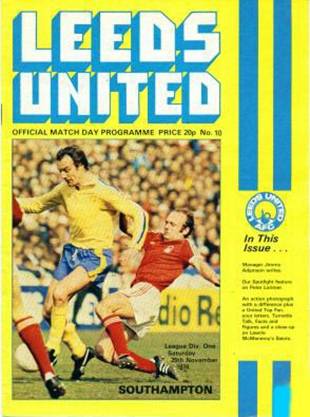
Memory Match No. 5: Leeds Utd 4, Southampton 0 (25.11.1978)

A journey further back in time for this week’s Memory Match, to the golden, hazy days of theImage late seventies. This was a post-glory era Leeds United, but not too bad a side for all that – especially during the early part of Jimmy Adamson’s Elland Road managership. These were the days when the famous old stadium was dominated from all four corners by the tallest floodlights in Britain, towering 260 feet into the Yorkshire sky, and illuminating proceedings with their distinctive diamond-shaped arrays of 220 lamps each. Genial Jim Callaghan was Old Labour’s last Prime Minister before Maggie Thatcher took charge for the Tories, we said goodbye to two long-running police drama series in Z-Cars and The Sweeney and songs from the soundtrack of hit musical Grease figured large in the singles charts along with the likes of Kate Bush, the Bee Gees and Boney M.

Leeds at this point were a club still trying to re-establish themselves as a success following a distinct decline from the greatness of Don Revie’s all-conquering United warriors. The previous two seasons had seen progress to both domestic semi-finals, but defeat to Man Utd in the FA Cup, and Brian Clough’s Nottingham Forest in the League Cup had blocked the path to Wembley on each occasion. Billy Bremner had moved on, Norman Hunter had gone – but the home crowd had a new favourite in Tony Currie, one of the few players who could genuinely live up to the sobriquet of “Midfield Maestro”. Currie had been signed from Sheffield United in the summer of 1976, and as the 78/79 season dawned he was surely in the prime of his career, shining for club and country alike, pulling the strings which controlled the team’s performance and frequently doing just as he pleased against helpless opponents.

This season had started with the surprise appointment of former Celtic manager Jock Stein to replace the sacked Jimmy Armfield. I still remember being on holiday in Spain, and my Dad chucking a hard-to-obtain English newspaper across at me with the headline “Stein For Leeds” on the back. I had been delighted, but sadly Big Jock’s stay at Elland Road was a mere 44 days before he left to take up his dream job as Scotland manager. So it was Adamson’s Army which greeted the teams on a bleak November afternoon as newly-promoted Southampton provided the opposition. Leeds’ home form had been reasonable, with a draw against West Brom and a narrow defeat to Arsenal in the previous five games, though Birmingham and Derby had both been convincingly beaten, and there had been a welcome 2-1 victory over Chelsea. Attendance levels though were relatively disappointing other than for the traditionally attractive matches against top teams, and a fairly sparse crowd of 23592 turned up for what was, on the face of it, a mundane fixture.

Leeds started as they preferred, attacking the South Stand end of the ground so as to save the Kop for a second-half assault, and they had the breakthrough after only fourteen minutes. Trevor Cherry, coming out of defence, played a probing ball up field where the burly Ray Hankin rose to head downwards to little Brian Flynn. United’s pocket dynamo was always adept at picking up possession in dangerous areas and making good use of the ball, and he was quick to scurry across the edge of the Saints penalty area towards the right, where he neatly slipped a pass to Arthur Graham. The Scottish winger was well-known for his ability to cut in from either wing, and once he got the ball in space on either foot, he could be quite lethal, as he proved now. Moving back infield, he easily evaded a defender before turning smartly to fire left-footed past former Halifax ‘keeper Terry Gennoe into the bottom right-hand corner. It was a clinical finish, giving the Southampton stopper no chance at all.

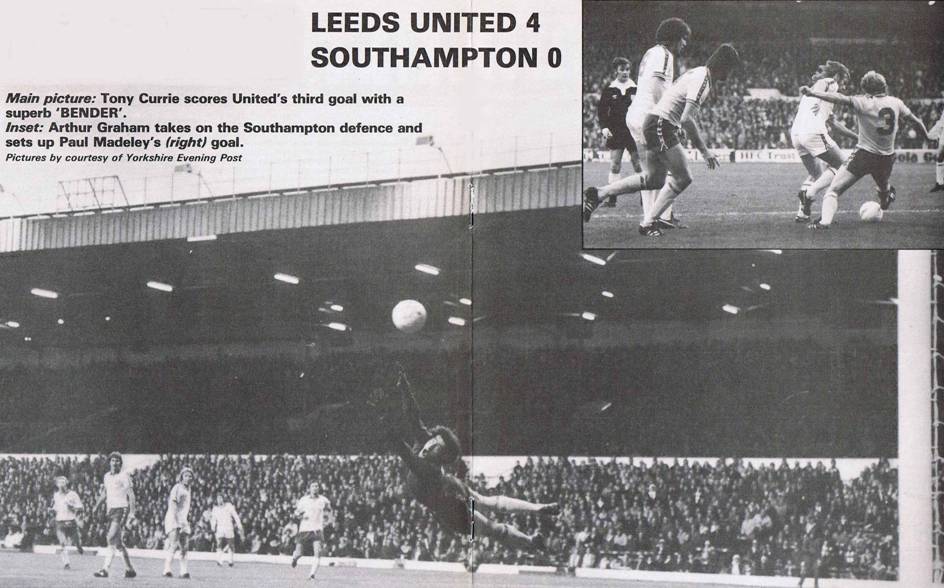
Eight minutes later, the lead was doubled, and this was a collectors’ item of a goal. Not since Boxing Day 1975 had Paul Madeley troubled the scorers, but here he was suddenly in what was nose-bleed territory for him, just outside the opposition area as Graham rolled in a pass from the right. United’s Rolls-Royce, as he had been dubbed, was a Mr Versatile of many years standing, having worn every outfield number for Leeds, but he was never exactly prolific in front of goal. Now though he seized on Graham’s pass and struck a left foot shot which took a cruel deflection, hopelessly wrong-footing Gennoe who could only watch as the ball bobbled into the net. 2-0 to United who were cruising at half-time, having been rather unluckily denied a third when John Hawley’s header thudded against an upright after a flowing move down the left.

The second half was only ten or so minutes old when one of the most famous Leeds United goals in living memory drew rapturous applause from the fans massed behind the goal at the Gelderd End. Tony Currie had been in full-on matador mode all day, taunting opponents with his mastery of possession, effortless control, trademark step-over and change of pace. His range of passing on form like today’s was almost Giles-esque, and there really is no higher praise than that. It had always looked like being Currie’s match to dominate, and now he scored the goal that cemented his place in United folklore. Snatching possession midway inside the Saints half, Currie mastered a lively bouncing ball before advancing on a nervously retreating Chris Nicholl. Rather than doing anything so mundane as beating his man, Currie looked up and, using the Saints defender as a shield, he simply bent the ball around him on a beautiful, curving trajectory, past the diving Gennoe to nestle in the far right-hand corner of the goal.

“Oh, my goodness!” intoned an awestruck Martin Tyler commentating for Yorkshire TV, “…and Tony Currie milks the applause that is so deserved.”

Image

The rout of the Saints was complete on 65 minutes, when a Trevor Cherry cross from deep on the right caught the visitors’ defence hopelessly square, leaving Hankin in space and onside. Yugoslav defender Ivan Golac, who had never scored in English football until today, now broke his duck in the most undesirable fashion, chasing back nobly to dispossess Hankin who was casually weighing up his options, but tragically succeeding only in lifting the ball over his ‘keeper and into his own net for 4-0.

For much of the remaining 25 minutes, Leeds seemed to take their foot off the gas somewhat, and allowed a Southampton side – who had, in truth, battled well throughout – a number of pots at David Harvey’s goal. The Leeds ‘keeper though, unaccountably frozen out of a Scottish International side that could well have used his agility and experience, was equal to everything thrown at him, and preserved a clean sheet without being troubled unduly.

It hadn’t been a fantastic match, or indeed an especially memorable one, apart from two superlative goals from Graham and Currie. History shows, too, that Southampton would have the last laugh that season, coming back from trailing 2-0 against Leeds United in the first leg of the League Cup semi-final at Elland Road, to draw that game 2-2. They then completed the job with a 1-0 victory in the second leg at The Dell, going through to lose the Wembley final against Nottingham Forest.

But for United it was the season that saw us back into European competition for the first time since our ill-fated European Cup Final against Bayern four years previously, and the Saints win contributed its fair share to that achievement. Sadly though Tony Currie was soon to depart, his then wife apparently homesick for London. He duly joined QPR and eventually graced Wembley at club level himself as Rangers played Tottenham in the FA Cup Final of 1982, before injury drew a close to a flamboyant and entertaining career. Leeds without Currie were never quite the same force again, and we were now on the downward spiral to eventual relegation in the 1981-82 season.

In many ways then 1978-79 was United’s last hurrah in the top flight, our last decent stab at competing in the top league until Howard Wilkinson restored that status in 1990; and Tony Currie was certainly in my opinion the last real Leeds Legend of the immediate post-Revie era. For me, he was one of the greatest, and I mourned his departure more than most I have witnessed over the years. It felt like the end of an era when he went, and so it ultimately proved to be. But Currie left us with some magical memories, perhaps the greatest of which remains that terrific banana shot at the Kop End, a goal worthy of any superstar, and one fit to grace any occasion.

Next: Memory Match No. 6: West Ham Utd 1, Leeds United 5. Upton Park was frequently a happy hunting ground for Leeds, and the Whites’ cause was aided on this occasion by a couple of Hammers dismissals in a May 1999 game where – for once – we seemed to get the rub of the green where the ref was concerned.

Leeds United For Sale Again – But What Happens In The Short Term?

Image

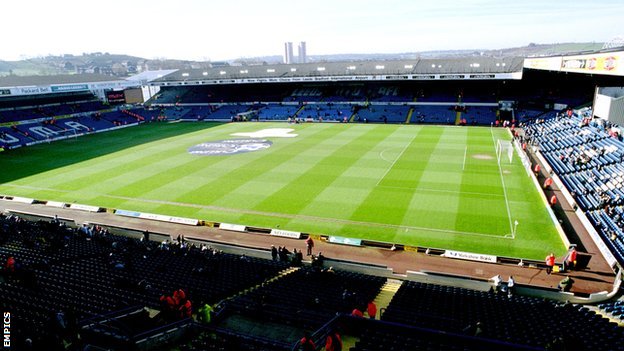
Leeds United’s Elland Road Stadium

Leeds United are officially up for sale again, just three months after GFH Capital completed their “bargain purchase” of the Club from cuddly Uncle Ken Bates on 21 December last year. This news might be received with joy, despair or indifference, depending on your current attitude to the low-budget kitchen-sink drama that is LUFC these days.

The joyous ones are the optimists, dreaming that – at last – a rich billionaire (as opposed to the sort of impoverished billionaires normally linked to the Club) will come steaming in on his souped-up camel, and purchase for us long-suffering fans the baubles we have craved ever since winning the Last Proper League Championship.

The pessimists meanwhile are withdrawing their heads back under the carapace of their impenetrable gloom, pausing only to remind the rest of us that they knew all this takeover talk was bollocks right from the start last May, that no-one with any dosh would come within a mile of Leeds United, and that we’ll now probably be sold back to Ken Bates for ten bob after a second administration, so that he can fulfill his stated aim of reducing us to the Ryman League, Division Three.

Personally, I’m languishing among the indifferent tendency, somewhere between these first two groups. I’ve quite frankly had enough of Leeds United this last year or so, especially after the battering all our psyches took with the roller-coaster TOMA* saga of last summer, and being roundly laughed at and suffering from chronic urine-extraction by dopey fans of daft little cobble-stone clubs (you know who you are.) It’s just not good for morale, and mine is shot through, thanks very much.

The thing is though, the Club has somehow to carry on its business of playing games of football with some appearance of trying to win them, and maybe in the process attracting what they are nowadays pleased to call “customers” through the computerised turnstiles. And this undertaking is not helped at all, not in the least, by any measure of uncertainty among the fanbase. Last summer was awful, and now – with GFH Capital apparently anticipating completion of a sale withing a window of between six and twelve months – we have more of the same in the offing. So another transfer window will pass without the urgent surgery needed to transform the current squad into a lean, mean winning machine. Another six months to a year during which the creeping disease of apathy will spread further throughout the body of support, once so vibrant and fanatically motivated. The manager is off, the latest boy wonder Super Sam is being tipped for a move to a proper football club and the fans are in the dark – as usual – regarding any long-term vision for our once-great Club.

Surely (you’d have thought) there must be some plan, some concrete strategy, for getting back to the Premier League, which is the only environment where a club like Leeds United – with its history, tradition, remaining infrastructure and global fanbase – can hope to survive and prosper. This has to be the minimum aim, and nobody with any ambitions of running the club should be under any illusions – once the Promised Land is reached, the support will not be content, like any old Wigan or Norwich, with mere survival. The Leeds fans will want to swagger in like they own the place, have a brief look around, and then win it. That’s what we did last time, 21 years ago, and the fact that it’s a totally different world nowadays will not stop that urgent demand for success, that imperious need to take on the game’s elite, and make them eat crow.

This demand, this greed and yearning for past glories to be repeated, can serve either as an inspiration for ambitious and visionary owners, or as a millstone around the neck of people who might want to come in, seek to have the club tick over in the lower reaches of the Premier League, and depart with some sort of profit. Obviously it’s to be hoped we might attract the former type, but they’ve not emerged as yet despite months of speculation about the shape of things to come post-Bates. The time is fast approaching when decisions need to be made for the good of Leeds United, about its strategy for success in the 21st Century, its model for progress in the new high-finance structure at the top end of the game and the picture it can justifiably paint for the fans of the type of club they’re going to have to support going forward. GFH Capital told us that they were here for the long haul, but now they’re jumping ship faster than the scarediest rat, making some of us wonder just how quickly that ship is sinking. What leadership can we expect from them now, what confidence can we have in them when they’re already yesterday’s men? Meanwhile we all remain firmly, blindly in the dark, where we’ve spent the bulk of the last decade, wondering what’s to become of our beloved Leeds.

Now that’s far, far too long a period of unhappiness and uncertainty for a group of people who have – mostly – continued to shell out their hard-earned, buy the tacky merchandise and roar their support from over-priced seats during a period of sustained failure and mostly crap football. The fact is that the Club is bang to rights on accusations of gross complacency and mistreatment of its prime asset – the highly vocal, passionate and still predominantly dedicated support, both immediate and match-going, and more generally in all parts of the globe. Fans want to know what’s going on at their club; quite understandably they want to be involved, they want to feel part of what’s going on. The Club have callously disregarded all of this for ages now, recent cosmetic gestures towards “fan engagement” notwithstanding, and despite welcome moves towards a more realistic pricing structure. There just hasn’t been enough transparency, and now we’re going to enter another disturbing period of uncertainty, to emerge eventually – well who knows in what shape we’ll emerge? Treat any group of “customers” (if we really must so term fans) with such blatant disregard and such arrogant refusal to consult them and address their concerns, and eventually – even with fanatics and people who live their lives through their obsession – you’ll lose them. I’ve been a fanatic, for 38 years, at some cost to my financial and social well-being, and yet they’ve damn nearly lost me. I’m starting to prefer my football wrapped in a film of nostalgia – it’s less painful than the current reality. But whatever defiant noises I might make, and however much I might warn of erosive apathy – I still care. Too deeply for my own good. And there remain thousands like me.

But we can’t carry on like this. It’s got way beyond a joke, and the jibes from opposing fans – all too well aware of our history, and nursing the standard anti-Leeds chip on their shoulders – are far less worrying than the grumbles of discontent from the ranks of the still-faithful. Get your act together, Leeds United, and do it soon, or preferably do it NOW. We’re still with you. But for how much longer?

*TOMA – For the uninitiated, this is an acronym referring to the perceived unlikelihood of Leeds United benefiting from a buyout to its advantage. Take Over My Arse.

Mini-rant #1- An Act of Faithlessness.

This is the first in a series of mini-rants, being bite-sized portions of my large supply of bile and spleen concerning matters that piss me off.  These handy snacks of vitriol shall be served occasionally by way of appetisers for the more verbose offerings I share as main courses.  The dessert menu is a work in progress, but you’re welcome to ask for the Whine List.

Apparently an Everton fan of 36 years support left today’s FA Cup tie against Wigan before half time with his team 0-3 down. He’d already booked a hotel room for what he’d obviously assumed was a nailed-on semi-final appearance at Wembley for the Toffees.

Well now – where to begin?  Honestly, doesn’t that make this outraged supporter, on two counts, the kind of “fan” you need like you need a sharp attack of dysentery. First the arrogance, assuming quarter-final success like that. Any football fan, deluded scummers* apart, will tell you that’s just begging for fate to kick you in the teeth. Idiot.

And walking out before 45 minutes is up. What a spineless, spoiled, selfish thing to do, showing a lack of faith, courage and moral fibre. Look at Arsenal, 0-4 down at Reading this season, and won 7-5. They had fans desert them too, and boy did those of little faith look stupid.

So well done that soft, limp Toffee.  Double idiot, and a wimp to boot.  He should take his support elsewhere if you ask me – and I think I know just the place.  He sounds absolutely ideal for the plastic, whinging, glory-hunting congregation at Old Toilet, home of the “Greatest Football Club In The World™” – he’d fit right in there, though he’d probably need to adopt a home counties accent.

What is the game, and the support, coming to these days??  Yours, Disgusted of Leeds.

*Scummers: a term of endearment employed by Leeds United fans to denote followers of The Mighty Manchester United.

Man United – Why Always Them?

Former Manchester City maverick Mario Balotelli will be remembered in the English game for many things, but prominent among those various goals, skills and misdemeanours will be his famous celebration after scoring against Manchester United at Old Trafford last season in City’s 6-1 eclipsing of their local rivals.  Balotelli slotted the ball home calmly at the Stretford End, turned away with no sign of emotion on his face, and lifted his City shirt to reveal a t-shirt on which was printed the heartfelt plea “Why Always Me?”.  The message, after a series of incidents culminating in a row with the emergency services when he set off a firework in his bathroom at home, clearly indicated a feeling that he was being scapegoated to a certain extent.  To add insult to his perceived injury, he was booked for the t-shirt display.
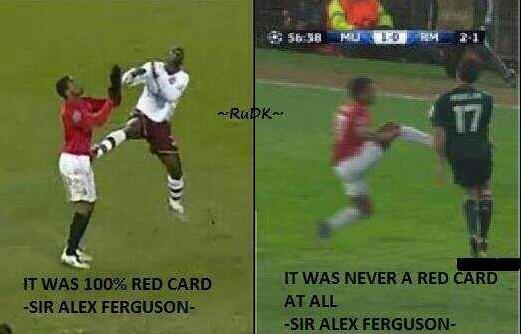
Recent events, on top of a long history of prominent stories figuring the controversy and fuss that attend one football club above all others, might lead us to ask a somewhat wider version of the same question.

Why is it always Manchester United?

The furore surrounding their Champions League exit on the 5th March is fairly typical of the controversy the Champions-elect seem to attract, like flies to a bad piece of meat, on such a regular basis that you tend to wonder whether it’s just coincidence or a Machiavellian form of press-management.  So “enraged” was manager Alex Ferguson after their defeat, which turned on the dismissal of Nani for what might charitably be termed a high tackle; that he refused to appear before the assembled press after the game.  He was “too distraught” apparently, to fulfil his mandatory duties in that regard.  To the media of course, a story about a no-show from Ferguson is a much bigger scoop than anything most managers might say in adhering to their agreed obligations.  But Manchester United and controversy have gone together like port and nuts for a long, long time now.

ImageCloser examination of the incident in focus this time reveals a worrying lack of consistency in Ferguson’s emotional reactions over remarkably comparable incidents.  Nani’s liver-high tackle was described dogmatically as “definitely not a red card”, paving the way for Man Utd claims of ill-treatment and bias.  A virtually identical tackle some time before, by Arsenal’s Eboue on Ferguson’s own player Evra, was also punished by a red card, but that one drew praise from the choleric Scot, who stated that the decision was “100% correct”.  This apparent self-contradiction is nothing new in the world of Alex Ferguson, or indeed in the wider manifestations of the club who like to brand themselves “The Greatest in the World”.

At the end of the Real Madrid match, enraged home defender Rio Ferdinand saw fit to get up close and personal with the referee who had dared dismiss Nani, sarcastically applauding him at point-blank range.   This is a widely-recognised form of dissent, and would normally merit a yellow card.  The referee did nothing, and UEFA have since confirmed that no action will be taken against Ferdinand.  It would be tempting to ask what sort of message this sends out to aspiring young players, if the answer were not so glaringly obvious.  That message is, as ever:  Man Utd can basically do just as they like, the game’s ruling authorities being so much in thrall to the club’s global profile – and the markets dependent upon its prosperity – that they will often turn a Nelsonian blind eye to such flouting of the rules, in the fond hope that nobody will notice when other clubs are dealt with more severely for like offences.

It has been said, with some justification, that one of the more hackneyed clichés in today’s game is the regular statement from the Football Association along the lines of “We have looked into (insert name of misdemeanour perpetrated by the Man Utd club or employee here), and can confirm that no further action will be taken.”

This sort of thing has been going on for many years, and while most clubs might shy away from such regular media attention of a not entirely positive nature, Man Utd as an entity appear to subscribe to the old maxim that there’s simply no such thing as bad publicity.  They have displayed a talent for remaining newsworthy, certainly on the back pages and not infrequently on the front as well, more or less continually, and dating back to well before their current era of success.  The incidents are many, and mostly quite unsavoury – Rooney elbowing a Wigan player and getting off scot-free, dodgy penalties too many to number, the legendary difficulty of seeing a penalty awarded against them and so on and so forth – and yet the default press position remains that the club are pre-eminent in the game for reasons of skill, charisma and courage, an apparent myth lapped up eagerly by the global fan-base, most of whom have never seen the team play in the flesh.

We hear far too much also of Ferguson’s so-called “mind-games”, a phenomenon particularly beloved of the media in this country, but one which appears to consist largely of an elderly gentleman having great difficulty sticking to the path of veracity at those press-conferences he deigns to attend.  Madrid manager Jose Mourinho is one who prospers in these psychological duels – in Ferguson’s petulant absence after the game last Tuesday, he stated that “the better team lost”, and walked off, content at having fanned the flames of the Man Utd manager’s fury.

It seems though that UEFA are after all to look into Ferguson’s failure to turn up for the press after this latest controversial occasion.  Presumably they will investigate fully, and a technical charge of “Sulking” might just possibly ensue.  But it would be unwise to place too much money on such an outcome; it may well be that we’ll yet again hear those old, familiar words “no further action will be taken”.

Memory Match No. 3: Leeds United 3, Man U 1. 24.12.1995

1995-96 was the last full season of Sergeant Wilko’s eventful reign at Elland Road. His influence over the club was crumbling amid rumours of money problems, takeovers and dressing-room discontent, a tale that would doubtless strike a chord with Messrs. Grayson and Warnock of more recent vintage. This was a season that had started off with a flurry of Tony Yeboah thunderbolts and some impressive results and performances which appeared to promise much. Sadly though, it would peter out in a shocking late-season run following a League Cup Final humiliation at Wembley, courtesy of Aston Villa. Howard Wilkinson was a dead man walking from that time on.

Worrying signs of defensive frailty and general ineptitude had been all too obvious just the previous week at Hillsborough. United had succumbed spinelessly to a 6-2 defeat at the hands of an unremarkable Sheffield Wednesday side and – all bravado aside – there wasn’t much optimism in the hearts of the faithful as this fixture against the arch-enemy loomed.

It was certainly a different Christmas Eve for me. I hadn’t exactly led a sheltered life up to that point, but this was the first time – and the last, to date – I’d ever risen the day before Christmas to bacon sandwiches at 6 am, closely followed by numerous Budweisers with the Sunday papers in a fan-friendly pub, as we waited for our “Scum Match Special” mini-bus. The queasy feeling before any match against “Them” was therefore multiplied by unaccustomed early-morning grease and alcohol, and I was feeling several shades of not-too-good as we set off for Elland Road. It was an 11:30 kick-off, live on Sky, and it promised either to make or break the whole of Christmas for us fans, and for our hopeful families.

The situation between the Uniteds of Leeds and Salford is one of a legendary mutual animosity, even at the best of times. Let’s not mince words here, the two sets of fans hate loathe and detest each other, and open warfare is the norm. Revisionist football pundits would have us believe that this is strictly a one-way affair, but you only have to tune into one of Sky’s glitzy live TV love-ins for a Man U match, and whoever they are playing, our Home-Counties friends are in full voice with their “We all hate Leeds scum”. Even Alex Ferguson, the Red Devils’ not-altogether-likeable manager, makes no bones about it; some of his more coherent sound bites feature his opinion that Elland Road is “the most intimidating arena in Europe”. He’s also stated that going to Liverpool is nowhere near as bad as going to Leeds; clearly, he’s never been for a late-night pint in Old Swan or Dodge City.

So, Yuletide or not, the usual poisonous atmosphere was in evidence as the two teams walked out before a 39801 crowd that overcast morning. Just as Leeds were smarting from their Hillsborough debacle, so Man U were struggling to emerge from a poor run, winless for a month and dispatched by Liverpool the previous week. This seasonal fixture was a chance of redemption for both sides.

Image

Macca slots the penalty home

By kick-off time, I was starting to feel properly ill, and in dire need of a pick-me-up. This arrived in a most unlikely form after a mere five minutes, when a Leeds corner swung over from the right. Richard Jobson rose on the edge of the area to head towards goal, where David Wetherall, lethal against Man U in the past, was challenging for a decisive touch. But that touch came instead from the upraised, red-sleeved arm of Nicky Butt – and referee Dermot Gallagher’s whistle sounded for a penalty.

Peering from the Kop at the other end of the ground, through an alcoholic fug, I could hardly believe my eyes. Leeds just didn’t get penalties against “Them”. It would happen the other way around alright, too often, and even from three yards outside the area but this was unprecedented, since our Title-winning year anyway. Steve Bruce evidently thought it was just too much to bear, and screamed his violent protests into Gallagher’s face, having to be restrained by Gary MacAllister, who appeared to be trying to explain the rules to the furious defender. The guilty look on Butt’s face, though, spoke volumes. MacAllister placed the ball on the spot, and sent it sweetly into the top right corner for 1-0, giving Peter Schmeichel not even the ghost of a chance. The celebrations were raucous and deafening as the Elland Road cauldron exploded with joy – and inside my skull, the trip-hammer of a beer-fuelled headache pounded away anew, utterly failing though to banish my smile of delight.

Leeds had the bit between their teeth now, and Brian Deane was suddenly clear for an instant outside the right corner of the Man U penalty area, played in by a cute pass from Carlton Palmer. Schmeichel was out swiftly to smother the chance, but Deane managed to dink the ball over him, only for it to clip the crossbar and bounce away to safety. A two-goal lead at that stage would have felt unlikely yet deserved, as Leeds United had been on the front foot right from the off. Soon, though, a lesson was to be delivered about what happens when you miss chances against this lot.

The unlikely culprit as Leeds were pegged back was Gary Speed. Receiving the ball in the left-back position, he tried to beat Butt instead of clearing long, and was robbed of possession. Butt looked up, and placed a neat pass inside to Andy Cole, whose efficient first-time finish levelled the match. Suddenly, my headache was even worse, and I was starting to wonder about the fate of my breakfast too. Time for another reviving injection of optimism as Leeds surged forward, and Speed so nearly made up for his defensive error, playing a one-two with Tomas Brolin which gave him space to put in a right-foot shot that went narrowly wide.

Image

Yeboah beats Schmeichel for the second goal

The game had settled down by this time, and both sides were showing enough ambition to feel that they were in with a chance of victory. Leeds though had thrown off their Sheffield blues, and attacked with verve and purpose. Now, a defensive position was coolly handled by Gary Kelly, finding the time and space to launch a long clearance forward, where Brolin headed on. The ball was loose, and surely meat and drink for Man U’s international defender Paul Parker – but he inexplicably let it bounce over his foot. Yeboah pounced on it like a hound on a rat, and he was away, surging towards goal with ex-Leeds defender Denis Irwin backing off. Yeboah in this mood was usually irresistible, and sure enough none of Irwin’s careful jockeying could prevent him from finding that vital half-yard of space. The gap appeared, Schmeichel came out to block, and Yeboah clipped the ball sumptuously just out of the Danish ‘keeper’s reach, up and over to nestle in the far corner of the South Stand net.

Again, that explosion of noise and joy, again my fragile system was assailed by the rough-and-tumble of riotous celebration. 2-1 up against the team we loved to hate; the cockneys at the far end were suddenly silent and morose. “You’re not singing anymore!” we blasted at them, and indeed, little would be heard from the away fans for the rest of the game.

Image

Brian Deane makes it 3

The second half was another tale of give and take, both sides able to cause trouble up front, but both seemingly capable of dealing with all that was thrown at them. The onus was on Man U to retrieve a losing situation, but Leeds were rarely in great trouble, and as the game entered its final quarter there was unprecedented optimism that we could close this one out, and enter Christmas on a real high. Leeds weren’t simply sitting back and absorbing pressure – and the maxim of attack being the best form of defence was to serve them well. On 73 minutes, Jobson made a foray down the left, and was fouled by Cole chasing back. The resulting free-kick was played to MacAllister in space in the middle of the park, and he swiftly moved it out to the right wing. Brolin picked up possession, and then slipped the ball to the overlapping Palmer, who surged into the box, and then turned past Irwin to set up Brolin again on the edge of the area. The much-maligned Swede, making the contribution I best remember him for, chipped the ball sweetly first-time, standing it up just around the penalty spot, where Deane’s exemplary movement had won him the space to rise and plant a firm header past a helpless Schmeichel into the net. 3-1 and finis.

After the game, and before the Yuletide celebrations could begin in earnest, other traditions had to be observed. Ferguson, naturally, had to moan about the penalty. “It was a very surprising decision, given in circumstances that were beyond me.” whinged the Purple-nosed One, in evident ignorance of the deliberate handball provisions – but perhaps aiming to justify Bruce’s undignified and almost psychotic protest at the time. And the massed ranks of the Kop Choir had to regale the departing Man U fans with victory taunts as they sulked away, silent and crestfallen, headed for all points south.

I can’t remember the journey home, or even how spectacularly ill I was when I got there, although I’m told I was the picture of ecstatic yet grossly hung-over ebullience. I just know it was my happiest Christmas Eve ever, ensuring a deliriously festive spirit for the whole holiday, much to the delight of my long-suffering wife and two-year-old daughter.

Merry Christmas, everybody! And God bless us, every one. Except Them, from There.

Next: Memory Match No. 4: Leeds United 4, Derby County 3. 1997-98 included a purple patch for Leeds United, and a series of “comeback wins”. Perhaps the best was this recovery from 3-0 down at Elland Road against the Rams.

Memory Match No. 2: Sheffield Wednesday 1, Leeds United 6 12.1.1992

Image

As 1991 turned into 1992, the two-horse English Title race was hotting up.  Man U had suffered a shocking reverse on New Year’s Day, capitulating 4-1 at home to QPR, and then later that January 1st, Leeds had won competently 3-1 at West Ham to remain well in the race for the ultimate domestic honour.  The scene was adequately set, then, for Wilko’s first return to Wednesday since he had quit Hillsborough to become Leeds boss in 1988.  This would also be Lee Chapman’s last game before his season-threatening FA Cup injury, which resulted in the drafting in of one Eric Cantona – with all the long term consequences that would entail.  But Chappy was destined to be sidelined only temporarily, and he went out in the most emphatic style.

There was a crowd of 32228 at Hillsborough, the usual vociferous contingent of travelling Leeds fans rivalling the home crowd for noise from the outset, and completely drowning them as the game went on.  Leeds United were weakened, so it seemed, by the absence of the injured Gordon Strachan and suspended David Batty, half of their legendary midfield Fantastic Four.  Any side, surely, would miss performers of such calibre.  Leeds, though, seemed determined to make light of the problem, and tore into their hosts from the start.  Full-back Tony Dorigo made an early darting run, cutting in from the left and making good progress down the centre of the pitch, before unleashing a right-foot thunderbolt that Wednesday ‘keeper Chris Woods had to tip over.  From the resulting Gary MacAllister corner, Chris Fairclough rose to head downwards, and found Chapman in splendid isolation four yards out; his finish swift and deadly for 1-0.

For a local derby, the contest had been decidedly one-way traffic – Chapman was to send two towering headers just wide before Carl Shutt had a scuffed shot smothered by Woods in the home goal.  Then, a true champagne moment as Mel Sterland fed the ball to Chapman on the right.  In a completely untypical burst of pace and control, Chappy surged between two hapless Wednesday defenders, raced into the area, and unleashed a shot that beat Woods completely, just clipping the frame of the goal to rapturous applause from the Leeds fans at the Leppings Lane End.  I remember thinking at the time that anything was possible now, if Lee Chapman could do something so utterly out of character.  And so it proved as, from a free kick awarded just right of centre some ten yards outside the box, Dorigo stepped up to absolutely hammer a left foot drive past the helpless Woods.  Cue mayhem and cavortings as the Leeds hordes behind the goal, celebrated as clean a strike as you could ever wish to see, the ball a blur as it arrowed into the far corner with deadly precision and power.

At 2-0 down, the home side were making increasingly desperate attempts to gain some sort of foothold in the match.  This desperation was adequately demonstrated when, from a harmless-looking ball into the Leeds area, Wednesday striker Gordon Watson ran in front of Chris Whyte, continued on for another step or two, and then hurled himself into the air, landing in agonised paroxysms of simulation between a bemused Whyte and Leeds ‘keeper John Lukic.  Such obvious fraud and villainy could have only one outcome, and the stadium held its collective breath for sentence to be passed on the miscreant.  Instead – amazingly – referee Philip Don pointed to the spot.  Whether none of the officials had seen the extent of Watson’s ham-acting, or whether they were moved by sympathy for the mauling Wednesday were taking from a rampant Leeds, it’s impossible to tell.  The outcome was the same either way.  Ex-Leeds hero John Sheridan stepped up, saw his penalty brilliantly saved as Lukic tipped it against his right-hand post, and then gleefully belted home the rebound to give Wednesday a massively unmerited lifeline.

This act of base and scurvy treachery required nothing less than a riposte of the utmost nobility and beauty, so we said to ourselves, though probably in more Anglo-Saxon terms.  And, happily, that’s just what came to pass.  Only six minutes after the home side’s ridiculous blagging of a comically unfair route back into the game, Leeds took effortless control again with a goal sublime in both its conception and execution.  Lukic bowled the ball out to Dorigo on the left flank; he sent it first time down the line to Gary Speed, who took one steadying touch before sending a beautiful flighted cross into the Wednesday area.  And there, inevitably, was Chapman, horizontal in mid-air, neck cocked to hammer the ball unanswerably past Woods, the perfect counterpunch to Watson’s knavish low blow.  It was a gorgeous goal, sweeping the length of the left side, taking the entire home team right out of the game, and re-establishing the two goal margin which was the least Leeds United deserved at half-time.

The second half that ensued was simply a story of how a blood-and-thunder Yorkshire derby turned into a stroll in the park for Leeds United.  It seemed as if all the life had been sucked out of the home team – a Wednesday side who, let’s not forget, were unbeaten at home since the opening day of the season, and who would go on to finish third in the table.  So they were no mugs, but Leeds United were absolutely irresistible on the day, and would have hammered far better teams than the hapless, bewildered Owls.

It’s possible that Wednesday were simply embarrassed about that cringe-worthy penalty, possibly they were dog-tired, having been run ragged since the start.  Whatever the case, their heads dropped steadily further and further as the game progressed, and they offered little resistance as Leeds proceeded to throttle the life out of them.  Chapman completed his hat-trick five minutes after the hour, heading in after Speed had struck the bar from a corner.  Poor Speedo was looking the other way, bemoaning his bad luck when the ball hit the back of the net after all, turning his frustration to joy.  Then, perennial bit-part player Mike Whitlow ventured forward, just because he could, and rose unchallenged to meet Rod Wallace’s right-wing cross and head easily over a stranded Woods.  It was left to little Wallace to administer the coup de grâce, striding clear after a shimmering exchange of passes in midfield to dink the ball over the advancing ‘keeper, and put the suffering home side finally out of their misery.

For Leeds, it had been their biggest away win in over 60 years as they returned to the First Division summit in the best possible manner – they got six, but they really could have had ten or a dozen.  The message had been sent out loud and clear to the watching millions in Live TV Land: United were deadly serious about their Championship challenge.  They would surely look back though after their eventual Title success, and identify this sumptuous display as one that defined them as potentially the best team in the land.  For Wednesday, it was total humiliation and – truth to tell – very difficult to sympathise.  Better by far to lose 6-0 than to be tainted as they were by such a crass and obvious example of cheating – and it hardly reflected much credit on the match officials, either.  But the cheats on this occasion failed utterly to prosper.

It was a massively impressive performance, a hugely significant victory, and the sweetest possible return for United’s ex-Owls contingent.  Mel Sterland always took great delight in beating the Blades, but this victory over his boyhood favourites would have only happy memories for him, as indeed for Chapman, Shutt and of course the triumphantly-returning prodigal Sergeant himself.  Leeds would march on to the Title, finishing four points clear with the most wins and least defeats, unarguably deserving Champions (although the usual suspects argued anyway).  Man U’s quarter-of-a-century wait for a Title would extend for another twelve delightful months before Mr. Murdoch ushered in an era of success for them, aided by our own enfant terrible.  And Sheffield Wednesday?  They would recover to finish impressively, despite another awful trouncing at deposed Champions Arsenal.

1991-92 was a season of nip-and-tuck, with titanic struggles in both Cup competitions adding spice to the League fare as the battle for honours raged on three fronts.  But there can be no doubt whatsoever that January 12th 1992 belonged entirely to Leeds United, who looked like Champions a full four months early with this five star, six of the best Masterclass display crowning them as Yorkshire’s finest – just as we, and indeed the Wednesday fans in their heart of hearts, had always known.

Next:  Memory Match No. 3:  Xmas Eve 1995 – Leeds United 3. Man U 1.  Join me again, for an early start to Christmas, a classic Yeboah finish, Brolin’s finest hour and an actual penalty against “Them, From There”.