Category Archives: Television

Memory Match No. 2: Sheffield Wednesday 1, Leeds United 6 12.1.1992

Image

As 1991 turned into 1992, the two-horse English Title race was hotting up.  Man U had suffered a shocking reverse on New Year’s Day, capitulating 4-1 at home to QPR, and then later that January 1st, Leeds had won competently 3-1 at West Ham to remain well in the race for the ultimate domestic honour.  The scene was adequately set, then, for Wilko’s first return to Wednesday since he had quit Hillsborough to become Leeds boss in 1988.  This would also be Lee Chapman’s last game before his season-threatening FA Cup injury, which resulted in the drafting in of one Eric Cantona – with all the long term consequences that would entail.  But Chappy was destined to be sidelined only temporarily, and he went out in the most emphatic style.

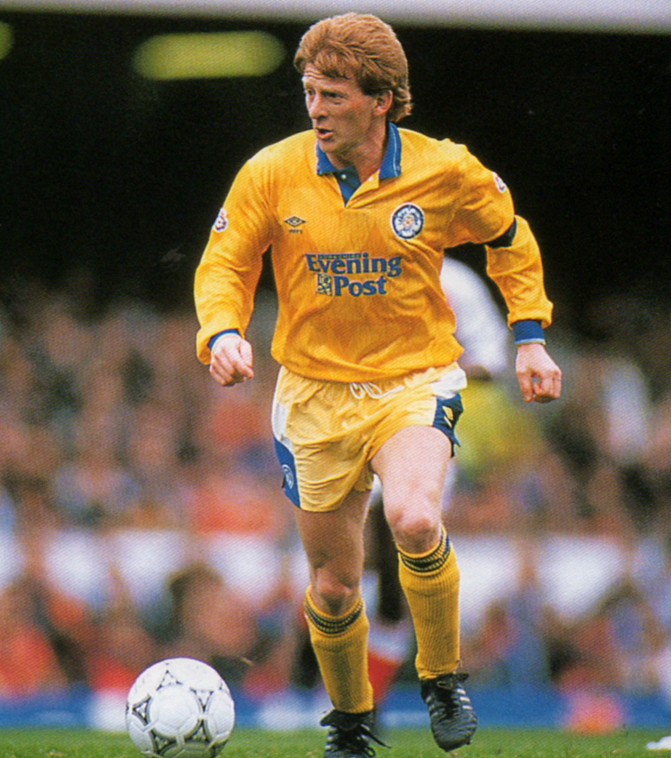
There was a crowd of 32228 at Hillsborough, the usual vociferous contingent of travelling Leeds fans rivalling the home crowd for noise from the outset, and completely drowning them as the game went on.  Leeds United were weakened, so it seemed, by the absence of the injured Gordon Strachan and suspended David Batty, half of their legendary midfield Fantastic Four.  Any side, surely, would miss performers of such calibre.  Leeds, though, seemed determined to make light of the problem, and tore into their hosts from the start.  Full-back Tony Dorigo made an early darting run, cutting in from the left and making good progress down the centre of the pitch, before unleashing a right-foot thunderbolt that Wednesday ‘keeper Chris Woods had to tip over.  From the resulting Gary MacAllister corner, Chris Fairclough rose to head downwards, and found Chapman in splendid isolation four yards out; his finish swift and deadly for 1-0.

For a local derby, the contest had been decidedly one-way traffic – Chapman was to send two towering headers just wide before Carl Shutt had a scuffed shot smothered by Woods in the home goal.  Then, a true champagne moment as Mel Sterland fed the ball to Chapman on the right.  In a completely untypical burst of pace and control, Chappy surged between two hapless Wednesday defenders, raced into the area, and unleashed a shot that beat Woods completely, just clipping the frame of the goal to rapturous applause from the Leeds fans at the Leppings Lane End.  I remember thinking at the time that anything was possible now, if Lee Chapman could do something so utterly out of character.  And so it proved as, from a free kick awarded just right of centre some ten yards outside the box, Dorigo stepped up to absolutely hammer a left foot drive past the helpless Woods.  Cue mayhem and cavortings as the Leeds hordes behind the goal, celebrated as clean a strike as you could ever wish to see, the ball a blur as it arrowed into the far corner with deadly precision and power.

At 2-0 down, the home side were making increasingly desperate attempts to gain some sort of foothold in the match.  This desperation was adequately demonstrated when, from a harmless-looking ball into the Leeds area, Wednesday striker Gordon Watson ran in front of Chris Whyte, continued on for another step or two, and then hurled himself into the air, landing in agonised paroxysms of simulation between a bemused Whyte and Leeds ‘keeper John Lukic.  Such obvious fraud and villainy could have only one outcome, and the stadium held its collective breath for sentence to be passed on the miscreant.  Instead – amazingly – referee Philip Don pointed to the spot.  Whether none of the officials had seen the extent of Watson’s ham-acting, or whether they were moved by sympathy for the mauling Wednesday were taking from a rampant Leeds, it’s impossible to tell.  The outcome was the same either way.  Ex-Leeds hero John Sheridan stepped up, saw his penalty brilliantly saved as Lukic tipped it against his right-hand post, and then gleefully belted home the rebound to give Wednesday a massively unmerited lifeline.

This act of base and scurvy treachery required nothing less than a riposte of the utmost nobility and beauty, so we said to ourselves, though probably in more Anglo-Saxon terms.  And, happily, that’s just what came to pass.  Only six minutes after the home side’s ridiculous blagging of a comically unfair route back into the game, Leeds took effortless control again with a goal sublime in both its conception and execution.  Lukic bowled the ball out to Dorigo on the left flank; he sent it first time down the line to Gary Speed, who took one steadying touch before sending a beautiful flighted cross into the Wednesday area.  And there, inevitably, was Chapman, horizontal in mid-air, neck cocked to hammer the ball unanswerably past Woods, the perfect counterpunch to Watson’s knavish low blow.  It was a gorgeous goal, sweeping the length of the left side, taking the entire home team right out of the game, and re-establishing the two goal margin which was the least Leeds United deserved at half-time.

The second half that ensued was simply a story of how a blood-and-thunder Yorkshire derby turned into a stroll in the park for Leeds United.  It seemed as if all the life had been sucked out of the home team – a Wednesday side who, let’s not forget, were unbeaten at home since the opening day of the season, and who would go on to finish third in the table.  So they were no mugs, but Leeds United were absolutely irresistible on the day, and would have hammered far better teams than the hapless, bewildered Owls.

It’s possible that Wednesday were simply embarrassed about that cringe-worthy penalty, possibly they were dog-tired, having been run ragged since the start.  Whatever the case, their heads dropped steadily further and further as the game progressed, and they offered little resistance as Leeds proceeded to throttle the life out of them.  Chapman completed his hat-trick five minutes after the hour, heading in after Speed had struck the bar from a corner.  Poor Speedo was looking the other way, bemoaning his bad luck when the ball hit the back of the net after all, turning his frustration to joy.  Then, perennial bit-part player Mike Whitlow ventured forward, just because he could, and rose unchallenged to meet Rod Wallace’s right-wing cross and head easily over a stranded Woods.  It was left to little Wallace to administer the coup de grâce, striding clear after a shimmering exchange of passes in midfield to dink the ball over the advancing ‘keeper, and put the suffering home side finally out of their misery.

For Leeds, it had been their biggest away win in over 60 years as they returned to the First Division summit in the best possible manner – they got six, but they really could have had ten or a dozen.  The message had been sent out loud and clear to the watching millions in Live TV Land: United were deadly serious about their Championship challenge.  They would surely look back though after their eventual Title success, and identify this sumptuous display as one that defined them as potentially the best team in the land.  For Wednesday, it was total humiliation and – truth to tell – very difficult to sympathise.  Better by far to lose 6-0 than to be tainted as they were by such a crass and obvious example of cheating – and it hardly reflected much credit on the match officials, either.  But the cheats on this occasion failed utterly to prosper.

It was a massively impressive performance, a hugely significant victory, and the sweetest possible return for United’s ex-Owls contingent.  Mel Sterland always took great delight in beating the Blades, but this victory over his boyhood favourites would have only happy memories for him, as indeed for Chapman, Shutt and of course the triumphantly-returning prodigal Sergeant himself.  Leeds would march on to the Title, finishing four points clear with the most wins and least defeats, unarguably deserving Champions (although the usual suspects argued anyway).  Man U’s quarter-of-a-century wait for a Title would extend for another twelve delightful months before Mr. Murdoch ushered in an era of success for them, aided by our own enfant terrible.  And Sheffield Wednesday?  They would recover to finish impressively, despite another awful trouncing at deposed Champions Arsenal.

1991-92 was a season of nip-and-tuck, with titanic struggles in both Cup competitions adding spice to the League fare as the battle for honours raged on three fronts.  But there can be no doubt whatsoever that January 12th 1992 belonged entirely to Leeds United, who looked like Champions a full four months early with this five star, six of the best Masterclass display crowning them as Yorkshire’s finest – just as we, and indeed the Wednesday fans in their heart of hearts, had always known.

Next:  Memory Match No. 3:  Xmas Eve 1995 – Leeds United 3. Man U 1.  Join me again, for an early start to Christmas, a classic Yeboah finish, Brolin’s finest hour and an actual penalty against “Them, From There”.

Stand Up, If You Hate Man U – And Think It Might Be TV’s Fault

Hate Man U

On Saturday 8th January 2005, Manchester United played Exeter City in the 3rd round of the F.A. Cup. It was something of a mismatch on paper, but surprisingly a plucky Exeter team held out for a 0-0 draw, and took the holders to a replay. A significant achievement for the minnows, but this game was noteworthy for another reason; to date it remains the last F.A. Cup tie involving Manchester United not to have been shown live on TV.

Even on the face of it, this is a remarkable statistic. Particularly in the earlier rounds, there are many matches from which TV companies can take their pick, and traditionally the perceived likelihood of an upset is a big draw. Given the perennial dominance of Manchester United, it’s usually difficult to see much chance of a giant-killing, and the interest in games involving them, you might think, will be mainly for those occasions when they’re drawn against a Chelsea, or a Liverpool, or maybe even a Manchester City or an Arsenal.

Looking at the list of games included in this amazing run of uninterrupted TV spotlight, some of them really do make you wonder what the companies concerned hoped to achieve, with the chances of an embarrassingly one-sided contest surely outweighing by far any prospect of a surprise. It begs the question of whether broadcasters are putting too high a priority on audience over entertainment value. There may be a certain piquant charm in seeing the likes of Burton Albion gazing wide-eyed at the immensity of Old Trafford, but some of the ties televised have lacked even this saving grace. Middlesbrough or Reading at home? Hardly sets the pulse racing, does it?

Any hint of complaint about Manchester United will, naturally, bring anguished howls of protest from the direction of London and Devon, as hard-core Reds, some of whom may even have visited Old Trafford, loudly complain about this latest manifestation of “jealousy”. It’s become rather a knee-jerk reaction, but there’s really not a lot of foundation for it. Anyone truly motivated by envy (jealousy means something different, chaps, look it up) has a simple solution at hand – simply jump aboard the bandwagon. The prevalence of the Old Trafford club on our TV screens will certainly garner them increased “support” from those who just want to be identified with such a vulgar example of a club gorging on success. It is the more negative effect of blanket coverage that should be worrying, not so much for Manchester United, but for the sport itself.

For there is a danger here that the media have not only created a monster, but that they are actively encouraging that monster to eclipse all their rivals. The basis of any sport must be healthy competition, but there is disquieting evidence that the playing field has not been level for a long time now. It doesn’t take too much digging to unearth some unsettling trends. One study over a number of matches suggested that 88% of all marginal decisions went the way of Manchester United, and there was also a distinct lack of penalties awarded against them in league games at Old Trafford over a period of years. There have also been instances of referees who have displeased Alex Ferguson mysteriously disappearing for months from their fixtures. In a game of fine margins, as any game is at professional level, evidence that one club enjoys preferential treatment is a matter of concern. Such a trend, given the amount of money flowing into the game, could easily lead that one club into an unhealthy dominance, to the detriment, ultimately, of the spectacle as a whole. Fierce competition is so crucial to any healthy sport, that the importance of this principle is difficult to overstate.

Success, they say, is all about the steady accumulation of marginal gains. Manchester United as an institution appears fully to appreciate this, as any club should. But these days, the media are the game’s paymasters, particularly the TV companies – and when they start favouring one club above all others, then you have to fear for the ability of others to compete in the long term. It’s a matter of concern – and it could easily become a self-fulfilling prophecy, as more coverage (of an almost exclusively favourable nature) promotes more support ever further afield for “United” as the media love to call them. And the more support they gain, the more of a market there is which will feed on their success, so the more commercially desirable their success will become – and commercial pressure speaks volumes when knife-edge decisions are to be made.

It would be difficult to imagine that any other club should have such a long, unbroken run of live TV coverage in their F.A. Cup ties. In the 4th round of this year’s competition the other week, they figured in their 38th consecutive such event. The home game against Fulham followed its predictable, boring script – early penalty, spineless opposition, comfortable home win. Meanwhile, Brighton faced Arsenal, in what was, equally predictably, a much more exciting contest; two sides playing good football, and the prospect of a shock never far away. But this tie was not seen live. In the 5th round, Man U will face Reading at home, which will probably, let’s face it, be another Fulham-esque stroll. And, sure enough, yawn yawn, it’s live on the box again, despite the fact that there are murmurings of discontent now, from some sections of the press who evidently realise how boring it all is.

As a Leeds United supporter, I’ve had cause to bless the tendency of TV companies to cover even the games where “United” seem certain to roll over the opposition. On January 3rd 2010, Leeds, then of the third tier, triumphed at Old Trafford before a live ITV audience, sending the Champions spinning out of the Cup at the earliest possible stage. But satisfactory as this was, it’s the exception, not the rule – normally the colossus will trample the underdogs, and their millions of fans worldwide will be happy. But what about the rest of us? Are we to continue paying our satellite subscriptions, and buying our match tickets, for the privilege of watching Man U clean up as the stakes become higher, and the odds become ever more skewed in their favour?

At some point, worms will start turning and – at the risk of mixing metaphors – maybe the bubble will finally burst. Then, chill winds of reality will blast through the offices of the TV moguls. Don’t say you weren’t warned.

“Blue Bloods” – Off-The-Peg Morality and The American Dream

ImageImage

Image

“Blue Bloods” is a CBS-produced TV drama – now in its third season – airing on Sky Atlantic in the UK, which typifies the successful formula used to create a top-rating series stateside.  It centres on the Irish-American Reagan family, a bunch of high-achievers and strong role models, who pretty much run the NYPD between them, and also – in the shape of Assistant District Attorney Erin Reagan – have a massive influence over the prosecution of all the ne’er-do-wells apprehended week by week.

The Reagans are a disparate collection of characters – all human life is there, of a positive and admirable kind, anyway.  Frank Reagan (Tom Selleck) is the head honcho, as Police Commissioner, his Pop and perennial éminence grise Henry (Len Cariou) also held that office, but is now retired and dispenses slightly crotchety wisdom informally, in the family setting.  Frank’s two sons are obligingly different types of police officer – Danny (Donnie Wahlberg) is the hard-nosed yet lovable detective, and Jamie (Will Estes) is the rookie, law-graduated yet lovable street cop.  Between them, these two officers are responsible for just about all the law enforcement and bad-guy nabbing in New York City on any given day, swinging into action after receiving pearls of fatherly wisdom from dad Frank, and hauling their quarry to be processed by sister Erin (Bridget Moynahan), the principled yet lovable prosecuting counsel.

As we can clearly see, the family theme beloved of American popular culture is particularly strong here.  The Reagans, we learn, have hauled themselves up from humble and inauspicious circumstances (Frank’s grand-daddy was – whisper it softly – a shiftless alcoholic!) by hard work, unswerving rectitude, devotion to the Mother Church and regular injections of moral fibre dispensed at the family dining table.  They think no small beans of themselves – oft is heard the stern admonition “Remember – you’re a Reagan”.  The aforementioned dining table is a huge affair, laden with food symbolising the bounty deserved by all God-fearing, hard-working folk, and it is here that family issues are thrashed out, subject always to the casting-vote wisdom of one or other elder statesman.

On the street, the action is often hot and fierce, and some moral dilemma is always just around the corner.  Detective Danny tends to be the fulcrum for most of this activity, his hard-nosed yet lovable tendencies neatly counter-balanced by his partner detective, Jackie Curatola (Jennifer Esposito), a tough yet lovable dame whose trusty gun is worn artlessly displayed upon a shapely hip, and whose heart is good.  Patrolman Jamie, during momentary lulls, will deal with less immediately life-threatening issues – he brings a fresh-faced approach to law enforcement, frequently showing his more hard-bitten and cynical colleagues the error of their ways, by the application of homespun Reagan principles and a boyish grin.

The Reagans have had their problems; all has not always been rosy in their garden.  Frank’s eldest son, Joe, died in the line of duty – but this might almost be seen as lay-your-life-down credibility, an essential qualification for such an exemplary family.  Frank is also a widower, bless him, and daughter Erin is divorced – we get the distinct feeling she married beneath her, but hey, it would be hard not to.  There are three generations of service veterans to provide the right kind of backbone for this American dream, and the recurring visits to the family table are a hymn to extended-family devotion, enlightened discipline for the youngsters, unquestioned fidelity in the surviving marriage (Danny’s, despite his regard for his disconcertingly hot detective partner) and just generally The Right Way Of Doing Things.

For anyone who likes some fairly compelling action, a neat delivery of morals and homilies every week, and the pre-packaged security of the family home and fairly smug prosperity, “Blue Bloods” is the ideal TV series.  Beyond a nagging feeling that it would be easier to watch for a UK audience without some of the schmaltzy sermonising, it’s actually a pretty good watch – the production values are excellent, the acting generally good, and you do get used – eventually – to Selleck’s habit of slowly exhaling through his nose in a wise way, whenever he’s contemplating some knotty problem, or about to deliver a tablet of sagacity.

The suspension of disbelief is, in any event, a pre-requisite for a TV drama these days – the way real life pans out simply wouldn’t make good viewing.  So you find you can handle the apparently accepted fact that one family seems to hold such complete sway over law enforcement and the administration of justice in a teeming metropolis like NYC.  Then again, the Reagans are simply one hell of a family – as they’re usually just about to tell us.