Tag Archives: Austerity

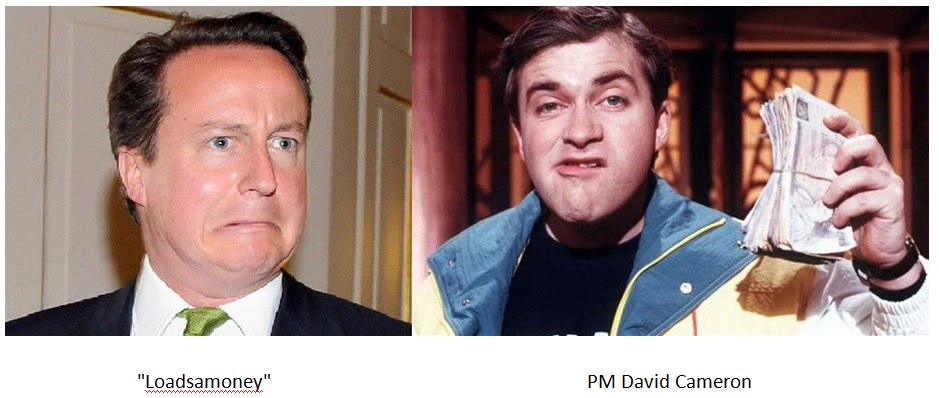
“Loadsamoney” Cameron in “Tasteless and Ignorant Flash Git” Row

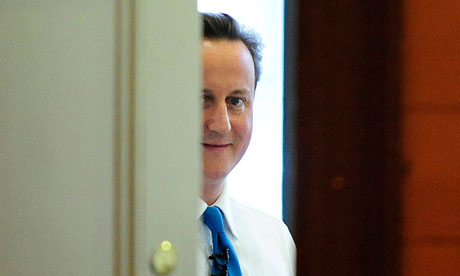
ImagePrime Minister David Cameron has had his judgement called into question yet again after a “date-night” meal out with his wife on Friday at a pizza restaurant in Soho.  Having enjoyed a simple repast of pizza and lasagne, accompanied by dough balls and a bottle of red – amounting to a bill of around £45 – the Premier stunned onlookers by airily leaving his delighted waiter a tip of £50.  One diner, struggling to find a reason for this munificent largesse, later wondered in a baffled tweet whether Mr Cameron was perhaps feeling flush after saving some money on his order by using a discount coupon.  Others have speculated that a tendency to be a heavy tipper could be compensatory behaviour given his history as a former member of the notorious Bullingdon Club, an exclusive society at Oxford University noted for its habit of smashing up restaurants and paying up on the spot for damage caused.  But Cameron has not always been so generous, once failing to leave a tip at all for a waitress who, not recognising the PM, said she was too busy to carry his coffee order to his table.

Whatever Mr Cameron’s motivation – and let’s not forget there’s a very happy waiter at the centre of this story – such extravagant actions are always open to criticism for a man so very much in the glare of public scrutiny.  Given that, and allowing also for his government’s implacable stance on its much-criticised austerity programme, it may be felt in some quarters that a £50 tip on a bill of rather less than that sends out all the wrong messages.  It’s an action, some may well carp, that can easily be related to the archetypal “flash git” yuppie of the eighties, so memorably portrayed by Harry Enfield as his “Loadsamoney” character, who would flaunt his wealth ostentatiously, waving wads of cash and lighting cigars with twenty pound notes.  This was of course satire, which is at the very cutting-edge of good comedy, and rightly so.  But all the best satire has that kernel of truth which validates its message, and the “Loadsamoney” image had many parallels in real life.  In casually handing over £50 to an incredulous waiter, Mr Cameron surely risks criticism from those who will say this shows the extent to which he is out of touch with millions nationwide to whom £50 would represent a weekly family shopping budget.

It’s not so long ago that Cameron’s blundering Work and Pensions Secretary, Iain Duncan-Smith, unwisely raised his head above the parapet with a claim that he’d be able to live on £53 a week, only to have to duck it down again hastily when a massively-supported public petition called on him to do just that.  The Coalition government seem a little damage-prone in terms of such tactical own-goals, and whatever message they are trying to get across about the need for everyone to tighten the belt, grin bravely and get on with it, is continually undermined by examples of individual ministers piteously whining that their lot is not a happy one.

The Tory MP for Mid Derbyshire, Pauline Latham, recently described how she was “left in tears” after clashing with officials from the Independent Parliamentary Standards Authority (Ipsa) over the matter of her security enhancements and just who is expected to pay the £9000 bill.  That’s a story which many will find less than heart-rending when so many pensioners face the “heat or eat” dilemma.  MP’s of all parties have agitated for a while now for salary increases of up to 32% at a time when public pay is frozen.  Failed bankers and incompetent Chief Executives are still routinely walking away from the disasters they have created with severance packages well into seven figures, whilst the poorest of the poor face a struggle to find the weekly bedroom tax bill, a struggle that has in several tragic cases terminated in suicide.

It is doubtful whether Cameron, replete with pizza, dough balls, wine and relaxed, chilled-out bonhomie, will have had any of this to the forefront of his mind when he grandly tipped his waiter before heading off back to work at the G8 Summit in Northern Ireland, where all his food and hospitality will be funded by grateful taxpayers.  The point is though, surely, that he should be aware of all of these issues, all of the time, and that this awareness should advise his every move.  To expose himself and by extension his government, to such ridicule and criticism over what was quite probably a sincere enough gesture (assuming that the tip really was from the PM’s own back pocket), shows a want of understanding and a failure to appreciate just how such public generosity, on a scale out of the reach of 98% of the population, will resonate with those who are struggling to make ends meet.  The lack of political awareness in a man elevated to Cameron’s high office is more than a little worrying.  If the tip had to be given, could it – should it – have been made in a less public way?  At least then, even if the story had come out, the effect would have been diluted by relative subtlety instead of appearing so crass and opportunistic.

The sad fact is that many in the Tory party, or even in the coalition government as a whole, will tend to dismiss an item of news like this as “pointless and frivolous” or a “storm in a teacup”.  But they would miss the point in so doing.  Because the incident is in the public arena, it has to be viewed in the context of the times, and that is very much a picture of so many people suffering and struggling due to our rulers’ insistence – against the better judgement of such bodies as the International Monetary Fund – on cutting, cutting and cutting again, cutting to the bone at the lower end of society where any further cuts are likely to lead to collapse.  And while this is going on, the PM is out on the town, taking in a show, heading off to a politicians’ junket with the finest of freebie food and drink, and casually, arrogantly chucking 50 quid at a waiter as if to say, “There you go, my good man.  It’s nothing to me.”

Mr Cameron, really.  It is time to give your head a shake, re-awaken whatever political awareness you ever had, and start to think about what you say and do.  Some of us out here would just love to have a chat with you about Real Life.

Fox In The Running?

Q: When is a Fox not a fox?

A: When it’s a sacrificial lamb.

Image

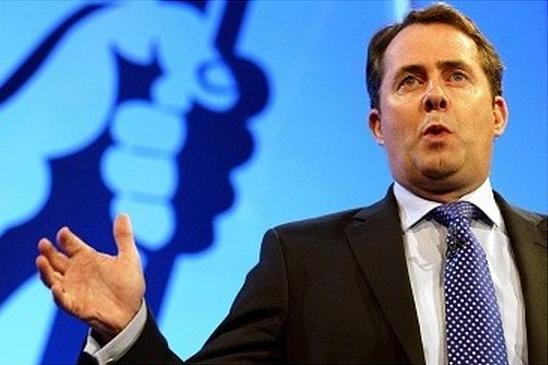
Liam Fox

The Fox in question – Liam of that ilk – is due to make a speech containing radical proposals exceeding in scope and intent anything the Coalition Government has so far contemplated. His true motives for this are unclear. He may just possibly be unaware of his potential status as patsy-in-waiting for the Tory Party’s increasingly Machiavellian convolutions, as it attempts to portray itself as a party of government beyond the next election. Then again, perhaps the cunning Fox genuinely feels that he really can rally the Conservative right wing with a view to becoming the anointed leader if and when David Cameron falls on his sword, or is stabbed in the back by the Men in Grey Suits, depending on how the last scene of the Coalition melodrama plays out.

Whatever the case, the scenario of an increasingly unpopular political party showing determination to plough its chosen furrow – despite a radical call-to-arms from the loony fringes – is hardly new. Labour gave us a glimpse of a few left-wing skeletons in their briefly-opened closet of horrors in the early eighties, and some feel that this paved the way for that party’s subsequent re-branding of itself as New Labour and the eventual Blair-Brown axis. Liam Fox might of course be entirely serious about making an early move to be seen as prospective leader material – if the reaction of the Tories, post coalition break-up, were to be a lurch to the Right. But it’s also tiresomely probable that he’s simply providing the necessary scare story, which can then be shot down by the incumbent PM, so that Cameron’s rigid position on his chosen course of austerity might be seen as more palatable relative to What Might Have Been.

Fox has in fact found it necessary to push back the boundaries of what is really credible, in his attempts to find depths of draconian savagery which even the Tory party might not plumb. Against a background of the demonisation of a whole sector of society – encompassing the poor, low-paid workers and the disabled – with swingeing cuts to the disposable income of all these people justified by portraying them as society-sapping freeloaders, it’s not easy to contemplate even more vindictive measures. Add to that the fact that tax changes in April will see a group of previously impoverished millionaires benefiting from tax reductions of £100,000 a year, and one can easily understand how difficult it is these days to appear truly loony in the context of all things Conservative. But Liam, bless him, appears to have managed it.

In point of fact, Mr Fox’s speech to the Institute of Economic Affairs next Monday is likely to break new ground right in the heart of right wing Tory dreamland “Rob the Poor to Feed the Rich” territory. Voicing what other extreme Conservatives hardly dare think – save only in their most secret and grandiose fantasies – Fox is tipped to call for a five year freeze on public spending, with no protective ring-fencing for schools, foreign aid or the NHS. That’s the poor robbed, but on an even more lavish scale than the current government are managing. And Fox will, according to the Times, also propose that there should be a thorough rethink of earnings and savings taxation, including a Capital Gains Tax holiday “to breathe life into the ailing economy”. The Times also reports that the former Defence secretary will say:

“I believe that in leaving money in people’s pockets, economic activity will follow. People will buy houses, invest for their future or just go shopping.

“Whichever is the case, it’s creating a society that is sustainable for the future in the way that our current – welfare-dependent and debt-ridden – economy is not.

“We should gradually move towards the reduction – or even abolition – of the taxes where the state not only taxes the same money on multiple occasions but discourages the very behaviour that would lead to a more responsible society.”

So that’s the rich fed, and there is likely to be much salivating in the Tory Shires at the prospect – however unlikely it is to actually materialise – of such a juicy package. It is of course a fact that, in order to leave money in people’s pockets, that money has to be there in the first place. But the poor are incidental to this speech, whether it’s a serious attempt to influence policy, or just a scare tactic to deflect criticism of the current programme. The poor are unlikely to vote Tory (although it’s increasingly probable they might vote UKIP), and they are perceived, as a body, to be more of an unwanted expense than any potential source of economic growth. It is the already rich to whom Liam Fox is seeking to appeal; those on the right of the parliamentary party and of the Conservative movement nationally. It is there that he will find his natural support if any ambitions of leadership are ever to come to fruition.

Whatever the thinking behind Fox’s forthcoming speech, he is not the only predatory scavenger circling the beleaguered Prime Minister. MP Sarah Wollaston has warned the Premier, in a series of tweets, about the need to tackle problems with his inner circle of immediate colleagues, consisting as it does of the “posh, male & white”. Wollaston is a known Cameron acolyte, but her words will be encouraging to Home Secretary Theresa May, who has recently broken cover with her own finely-drafted proposals covering a number of governmental departments, and – again – tailored to appeal to the Tory right.

Most worrying of all perhaps, is a vote of confidence from Baroness Warsi, who stated that Cameron has the support of “large parts” of his party, and that “he is doing a very difficult job in very difficult circumstances.” Such a very qualified endorsement is likely to be cold comfort to the Prime Minister as he studies the minute details of the Liam Fox speech, and Cameron may well reflect on the experience of football managers since time immemorial; that the vote of confidence is frequently a precursor to a frogmarch up the scaffold steps and the ceremonial fall of the axe. Unless, of course, friend Liam does the merciful thing, and slides the knife into his ribs before any organised coup.

Et tu, Foxy.

Ferkin-Scheidt Speaks Out On “Dining Room Tax”

In the wake of revelations that Local Authorities will be allowed to classify dining rooms as “bedrooms” for the purposes of the so-called “Bedroom Tax”, the Coalition has moved to clarify the position still further.

A Government spokesman who wished to remain anonymous, but who is in fact Iain Ferkin-Scheidt (pictured below) was quoted today as saying:

Image

Iain Ferkin-Scheidt yesterday

“Social housing tenants need to be clear about this. Any room that can be deemed superfluous to the requirements of a Housing Benefit claimant should be counted as a “bedroom” for these purposes – for example a dining-room, conservatory and so forth. I believe that some of you people still have what they used to call “parlours” – and yes, they can be defined as bedrooms too. This will be a matter for Local Authorities’ discretion, but they will need to justify their decisions to High Command.” Going a little purple around the jowls, Mr Ferkin-Scheidt went on: “We have to be very, very careful about terminology here. This is not a “bedroom tax”, it is a Spare Room Subsidy. The Prime Minister himself, long may he reign, has stated this. We want to make it quite clear that this is a measure aimed at shirkers, not workers. Lame excuses such as disability – if you’ll pardon the pun – simply will not wash; much as is the case with most of the frightful common types we’re aiming at here.”

When asked about the fact that many Housing Benefit claimants are actually workers in low-paid employment, Mr Ferkin-Scheidt remained bullish in his defence of policy. “It’s quite simple,” he explained kindly. “Those people on Housing Benefit cannot expect the rest of us to subsidise luxuries for them such as spare bedrooms and parlours and dining rooms or what-have-you, out of our taxes – particularly as many of us will actually be paying up to £100,000 a year less tax from April. As you can see from that figure alone, the country simply cannot sustain extravagance on this scale.

“Those who have failed to provide for themselves and their families, by obtaining only part-time or low-paid employment will have to accept that they are not deserving of the same privileges as good, honest, hard-working, tax-evading, Tory-voting people who bought their own Council Houses in the 80’s when St Margaret was Queen. We shall be taking further measures to ensure that this distinction is recognised, and to remove the burden of financial responsibility from the over-stretched rich. The fact is that the poor, the disabled and the long-term sick have had it easy for far, far too long now. I am currently studying proposals for what some are already calling a “Hot Tap Tax”, although it is in fact a heated water subsidy. Some of us feel – in all compassion and sincerity – that it is an unconscionable luxury for the Shirking Classes to have hot water on tap, and it may well be that Housing Benefit claimants who live in homes with hot running water, showers, flush toilets and so on and so forth, will at some point in the future be subjected to a further cut of 30% in their Benefit, unless they take up the option of moving to a smaller property, with a stand-pipe, and outdoor privy and a well. We are determined to bring the good old days back to this great country.”

Pressed further on the matter of future proposals along these lines, Mr Ferkin-Scheidt refused to reveal any more concrete details, but promised a fuller statement after the second reading of the new “Workhouses & Treadmills Bill” currently proceeding through the House of Lords.

“This Government is pledged to firm, decisive action,” he confirmed. “Did your great-great-great grandmother have hot running water? No, of course she didn’t, and neither did mine – although she did have staff to carry heated water up eight flights of stairs for her – but that’s to become tied up in detail. There’s fridges, too, and all those nasty wide-screen TV’s. Did Sir Winston’s mother have a fridge? Or a 42” LCD TV? And, look – let’s be totally honest here. Ice can be chipped from a frozen well, and allowed to melt. Cold water can then be heated for all the simpler needs of the sub-strata of society, and a short walk down the street to a shared privy never killed anybody, except a few disease-ridden ne’er-do-wells who were never going to become economically productive units anyway. Hot water and indoor flush toilets are privileges, not rights – and we are determined that the Party of Privilege shall live up to its traditions and ensure that people are once again well aware of their place in life.”

Mr. Ferkin-Scheidt is 104.

The Big Lie – David Cameron’s Divide And Rule Strategy

Image

The concept of The Big Lie as a propaganda technique has a long and well-documented, though tragically chequered history.  It was a charge leveled at Jews by Adolf Hitler, with chilling irony as it turned out, accusing them en masse of laying the blame for Germany’s defeat in World War I at the feet of German General Erich Ludendorff.

Hitler’s definition of the Big Lie in his infamous “Mein Kampf” referred to a lie which is “so colossal that no-one would believe anyone could have the impudence to distort the truth so infamously”, and which would therefore, paradoxically, be accepted as true.  “Mein Kampf” was published in 1925, but history tells us that both Hitler and his loathsome creature of propaganda, Josef Goebbels, would use the Big Lie technique in an attempt to justify the persecution and mass murder of six million Jews, many of them German citizens, during World War II.  Historian Jeffrey Herf maintains that the Big Lie was employed by the Nazis to transform a long-standing antisemitism into a culture of acceptance for a programme of genocide, at least among the thousands of people required to collaborate or actually undertake the mass-slaughter of so many fellow human beings.

The Nazis’ euphemistic reference to a “Final Solution” was intended to mask a foul crime, perpetrated on a vast pan-continental scale, and justified by the Big Lie.  It is the most extreme example conceivable of what can happen when such an effective propaganda tool is deployed and redeployed, over and over, a drip-feed of hate-fueled misinformation which sinks deeply into the public consciousness and breeds uncritical acceptance of dogmas that might otherwise be hotly disputed.  But the identical technique continues in use today, and while the end result is not comparable to the fate of the Holocaust victims, the thinking behind modern propaganda, with its intent of marginalising an entire section of society, is directly analogous.

Image

Enter the Big Liar

The current Government’s presentation of its policies to tackle a massive public debt is an object lesson in the effective use of the Big Lie.  Pathologically opposed to any measures which might unduly affect the “wealth-creating potential” of the better-off, they are nevertheless determined to make massive reductions in public expenditure, and have targeted the Welfare Budget as a potential source of great savings.  The impact on household budgets, of which every penny is already earmarked, is readily foreseeable.  Once you cut to the bone, any further cuts are likely to lead to collapse, and fears are being expressed by voluntary organisations like the Citizens Advice Bureau that the consequences for the poorest will be grave.  It’s also realistic to fear that the creation of a sub-culture, helpless to resist the diminution of its resources and likely to be forced into dependence on food banks, is inimical to prospects for national recovery.  Looked at in that light, how can such policies be presented as The Answer To All Our Problems?

Enter the Big Liar, stage right.  Since the formation of Cameron’s Coalition ConDem government, it’s been noticeable how much we’ve heard, via every mouthpiece and interface of the media, about Benefit Cheats.  Benefit Fraudsters.  Welfare Scroungers.  Shirkers, Not Workers.  Now, any government worth its rhetorical mettle is good for the odd sound-bite, but Mr. Cameron’s administration are as hot as any in peddling its preferred take on the “issues that face us all”.  And after all, who could have the impudence to distort the truth so infamously?  So it must be true, then.  Meanwhile, those responsible for the banking crisis, the Libor scandal, and other examples of fat cats acting criminally – or merely irresponsibly – in their frantic scramble to get even fatter, must be very grateful for where the spotlight is currently shining.

You have to listen very patiently to the more serious news outlets to hear about the depredations visited upon us by the rich and greedy. But it’s open season on those hampered by disability, poor employment prospects, sickness, infirmity and grinding poverty.  Soft targets all, and there are plenty of establishment-friendly tabloids happy to feed us a daily diet of how tax money is wasted on affording such ne’er-do-wells a life of luxury, and the privilege of snoring behind drawn blinds whilst the industrious head off to work.

So how do these stories stand up to closer examination?   Well, hardly at all, in truth.  The “shirkers, not workers” myth is easily exploded – merely by looking at the proportion of the welfare budget spent on in-work benefits.  These are benefits paid to those who have a job, but one where the wage is so pitifully low that it’s impossible for the family to subsist without an income supplement.  Hardly shirkers, these people – exploited?  Yes.  Scroungers?  It’s the Big Lie in action.

What about Benefit Fraud, then?  Again, you’d be surprised to read the figures, given the loud and plaintive trumpeting of this “scandal” by the likes of the “Daily Mail”.  It appears the Great British Public believe that 27% of the Welfare Budget is claimed fraudulently.  The official UK Government figure?  0.7%.  2-0 to the Big Lie.

The latest manifestation of the way in which a section of society is marginalised now rears its ugly head.  Thousands of people currently entitled to Disability benefits due to their care or mobility needs are going to be re-assessed under notably harsher entitlement tests, over the next few years.  No improvement in their condition, no lessening of their needs will be required for their benefits to be stopped.  The goal-posts are being moved, and a lot of helpless people, who previously managed to conduct their own lives assisted by the benefit payable for their condition, will be shown the red card and banished to the hinterland of dependence upon others.   Extreme examples of families on £20,000 a year in benefits are quoted to justify swingeing cuts.  Believe me, you just don’t want to know how disabled you’d have to be to qualify for anything like that level of help.  The Big Lie rides again.

This administration is unfocused and incompetent, thrashing about horribly in its desperation to somehow prove itself worthy of re-election.  A shoddy, unattractive and vindictive lot. riven by internal strife and barely suppressed internecine warfare, far more concerned by partisan interests than fair government for all.  But, hey – credit where it’s due:  there’s not a whole hell of a lot that Josef Goebbels or Adolf himself could teach them about propaganda, oppression of the vulnerable and the Big Lie.

The Big Lie – David Cameron’s Divide And Rule Strategy

Image

The concept of The Big Lie as a propaganda technique has a long and well-documented, though tragically chequered history. It was a charge leveled at Jews by Adolf Hitler, with chilling irony as it turned out, accusing them en masse of laying the blame for Germany’s defeat in World War I at the feet of German General Erich Ludendorff.

Hitler’s definition of the Big Lie in his infamous “Mein Kampf” referred to a lie which is “so colossal that no-one would believe anyone could have the impudence to distort the truth so infamously”, and which would therefore, paradoxically, be accepted as true. “Mein Kampf” was published in 1925, but history tells us that both Hitler and his loathsome creature of propaganda, Josef Goebbels, would use the Big Lie technique in an attempt to justify the persecution and mass murder of six million Jews, many of them German citizens, during World War II. Historian Jeffrey Herf maintains that the Big Lie was employed by the Nazis to transform a long-standing antisemitism into a culture of acceptance for a programme of genocide, at least among the thousands of people required to collaborate or actually undertake the mass-slaughter of so many fellow human beings.

The Nazis’ euphemistic reference to a “Final Solution” was intended to mask a foul crime, perpetrated on a vast pan-continental scale, and justified by the Big Lie. It is the most extreme example conceivable of what can happen when such an effective propaganda tool is deployed and redeployed, over and over, a drip-feed of hate-fueled misinformation which sinks deeply into the public consciousness and breeds uncritical acceptance of dogmas that might otherwise be hotly disputed. But the identical technique continues in use today, and while the end result is not comparable to the fate of the Holocaust victims, the thinking behind modern propaganda, with its intent of marginalising an entire section of society, is directly analogous.

Image

Enter the Big Liar

The current Government’s presentation of its policies to tackle a massive public debt is an object lesson in the effective use of the Big Lie. Pathologically opposed to any measures which might unduly affect the “wealth-creating potential” of the better-off, they are nevertheless determined to make massive reductions in public expenditure, and have targeted the Welfare Budget as a potential source of great savings. The impact on household budgets, of which every penny is already earmarked, is readily foreseeable. Once you cut to the bone, any further cuts are likely to lead to collapse, and fears are being expressed by voluntary organisations like the Citizens Advice Bureau that the consequences for the poorest will be grave. It’s also realistic to fear that the creation of a sub-culture, helpless to resist the diminution of its resources and likely to be forced into dependence on food banks, is inimical to prospects for national recovery. Looked at in that light, how can such policies be presented as The Answer To All Our Problems?

Enter the Big Liar, stage right. Since the formation of Cameron’s Coalition ConDem government, it’s been noticeable how much we’ve heard, via every mouthpiece and interface of the media, about Benefit Cheats. Benefit Fraudsters. Welfare Scroungers. Shirkers, Not Workers. Now, any government worth its rhetorical mettle is good for the odd sound-bite, but Mr. Cameron’s administration are as hot as any in peddling its preferred take on the “issues that face us all”. And after all, who could have the impudence to distort the truth so infamously? So it must be true, then. Meanwhile, those responsible for the banking crisis, the Libor scandal, and other examples of fat cats acting criminally – or merely irresponsibly – in their frantic scramble to get even fatter, must be very grateful for where the spotlight is currently shining.

You have to listen very patiently to the more serious news outlets to hear about the depredations visited upon us by the rich and greedy. But it’s open season on those hampered by disability, poor employment prospects, sickness, infirmity and grinding poverty. Soft targets all, and there are plenty of establishment-friendly tabloids happy to feed us a daily diet of how tax money is wasted on affording such ne’er-do-wells a life of luxury, and the privilege of snoring behind drawn blinds whilst the industrious head off to work.

So how do these stories stand up to closer examination? Well, hardly at all, in truth. The “shirkers, not workers” myth is easily exploded – merely by looking at the proportion of the welfare budget spent on in-work benefits. These are benefits paid to those who have a job, but one where the wage is so pitifully low that it’s impossible for the family to subsist without an income supplement. Hardly shirkers, these people – exploited? Yes. Scroungers? It’s the Big Lie in action.

What about Benefit Fraud, then? Again, you’d be surprised to read the figures, given the loud and plaintive trumpeting of this “scandal” by the likes of the “Daily Mail”. It appears the Great British Public believe that 27% of the Welfare Budget is claimed fraudulently. The official UK Government figure? 0.7%. 2-0 to the Big Lie.

The latest manifestation of the way in which a section of society is marginalised now rears its ugly head. Thousands of people currently entitled to Disability benefits due to their care or mobility needs are going to be re-assessed under notably harsher entitlement tests, over the next few years. No improvement in their condition, no lessening of their needs will be required for their benefits to be stopped. The goal-posts are being moved, and a lot of helpless people, who previously managed to conduct their own lives assisted by the benefit payable for their condition, will be shown the red card and banished to the hinterland of dependence upon others. Extreme examples of families on £20,000 a year in benefits are quoted to justify swingeing cuts. Believe me, you just don’t want to know how disabled you’d have to be to qualify for anything like that level of help. The Big Lie rides again.

This administration is unfocused and incompetent, thrashing about horribly in its desperation to somehow prove itself worthy of re-election. A shoddy, unattractive and vindictive lot. riven by internal strife and barely suppressed internecine warfare, far more concerned by partisan interests than fair government for all. But, hey – credit where it’s due: there’s not a whole hell of a lot that Josef Goebbels or Adolf himself could teach them about propaganda, oppression of the vulnerable and the Big Lie.

Unity, Not Division – The Lessons Of The London Olympics.

It was the best of times; it was the worst of times…

Charles Dickens’ summing up of one particular period in history could serve very well as an epitaph for many years in this century, or any other – but few more so, surely, than 2012 – a time of unity, yet a time of division.

This was a year of high peaks and deep troughs. From a United Kingdom perspective, we can look back with pride on a triumphant staging of the Olympic Games and the Paralympics in London last summer. Rarely can a sporting spectacle have so united people; many who would normally fail to show a flicker of interest in sport were swept along on the wave of enthusiasm generated by the performances and achievements of our gallant competitors.

Sport in a wider sense came to the fore as a catalyst for optimism and togetherness. Andy Murray had his best Wimbledon ever, won over cynical hearts with his tears after narrowly losing in the Final, and then swept to Olympic gold and – at last – won a Grand Slam event, the U.S. Open. The Ryder Cup golf team, having dug themselves into a frightful hole, emerged gloriously as winners in the end, a comeback as miraculous as any other in that competition’s history. Even the Test Cricket team, having started the year poorly, ended it victoriously, winning in India for the first time since 1984.

As we are always being told, though, sport isn’t everything. In a wider sense, the news has not been so good. Austerity continues to cast a shadow over all of us – though that shadow appears to be significantly longer for some than for others. The mantra chanted by our rulers is “we’re all in it together”. But the question of just what we’re in, and to what depth, is left open.

What seems undeniable is that there are unsettling signs of division being created in society as a matter of policy. Divide and rule, as the old saw has it. The arithmetic of recovery seems to dictate that the way forward is belt-tightening all round. But some sections of the population are in danger of ending up so emaciated, that however much tighter they might fasten their belts, they’re still liable to be caught with their pants down when the bills fall due.

People claiming benefits – even the majority who claim in-work benefits – are being cast as the villains of the piece when culprits are sought for the mess we’re in. The marginal effect of cuts to income at this end of the scale is far greater than could be perceived by – to pluck an example out of thin air – a City banker. But such cuts are proving to be a popular measure, and this is due largely to the rhetoric directed against those whose circumstances force their reliance on state benefits. And let’s not forget that many of these citizens are just as industrious as anybody else, but are forced by low pay to seek financial assistance from the benefits system. Then of course there are the genuinely disabled. Who’s the real villain here?

Benjamin Franklin, prior to signing the U.S. Declaration of Independence, memorably stated “Gentlemen, we must all hang together, or assuredly we shall all hang separately”. The message that no group of people can succeed and prosper who are divided against themselves, applies equally to society at large. We must beware the toxicity of creating schisms among our populace, however pragmatic an approach this might appear in Whitehall or Fleet Street when harsh measures need to be justified.

The feel-good factor of 2012 was all about unity and pride in the nation and its achievements; anybody who witnessed the Olympics, or Wimbledon, or indeed the traditional Last Night of the Proms could bear witness to that. The contrast with this current process of division is stark, and telling. Any policy that promotes whispering campaigns, suspicion and dislike of any group of people, merely to popularise draconian financial sanctions, is negative and unjust in the extreme. We must surely look to the good of last year, to unity and positivity, as embodied when the nation as a whole got behind our athletes and parathletes. This is the ethos that should drive any programme of recovery, not a selective demonising of a whole, hapless section of society.

If we really are all in it together, then we have to stick together, and succeed together. Surely that is the best lesson 2012 has for this New Year.