Tag Archives: Lee Chapman

Leeds Utd Legend: Lee Chapman – by Rob Atkinson

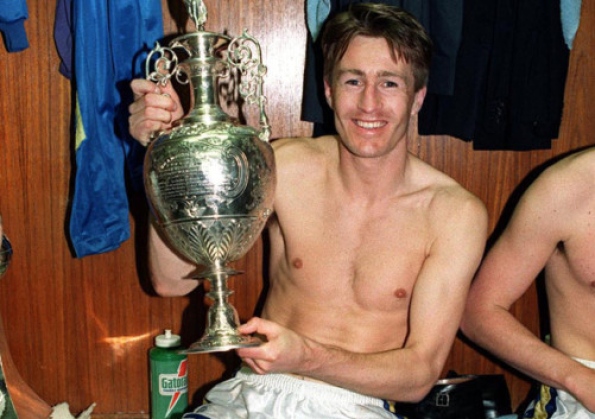
Leee Chapman, Whites Legend and Last Champion “Leee” Chapman, Whites Legend and Last Champion[/caption]

It all started with a slightly bizarre Yorkshire Evening Post back page headline.  “Chapman Wings In”, it screamed – signaling Leeds United’s signing of the tall striker for the 1989/90 run-in.  A winger he most certainly was not, but many Leeds fans didn’t really fancy him to be all that much of a centre-forward either and it’s fair to say that the bulk of the support weren’t exactly overwhelmed by Sergeant Wilko’s latest transfer swoop.  But Lee Chapman was to win our hearts as he trod a goal-laden path to the top with Leeds, and any slight technical shortcomings were more than outweighed by his willingness to get in there where it hurts, to put his head in where many would hesitate to risk a boot.  Whites fans do love a recklessly brave warrior who’s worthy of the badge.

I well remember seeing one example of this bravery at close quarters when I attended a 0-0 draw at Tottenham shortly after we were promoted.  Challenged aerially as he went for a ball near the touchline, Chappy hurtled off the field of play to land senseless in an ungainly heap, face-first on the perimeter smack in front of where I was sitting.  Thus I was an unwilling witness to the worst case of gravel-rash imaginable when Leee (as he was fondly known by The Square Ball fanzine) tottered to his feet, his classic profile seemingly having been scraped off to a large degree by the unforgiving Spurs running track.  Such a mess of grimy blood and snot had to be seen to be believed, and I honestly wondered if he wouldn’t be out until the end of the season; but Leee – true to courageous form – was back in double-quick time to finish the campaign with thirty goals.

The following season he managed to break a wrist in trying to save a cup-tie at Elland Road, and during his absence we took the fateful decision to recruit enfant terrible Eric Cantona.  But again Chappy came back, and played a far greater part in that season’s title success than the mercurial Frenchman.  Brave he certainly was, and an unerring gatherer of goals too, sometimes clumsy in his execution of the finish, but still lethally effective.  The highlights were many – a hat-trick at home to Liverpool in an epic 4-5 defeat when he had a goal wrongly disallowed to deny Leeds a deserved draw.  Chappy had this wonderful knack of hurtling like some blond Exocet missile to connect with quality deliveries from either flank; goals at Aston Villa from a Mel Sterland cross, and at Sheffield Wednesday, courtesy of Gary Speed, stand out in the memory of those who were lucky enough to be there.  And in that Hillsborough match there was a rare glimpse of Lee’s unsuspected streak of genius as he picked up possession on the right, burst between two floundering defenders into the area, and pinged a shot against the Wednesday crossbar.  It was the gilt-edged stuff of absolute fantasy.

Lee Chapman was not a player of extravagant talent, nor did he play pretty football embellished with flicks and tricks – not usually , anyway.  But he was a devastatingly effective spearhead for Leeds over a period of several seasons, his time at the club coinciding with the second-greatest period in our history, his goals securing many a valuable win and draw, home and away.  He is fondly remembered as an archetypal Leeds player – fully committed and willing to risk injury for the sake of the shirt.  Memorably, he returned for a brief loan spell in the mid-nineties, welcomed back into the fold by rapturous Elland Road applause, only to be sent off for a stray elbow as he challenged for yet another high ball.

Leeds have had many great centre-forwards in their history – from the peerless John Charles downwards through Mick Jones, Joe Jordan, to the more modern heroes like Tony Yeboah and maybe even Jermaine Beckford.  All those names have notable achievements on their Elland Road CV, and Lee Chapman deserves his place in such a Hall of Fame; as tribute to his attitude, his bravery and of course his goals.  For a Leeds United centre-forward, there can be no higher praise than that.

Whites Legend – Lee “Leee” Chapman

Leee Chapman, Whites Legend and Last Champion “Leee” Chapman, Whites Legend and Last Champion[/caption]

It all started with a slightly bizarre Yorkshire Evening Post back page headline.  “Chapman Wings In”, it screamed – signaling Leeds United’s signing of the tall striker for the 1989/90 run-in.  A winger he most certainly was not, but many Leeds fans didn’t really fancy him to be all that much of a centre-forward either and it’s fair to say that the bulk of the support weren’t exactly overwhelmed by Sergeant Wilko’s latest transfer swoop.  But Lee Chapman was to win our hearts as he trod a goal-laden path to the top with Leeds, and any slight technical shortcomings were more than outweighed by his willingness to get in there where it hurts, to put his head in where many would hesitate to risk a boot.  Whites fans do love a recklessly brave warrior who’s worthy of the badge.

I well remember seeing one example of this bravery at close quarters when I attended a 0-0 draw at Tottenham shortly after we were promoted.  Challenged aerially as he went for a ball near the touchline, Chappy hurtled off the field of play to land senseless in an ungainly heap, face-first on the perimeter smack in front of where I was sitting.  Thus I was an unwilling witness to the worst case of gravel-rash imaginable when Leee (as he was fondly known by The Square Ball fanzine) tottered to his feet, his classic profile seemingly having been scraped off to a large degree by the unforgiving Spurs running track.  Such a mess of grimy blood and snot had to be seen to be believed, and I honestly wondered if he wouldn’t be out until the end of the season; but Leee – true to courageous form – was back in double-quick time to finish the campaign with thirty goals.

The following season he managed to break a wrist in trying to save a cup-tie at Elland Road, and during his absence we took the fateful decision to recruit enfant terrible Eric Cantona.  But again Chappy came back, and played a far greater part in that season’s title success than the mercurial Frenchman.  Brave he certainly was, and an unerring gatherer of goals too, sometimes clumsy in his execution of the finish, but still lethally effective.  The highlights were many – a hat-trick at home to Liverpool in an epic 4-5 defeat when he had a goal wrongly disallowed to deny Leeds a deserved draw.  Chappy had this wonderful knack of hurtling like some blond Exocet missile to connect with quality deliveries from either flank; goals at Aston Villa from a Mel Sterland cross, and at Sheffield Wednesday, courtesy of Gary Speed, stand out in the memory of those who were lucky enough to be there.  And in that Hillsborough match there was a rare glimpse of Lee’s unsuspected streak of genius as he picked up possession on the right, burst between two floundering defenders into the area, and pinged a shot against the Wednesday crossbar.  It was the gilt-edged stuff of absolute fantasy.

Lee Chapman was not a player of extravagant talent, nor did he play pretty football embellished with flicks and tricks – not usually , anyway.  But he was a devastatingly effective spearhead for Leeds over a period of several seasons, his time at the club coinciding with the second-greatest period in our history, his goals securing many a valuable win and draw, home and away.  He is fondly remembered as an archetypal Leeds player – fully committed and willing to risk injury for the sake of the shirt.  Memorably, he returned for a brief loan spell in the mid-nineties, welcomed back into the fold by rapturous Elland Road applause, only to be sent off for a stray elbow as he challenged for yet another high ball.

Leeds have had many great centre-forwards in their history – from the peerless John Charles downwards through Mick Jones, Joe Jordan, to the more modern heroes like Tony Yeboah and maybe even Jermaine Beckford.  All those names have notable achievements on their Elland Road CV, and Lee Chapman deserves his place in such a Hall of Fame; as tribute to his attitude, his bravery and of course his goals.  For a Leeds United centre-forward, there can be no higher praise than that.

Memory Match No. 2: Sheffield Wednesday 1, Leeds United 6 12.1.1992

Image

As 1991 turned into 1992, the two-horse English Title race was hotting up.  Man U had suffered a shocking reverse on New Year’s Day, capitulating 4-1 at home to QPR, and then later that January 1st, Leeds had won competently 3-1 at West Ham to remain well in the race for the ultimate domestic honour.  The scene was adequately set, then, for Wilko’s first return to Wednesday since he had quit Hillsborough to become Leeds boss in 1988.  This would also be Lee Chapman’s last game before his season-threatening FA Cup injury, which resulted in the drafting in of one Eric Cantona – with all the long term consequences that would entail.  But Chappy was destined to be sidelined only temporarily, and he went out in the most emphatic style.

There was a crowd of 32228 at Hillsborough, the usual vociferous contingent of travelling Leeds fans rivalling the home crowd for noise from the outset, and completely drowning them as the game went on.  Leeds United were weakened, so it seemed, by the absence of the injured Gordon Strachan and suspended David Batty, half of their legendary midfield Fantastic Four.  Any side, surely, would miss performers of such calibre.  Leeds, though, seemed determined to make light of the problem, and tore into their hosts from the start.  Full-back Tony Dorigo made an early darting run, cutting in from the left and making good progress down the centre of the pitch, before unleashing a right-foot thunderbolt that Wednesday ‘keeper Chris Woods had to tip over.  From the resulting Gary MacAllister corner, Chris Fairclough rose to head downwards, and found Chapman in splendid isolation four yards out; his finish swift and deadly for 1-0.

For a local derby, the contest had been decidedly one-way traffic – Chapman was to send two towering headers just wide before Carl Shutt had a scuffed shot smothered by Woods in the home goal.  Then, a true champagne moment as Mel Sterland fed the ball to Chapman on the right.  In a completely untypical burst of pace and control, Chappy surged between two hapless Wednesday defenders, raced into the area, and unleashed a shot that beat Woods completely, just clipping the frame of the goal to rapturous applause from the Leeds fans at the Leppings Lane End.  I remember thinking at the time that anything was possible now, if Lee Chapman could do something so utterly out of character.  And so it proved as, from a free kick awarded just right of centre some ten yards outside the box, Dorigo stepped up to absolutely hammer a left foot drive past the helpless Woods.  Cue mayhem and cavortings as the Leeds hordes behind the goal, celebrated as clean a strike as you could ever wish to see, the ball a blur as it arrowed into the far corner with deadly precision and power.

At 2-0 down, the home side were making increasingly desperate attempts to gain some sort of foothold in the match.  This desperation was adequately demonstrated when, from a harmless-looking ball into the Leeds area, Wednesday striker Gordon Watson ran in front of Chris Whyte, continued on for another step or two, and then hurled himself into the air, landing in agonised paroxysms of simulation between a bemused Whyte and Leeds ‘keeper John Lukic.  Such obvious fraud and villainy could have only one outcome, and the stadium held its collective breath for sentence to be passed on the miscreant.  Instead – amazingly – referee Philip Don pointed to the spot.  Whether none of the officials had seen the extent of Watson’s ham-acting, or whether they were moved by sympathy for the mauling Wednesday were taking from a rampant Leeds, it’s impossible to tell.  The outcome was the same either way.  Ex-Leeds hero John Sheridan stepped up, saw his penalty brilliantly saved as Lukic tipped it against his right-hand post, and then gleefully belted home the rebound to give Wednesday a massively unmerited lifeline.

This act of base and scurvy treachery required nothing less than a riposte of the utmost nobility and beauty, so we said to ourselves, though probably in more Anglo-Saxon terms.  And, happily, that’s just what came to pass.  Only six minutes after the home side’s ridiculous blagging of a comically unfair route back into the game, Leeds took effortless control again with a goal sublime in both its conception and execution.  Lukic bowled the ball out to Dorigo on the left flank; he sent it first time down the line to Gary Speed, who took one steadying touch before sending a beautiful flighted cross into the Wednesday area.  And there, inevitably, was Chapman, horizontal in mid-air, neck cocked to hammer the ball unanswerably past Woods, the perfect counterpunch to Watson’s knavish low blow.  It was a gorgeous goal, sweeping the length of the left side, taking the entire home team right out of the game, and re-establishing the two goal margin which was the least Leeds United deserved at half-time.

The second half that ensued was simply a story of how a blood-and-thunder Yorkshire derby turned into a stroll in the park for Leeds United.  It seemed as if all the life had been sucked out of the home team – a Wednesday side who, let’s not forget, were unbeaten at home since the opening day of the season, and who would go on to finish third in the table.  So they were no mugs, but Leeds United were absolutely irresistible on the day, and would have hammered far better teams than the hapless, bewildered Owls.

It’s possible that Wednesday were simply embarrassed about that cringe-worthy penalty, possibly they were dog-tired, having been run ragged since the start.  Whatever the case, their heads dropped steadily further and further as the game progressed, and they offered little resistance as Leeds proceeded to throttle the life out of them.  Chapman completed his hat-trick five minutes after the hour, heading in after Speed had struck the bar from a corner.  Poor Speedo was looking the other way, bemoaning his bad luck when the ball hit the back of the net after all, turning his frustration to joy.  Then, perennial bit-part player Mike Whitlow ventured forward, just because he could, and rose unchallenged to meet Rod Wallace’s right-wing cross and head easily over a stranded Woods.  It was left to little Wallace to administer the coup de grâce, striding clear after a shimmering exchange of passes in midfield to dink the ball over the advancing ‘keeper, and put the suffering home side finally out of their misery.

For Leeds, it had been their biggest away win in over 60 years as they returned to the First Division summit in the best possible manner – they got six, but they really could have had ten or a dozen.  The message had been sent out loud and clear to the watching millions in Live TV Land: United were deadly serious about their Championship challenge.  They would surely look back though after their eventual Title success, and identify this sumptuous display as one that defined them as potentially the best team in the land.  For Wednesday, it was total humiliation and – truth to tell – very difficult to sympathise.  Better by far to lose 6-0 than to be tainted as they were by such a crass and obvious example of cheating – and it hardly reflected much credit on the match officials, either.  But the cheats on this occasion failed utterly to prosper.

It was a massively impressive performance, a hugely significant victory, and the sweetest possible return for United’s ex-Owls contingent.  Mel Sterland always took great delight in beating the Blades, but this victory over his boyhood favourites would have only happy memories for him, as indeed for Chapman, Shutt and of course the triumphantly-returning prodigal Sergeant himself.  Leeds would march on to the Title, finishing four points clear with the most wins and least defeats, unarguably deserving Champions (although the usual suspects argued anyway).  Man U’s quarter-of-a-century wait for a Title would extend for another twelve delightful months before Mr. Murdoch ushered in an era of success for them, aided by our own enfant terrible.  And Sheffield Wednesday?  They would recover to finish impressively, despite another awful trouncing at deposed Champions Arsenal.

1991-92 was a season of nip-and-tuck, with titanic struggles in both Cup competitions adding spice to the League fare as the battle for honours raged on three fronts.  But there can be no doubt whatsoever that January 12th 1992 belonged entirely to Leeds United, who looked like Champions a full four months early with this five star, six of the best Masterclass display crowning them as Yorkshire’s finest – just as we, and indeed the Wednesday fans in their heart of hearts, had always known.

Next:  Memory Match No. 3:  Xmas Eve 1995 – Leeds United 3. Man U 1.  Join me again, for an early start to Christmas, a classic Yeboah finish, Brolin’s finest hour and an actual penalty against “Them, From There”.

Memory Match No. 1: Leeds United 4, Liverpool 5 (13.4.91)

The idea of a “Memory Match” series of articles is hardly original, but it can be fun, particularly when the present doesn’t offer us much to shout about – and let’s face it, there are loads of games in the Leeds United back-catalogue well worth recalling, and savouring anew.

Despite the encouraging win over Blackpool, it’s probably fair to say that this season is in danger of petering out, leaving us looking forward to a whole new campaign for our hopes of a fresh start post-Bates (who shall be known as President Irrelevant next season.) Things have been so dire at times, that the recollection even of a defeat can be preferable to gloomily contemplating our current prospects – as long as that defeat was a really special one, with gloriously redeeming aspects to it.

Such a match, such a defeat, was the home game with Liverpool in front of a 31460 crowd during our first Sergeant Wilko-flavoured top-flight season of 1990-91. It had been a good season – we were nicely established back at the right end of the top table. We’d had some tasty results and the name of Leeds United was well and truly back on the agenda, despite the slightly grudging attitude of the southern-based media.

I’d been anticipating the Liverpool game above most others. There was that satisfying all-White versus all-Red thing, against the green backdrop of the turf, which appealed to the eye of the beholder. But also, I had a real problem with Liverpool FC. They’d been the opposition in my first ever game at Elland Road, a traditional 3 pm Saturday kick-off in April 1975. I’d gone into the ground with my Dad and brother, all wide-eyed and expectant, and Elland Road blew me away, so much more vivid than it had ever been on the telly. I knew straight away that this was love, and that it would be for life. Then Liverpool callously spoiled my debut, beating us 2-0. The following season, they did it again, 3-0 this time. I didn’t even see us score against the Reds until Daisy McNiven’s late equaliser in 1977. By the time we got relegated, in 1982, it had got to the point where I expected nothing but a hiding from Liverpool games, and that’s invariably what I got. I hated Liverpool.

So, in that first post-promotion season, when we’d looked like a seriously top team again, I was all vengeful and ready for the Reds, who had recently been stunned by the resignation of Manager Kenny Dalglish, and I trusted the lads to be at least as committed as I was. And to be fair, they did look right at it, early on. Carl Shutt burst through down the right to sting the hands of their ‘keeper. Mel Sterland planted a free header wide from around the penalty spot, wee Gordon Strachan was buzzing about to good effect in midfield, Leeds were playing well. Then, the sky fell in.

John Barnes, Liverpool’s lithe, lissom winger, chose that day to really turn it on – just as we’d all wished he would for England ever since his legendary goal against Brazil in the Maracanã – but his virtuosity for his club on this day was bad news for Leeds United. First, he dinked a dipping ball to the far post at the Kop End, and the roof of our net billowed as Ray Houghton finished. Next, he was involved in the award of a clear penalty, struck past John Lukic with power and precision by Liverpool’s wardrobe-shaped Danish scouser, Jan Molby.

Leeds had been well in the game, but Liverpool had carved out and taken their chances, and my familiar Red nightmare was playing itself out yet again. Now, David Speedie – that unlikeliest of Liverpool players for their era of success – forced himself in on the act, first having a goal disallowed, then scoring at the far post after more good work from Barnes on the left. Leeds were ragged and despondent, and it was no surprise when Barnes again, after a nifty one-two near the halfway line, scorched clear to clip a fourth past a helpless Lukic, and leave me sitting drained and woeful on the terrace steps throughout half-time, head in hands, despairing at the four goal gap and fearing what might yet be to come. I’m sure too that this was the first time I ever heard Monty Python’s “Always Look on the Bright Side of Life” played over the tannoy – and taken up by a stunned home crowd who were even yet able to indulge in a bit of gallows humour.

When the second half started, I saw the Liverpool reserve ‘keeper Mike Hooper running towards us. Hooper had been standing in for a few games for the regular No. 1, Bruce Grobbelaar, and I was more than a little disappointed. I’d had this recurring wish-fulfilment dream about sneaking down off the Kop while play was up the other end and, with a hitherto concealed pair of scissors, neatly snipping off Bruce’s annoying little pony-tail. It was probably just as well that temptation had been moved out of my way, but I doubt I’d have really done it – ex-guerrilla Grobbelaar would have killed me anyway, and I’d most likely have got arrested, too.

Hooper was under pressure immediately, as Leeds had rediscovered their vim, and forced Liverpool back. The breakthrough came when the keeper could only push out a scuffed Gary MacAllister shot, and Lee Chapman was there to bundle the ball unconvincingly home off the crossbar. Then Chappers challenged for a high ball at the near post, and in it went – only for the ref to disallow it, his dismissive reaction to Chapman’s protests further enraging the hyped-up hordes on the Gelderd End. Hopes revived though as the ball sailed over a clearly-fouled Chapman from the left and landed in the area at the feet of Shutt, who swivelled to score competently. 2-4 now, and maybe an unlikely comeback was in the offing. But almost immediately, Ian Rush mugged Chris Whyte just outside our box, and back heeled into the path of Barnes who took it on and scored a brilliant fifth, to renewed home despair.

Leeds seemed to know that they had to hit back hard and swiftly, and the best goal of the game arrived when Dave Batty struck a wonderful bending, scything cross from deep on the right, and Chapman hurtled through mid-air to meet it with a bullet-header, beating the startled Hooper all ends up. Two behind now, and Liverpool looked as if they were just holding on, the pressure from a stoked-up Leeds incessant.

The match had become a breathless spectacle, surreal in its ebb and flow, more like some sort of high-class park game than your archetypal tight, defensively-sound First Division grapple. Leeds seemed always on the brink of total annihilation, and yet Liverpool, seasoned top-league campaigners, couldn’t quite manage to shake off these upstart newcomers, who kept on snapping relentlessly at their coat-tails like eager pups. Strachan typified the defiance and endeavour, popping up everywhere, probing and passing. Now he received the ball on the right corner of the Liverpool penalty area, and set off on one of those scampering little runs where he didn’t so much beat defenders for pace, as manoeuvre adroitly around them, like some pesky little tug in among ponderous oil-tankers. He did this now, beating two or three Liverpool defenders inside a few square yards, and then clipping a delightful ball to the far post, where Chapman towered to complete his hat-trick, the arrears reduced to one.

And that, gentle reader, is as good as it got. Try though they might, the gallant battlers in white could force no further concessions from a Liverpool team who had looked like running away with the game at half-time, but who were virtually on their knees by the final whistle. It was a defeat – glorious, inspiring even, but bringing with it the zero points haul of any other defeat. On the day though, the crowd weren’t counting league table points, and the buzz as the throng left the stadium was of a fantastic comeback against a top, top team – pride was in the air, loud and throaty and no-one was bemoaning the loss. As one person loudly declaimed emerging, from the Kop exit, “we gave ‘em a four goal start, then hammered ‘em 4-1!” Well, quite. It had been, by far, my best-ever Liverpool game, better even than the last-gasp draw we’d salvaged in 1977. It also told us all we needed to know about the battling qualities of Wilko’s Leeds United; an injection of quality the following year would garner the Champion’s crown for us, and also along the way, my long-awaited first victory over the Anfield Reds.

For that, the wait would prove worthwhile. But on this April day in 1991, those of us who had suffered through the wilderness years could see promising signs, even in defeat. United were most decidedly back.

Next: Memory Match No. 2: January 1992 – Sheffield Wednesday 1, Leeds United 6. Tune in for another Chappers hat-trick, and “The Worst Dive Ever”.