Tag Archives: Liverpool

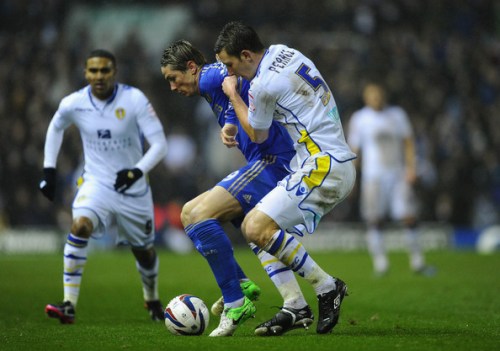
With Bielsa Joining Leeds, Legendary Striker Fernando Torres Cannot be Ruled Out – by Rob Atkinson

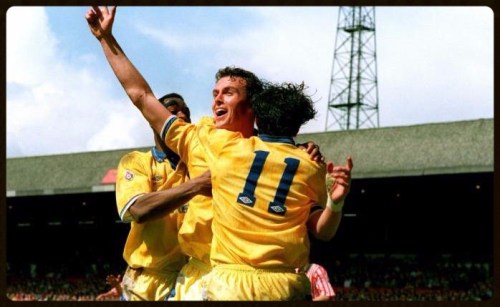
Fernando+Torres+Leeds+United+v+Chelsea+Capital+a5U_uColm1Xl

Fernando Torres – on his way back to Elland Road?

SkyBet have suspended betting now on the question of the next Leeds United manager – the last price available on Marcelo Bielsa was, reportedly, a not altogether generous 20-1 on. If the bookies expect you to invest £20 to gain a quid, then you can bet they’re fairly certain of the eventual outcome – and now, even that price is off the table. With other sources reporting that Bielsa has been granted a work permit, it seems nailed-on that “El Loco” will be installed in the Elland Road hotseat in the very near future.

To say that this represents a change in United’s recruitment policy is hopelessly inadequate. It’s like saying that Leicester City‘s 2015 title triumph was mildly surprising, or that Harry Kewell is perhaps lacking slightly in the nobler scruples. Bielsa to Leeds is a seismic event, something that shows the club are getting seriously serious in their approach to achieving promotion to the Promised Land. As the wise Yorkshireman observed when he sampled his neighbour’s parsnip wine, “Owt could ‘appen ‘ere”.

That being the case, other stories in circulation, yarns that would normally be dismissed as too outlandish and fanciful even for Coronation Street, must now be treated a little more respectfully. In layman’s terms: if Bielsa can agree to take over at Leeds, and especially if he’s managed to get the club to grant him a big say in all footballing matters including transfers, then pretty much anything can happen now. We’re entering an alternate reality here, one for which the last decade and a half has left us totally unprepared. It is indeed a whole new ball game.

So, when rumour has it that Leeds United, at Senor Bielsa’s behest, are showing an interest in former Liverpool and Chelsea striker Fernando Torres, now 34 but eminently capable still of tearing the Championship division a new one, then my advice would have to be: Titter ye not. Put aside your initial impulse to scoff, carp and otherwise demonstrate your scorn. A new reality is upon us, and who can say with any certainty what’s possible or probable under these radically different circumstances? Not I, and, I’d respectfully suggest, not you either.

Even now, though, with an improbability field so vast drifting around Elland Road, that you’d be forgiven for demanding a refund on your Hitchhikers Guide to the Galaxy, some possibilities must be counted as less likely than others. Bielsa? Almost certainly. Abel Hernandez? Where else is the lad going to go? Kyle Bartley? Agent Ayling is on the case. But Torres – a legend in the truest football sense of the world – that has to be a bit more of a stretch. SkyBet, supremely confident about Bielsa, regard Torres to Leeds rather more circumspectly at 33-1. They appear to see Japan as his likely destination, with Premier League minnows Newcastle also much more highly fancied than Yorkshire’s Number One, at 12-1.

Then again, it’s at Leeds United where the nigh-on impossible stuff appears to be happening right now. It should be remembered that Torres would be the third ex-Liverpool striker to join Leeds in the last couple of decades, following on from Ian Rush and Robbie Fowler. Could we really see Fernando Torres leading the line for the Whites at Millwall and Rotherham next season? The way things are around LS11 at the moment, you’d better think twice about betting against it.

The Silver Jubilee of Leeds United’s “Last Champions”   –   by Rob Atkinson

Jon Newsome whose goal was so crucial

Twenty-five years ago today, Leeds United became The Last Champions. They became the ultimate winners of the old-style Football League, which was superseded but never surpassed by Sky’s glitzy soccer revolution. There’s even a film about it now, the newly-released Do You Want To Win? Well they certainly did want to win, and I was there that day to see the passing of the old era, and the immortalisation of Wilko’s Warriors.

Parked up in the scruffy environs of Bramall Lane, Sheffield, just about the first thing my mate Dave did as we walked to the ground was to drag me back out of the path of a van as I stepped out to cross a road, oblivious of traffic, lost in thought. We grinned at my narrow escape and agreed: good omen. And then we were high up in the seats of the upper tier behind the goal at the away end of Sheffield United’s quaintly ill-designed stadium. The day was gusty, and so the football would prove to be. It was a match of ebb and flow, the Sheffield United faithful eager to deny Leeds their chance of clinching the title, Leeds fans loud, proud and defiant with self-belief. If we won, and Man U lost at Liverpool later, we were Champions.

You’ll probably have seen the goals from that game hundreds of times. It plays through now, all these years later, in the Football Highlights studio of my mind; joy for the home side as Alan Cork, bald of pate, pokes the ball home to give Sheffield the lead. Then, midfield tussles in the swirling wind, as the Whites try valiantly to come back. A late first-half free kick, which Gordon Strachan races to take before the home defence is ready, finding Rod Wallace who tips the ball past the home keeper’s attempt to save. Defenders scramble to clear, only to hit the late, great Gary Speed who bounces the ball back to ricochet off Wallace – into the net. Cue pandemonium in the away end. Level at half time, we’re breathless with drama and the hurly-burly of it all, raucous with United anthems, nervous of what’s yet to come.  

In the second half, though we don’t know it, human tragedy unfolds: Sheffield ‘keeper Mel Rees, injured in the mêlée leading to Leeds’ leveller, thigh heavily strapped, can hardly move and is hampered for the second Leeds goal as Jon Newsome stoops to head in at the far post. Rees was due a Welsh international call-up the next day, but has to pull out because of his injury. He would never play football again because he was to develop cancer and die a year later, tragically young at 26.

RIP, Mel Rees.

The crazy game continues crazily. A ball across the Leeds box is retrieved by home defender John Pemberton, who turns it back towards the goal-line where Lee Chapman sticks out a leg for an own-goal greeted with horror by the Leeds contingent. We’re level again. But enfant terrible Eric Cantona enters the fray, and within a few minutes he’s chasing a loose ball into the Sheffield half, Wallace scampering alongside and home defender Brian Gayle lumbering back in a desperate attempt to clear the danger. And it’s Gayle, former Man City man, who finally slays Man United. From my vantage point at the opposite end, I see him head the ball, and the action is suddenly slow motion. Poor Mel Rees is stranded far out of goal; the ball is sailing over his head in a slow loop, bouncing tantalisingly towards the empty net…

Then I’m watching at full speed again, as Cantona and Wallace raise their arms in triumph, wheeling away in delight, and even as I wonder what they’re up to, I realise that the ball is nestling in the Sheffield United goal. An ironically red mist descends; I am utterly beside myself in delirious joy, leaping around feverishly, roaring like a demented bull, face congested, eyes bulging, hyperventilating. I grab a helpless wee St John’s Ambulance man by his lapels and scream into his terrified face “Get me some oxygen!!!” The mad moment passes, I drop the ashen medic and some measure of sanity returns, but we’re still cavorting and diving all over each other, a seething, sweating mass of Leeds, because we know it’s over, we know that Sheffield are beaten, and we know that Man U don’t have an earthly at Anfield, not a prayer. We were Champions; on that windiest and gustiest of days, a Gayle from Manchester City has blown Man U away and decided in an instant the fate of all three Uniteds from Manchester, Sheffield and Leeds.

Leeds United, the undisputed cream of the crop. It all seems so long ago now. Happy silver anniversary, to the heroes – and also to the massive supporting cast of jubilant fans.

The Hillsborough Disaster Warnings That Weren’t Heeded – by Rob Atkinson

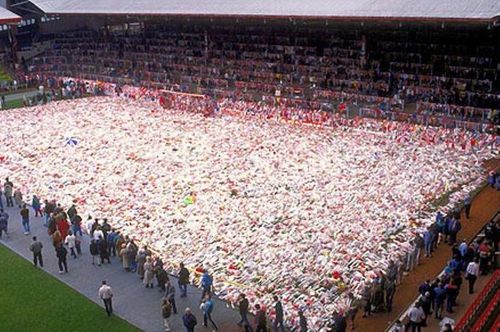
Hillsborough - an Anfield tribute

Hillsborough – an Anfield tribute

Incredibly, 27 years have flashed past already, since that awful spring day in 1989, when 96 football fans turned up to follow their team towards Wembley – and never came home again. I was one of a paltry 14,915 at Elland Road that day, watching Leeds United eke out a 1-0 home win over Brighton as Sgt. Wilko’s first half-season meandered to an uneventful close. When the news filtered through that there had been “trouble” in the semi-final between Liverpool and Nottingham Forest, the initial reaction was as predictable as it was wide of the mark: “the scousers are at it again.” Heysel was still fresh in the memory, English clubs were still banned from Europe – and nobody judges football fans quite like other football fans (or, at least, so we thought until the Sun got going). We were tolerably certain, as a bunch of Leeds supporters, that the Liverpool fans had caused more bother, and we glumly predicted another indiscriminate backlash that would envelop us all.

As we were on our way out of Elland Road, though, the full, awful impact started to hit home. There were deaths – people had actually died at an English football stadium – something that hadn’t happened on anything like this scale before. Apart from the Bradford fire – a very different disaster – the only comparable event in England had been the Burnden Park tragedy at Bolton, when 33 had lost their lives in a crush at a hopelessly inadequate ground with over 85,000 attending an FA Cup quarter final. That had been well over a generation before, in 1946. Surely, it couldn’t really be happening again, on an even greater scale, in the shiny bright late eighties?

But as we looked on in horror, the TV and radio news brought increasingly sombre statistics while the death toll steadily mounted – and later the sheer ghastliness of the event would be magnified as the tale of criminal incompetence and official negligence was revealed – and as the filthy end of the press, abetted by weaselling functionaries in Government and the Civil Service, jumped on the “blame the fans” bandwagon that other football supporters had vacated as soon as the scale and nature of the catastrophe became apparent.

If you were a Leeds United fan, a chill ran through you when you thought about what had happened; when you realised that this had, indeed, been a disaster waiting to happen. The Hillsborough Stadium was so oriented that the organising authorities found it easier, more convenient, to allocate stands to the fans of opposing semi-finalists based on where the bulk of those fans were travelling from. So, in 1989, Forest got the large Kop End, while the much larger Liverpool contingent were shovelled into the Leppings Lane End behind the opposite goal. It was the same the year before, when the same two teams contested the 1988 semi-final. And, similarly, in 1987, when Coventry of the Midlands faced Leeds United of the North, the greater Leeds numbers found themselves packed tight in Leppings Lane, while the smaller Coventry band enjoyed the wide open spaces on the Hillsborough Kop.

So two years prior to the Hillsborough Disaster, I and thousands of others were packed into the smaller Leppings Lane End on that April the 12th of 1987. The atmosphere was electric; it was United’s first FA Cup semi for ten years and Billy Bremner‘s men had been in terrific form as they challenged for a double of the Cup and promotion to the old Division One. We were jammed in like sardines on that terrace; looking up you could see fans climbing out of the back of the crowd, up over the wall and into the upper tier of the stand where space was more freely available.

Down on the packed terrace, it was swaying, singing fever pitch from before the kick-off right through to the heart-breaking climax of extra time. You weren’t an individual, you were part of a seething mass that moved as one, shouted and sang as one and breathed – when it could – as one. When Leeds scored their two goals, it was mayhem in there – you couldn’t move, you couldn’t breathe, you just bobbed about like a cork on stormy waters, battered by the ecstasy of the crowd, loving it and, at the same time, just a bit worried about where your next gulp of oxygen was coming from. Leeds took the lead early, David Rennie scoring down at the far end. That shattering celebration was topped when, having gone 2-1 behind, Leeds clawed it back right in front of us as Keith Edwards headed an equaliser and the United army exploded with joy. It was the single most jubilant and yet terrifying moment of my life to that point.

Later, after the match was over, as we trailed away despondently from the scene of an heroic defeat, there was time to reflect on what had been an afternoon of highs and lows, with the physical reaction of that epic few hours inside a pressure cooker swiftly setting in. With the benefit of twenty-twenty hindsight, it’s easy enough now to look back over twenty-nine years and think: “Yes, we were lucky.” Lucky that the incompetence threshold wasn’t passed that day when we were there. Lucky that enough of the terrace fans got into the upper tier to relieve the pressure ever so slightly – was that a factor?  So lucky that it wasn’t us, when it easily could have been. Lucky, ultimately, to be alive and kicking still. The warning signs were there – they just weren’t perceived by those of us – the fans – for whom it had just been another somewhat uncomfortable but thrilling spectator experience. That those signs weren’t recognised or heeded by the people responsible for public safety is a far more damning fact.

Poignantly enough, the luck we’d had that day wasn’t shared by 96 Liverpool supporters two years later. They set off happily, to support their heroes – and, tragically, they never returned. Twenty-seven years on, the wait for justice has been torturous for all concerned. The families and friends left behind, veterans of over a quarter of a century of grief and loss, have never given up their courageous fight, despite cover-ups and official brick walls, despite scurrilous press coverage which reached an obscene and disgusting low point with the Sun – that vanguard of the gutter press – and its sickening lies. 

Now, there is an inquest verdict at last. We have the official findings of unlawful killing and, surely there is finally justice for The 96. And indeed for all of the friends and family they left behind. Yet, even now, with the South Yorkshire Police Force unreservedly accepting the inquest findings, we still have the likes of Thatcher aide Bernard Ingham refusing to apologise for his own scandalous remarks in the wake of the disaster, now utterly discredited as he himself has been. There is no remorse or regret from Ingham, who stands as a symbol of official ignorance and deceit. All he is good for now, this bitter, bigoted old man, is sitting at home and growing his comedy eyebrows.

Twenty-seven years is far too long for anyone bereaved of their loved ones to wait – but justice is worth waiting for, if only so that the dead can sleep more peacefully and the living can have closure of a sort – and move on with the business of being alive. And – as a footnote – how appropriate it would now be if Liverpool FC could go on to win the Europa League after that thrilling victory over Borussia Dortmund – just for the families, the friends and those that were lost on that fateful day and in its aftermath..

There could be no finer or more fitting tribute to The 96, surely, than this long-awaited justice that has been served today – and the return of the Champions League football to Anfield.

Let it be.

When the Anfield Kop Saluted our Leeds United Champions – by Rob Atkinson

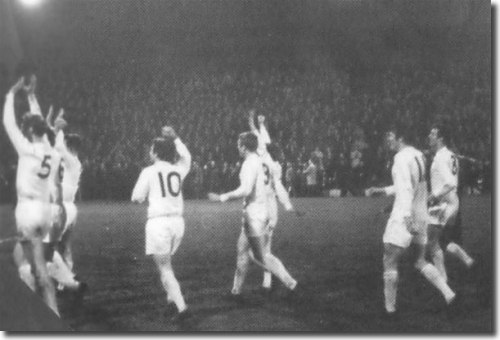
Leeds United's Champions take the tributes of the Liverpool Kop

Leeds United’s Champions take the tributes of the Liverpool Kop

Each of Leeds United’s three Football League Championship titles was clinched at Anfield, home of Liverpool FC.  In 1992, the Reds were good enough to beat a demoralised Man U 2-0 which, added to our earlier triumph at Bramall Lane, saw us as Champions by 4 points in the last ever proper old-style league competition.  In 1974, Liverpool obliged at Anfield again, losing at home to Arsenal to ensure that they couldn’t overhaul us at the top.  I remember a TV programme going to an ad break and then an information board coming up which read “Football result: Liverpool 0, Arsenal 1 – LEEDS UNITED ARE THE CHAMPIONS”  That simple memory still sends a tingle down my spine, even forty years on.

And of course – probably best of all – Leeds United’s first ever title success at the top level of the game came after a showdown between the two deadly but mutually respectful rivals on April 28 1969 – almost exactly 45 years ago. Leeds had come to Anfield knowing that a point would clinch the league, and they set out their stall as only they could to obtain that point, in the toughest place possible.  They would go on to beat Nottingham Forest in the last game of that season to reach a record 67 points – a mark that wasn’t beaten until Liverpool themselves recorded 68 points, ironically with a 3-0 win at Elland Road, in their fabulous 1978/79 Championship year.

That legendary Leeds United squad of the sixties and seventies hung on Don Revie’s every word, they would follow him into the pit of Hell itself and they trusted him implicitly.  This was the cornerstone of the relationship between team and boss; the unit thus formed was formidable indeed and, on their day, there was no-one to touch them.  It was often said of that Leeds side that if you cut one, they all bled – and then you’d better watch out, because they’d be after you as one man to seek retribution. They would do anything for each other and anything for the legendary Don – but on that historic night at Anfield 45 years back, they must have come as near as they ever came to saying “You what, gaffer?  Are you bloody sure??”

On the final whistle, as the Leeds players cavorted with joy in front of their delirious fans at this first delightful taste of being The Best – and as the weary Liverpool troops, having given their all in vain, sportingly congratulated the new Champions – Revie came over to Billy Bremner and confirmed to him that he was to lead his team over to the Kop. This, remember, was at a time when crowd violence was becoming very fashionable.  A similar gesture at the Theatre of Hollow Myths down Trafford way, and sundry other less-than-welcoming grounds around the country, might very well have got you a crack on the head with a pool ball or a dart in the eye. It did rather seem to be pushing things a bit – but Revie was insistent, and he was very definitely The Boss.

So it happened that Billy Bremner, captain of champions Leeds United, gathered his players together and led them on a long, slow walk to the legendary Anfield Kop.  When it was realised what was happening, a hush fell on the ground.  In near-silence, the heroes in white walked on, nearer and nearer to the most iconic terrace of them all.

On the night, Bremner had won the toss for Leeds, and had elected to make the Reds attack the Kop in the first half; a tactical ploy that went against the home side’s preference for a second half onslaught on their favourite end. So the Leeds players had to walk nearly the length of the pitch to approach the massed Liverpool fans behind the Kop goal, and with every passing second, the silence became more loaded – almost a solid thing you might cut with a knife.  Leeds United were asking for it – what would they get?

What they did get is now the stuff of legend and has passed deservedly into United and Liverpool folklore.  As the triumphant yet apprehensive Leeds warriors finally neared the Kop, the long silence was finally broken as the first cry of “Champions!” went up, swiftly echoed by others on the still-packed terrace – until finally the whole 27,000 population of that mighty hill were acclaiming the title-winners with the same shout, over and over again: “Champions! Champions! Champions!!”

This was completely unprecedented; a moment unparalleled before or since, something to raise the hairs on the back of your neck, the ultimate acknowledgement of respect and admiration even out of defeat – and a massive credit to the football fans of Liverpool FC.  It was the epitome of true rivalry between two crack teams, forged out of one of the grisliest on-field battles any football ground had witnessed for many a long year.  No finer tribute could have been paid by any fans, anywhere – and the Leeds players stayed out there, in front of the Kop, for a good quarter of an hour or more, paying their respects to both sets of fans.

Later, in the dressing room, Leeds celebrated anew with champagne provided by Bill Shankly, whose quote was short and to the point: ‘Leeds United are worthy champions,’ he said. ‘They are a great side.’  Revie responded by praising Liverpool, the club, the fans and their fine team. ‘The reception given us by the sporting Liverpool crowd was truly magnificent,’ he acknowledged, ‘and so, for that matter, was our defence tonight. It was superb in everything.’  The conduct and bearing of both managers was a mark of the relationship between the two top clubs in the land – and a marked contrast to the ungraceful reaction of Alex Ferguson at the same venue 23 years later, after the Leeds of 1992 had pipped his charges to the Last Championship Title and he, characteristically, dripped bile and acid all over the occasion.

Looking back from today’s perspective, with managers bitching about each other, players diving, cheating and trying to get each other into disciplinary trouble – and the stench of filthy lucre all-pervading – it seems far longer ago than 45 years to that Anfield night when the competition was so unremittingly fierce; white-hot, with no quarter given or asked for.   And yet after the battle was done, all that remained was respect from the teams for each other, of the staff for their opposite numbers, and of both sets of fans for an epic battle well fought.

Sadly, those days are gone, never to return.  But for those of us lucky enough to be able to remember, those images will never fade, the sound of those tributes can still be heard ringing out across the years.  It was a night of triumph and disaster, as these decisive nights tend to be, depending on whether you were White or Red; but it was also, let us not forget, a night of dignity, respect and utter, unalloyed class – not least from those 27,000 Liverpool fans on the Anfield Kop.    

Will Everton Make a Title Gift to Liverpool? – by Rob Atkinson

Chelsea’s immaculate win at Anfield sees them hang on in the Premier League title race but, in truth, it’s of more real use to Manchester City than it is to themselves – despite another touchline scamper of triumph from The Poorly One, Jose Mourinho.

Though City won at Palace today, they will still need to get a result at Everton, who are themselves clinging on to receding hopes of Champions League qualification. This is assuming, of course, that Liverpool can now win their last two matches of the season.

It may very well be that, if Everton can deny City at Goodison, they will have gift-wrapped a 19th top division title for their deadly local rivals. How that would go down in the Blue half of Merseyside is anyone’s guess.

I’d still back Liverpool – and I’m sure that if they do need a massive favour from the Blues – then the Reds will be suitably grateful.

Paddy Kenny’s Agent Says “Paddy is Fit” In Touching Romantic Tribute – by Rob Atkinson

Gorgeous, pouting, keeper Paddy Kenny

Gorgeous, pouting, keeper Paddy Kenny

Paddy Kenny’s agent has come out with a disarming statement of his regard for the long-serving goal-keeper, stating that he is “fit”.  In associated news, Frank Lampard’s agent has said that his client is “endearingly chubby” while the representatives of Fernando Torres, Ross McCormack and Steve Gerrard all expressed opinions that could be summed up by the phrase “Let’s face it: you would, wouldn’t you?”

Meanwhile, the agents of Wayne “Shrek” Rooney, Rio “Plug” Ferdinand and Luis “Mr. Ed” Suarez were not available for comment.

Leeds Forever – but Liverpool for the Title Would be a Feelgood Feast – by Rob Atkinson

Liverpool - climbing back onto their perch

Liverpool – climbing back onto their perch

Liverpool, having thrashed Man U at the Theatre of Hollow Myths last week, had to work a bit harder at Cardiff, going behind twice before emerging impressive 6-3 winners.  It will, however, have been the easy triumph over the Pride of Devon that provided the Real Reds with the most pleasure – these are two clubs who, to say the least, aren’t exactly fond of each other.  The last thing either wants to see is the other winning the league – which means that there are a lot of nervous plastics out there, sweating in their Devon armchairs right now; because Liverpool seem to mean business and they are currently rather handily-placed for a late title push.

For the neutral, things could hardly be better, with the tables so dramatically turned in this long-standing battle of Lancastrian one-upmanship.  Rivalry of that depth and bitterness tends to polarise opinion – there aren’t many fence-sitters when Man U and Liverpool meet.  For me, as a true white rose White, if Liverpool were to be Champions again at the end of this season, it would be an outcome second only to seeing my own beloved Leeds back on top.  OK, so I’m a proud Leeds United fan – so what has this got to do with me?

Well, I’d have to start by declaring an interest – as a die-hard supporter of the One True United from the right (Yorkshire) side of the Pennines, I’m not exactly enamoured of Man U.  I never had much time for them, even before that awful, whisky-nosed Govan Git came down to pour his choleric bile all over what had, until then, been a relatively civilised (give or take Brian Clough and nearly all the fans) English football scene.  There was always that irritating air of spurious arrogance about them, as well as this “you’ve got to love us because of the Busby Babes” thing – which all the media seemed to lap up so eagerly, much to the disgust of real fans everywhere.  So clearly, I don’t like them – never did.  That’s in my Leeds United DNA.  But I’m not just a Leeds fan, I’m a fan of football in its widest sense – and I mourn the game we once knew which seems to be gone forever, swept away by a grotty tide of filthy lucre

Time was when Man U were grudgingly respected, other than by determined haters like me and my fellow Whites.  Since Sir Alex Taggart landed at the Theatre of Hollow Myths though, they’ve gone from “quite easy to dislike” to “impossible to stand the sight of” faster than you could say “Envious of Liverpool”.  The Purple-Conked One made it clear from the off that he was determined to “knock Liverpool off their perch”.  What we didn’t realise when he started his vendetta in 1988, showing no immediate sign of being any more successful than any of the other post-Busby failures, was that the whole face of football would have to change to realise Ferguson’s warped dream.

In 1967, Man U won their last ever proper League Title, making seven in total – quite respectable.  Then – nothing, for 26 years, culminating in a deserved last-ever old-style Football League Championship triumph for Leeds United. But since 1993, when a greedy and ruthless Aussie bought the game and gift-wrapped it for a curmudgeonly and ruthless Scot, the title “race” has been more of a procession.  The honour has ceased to be about virtuosity on the field; now it’s mainly about money and markets, and Man U have had much more of both during the whole Murdoch era.  Result: thirteen plastic titles.

Football is now a tacky, merchandise-driven, unseemly drive for profit over pride, and the dominance by Man U of such a grubby era is undeniably apt.  But we are still close enough in time to the pre-greed days for those of us of a certain age to remember when the game was about glory, not greed; when the aim was winning, not wonga, when the important people were supporters, not shareholders.  In those days, the distribution of wealth was far more even, and the field of possible title-winners was far wider; the competition (over a grueling 42 match course, with un-manicured pitches and un-pampered pros) was far more fierce.  And yet, even in this environment of white-hot combat and intense rivalry, Liverpool reigned supreme, not for months, not years, but for literally two decades.  By 1992, they had compiled an honours list that seemed likely to see them at the top of the game for many years to come – unless someone sneaked in and moved the goalposts.  Cue evil Uncle Rupert.

Man U fans can crow all they want about 20 titles (and, true to their loathsome nature, they will).  But the evidence to confound them is there for all to see, like some geological stratum separating the dinosaurs from the mammoths.  That schism dividing the game as it was up to ’92, from the showbiz shenanigans of ’93 onwards, stands out like a Tory at a Foodbank, exposing Man U as the wealth-backed, monopolising opportunists that they are.  And it has all been done with such bad grace, another indictment of this new and joyless age we’ve been plodding through these last twenty-odd years.  No gentle wisdom of the Bob Paisley variety – instead we had the sour bile of Ferguson and now seemingly a Fergie-Lite clone in the newly growly and grouchy, yet undeniably Gollum-esque David Moyes.  No loveable old-style hard-man Desperate Dan type like Tommy Smith – we just had the manufactured machismo of Roy Keane, a supposed tough-guy with an assumed snarl and trademark glower, whose typical party trick was to sneak up behind wee Jason McAteer and fell that not-exactly-scary individual with a sly elbow.

The comparisons could go on all day, but the bottom line is that Liverpool at their peak – and it was a hell of a peak – typified all the values of football that some of us remember from a pre-Sky, pre-glitz, pre-greed age when it really was all about a ball.  Now, it’s all about money, and contracts, and egos, and snide bitching to the media if you don’t get all your own way – and lo, we have generally had the champions we deserve.

Only now, when Taggart has slithered into retirement, are we seeing anything like a level playing-field – and even then, it’s just among the moneyed elite of the Premier League.  Without Ferguson, we suddenly have a new Big Four, sans Man U, and all the better for that.  For all of this season, it has been the thoroughbreds of Liverpool, City, Arsenal and Chelsea dominating at the top, whilst Man U desperately cling to the coat-tails of Everton and Spurs, desperate even for the dubious compensation of Europa League qualification. Clearly, then, the era of Man U domination has been much more a function of the unique personality – to put it politely – of Ferguson, than any real superiority on the pitch.  In a game of fine margins, that crucial factor made such a difference. Hence, the whole record of the past 21 years would appear to have been slewed in one club’s favour, courtesy of one bile-ridden Glaswegian and a covey of co-operative referees.  The records, as they appear to stand, are grossly misleading.

To apply a conversion rate which takes account of the foregoing and sums up all the anger and disgust I feel for the way our game has been degraded – I’d say each Premier League (or Premiership, or whatever else it’s been marketed as) is worth maybe half – at the very most – of each proper Football League Championship from the days when the game still belonged to us and the world was a happier and more carefree place.

At that rate, Man U are still a good long distance behind Liverpool, which – judging by the paucity of ability and bottle they have displayed under Moyes this season – is precisely where they belong.  Now we’re witnessing a resurgence for the club which – under Shankly, Paisley and the other boot-room boys – dominated English football for most of my youth and early adulthood. A Liverpool title victory this season would be the closest we can now get to a return of those good old days.

Because of the Ferguson Factor, history and the record books are poor teachers for the modern student of football.  So as the Reds look to challenge strongly again at the very top of the English game, while a Fergie-less Man U, shorn of their X-factor, languish in their mighty wake – what better time than now to emphasise the simple truth once and for all? Liverpool are still The Greatest.
Man Utd Fans Descend to Millwall Level as Liverpool Triumph – by Rob Atkinson

Liverpool fans show what football banter really is all about

Liverpool fans show what football banter really is all about

As a Leeds United fan, I’ve long experience of bitter rivalry between mutually-hostile supporters of various clubs. There has been violence, there has been offensive chanting – it was a big part of the football landscape for far too long. Happily, there has been some improvement over the past couple of decades, but in a couple of isolated pockets, things are as bad as ever. Worse, in fact – because in addition to the unpleasant taste left behind by the revolting chants still in common use whenever you go to such beauty spots as Bermondsey or Stretford, there is now, from the animals who follow Millwall and Man U, the rank stench of hypocrisy.

The game between the fallen champions and Liverpool at the weekend brought this phenomenon into sharp focus.  Man U fans have problems with Liverpool. There’s an inferiority complex that won’t go away, for a start.  Then there’s what they describe as the Liverpool supporters’ appetite for mawkishness over things like Hillsborough, conveniently forgetting their own habit of taking out an onion every February 6th and weeping crocodile tears over Munich – surely the most profitable air disaster any club has ever struck upon.  Still, the Man U faithful turn a blind eye to any apparent inconsistency and continue to demand tributes to “the flowers of Manchester” whilst dubbing Liverpool the “City of Pity”.

In the latest meeting between these two old rivals, Liverpool ran out easy winners at the Theatre of Hollow Myths, the assembled Man U fans having come from the traditional hotbeds of Devon, Cornwall and Milton Keynes only to witness their favourites being given a footballing lesson.  This was clearly too much for them, and they reacted with a repeated chorus along the lines of  ‘The Sun was right, murderers’, with reference to that gutter tabloid’s disgraceful coverage at the time of the Hillsborough disaster. Classy, eh?  96 people went to the football in Sheffield in 1989, and never came home – and here are modern day football fans mocking  the bereaved because they’re losing a football match. Naturally, the media will refuse to mention this – the nastier habits of the Man U congregation tend to be swept hastily under the carpet, for sound commercial reasons.

Next weekend, Leeds United meet Millwall, another club whose fans enjoy mocking opposition fans over light-hearted matters like violent death; but those same fans become all self-righteous when it is suggested to them that their behaviour is that of inbred morons.  Their justification for their regular outpourings of hate-filled bile tends to boil down to “well you lot do it, innit”. Now, the shameful fact is that Leeds United did used to have a problem with a minority of their fans who enjoyed baiting rival supporters in just this way. That kind of thing was all the rage back in the vicious eighties, a time when United’s support was heavily infiltrated by racists and other such dross.  Things are much better at Leeds now, due in no small measure to supporters’ initiatives and anti-racist, anti-thug fanzines.  The whole of football has done much to clean up its act – with the notable but ill-publicised exceptions of Man U and Millwall.

The actions of a minority of Man U fans, in singing that sick and sickening song during their humiliation by Liverpool, puts them on a par with the thugs and Neanderthals of Millwall.  Both sets of fans glory in the misery, death and bereavement of others.  Both sets emit high-pitched squeals should anyone attempt to upbraid them about it.   Both sets come predominately from London (saving Man U’s west country brethren).  Both sets are also scum – pure and simple.

We at Leeds may not have to put up with the cretinous behaviour of Millwall fans again.  Next weekend’s game is at Elland Road, and Millwall tend to bring a following of maybe a couple of dozen to us, for some reason which, they will tell you, is totally connected with policing restrictions, and nothing at all to do with being a bit too chicken to venture up Norf.  And by next season, they’ll most probably be in League One – gone and forgotten, late and unlamented.

But it doubtless won’t be too long before our paths cross with Man U again, and inevitably they will bring their Turkish favours to Elland Road, heedless of the fact that Munich taunts from the home fans are largely a thing of the past. And, as usual, the media will fail to take them to task for it. But they’ve proved all over again in the Liverpool game, for all the world to see and hear, that they still have all the taste and decorum of a sty of diseased pigs – so we should perhaps expect such behaviour, and pity those who are simply too subhuman to conduct themselves otherwise.
It’s a shame, now that, Millwall apart, the rest of football has cleaned up its act a bit.  But really – and this is the nub of the issue – what else can you expect of such irredeemable, low-life scum? Let’s just thank the footballing Gods that they’re getting a long-overdue taste of what it’s like in the real world – now that their team has turned to dross in the absence of the Demented One.  Enjoy it, scummers.  It couldn’t happen to more a deserving set of morons.

England Internationals Should Play for Free – by Rob Atkinson

Image

Three Lions – all the incentive needed and more.

After England’s successful World Cup qualifying campaign, the dust is now starting to settle, and thoughts are beginning to intrude along the lines of: Oh, Christ, spare us another World Cup finals performance like the last one.  It’s a memory just too depressing for words as highly-talented yet grossly over-paid young players sulked around the pitch as if they’d forgotten exactly how lucky they were to be there at all.

The fanatical travelling army which follows England everywhere were shocked into spells of stunned silence at the lassitude and sheer incompetence of some of their so-called heroes in an England team made up, as is usual in these money-mad times, of multi-millionaires, millionaires, and perhaps two or three of the merely very rich.  The fans turned to each other and asked, what the bleedin’ hell is going on?  Well, situation normal, isn’t it?  What a load of overpaid rubbish.  We’ll stay at home and watch it on the box another time. It goes without saying though, that the fans will always be there.

With the money in the game, the long-established infrastructure, and the size of our nation relative, say, to a country like Holland which produces excellence as a matter of course, we should be doing better in these massive pan-global tournaments.  But however easily, or even gloriously we manage to get there, it always seems to go wrong – at least it has so far this century.  The relative glory days of Mexico ’86, Italia ’90 or even England ’96 are a long time ago now.  Something is rotten in the state of England.  What are the missing ingredients?

Allow me to propose an old-fashioned answer: Pride and Passion.  Those two words sum up the edge that England teams, maybe lacking in the technical gifts of continental and latin american players, used to possess; attributes that used to see us through against higher levels of skill and flair. These are the qualities our national team has shown too little of over the years, qualities the fans still possess in abundance.

Now, I’m not suggesting that the players who represent England are lacking totally in either commodity, but I would venture the opinion that they is no longer the over-riding motivation.  Money – oodles of it – always looms far too large within the game.  To clear the players’ heads, to rid them of competing considerations and leave them focused on the job in hand, to nurture the mindset that they are representing their country, and carrying the hopes of millions, I would propose – quite seriously – that we abandon henceforth the practice of paying players to play for England.

This is not a new idea, not by any means.  Before World War Two, players selected for England were invited to choose a match fee OR a souvenir medal – not both.  They invariably opted for the medal – and this in an era when professional football wages were capped at a level not far above those of a skilled worker.  But pride and passion motivated them.

Nowadays of course, footballers earn a vast amount, and some would say good luck to them – but do they really need to be paid over and above their club contracts for what is still a signal honour?  The playing employees of Liverpool, Man U, Man City, Spurs, Chelsea, Arsenal and the rest pull down many, many times the average wage and exist on an entirely different plane to those who shell out their hard-earned to watch them perform.  How does this affect the way we see them?

As things stand, the emotional distance between the crowd and the players is magnified by a patently enormous gulf in financial status, which breeds resentment among the fans when things aren’t going well on the field (look at him, fifty grand a week, and he couldn’t trap a bag of cement). Would the frequently toxic nature of that crowd/team relationship not be improved if the players were really playing for the shirt and the cap, and nothing else?

Removal of monetary rewards would not be universally popular among the players – but might this not help sort out the committed from the opportunist, and thus – to risk an archaic phrase – engender a more positive team spirit?

There would be no unpalatable need for the FA to profit by the players’ noble sacrifice.  The money that now goes on match fees and bonuses should instead be diverted to a charity of the players’ choice – and would this not only provide an additional incentive to win, but also enhance the team’s good-guy credentials?

They might feel, deep inside, that they’re a cut above the opposition – who are shamelessly, brazenly, doing it for the money.  It might even give them that crucial edge. Success is, after all, about the steady accumulation of marginal gains.

No match fees or any bonus, not a red cent – just an international cap.  No taint of lucre in the motivations of the players, who would in any case be set for life even if they never earned another penny.  No charge of “mercenary footballers” from a disgruntled crowd – rather it would be:  well done lads, you’re doing it for England and glory.  If you didn’t win – well, we know you were giving of your best, for love of the shirt and charitable causes.  Think of that.  Wouldn’t our England players rather be loved and admired, than just that tiny bit richer?

Can there really be a better incentive than national pride and sheer altruism, uncluttered by the financial bottom line?  Wouldn’t there just possibly be a whole new dynamic around the currently unfancied England setup that might even take us onwards and upwards? Am I being hopelessly idealistic or even naïve?

Well, perhaps I am – but I would humbly suggest that it’s got to be a better way, and is certainly worth a try.

13 Years Ago Today, Leeds United Edge Out Liverpool With “The Duke” At His Best – by Rob Atkinson

Image

The bare facts hardly do credit to a stunning afternoon at Elland Road on November 4th 2000.  An injury-hit Leeds United faced old enemies Liverpool in Premier League game which saw Liverpool take a two-goal lead, get pegged back at 2-2, take the lead again – and then finally succumb 4-3 in the archetypal see-saw football match.  Leeds had won, and Australian centre-forward Mark Viduka had gone one better than the traditional striker’s dream of a hat-trick in a high profile victory.  Viduka – the Duke – had scored all four, single-handedly breaking the hearts of the Reds whose manager Gerard Houllier was left speechless with shock and disappointment.

In truth, Liverpool were well-set for victory as they cruised to an early two goal lead through Hyypia and Ziege, taking advantage of slapdash Leeds defending.  The home team were weakened by the absence of regulars like Nigel Martyn, Lucas Radebe, Harry Kewell, Danny Mills, Michael Duberry and Michael Bridges.  Bit-part player Jacob Burns started and Danny Hay would come on as one of only four fit subs – this was very much a patched-up United side.  After such a start heads might have gone down in the Leeds ranks, but Alan Smith was still up for the battle, chasing every cause and closing down in his unique combative style.  It was a typically aggressive piece of Smithy harrying that saw Leeds back in the game after 25 minutes, as he blocked a Ziege clearance and saw the ball bounce right into the path of an onside Viduka in the Liverpool area.  No further invitation was needed; the burly Aussie executed the most delicate of chips to beat Reds keeper Sander Westerveld all ends up.  The teams went in at the interval with Liverpool ahead 2-1 – but some of the momentum was back with Leeds.

Shortly after the start of the second half, United were level – and this was a goal to remember.  Gary Kelly broke swiftly down the right, looked up and delivered a pinpoint cross which Viduka met with a towering near-post header, sending the ball arrowing high into the net for a fantastic equaliser.  The effervescent Smith then missed a clear chance to put Leeds ahead, and that looked a costly error when Liverpool surged back in front just after the hour.  Berger crossed from the left to find Vladimir Smicer who cleverly worked himself the space to slide his shot past a despairing Paul Robinson and into the net.  A bitter blow for a makeshift Leeds side that had hauled itself, against long odds, back into the game.

Many indeed would have expected Leeds to crumble at this point, but to their eternal credit they stayed competitive and kept fighting.  The next goal was always going to be crucial; a fourth for Liverpool would certainly have finished Leeds off.  However, the game’s sixth and best goal saw Mark Viduka complete his hat-trick with a finish of amazing artistry for such a big man. Former Evertonian Olivier Dacourt saw a powerful shot blocked by Ziege, but managed to feed the rebound first time through to Viduka at the right edge of the penalty area.  Most strikers would have tried to get a shot off, but Viduka, spinning unpredictably through 360 degrees, threw off the attentions of the Liverpool defence and finished sublimely into the far corner.

At this stage, the overjoyed Leeds support would probably have settled for a draw that had, at one point, looked like being more than they could dream of.  But Viduka was not finished yet.  Only three minutes later, he finally ended Liverpool’s chances with a fourth goal which, it must be said, owed as much to a generous linesman as it did to the Duke’s skill and lethal finishing.  The Leeds striker was surely offside as the ball reached him yet again in a threatening position inside the Liverpool area – but he didn’t hang around to see if a flag went up or a whistle blew.

In the event, neither happened and Mark Viduka produced yet another delicately-crafted finish, the ball arcing beautifully over a committed Westerveld and dropping into Liverpool’s net.  4-3 now and pandemonium as Leeds led for the first time, as unlikely a scenario as you could possibly have imagined after only 20 minutes of this incredible game.  Liverpool fought to the last, but so did Leeds to hang on grimly to their hard-won advantage.  Dacourt finished the game barely able to move, the Liverpool players finished it hardly able to believe what had happened to them.  The contrasting body language of the jubilant United manager O’Leary and his crestfallen Liverpool counterpart told the story of this result and of a game that will always be a part of the folklore surrounding this long-standing rivalry.

Liverpool had fought gallantly and lost.  Leeds had defied the odds and their injury toll to win.  But the undoubted hero of the hour, thirteen years ago today, was beyond any shadow of a doubt the United centre-forward Mark Viduka.  The Duke – Leeds United legend with his own permanent place in Elland Road history.