
Tag Archives: Manchester United

Man U’s “Olympic Diving Trio” Fail to Deny Spurs – by Rob Atkinson

Image

That Moyes half-time team talk in full

It seemed as though the selection of referee for today’s Man U v Spurs match at the Theatre of Hollow Myths was spot on and just right for the job in hand.  Howard Webb is a man who has proved time and time again that he’s one referee who knows exactly how to deal with the acknowledged divers of the best Man U tradition. Howard does not shirk his responsibility, Howard acts decisively. Howard doesn’t even hesitate; he gets the whistle to the lips and blows shrilly for the statutory penalty.  We’ve seen it repeatedly down the years.  The man is Mr Consistent, and his collection of Premier League title winners medals have been due reward for this.

But clearly, something went badly wrong today.  A goal down at half time, and needing their main man on form in the second half, Man U increased their divers complement, using all three specialists at the club with Ashley Young joining Welbeck and the promising young triple-salko expert Januzaj.  Between them, these three gave Webb every opportunity to award penalties, with brilliant build-up play leading to immaculate finishes, landing on the face in the box in the approved fashion. Webb, though, appeared to have forgotten his lines completely, refusing to give even one penalty and actually booking the latest “New George Best”! His performance was disgraceful, and he is expected to be carpeted at Carrington later this week. On this performance, Webb’s place in Moyes’ matchday squad must be in doubt.

Looking at the displays of the three-man dive squad against Spurs, any and all of them could have had success on the day were it not for the official deciding to come over all impartial, in blatant breach of the standard contract.  Let’s take Danny Welbeck first:

Image

Welbeck’s matchday scorecard

Danny tried hard, but possibly a little too hard.  One of the tabloids, the Metro, has chosen to be a little treacherous and highlight one of the lad’s less subtle dives – and oh dear, it does look bad (see here). Overall, not one of Danny’s better displays. But, at the risk of straying into irrelevant areas, at least he scored.

Moving on, let’s check out the promising young Adnan Januzaj’s form:

Image

The Januzaj scores.

Young Adnan again is a trier and he shows real potential.  The fact is though that he’s been booked at least twice now, for “simulation” as they prefer to call it these days (cheating is such a nasty word). This may indicate that he’s perhaps not yet a true Man U class diver.  It’s a part of his game he’ll obviously be encouraged to work on – Moyes is on record as saying he’ll be having a chat with the lad, and there are good, solid examples of effective diving already at the club, from whom he can learn a great deal.  But for the moment, he’s flattering to deceive, and there are even suggestions that the blatant nature of some of his “precipitate descents to ground level” are threatening to blow the gaff on the very fabric of the club’s entire diving policy. This is something that should put all concerned on notice; the quality of diving needs to be addressed just as much as does the inexplicable form of the normally-reliable Webb.

Last, but by no means least, we have Man U’s main diver, usually benched until his particular gifts are needed – the one and only Ashley “Nautilus” Young:
Image

Ashley’s impeccable style and artistic interpretation

If there is one man who should shoulder no blame whatsoever for today’s defeat, it’s that man Young.  Always available to come on when required, his single-minded approach warms the hearts of every fan from Torquay to Milton Keynes and back again.  Such dedication deserves some reward; on days like this, Ashley could be forgiven for thinking he might as well go back to playing football.  But such a devoted practitioner of his art will not long be cast down.  You can guarantee that Ashley will be back, arms and legs akimbo, nose ploughing a furrow inside the eighteen yard box and that lovely, fluid motion as the dive turns seamlessly into a loudly-squealed appeal to the normally willing ref.  Looking at today’s match, Moyes was livid that one dive of utter quality didn’t result in a penalty. Unlucky, Ashley – don’t give up.

As for the rest of the match – Spurs even had the cheek to claim a penalty of their own.  But goals either side of half-time, both inexplicably allowed, were enough in the end to see them take the three points.  Sadly, it will have been an uncomfortable journey back south for the bulk of the Man U support, having to share trains with gloating Spurs fans.  It’s at times like these that the mettle of such faithful and dedicated gloryhunters is truly put to the test.

These are worrying times though for Man U.  Spurs have been nothing special this term, and the fact that they have been able to face Man U’s triple threat and not concede even ONE penalty is a matter of grave concern.  Some MPs in Home Counties constituencies are being asked to table questions in the House.  It’s that serious.  The problem, clearly, is with Webb – and you’d almost wonder on today’s performance if someone’s got at him? The Premier League Referee’s Panel, perhaps – though they’re normally very good at keeping their nose out of Man U’s private affairs.  Whatever has happened, something has to be sorted out, and soon – or it will be hard to see how personnel changes are to be avoided.  Several younger refs have put in promising performances for Man U lately, one even pulling a muscle in his eagerness to point to the spot.  It may even be time to think the unthinkable and act to replace Howard – even though there’s little doubt that he will go down as one of the true greats in the club’s history.

It would be interesting to be a fly on the wall when Webb is summoned to meet an irate David Moyes in the next few days. He’s likely to have to do some hard, fast talking to have any hope of retaining his squad number, and even then it’s likely that beady eyes will be watching him from the stand.  Yes, even his old mentor S’ralex is rumoured to be bitterly disappointed with Webb’s lamentable display today.  Things are getting serious – for sound marketing reasons, Man U simply must finish in the top four at the very, very least.  So could we really be about to see the end of a glorious Man U career?  The next few days way well decide that.

Cristiano Ronaldo to Sweep Board in Fifa’s ‘Narcissist of the Year’ Awards – by Rob Atkinson

Image

A tender moment between CR7 and his biggest hero

Sometimes, you catch sight of a headline and, as you feel your eyebrows heading for your hairline, you wonder to yourself: “Did I really read that right?” Such a headline caught my notice the other day. “Cristiano Ronaldo opens a museum in his own honour in Madeira, Portugal“, it read. My eyebrows still haven’t returned to their default position – if fact I may well have pulled a couple of muscles there.

The thing is, the story in itself is not that surprising or earth-shattering. The impact is more of a jolt of self-affirmation – having a deep-rooted prejudice confirmed, right out of the blue like that.  You just think – well, I was right about that lad.  You see, I’ve long felt that Senhor Ronaldo has a touch of the Narcissus Complex about him. Many was the time when some noted Man U mouthpiece such as S’ralex Ferguson would say, with no evident sense of irony “Cristiano is the archetypal Man U player” or some such platitude. And I’d just nod, thinking to myself: isn’t he just. As was Royston Keane, pretend tough guy, for his blithe belief that the rules of the game were for lesser mortals. Cantona too, for his strutting, turned-up-collar arrogance – noticeably absent in his time at Leeds United where the likes of Strachan and Batty would have beaten it out of him.

So, despite Ronaldo’s much-publicised yearning to head off for pastures Iberian, I was actually quite surprised when he left the Theatre of Hollow Myths a couple of years back. He just seemed like a perfect fit for that particular club, an apt representative of the puffed-up, self-regarding Pride of Devon. Since arriving in Madrid, a constant theme has been his desire to be regarded in the same light he regards himself – if such a thing were only possible. Because, alongside his undoubted brilliance as a player and his lavish habit of scoring goals at an unprecedented rate for a winger, there has always been this “look at me” air about him.

This particular manifestation of narcissism is at its most apparent when he’s playing in a high-profile match, at the World Cup finals, for instance. There, the games are played in stadia equipped with those flying cams which zip about aerially, capturing close-ups of players from a position, seemingly, just above their heads. So whenever Ronaldo misses a goal or protests to the referee (he does this a lot), you’ll see him in a match like this, glancing at the nearest robot camera, then maybe checking out his magnified image on the inevitable big screen, admiring the pose even as he’s striking it.  He has a special “poised to take a free kick” pose as well – you’ve probably noticed.  He loves this one – legs akimbo, stock still, seemingly waiting for the crowd to subside to an awed hush. He sneaks little sidelong glances at the big screen then too, checking himself out.  It’s really quite funny and a little bit pitiful. There’s no denying that he’s a very good-looking lad, and yet this too-evident, overpowering self-adoration is curiously unattractive, casting a patina of ugliness onto features usually apt to set hearts, not all of them female, a-flutter.

It’s a character trait that makes it impossible to define Ronaldo simply in terms of his technical ability, his genius with a football at his feet, or even his extravagant goalscoring record. In this way, the narcissistic flaw in his make-up serves to keep him out of the Pantheon of True Greats, players – many of lesser ability – who combined admirable qualities such as humility, modesty, self-restraint on and off the field – things like that – with their obvious talent. Marks of maturity and character all, and reminders that talent alone, even genius, is not enough. Ronaldo’s flaws are less extreme than, say, Georgie Best‘s – and he’s certainly a much better pro – but just as was the case with Best, those flaws threaten to have him remembered at least as much for the negative parts of his persona as the positive aspects of his game.

Ronaldo is simply unable to restrain this tendency to sound overtly, overweeningly in love with himself. As many know, when somebody is in love, they’re totally unable to comprehend how anyone would be able to resist loving the object of their adoration. It’s a type of tunnel vision – the lover cannot see anything but good about the loved. This would appear to be precisely the nature of Cristiano Ronaldo’s intensely passionate relationship with himself. If he ever needed a motto, he could do a lot worse than to open his Bible and paraphrase John 15:13, summing himself up with “Greater love hath no man than I for me”. By comparison, Narcissus himself comes over as having slight self-esteem issues. Ronaldo loves Ronaldo, and you get the feeling that he honestly can’t understand why the world at large can’t share in his joy.

The opening of the CR7 Museum, by the adored CR7 himself, in honour of the said adored CR7, sums all of this up quite neatly. It provides independent verification of mine and others’ long-standing summing-up of Cristiano Ronaldo, and as such it’s really more to be wryly laughed at than fumed over. But it is a pity, in its way: a footballer’s life as an active player is, after all, relatively brief. After retirement, and as the glittering career fades ever further into the past, history can take a more jaundiced view of the former star than those who were there in the instant, cheering and applauding as a virtuoso performer plied his genius trade. The later view of the legend, the “warts and all” version, can even come to focus more on the warts than on much else worthy of admiration.

If Ronaldo wants the eye of history to gaze benignly upon him (and you can bet your last penny he does), then a little humility, a little less obvious awareness of his own talent and gorgeousness would have been a big help. But it’s late in the day for that; even now he’s seen as someone in whom human virtues epitomised by the likes of John Charles or Bobby Moore are sadly absent. In the meantime though, why would Cristiano care? He is playing for one of the biggest clubs on the planet, he has won and will win many medals and trophies – his life is one grand, sweet song.

It’s just that he appears to have been blighted by a crucial part of his development; that few years spent at Man U which can have an unfortunate effect upon an impressionable young man, especially one with a certain arrogance about him, the air of a braggart. It can have him believing in his own publicity and the rightness of everything he does or thinks, an impression reinforced by a complaisant media. Other, similar examples of this type have emerged from the club, other flawed characters who would have benefited from formative years spent in a less privileged and less insular environment. It manifests itself differently in Beckham, Keane, Cantona and a few more who spring to mind – but all of these players have emerged from Man U with character issues to confront, something they’re doing with varying degrees of determination and success. It does have to be said that not everyone is carried away on such a perilous tide; Paul Scholes for instance remained firmly detached from all the hype, to his eternal credit – and simply got on with his job. Andrei Kanchelskis was another such.

Cristiano Ronaldo is simply the most obvious example of the kind of young man who in many ways summed up the character of a club like Man U, but in many more ways was in sore need of being taken down a peg or two when the time was still ripe for his character to develop along more attractive lines. The moral is, I suppose: If you have a talented youth who thinks he’s the bees’ knees – send him to Barnsley where he’ll learn the rudiments and have the more offensive edges knocked off him. You won’t produce quite such a polished player that way, it must be admitted. But you would end up with a much better all-round bloke; one who would perhaps guffaw derisively at the thought of opening a museum in his own honour.

Darren Fletcher of Man Utd a Positive Role Model for the Chronically Ill – by Rob Atkinson

For a Leeds United fan, yesterday’s news that Man U had won 3-0 at their perennial rabbit team Aston Villa was hardly welcome or, in itself, inspiring. The two Uniteds from either side of the Pennines share a mutual loathing that has become legendary and transcends geographical proximity or considerations of direct rivalry, the normal prerequisites for a healthy hate-hate relationship. The fact that Leeds and the club I fondly refer to as the Pride of Devon are miles apart both in location and in status has not affected the poisonous depths of the antipathy between the two.  We sing about them in terms of extreme dislike, they reciprocate in tones of mixed cockney and that characteristic West country burr. Neither set of fans would cross the road to save one of the enemy, by means of micturition, from a death by conflagration.  It’s been like that for years.

However, some things are more important than football’s strife and conflict, on or off the field.  The other news to emerge from Villa’s capitulation was without doubt positive, welcome and a thing to be celebrated by anyone who loves football – indeed by anyone at all. It is the story of a young athlete with a glittering career before him who was struck down by a chronic and debilitating medical condition, yet who has overcome that awful setback to regain a place among his team-mates playing a highly demanding game at the top level.

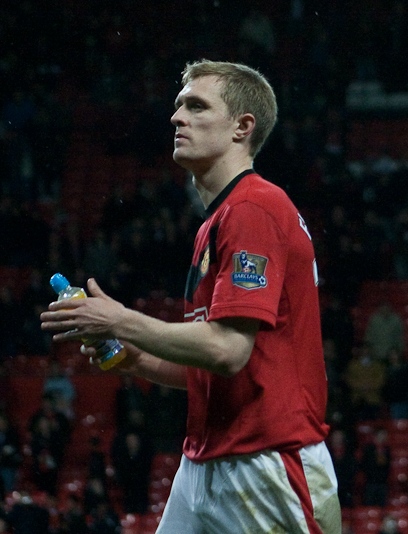
Image

Fletcher – back from the brink

Darren Fletcher made his senior bow for Man U in 2002 and performed with versatility and industry in midfield and defensive roles, depending on the requirements of his club, up until 2011 when he was finally struck down by the bowel condition ulcerative colitis, something he had been coping with whilst playing on – but which now necessitated rest and treatment.  It was announced that Fletcher would take an extended break from football to address his problems and, obviously, there were fears in some quarters about whether he would be able to return to such a demanding way of making his living.  Yet return he did, in September 2012, only to be then ruled out for the remainder of last season after undergoing an operation to lessen the effects of a condition which can have life-altering consequences depending on its severity and treatment. Last Saturday at Villa was Fletcher’s second comeback – but this time it seems that the problem may have been overcome for the longer term.

Fletcher himself certainly believes that he is back to stay, having beaten his health problems.  “This is it, I’m back for good,” he told MUTV, the club’s in house TV channel. “This (the Villa game) is hopefully the game which means I’m back now.

“I seem to have come through the setbacks and health issues and I’m thankful for that. It’s onwards and upwards now.  I always believed I would come back, I kept that mind-set. I think other people around me were trying to make me think otherwise, but I stayed strong and believed I would get back.”

All football fans should be wishing Fletcher the best and hoping earnestly that he is right to be optimistic about the future.  At 29, he still has a good part of his career ahead of him and, having shown the character and courage to overcome such a potentially demoralising and energy-sapping condition, he surely has much to give for club and also his country.  As the captain of Scotland, his will be an example of determination and courage in adversity that many will look up to, especially those stricken with this or similar conditions at an early age as Fletcher was – and many who are suffering at much younger ages.

Fletcher appears to have fought his fight and won – something that will give hope to many thousands of people who might otherwise be tempted to succumb to a belief that their health problems will stop them from achieving their life goals. Darren Fletcher looks set fair to achieve much more in his career, adding to what is already a glittering trophy and medal haul.  That he can do this despite such a serious setback is greatly to be admired.  The positive example he might set to others is difficult to over-state, and to call him a role-model is no exaggeration. Good luck to him as he regains full fitness and resumes a career that must at one point have been in doubt.  That is something which Darren Fletcher – to his eternal credit –  has clearly never accepted.

Happy Birthday “Lash” Lorimer, Leeds United Legend 67 Today – by Rob Atkinson

Image

Lorimer in action for Leeds United

One of the younger members of the Revie Glory Boys legends celebrates today – still three years away from his seventies, Lorimer was the tenderfoot of the team, making a League debut while still 15 years of age in September 1962.  Apparently, his parents had been offered £5,000 as a hefty cash inducement (almost £75,000 in today’s money) to have the young Peter sign for an unscrupulous club based just outside Manchester, but Lorimer preferred Leeds and went on to enjoy a long and successful career at Elland Road, encompassing two spells with the club.

Despite his early start, Lorimer had to wait until 1966 to become a regular in Revie’s fine team.  By the time he had become established, the young Scot had made a name for himself with his ferociously powerful shooting, the supposed velocity of his shot leading to the adoption of a terrace anthem especially for Lorimer “Ninety Miles an Hour”.  It was said that one penalty kick actually registered a startling 107 mph, giving the goalkeeper dangerously little time to get out of the way.

In the 1967 FA Cup semi final against Chelsea, Lorimer had the misfortune to have a late equaliser chalked off by the referee, when it was decided that the Chelsea wall was not back the full distance before the United winger struck a cannonball free-kick into the Blues’ net.  This was one of several bizarre refereeing decisions over the years which would conspire to label Leeds a “nearly club” – always the bridesmaids, never the bride.  In fact, Lorimer and Leeds won every honour in the domestic game in a decade of dominance that saw them generally acknowledged as the finest English club side of all time.  They picked up two Fairs Cups as well, and were never far out of the running for all competitions during that ten years at the top.

Lorimer won 21 caps for Scotland, appearing in the 1974 World Cup finals in West Germany where he scored in a group game against Zaire.  In 1975, he played in the pinnacle game of World club football, the European Cup Final against Bayern Munich at the Parc des Princes in Paris.  He scored a tremendous volley which appeared to put Leeds ahead, but the goal was dubiously disallowed after the referee consulted Bayern captain Franz Beckenbauer as well as his linesman.  United went on to lose, controversially, 2-0.

Lorimer left Leeds to join Vancouver Whitecaps after a spell at York City in 1979, but returned to Elland Road to be the on-field leader for a young United side in the early eighties second division.  During this second spell, Lorimer scored enough goals to surpass the record of John Charles, becoming the all-time record goal-scorer for Leeds United ending up with 238 goals from 676 appearances.

After retiring as a player, Lorimer suffered some comparatively hard times, but has bounced back to forge a career as a speaker, and also an ambassador for the club.  His role in the Ken Bates administration led to him receiving some criticism from a section of support who felt that his views as expressed made him a mouthpiece for the then-owner – but Lorimer remains involved at Leeds after the Bates era has ended, frequently contributing to local media with his views on the club’s direction and the make-up and performance of the squad.

Lorimer is a man who has filled many positions in and around Leeds United, but it will be for his superb performances in the the great Leeds United team of the sixties and seventies that he will be remembered – especially that lethal shot.  Happy birthday to Peter Lorimer – still a Leeds legend.

Leeds Lad James Milner Stars in Champions League “Tale of One City” – by Rob Atkinson

Image

Milner – star performance

It was a Tale of One City in the Champions League last night, as both Manchester clubs managed to overcome the odds and triumph in their last group games to progress into the knockout stage of the competition.  Leeds United fans – the ones who can cast their minds back to before the start of the nightmarish downhill run to near-oblivion – will have been pleased and not a little proud to see one of our own put in a dominant display against reigning European Champions Bayern Munich.

Milner’s excellent performance for City will have just slightly nibbled away at the extreme edge of exacting the tiniest morsel of revenge for a 38-year-old injustice. Paris 1975 – ’nuff said.  It’s only a crumb of comfort – but still, it was so good to see a lad with Leeds engraved on his heart sticking it up Bayern Munich, whatever shirt he was wearing.  And Milner’s performance last night in the Allianz Arena was one of his very, very best.

It had started out badly for City, patently out-played in the opening movement of what would turn out to be an opus of two halves. Within twelve minutes, Bayern were ahead by two goals – albeit that both were demonstrably offside – and looked in fair shape to inflict utter humiliation on the out-foxed Mancunians.  This pattern held for the first twenty minutes or so, but then City started to edge their way, inexorably, into a game that was becoming more of a contest as they gained some sort of hold in midfield.  On 28 minutes, James Milner made the first of his three crucial interventions, stooping to reach a deep cross beyond the far post and – somehow – angling himself to head it accurately back across the six-yard box where Silva was on hand to finish.  Half time arrived with City one behind, a situation they would have snatched your hand off for after the early lop-sided exchanges.

In the second half, City managed to retain control against a Bayern side who, on this evidence, seem to have a slight weakness for complacency. One of the main guilty parties in that respect was Brazilian defender Dante, an extravagantly-gifted individual who, nevertheless, seems less than keen on some of the one-to-one responsibilities of any effective defender.  He was guilty of a slapdash challenge on Milner deep inside Bayern’s penalty area on 53 minutes.  It would have been relatively simple to jockey the City player until he ran out of room and options, but Dante challenged, fouled – and it was a nailed-on penalty.  Kolarov’s conversion was a mix of placement and power, giving Neuer in the Munich goal not an earthly.  City were level at 2-2, needing an unlikely two further goals to top the group – and Bayern, unable to rid themselves of that two-nil complacency, were rattled and shaken.

In the event, City were doomed to fall just short of winning their group, but the victory that a third goal won them will be an enormous boost, possibly for their season as a whole.  Last season Arsenal won 2-0 here, and they have hardly looked back since.  Such is the size of the achievement; beating Bayern at home is not given to ordinary teams.  When that winner came it was Milner, naturally, who struck the decisive blow.  A right wing cross flew straight through the Munich area, confusing and bypassing two defenders. Milner, advancing from the left on a curving run, managed to open up his body shape to send a first-time right foot shot bending inside Neuer’s left hand post for a finish of beauty and a joy forever.

Bayern looked shattered and bewildered as they first pressed desperately for an equaliser and then played out time in the knowledge that a one-goal defeat would still see them win the group.  Even then, more casual and lackadaisical defending from Dante almost let in sub Negredo for a fourth to complete what would have been a disaster for the Germans.  On the night, they had deservedly been beaten by a City side that had got its act together to great effect – but there is little doubt that Bayern will address their shortcomings and come back strongly, as they did after the Arsenal defeat. Just ask Barcelona and Dortmund about that.

Meanwhile, back in England, the Tale of One City was playing itself out in much less glamorous vein as Man U managed to overcome a Shakhtar Donetsk side which unquestionably out-played them for the bulk of the ninety minutes.  One decisive finish from Phil Jones, a chance dispatched with a striker’s touch and assurance, was the difference between the teams at the final whistle, and Shakhtar went into the Europa League as Man U topped the group.  But this game had been about the away side failing to take advantage of its superior passing and movement, particularly in the first half when their hosts simply couldn’t get near them. Shakhtar had done everything but score, and you couldn’t help but wonder if they really were as good as Man U made them look.

It’s goals that count though and, consummate as they occasionally seemed, Shakhtar have disappeared from this year’s Champions League with only themselves to blame for that. Whether the Pride of Devon progress much further will depend on the draw – normally quite kind to them – and whether they can shake themselves out of the one-paced game they’re currently playing under an increasingly-anxious David Moyes.

On an evening when all of Manchester – as well as the Home Counties/West Country hotbeds of Man U support – had cause to celebrate victory in Europe, it was, more than anything, Jamie Milner’s night.  His display in helping City to a quite magnificent comeback victory was notable to say the least, and should serve to quell a few murmurings that he’s no long quite “at it” for this level. If Milner became available for transfer at any point in the next few years, there would be no shortage of takers – and on this evidence it would be a lucky club indeed that secured his services.  One fond dream of Leeds fans everywhere must be that – if we did secure promotion in the short-term – Milner would perhaps return to Elland Road to be our elder statesman.

How appropriate that would be for the former Elland Road Wunderkind – and what a welcome he would receive.  In the meantime, it did the hearts of the Leeds faithful good to see him battering Bayern, something that must be high on the bucket list of anyone with LUFC in their DNA.  Well played, James Milner – still a great lad and still a class act.

Don’t Tar Leeds United Fans With the Man U Gloryhunters Brush – by Rob Atkinson

Image

Oh, dear…

A lot of Man U fans have to face quite a bit of stick for being southern-based gloryhunters who’ve hardly ever visited the Theatre of Hollow Myths, because – well, because they’re southern-based gloryhunters who’ve hardly ever visited the Theatre of Hollow Myths.  Fair enough then, really – for it does seem from all available evidence that these sorry types make up a significant portion of the fallen champions’ “support”.   Tune into any biggish Man U home game and, during Sky’s feverishly-excited build-up, you’ll probably see some home fans being interviewed outside the ground, making predictions for the match ranging between anything from a 4-0 win to a 7-0 win.  It’s the accents that strike you.  A thick Ulster brogue here, a lugubrious Brummie yow-yow there.  Norfolk, Suffolk, take your pick of the Home Counties, most will be represented.  North-easterners, Devonians, the distinctive sound of Cornwall.

gloryhunterShamefully, there will also be the familiar tones of Yorkshire here and there, South Yorkshire mainly, but you do get the hideous experience of warm, West Yorkshire dialect emerging from a smug face surmounting one of those awful red shirts.  It’s shudderingly disgusting. You get the obvious cockneys – and last (and distinctly least) you’ll get a smattering of Lancastrians.  And really very, very few actual Mancunians, who are normally identifiable by their distinctive speech defects – “lickle” for “little” – hosspickle, for hospital, keckle for kettle, and so on.  For anyone seeking justification for his or her own instinctive antipathy towards Man U, it’s a rich vein of compulsive, repulsive viewing – and as a sort of straw poll, it shows that the oft-quoted charge of Man U fans being largely out-of-town gloryhunters has plenty of merit.

The important thing here is not simply where all these fans come from, but wherein lies their motivation for following the team they follow.  The fact is that Man U are not the only club with a large proportion of fans from outside of their own city limits.  My own Leeds United also have a large and faithful body of support from all over the country, indeed, all over the world.  This leads many of a Man U bent to do their research and emerge, flushed and excited, with what they feel is a cast-iron rebuttal of the “Man U gloryhunter” stereotype, arguing that it’s a phenomenon common to many higher-profile clubs.  On the face of it, this is true.  But as regards the question of proportion, it’s undeniable that Man U have a greater degree of support from outside of its own immediate area than almost any other club you could name.  And, in any event, the “where” of it is really just a basic fact.  The interesting question is the “why” of it.  What motivates these eager aliens to travel so far to follow their club – or at least to lash out so much on a Sky subscription and a comfy armchair?  And this is where the “gloryhunting” factor can be seen in full play.  Moreover, the “glory” that’s being hunted is not just a matter of trophies and medals – a lot of it has to do with the “Love us because of Munich” line so relentlessly pushed by the Man U club itself over the past 55 years.

Other clubs have been successful in this period, during which the game has reached saturation point in the media, compared with the pre-Munich era when interest was confined largely to the cloth-capped working classes and the back page of the daily newspapers.  But no other club was adopted by the media to the extent of Man U after Munich, a relationship that started out with shock and compassion but has evolved and warped over the years so that – stronger today than ever – it is now more about the protection and exploitation of markets than it is about the mystique that allegedly surrounds the legacy of Munich.  Whatever the rights and wrongs about the furore that has ALWAYS surrounded the Munich disaster – leading many to believe that it was unique and the worst sporting disaster ever – there can be little doubt that many Man U supporters with no remote connection to the Manchester area can trace back the origins of their support to Munich, either directly or through a parent.

The out-of-town support of other clubs, most particularly Leeds United, have not had anything like the cushy ride accorded to the Man U gloryhunters. Whereas those of a red persuasion have read reams of copy glorifying their chosen club and giving them what might truthfully be described as an overwhelmingly positive press, the Leeds fans have had the opposite experience going back fifty years.  Hating Leeds in the press has been a national pastime for decades now, and it is against this background – and without the long periods of sustained success achieved, by hook or by crook, over at Man U – that Leeds fans of all backgrounds, from whatever point on the globe, have somehow sustained the fanatical and feverishly proud nature of their support.

No, there is no gloryhunting for those who make the pilgrimage to Elland Road.  A few peaks of success in fifty years, besides which all has been humdrum with spells of blackest despair as their beloved club plumbed the depths of the third tier, with long spells away from the top-flight limelight. For a Man U fan – feeling themselves slighted by accusations of gloryhunting, coming as they do from Torquay – to level a counter charge of gloryhunting at a Leeds fan from Norway or from East Anglia, is a shot in the dark, a wildly inaccurate attempt at a counterpunch which serves only to emphasise their own desperate culpability.  The Man U fan who has supported them from an armchair in Milton Keynes since 1993 – and there are many such – is bang to rights as a gloryhunter.  A “plastic”, as we say in the argot of football vitriol.  They may harp on about the Busby Babes, about the thirteen plastic titles on the sideboard since Uncle Rupert bought the game and gift-wrapped it for them – but their motives are transparently obvious and their local clubs look at them with contempt as traitors to the region.

It takes a certain sort of character to follow such a path, for such reasons. Some will be motivated by the need to be associated with perceived size and success, for whatever is lacking in their own lives that has left them with such a need.  Dr. Freud, it’s over to you on that one.  Some are best summed-up by a lady with a penetrating voice who rang in angrily to BBC 606 after a rare Man U defeat at the Theatre of Hollow Myths.  “That’s not what I buy my season-ticket and travel up from London for!” she screeched in indignant tones of equine distress. “Any more of that and I might as well follow Spurs.”  She’s not alone in her rage and dissatisfaction, and one can only hope on her behalf that wherever she ended up, the prawn sandwiches were adequate.

It takes a certain sort of character too, to support Leeds, to tread that difficult path in the face of virtually universal hatred with very little in the way of tangible reward, team success – anything that might be described as glory.  For those who follow this rocky path from afar – the stalwart supporters from Scandinavia, the Leeds nutters from Norfolk, from Ireland, from pretty well everywhere you can stick a pin into the map of the UK – and much further afield – that takes a character rich in dedication and the ability to keep going in adversity.  There isn’t one Leeds fan I know who isn’t proud to be Leeds, and that pride, that passion, has survived some incredibly frustrating times when the future looked bleak – even at one point, non-existent.  And there are many Man U fans of pride and passion too – misguided souls of course, but still – proud.  Respect to them, but there are many, many who are more like that angry caller to 606, who throw a tantrum every time the club has a blip, who threaten to desert the ship with other, similarly morally bankrupt rats, before that ship shows even a sign of foundering.  Their current situation may well turn into more than a blip; the ship may not be buoyed up by quite as much media support and official wariness as in Ferguson’s reign – and it will be interesting to see how many fall by the wayside if Man U do fall away.

The comparison in the two basic characters of support highlights the bizarre ridiculousness of Man U fans throwing the “gloryhunter” charge back in the faces of Leeds fans for whom the glory lies in following their team through thin and thinner, and in simply being proud to be Leeds.  Gloryhunting is not primarily about geography, it’s about motivation too, and perhaps most of all, it’s about your own innate character and what you expect of yourself. If Leeds United won promotion this year, the “Double” next year and then the “Treble” the year after, I’d have a hell of a lot more to crow about – but I couldn’t be more proud to be Leeds than I am right now.  And I’m a local boy – and yet I know, with utter certainty, that those lads and lasses from further afield feel as I do, that the hairs on their necks stand up when they see the ground or hear the songs – and most of them have never seen us win a thing, but they’ll always be there and always proud.

The Man U gloryhunters, on the other hand, have seen them win a lot – that’s why they’re there.  But what will happen if the glory dries up, as well it might?  Where will the Man U gloryhunters be then?  They could easily be at Stamford Bridge or White Hart Lane, that’s where – or at least be wearing a different replica shirt whilst ensconced in their Home Counties armchairs. That’s the the character of those who attach themselves to the most convenient example of success, and it’s also the difference between them – the gloryhunting, plastic legion of the damned – and the proud and defiant Marching On Together brigade of Leeds United.

Good Day at the Office as United Beat Wigan and the Pride of Devon Lose to Everton – by Rob Atkinson

Image

Ross “Magic” McCormack scores again

Carlsberg don’t make Wednesday evenings, but if they did…

Victories don’t come much sweeter than a triumph over the Cup holders, with the decided bonus of a home defeat for the champions thrown in.  Like it or not (and I’m aware to my bafflement that taking pleasure from a Man U defeat is scorned by some of my more joyless fellow Leeds fans) – any Leeds win is a heightened pleasure when it’s accompanied by a defeat for Them.  When they lose at home, to their new manager’s and “star” striker’s former team, to the misery of their legion of armchair fans from Torquay to Singapore and back to Milton Keynes, then it’s several shades of sweet.  So slag me off all you like, you puritanical killjoys, I couldn’t care less. I was in a fine mood at United’s victory over Wigan – historic in its own right as we shall see – but news of a defeat for The Greatest Club in the Universe™ at the Theatre of Hollow Myths itself – that was the cherry on the icing on the cake.

Back to Leeds’ own fine win, and several “firsts” came along all at once tonight at Elland Road.  Our first league goal against Wigan Athletic, scored by – who else? – Ross McCormack.  The first time we’ve avoided defeat against the FA Cup winners, having lost our only two previous league meetings to nil.  And obviously, our first league win against the lancastrians, ending a 26 year wait for a victory of any sort since goals from Micky Adams and John Stiles (now, as then, a comedian) gave United a 2-0 win at the dilapidated old Springfield Park on the way to the 1987 FA Cup semi-final.

So, it was a great night at Elland Road, the fifth home win on the trot as United seek to make Elland Road the fortress it will have to be if we’re to challenge seriously this season.  It had been a worrying midweek thus far, a trend being established of clubs who have just sacked their managers achieving unlikely wins.  Wigan of course had just dispensed with the services of Owen Coyle.  Could they, wondered the football world hopefully, maintain the pattern and win at Leeds?

In the event, Leeds won decisively, before a decent midweek crowd of 25,888, although not without having to deal with a fair amount of pressure from visitors who had more than a fair share of possession.  But they didn’t have a Ross McCormack and that was the difference.  One goal in the first half and at the very least an assist for the winner after the break, and McCormack continues to demonstrate just how vital he is to this Leeds team.  One priority in January has to be the recruitment of an alternative source of goals – just in case disaster should strike and our major threat should be unavailable, whether through injury or suspension.  As for the possibility of losing Rossco in that transfer window – well, it just doesn’t bear thinking about.  His recent form will have seen his price rocket skywards, but it might be a price some are prepared to pay.

But enough of such paranoid gibberings.  McCormack must know he has the chance to write himself into the Leeds United history books as the natural successor to Jermaine Beckford, architect-in-chief of our last promotion. And now – in stark contrast to earlier in the season – the league table demonstrates quite clearly that it’s all up for grabs for Leeds, only a whisker outside the play offs and, with 28 games to go, a mere nine points off the very top of the league. Whatever the doom-and-gloom pessimists might say, that is not an unbridgeable gap, and there will be a few anxious glances being cast back over shoulders by the top few clubs as they hear the sound of Leeds United on the charge from the rear of the field.

After the “blip” at Blackburn, this win was as badly needed as it was efficiently executed.  Now, attentions must switch almost immediately to a Watford side who have lacked this season the con brio approach they showed last, when they were operating as the Italian B side in the English second tier – only to suffer the play-off disappointment so familiar to us Whites.  Beat Watford, and we’ll be looking well set.  This group of players is showing all the signs of togetherness and good team spirit and, all of a sudden, Elland Road may be seen as the place to be for good players looking for a good move in January.  That promises to be a very interesting month, but the priority now must be to make sure that December continues in the way it has started.

Whisper it softly – Leeds United are on the promotion path.  This could yet be a memorable and historic season.

Spurs Pay the Usual Penalty for Failing to Finish Off Man U – by Rob Atkinson

Look ref - here's what you do...

Look ref – here’s what you do…

Yesterday’s entertaining draw at White Hart Lane featured a Spurs team trying to recover from their six-goal hiding at Man City last time out, and a Man U team which featured Wayne Rooney, who should have been absent suspended after his wild kick at Cardiff last week, the type of foul for which only a Man U shirt will exempt the offender from a richly-deserved red card.  Rooney, let us not forget, scored twice at Cardiff when he should by rights have been wallowing in self-pity and an early bath.  And he scored twice again at Spurs, one of them a traditionally dodgy penalty as Welbeck somehow managed to hit the arm of keeper Lloris with his trailing leg and collapse like a house of cards – as per the kind of training drills they’ve provided at Carrington and the Cliff for years now.

The four goals Rooney has scored, when he shouldn’t have been on the pitch at all, have garnered the Pride of Devon 2 points that might well otherwise have been none.  David Moyes therefore has the nervousness of referees to thank for there not being a great deal more pressure on him this morning.  It was a factor that had often come to the aid of his curmudgeonly predecessor.  Plus ça change…

Spurs had taken the lead twice, firstly from a zippy Kyle Walker free-kick blasted along the ground under the defensive wall.  The Man U defenders had jumped in anticipation of something quite different, ending up politely letting Walker’s effort through to beat an unsighted de Gea.  The second Tottenham goal was a real beauty, Sandro looking up and striking a violent shot which soared into the net under the angle of post and crossbar, leaving the keeper rooted to the spot.

In between the two Tottenham strikes, Walker had gone from hero to zero when a cross ball into the Spurs area hit him too briskly for him to control it and bounced fortuitously into the path of Rooney (who shouldn’t have been playing).  Sandro’s goal was worthy of deciding any match, any time, anywhere. It was so good that Man U should really have put their hands up and said, ok – fair enough.  Instead, spoilsports that they are, they waited only three minutes before playing their penalty joker.  As Welbeck hit the ground, referee Dean had already sprung eagerly into life, risking muscle injury in his haste to sprint towards the penalty spot where he stood, quivering with virtue and resolution as he pointed for the award that was a foregone conclusion.  And Rooney – who should have been back home in Manchester – blasted his penalty down the middle to deny Spurs the win they probably deserved.

After the match, AVB – a man who has been under the cosh all week – was a mixture of defiant and philosophical.  He dismissed the rantings of the gutter rags with admirable contempt, not being drawn into any discussion of the scorn heaped upon his head since the disaster at the Etihad.  As for the Man U penalty, he simply shrugged and pointed out that he’s seen their players hang a leg out to win penalties before.  He knows, as we all do, that these are the penalties refs will always give at the end Man U are attacking, just as the ones they give in the area they’re defending are as common as hens’ teeth.  It’s the way of the world – and you could empathise with the Spurs manager’s wearily resigned acceptance of it. But rival managers must surely be heartily sick of this ridiculous quirk of the game by now. It’s been over twenty years, and the wonder is that, even with such a helpful wind at their backs, Man U have somehow contrived not to be champions on several occasions. That’s like tossing a double-headed coin and calling “tails”.

For all that it could have been worse for Man U, had Rooney been dismissed last week as he should have been, and had Welbeck been booked for deliberately tripping over the keeper’s hapless arm yesterday, as he should have been – still, two points from two away games is not vintage stuff.  But it’s two more than they should have had, and those nicked points might just count at the end of the season – even if it’s only to get Man U into the Europa League ahead of the likes of Newcastle.

Managers come and go, but some things never change, it seems – and so the fading champions are “only” nine points behind Arsenal, who looked irresistible at Cardiff.  There’s a long way to go yet – and surely there won’t be a defender’s gift and a soft penalty for Man U every week?  Watch this space.

Happy Birthday to Andy Ritchie: A Shining Light in Leeds’ Wilderness Years – by Rob Atkinson

Image

Andy Ritchie: post-Revie hero, 53 today

Happy Birthday today to one of the real stars of a fallow period for United: Andy Ritchie, a terrific striker who – from humble beginnings – made it as a hero of the Gelderd End at the One True United.

You could say of Andy that, by the time he arrived at Elland Road, he owed us a favour or two.  At the age of 18 while playing for man u, he had knocked in a hat-trick against Leeds in a 4-1 win for the Pride of Devon.  Not content with such precocious achievement, he did it again the following year, this time against Spurs.  Two top flight hat-tricks whilst still in your teens would seem to be a sign of real talent and the potential to succeed at the highest level – yet, in line with the brilliance of the managerial policy at the Theatre of Hollow Myths in those days, Ritchie was deemed surplus to requirements for “The Biggest Club In The Universe™”.  He was surprisingly sold in 1980 to Brighton and Hove Albion – doubtless to make room for some real talent at man u – such as Garry Birtles, Alan Brazil and Peter Davenport.

At Brighton, Ritchie again showed his worth as a striker to be respected, clocking up 26 goals in 102 appearances in what was always a struggling team.  Somewhat typically for his career, which turned out to be a bit of a saga of missed opportunities, he then moved on to Leeds United in 1983 in a swap deal which saw Terry Connor heading south to the Goldstone Ground.  The missed opportunity in question was the 1983 FA Cup Final which saw Brighton draw 2-2 with man u at Wembley.  This game was famous for the last minute of that draw, when one Gordon Smith was clean through with only Gary Bailey to beat.  “And Smith must score…!” shrieked the commentator.  Well, he didn’t – and Brighton let the country down by losing a replay 4-0.  The incident has gone down in Brighton folklore, they even had a fanzine with the title “And Smith Must Score”.  No disrespect to the hapless Gordon, but you suspect that Andy Ritchie would have scored. And how different might history have been then?

At Leeds, Ritchie settled down well and won the hearts of the fans he’d miffed with that hat-trick years earlier.  He was a solid performer for United in an era when they were few and far between, leading the line well and always reliable in front of goal.  He scored two hat-tricks for the club in season 1984-85, and played a prominent part too in the 1986-87 season, which saw Leeds under Billy Bremner reach the FA Cup semi-final and a Playoff Final replay, only to miss out narrowly on both fronts.

Ritchie’s career after Leeds saw him head back to lancashire, becoming a folk hero at Oldham as a player and later as manager.  With Oldham, Andy at last returned to the top flight, helping keep an unfashionable and poorly-resourced club there for a respectable three years, becoming founder members of the Premier League.  There was time at Oldham, too, for Ritchie to add to his unfortunate list of FA Cup near-misses.

Ritchie wound down his playing career at Scarborough, and then entered management and coaching at a number of clubs, including Oldham and Leeds United.  He is currently doing some football punditry with BBC Radio Leeds – he was the summariser for the win over Middlesbrough last weekend – and his name still crops up when lower league managerial jobs are vacant.

Andy Ritchie will probably go down in history as one of Oldham Athletic’s finest ever players – but he was a significant part of a generally bleak time in Leeds’ history too and is fondly remembered as a fine striker that we should probably have done more to hang on to.  Happy Birthday, Andy – thanks for some golden memories that lit up some very grey and dismal years for Leeds United.

Birthday Celebrations For Leeds Stars Worthington and Haaland – by Rob Atkinson

It’s a BOGOFF deal on ‘Life, Leeds United, the Universe & Everything‘ today.  Two birthdays for the price of one – and as the price is nowt, you’re doing pretty nicely, aren’t you?

Image

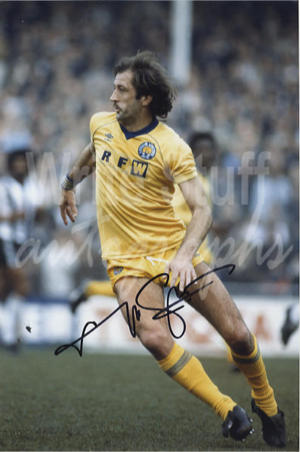
Frankly Leeds

First up, we have Frank Worthington, one of the maverick superstars of the Seventies and briefly a cult figure in LS11. Frank picks up his pension book today, attaining the age of 65 years.  He already had a terrific career behind him by the time he rolled up for a short but spectacular stay at Elland Road, initially with a rescue mission in mind.  Spells with Huddersfield, Leicester, Bolton and Birmingham may not have put any undue strain on the Worthington medal cabinet, but he had a reputation as a fine footballer, for whom the term “flamboyant” could easily have been coined – and as a deadly striker.  Missing out on a move to then-mighty Liverpool was an undoubted low-point in his footballing life – his medical had revealed high blood pressure – but it was still a long and varied career, with eight England caps and two goals for his country along the way – not bad for a flair player in an era of pragmatism.

The deal that brought Worthington to Elland Road was a straight swap, with the late Byron Stevenson heading the other way to Birmingham City. At Leeds, Frank came into a team suffering a prolonged goal-scoring drought which had dragged them deep into the relegation mire. Worthington immediately set about putting that right, scoring the winner at Sunderland and going on to notch a total of 15 goals in 35 appearances for Leeds.  Especially memorable was his contribution to a stunning 4-1 win at Aston Villa, who were only a matter of weeks from becoming European Champions.  Sadly, the team just wasn’t able to string enough results together to save United, who were relegated to Division Two despite the best efforts and goal-scoring feats of Mr Worthington.

Frank started the following season still in the white shirt, and scored a memorable double as Leeds won 3-2 at Sheffield Wednesday.  Soon, however, he was on his way for £50,000 to Sunderland and he went on to appear for pretty much every other club in the league after that, retiring eventually in his early forties – pretty good for a man with a “blood pressure problem”.  Many Happy Returns, Frank – and thanks for the memories.

Image

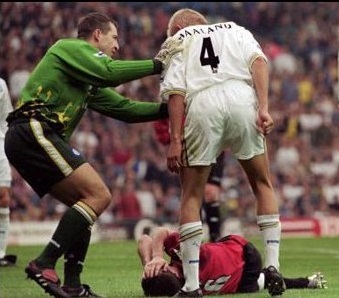
Get up Keane, you big girl

Another Elland Road cult star was Alf-Inge Haaland, a man whose terrific relationship with the fans survived his unfortunate lapse in returning with Man City and scoring a purler of a goal against us.  Alfie was one of those rare players who really “got” what playing for Leeds United was all about.  A passionate performer, he related to the crowd as few others before or since, picking up on their likes and hates and going with the flow of commitment and fight for the shirt.  This was epitomised in his attitude towards Man U – he made no bones of the fact that he disliked the club and their players.  This was particularly the case as regards Roy Keane – a man regularly and inexplicably bigged-up to this day by a fawning media, in the shape of cushion-faced anchorman Adrian Chiles, as a “hard man”. Haaland seemed to view Keane as a coward, claiming that the Irishman didn’t dare look him in the eye.  The nature of Keane’s eventual retribution would seem to bear this out.

In an incident during the United v Man U game at Elland Road in 1997, Keane injured himself attempting to foul Haaland from behind, rupturing his anterior cruciate ligament, an injury which put Keane out of the game for almost a year.  Famously, Haaland had stood over the prone Royston, accusing him of feigning injury so as to avoid being punished for the foul.  Harsh, but funny.  Keane was booked as he left the field on a stretcher, Man U lost 1-0, and a grudge was sparked that would last over three years for payback.  In April 2001, Haaland – by now a Man City player – was fouled by Keane in the local derby, the Irishman going over the ball to stamp on Haaland’s right knee.  Keane was initially punished lightly, but later admitted in his typically over-the-top autobiography that the foul had been a pre-meditated act of revenge.  It was in character for Keane to plan his long-delayed retaliation so as not to risk being hit back; one of his other famous fouls was an elbow to the head of notoriously non-tough little Jason McAteer, when Keane snuck up from behind to launch his assault unseen before running away.

Alfie Haaland, 41 today, is remembered by fans of Nottingham Forest, Leeds United and Man City as the type of player every team needs, one who will give his all and never give up, a professional footballer who comes as close as any to thinking and caring like a fan. For Leeds fans, Alfie’s oft-expressed antipathy towards Man U is enough to guarantee that he remains loved at Elland Road, though he can be magnanimous too.  He bears no grudge regarding Keane’s act of thuggish cowardice, expressing the hope that by now the Irish assistant manager will have grown up enough to set a better example to the players in his charge.  Many happy returns, Alfie.

Both Frank Worthington and Alf-Inge Haaland contributed in their different ways to widely-differing eras at Leeds United, and both are fondly remembered to this day.  Let’s raise a glass to both of them, two great servants who are both a year older today.  Cheers, lads!