Tag Archives: UK Football

Newcastle Might “Do a Leeds”? Don’t Make Me Laugh – by Rob Atkinson

doing a leeds

“Doing a Leeds”. It’s become a 21st Century football cliché or, more accurately, a refrain increasingly tiresome to the ears of Leeds United sympathisers. It’s hackneyed, it’s boring, it’s irritating. Moreover, almost invariably – when applied to other clubs – it’s nowhere near the truth.

What is “doing a Leeds”, after all? Well, it’s no mere common or garden tumble from grace, we can be sure of that. Most teams at some point will happen upon hard times and experience bad days after the bright sunshine of relatively heady heights. It’s a part of the charm of the game, without which things could get pretty boring. Central to the English condition is a love of seeing some smug, sleek success, happy on its pedestal, firstly wobble and falter, and then come tumbling amusingly down. There’s an inner satisfaction in beholding such a humbling of a complacent success story.

So, it’s a common experience, and even enjoyable – to the onlooker. The distinction between your ordinary, everyday descents into misfortune, though, and the phenomenon of “doing a Leeds”, is the height of the pedestal from which the tumble occurs. To “do a Leeds”, you must not just fall, you must fall precipitately, from a great, dizzying height, scattering riches from your pockets as you plunge headlong into the depths of misery, ignominy and despair. You must have experienced the sweetest of success, the heights of popular fame – and you must then be found grovelling, penniless and distraught in the filthiest of gutters, with barely a rag to your back and the authorities hunting you down for a debtors’ cell with beggary to follow. That’s doing a Leeds.

Following Newcastle United‘s latest piteous showing, as they lost 1-3 to Bournemouth to deepen their peril at the foot of the Premier League, some so-called pundits are expressing fears that the Geordies might be in danger of doing a Leeds if they were to tumble through the top-flight trapdoor come May. To such a suggestion, I can only respond thus: what utter, footling rubbish. Balderdash. Piffle. Crap. Newcastle will be miles off doing a Leeds until and unless they’re struggling in the basement of League Two and looking fearfully down the barrel of the Conference. They simply have not risen high enough to be associated with “doing a Leeds”, merely by a Parachute Payment-cushioned relegation to the Championship – not even if they were somehow to drop right through that division into League One.

Leeds United’s plummet from glory to grief was looked at – and, let’s be honest, gloated over – in the light of their historical success within living memory. The triumphs and disasters of the Don Revie years are the stuff of legends; though the Whites never won as much as they could and should have done, nevertheless they became true giants of the game. Widely regarded as one of the very finest club sides ever to grace these islands, Don’s lads were peerless on their day and set the benchmark for all future incarnations of Yorkshire’s Number One club.

Even after a post-Revie decline, which saw relegation and a measure of despair, Leeds were boldly revived and hit the top of the game again under Howard Wilkinson, powered by a classical midfield four of Batty, McAllister, Strachan and Speed. Three years or so after Wilko found Leeds towards the bottom of Division Two, and only one full season after promotion to Division One, Leeds were English Champions again – the Last Champions of the old-style Football League. Yet more immortality for the Whites of Elland Road, and that pedestal of popular fame (or notoriety) was as towering as ever.

The early 21st Century nosedive was all the steeper for the giddy heights from which Leeds were crashing. Financial disaster, gross mismanagement, a spell in the third tier, the reckless squandering of diamonds produced by the ever-fertile Youth Academy – all of this, viewed in the context of the club’s glorious and honour-laden history, made such a sickening decline almost unique in the annals of football history. “Doing a Leeds” therefore entered the sporting lexicon as an unprecedented extreme; it could be used only as a cautionary example, as there are no comparable instances. Smaller clubs have fallen further; comparable clubs have had bad times. But no club has crashed and burned quite as spectacularly as Leeds.

Newcastle United are a big club with a loyal and fervent following. They, too, have had a measure of bad management, and it looks as though their current failings could well lead to demotion this year. They are not so much flirting with relegation as spreadeagled on their backs, begging the Championship to have its way with them. But to suggest they might “do a Leeds” is laughable. Newcastle have been conspicuous over the last half century for their failure to make a mark on the game’s honours roll. Apart from one solitary Fairs Cup in the late sixties, the Toon Army have not troubled the scorers. Their last Championship was back in 1927, the same year Lindbergh conquered the Atlantic in his Spirit of St. Louis; the same year Dixie Dean scored 60 league goals for Everton. It’s a very long time ago. The FA Cup brought more success for the Tynesiders in the fifties – but in the modern era, they’ve been just another club, winning some, losing some, relegated, promoted; but mostly just watching the football world pass them by.

For the sake of Newcastle’s terrific fans, it’s to be hoped that their club never can be fairly said to have “done a Leeds”. A decline of that magnitude from their current status would realistically see them playing in a municipal parks league on Sunday mornings. The trouble facing the Geordies right now are severe enough, without exaggerating the nature of the perils that might lie ahead.

After this disastrous century so far, we at Leeds don’t have a lot left to us, apart from that glorious history and a mass of vivid memories. It’s a lot more than many other clubs have, but we need to keep special to us those things that mark us out as a club that’s just a bit different. The chilling uniqueness of “doing a Leeds” is one of those things that currently define our beloved United, along with the Revie legacy, the Last Champions and the glow of sitting at the top of the League as the Millennium clock ticked over from 1999 to 2000. Let’s not cheapen or demean any of these things by taking their names in vain, or using them inappropriately.

As for Newcastle United FC? Beware, bonny lads. You’re in danger of doing a Wolves.

Why Spend on Players, If You Can Buy Fans So Cheaply? – by Rob Atkinson

Cellino Out2

Cellino – determined to be popular – and ready to pay?

A fair-to-middling Championship player these days is going to set you back somewhere around £15,000 a week in wages. That estimate may even be on the conservative side (by that, I don’t mean a blatant lie, I mean somewhat under the actual level in reality). So, using extremely round and over-cautious figures, you’re probably looking at around 60 grand a month – just in wages.

And the thing is – a player can so easily let you down, by “not fitting in”, or “failing to adjust”. They’re delicate wee souls, these footballers. Expensive as they undeniably are, both upfront and in oncosts, they are by no means reliable. You can easily end up looking a mug, in committing to an upfront million or two, plus three-quarters of a million annually in wages – only for the player concerned to make zero impact on the first team, yet still go laughing all the way to the bank. Or limping, in the case of Chris Wood. There are a number of names for this syndrome, depending on the identity of the club it affects – here at Leeds United, we might choose from Botaka, Sloth or Wootton, perhaps. Any way you look at it, buying players is a deuced risky business, with a lot of money staked against potentially negligible return. If only there was a way of reversing that equation – paying peanuts and yet ending up looking quite good out of the deal. If only.

Leeds United‘s loco owner Massimo Cellino may, according to some reports today, have at least hoped he’d found such a reverse alternative. The gist of the report – which must be taken with extreme caution and a large bar of salt, due to its Daily Mail origins – is that Signor Cellino has hit on the novel wheeze of countering the well-deserved criticism he’s copped on social media by paying some clued-up I.T. type to unleash waves of optimism and positivity on the likes of Facebook. It’s even been suggested that a dedicated Facebook group, named Massimo Is God, or Cellino for Sainthood, or some such, has been set up with the express purpose of singing online hymns of praise to il Duce.

The person concerned, one Scott Gutteridge, has alleged that he was paid somewhere around £500 per month to spin this worldwide web of deceit – something he initially did in good faith to “exert a positive influence”, before belatedly realising that it was all “nothing more than propaganda with the wrongdoings being covered up by the club using the Facebook group to counter arguments”. Leeds United, Mr Gutteridge now concludes, is “a club rotten to the core”. One assumes that, if he ever was on the club payroll, he is now decidedly off it. Massimo might even feel that he’s a right to his money back.

The thing is, people really can be swayed by the incessant outpourings of certain vocal users of social media. That being the case, a nominal £500 a month might be seen as value for a man such as Cellino – who must occasionally think that the world is against him – in terms of the good press it can buy in relatively unregulated areas such as Facebook groups and so forth. Leeds fans are one of football’s larger and more active constituencies on the Internet. An attempt at transforming that healthy constituency into some latterday rotten borough could just reap more bounteous rewards than risky plunges into the transfer market. If you can get away with it, that is.

Let’s face it – at these rates, that sixty grand a month wage bill for Championship player Joe Average could get you somewhere around 120 bought and paid for propagandist/fan type people, all willing to spin away like little dervishes each month, in the interests of making Cellino seem palatable. What price these people put on their souls, if all this has any truth to it, is a matter for them. As a fairly vocal presence on the Interweb myself, my message to Cellino would be: you simply couldn’t afford me, my friend. Not that he’s ever asked, you understand.

Leeds United, as you might expect, has denied that there’s any truth in this story. The Daily Mail, for their part, insists it’s true – you might expect that, too, and with at least an equal measure of cynicism. Mr Gutteridge himself appears to be in the process of being taken to task on the matter in at least one highly respectable Leeds United Facebook group, but his responses are invisible to me for some reason. This means I’ve not been able to access any of his presumably pro-Cellino outpourings. Perhaps some of you, gentle readers, may have more luck.

Whatever the truth of the matter, the tragedy of it all is that you really can’t dismiss it out of hand. Despite the sensational unlikelihood of the allegations themselves, despite the fact that the story originates in the notoriously mendacious Daily Mail – despite all of that, you look at the claims and you think (a) Well, really – you just couldn’t make it up; and (b) Hang on, this is Cellino’s Leeds United. It could easily be true.

Let’s face it, you wouldn’t ever believe it of an Arsenal, or a Liverpool, or even, God help us, a Man U. But it’s Leeds United we’re talking about here, the Damned United, under that crazy, unscrupulous and fraudulent King of Corn. So, sadly, you can’t just laugh it off. The biggest tragedy of all here is that – whether the alleged payment concerned is £500 a month or even a lump sum of sixty pieces of silver – it really could all so easily be true.

Birthday Boy Strachan’s Crucial Rocket for Leeds United Against Leicester – by Rob Atkinson

"Have you ever seen a better goal?  Have you ever seen one better timed??" John Helm, YTV

“Have you ever seen a better goal? Have you ever seen one better timed??” John Helm, YTV

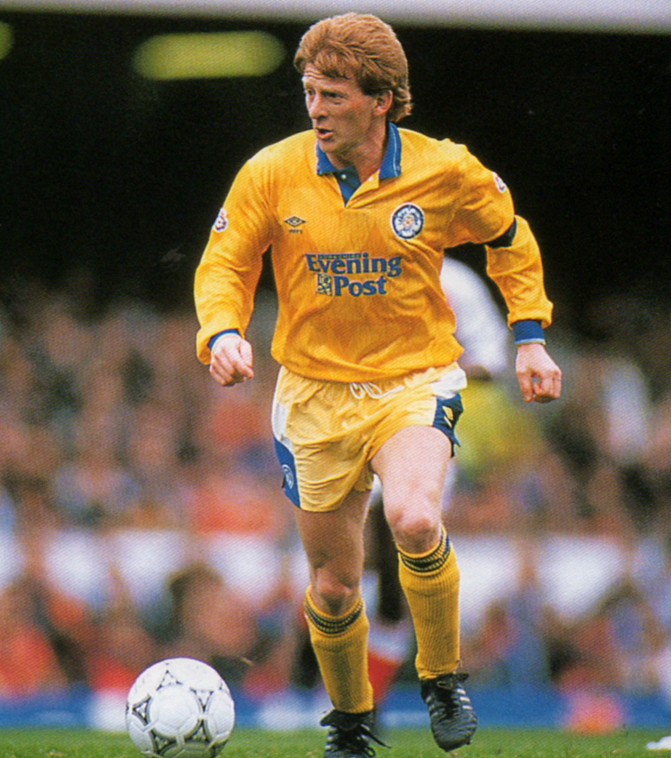
On the occasion of Gordon Strachan’s 59th birthday – and by the way, many happy returns, Sir – I thought I’d look back to what was possibly his defining moment as the man who did more than just about anyone to reinvent Leeds as a post-Revie force in English football.

It had been a long time coming since Don’s Glory Boys dispersed to pastures new and a Golden Era faded into the dim haze of memory. We had been eight years in the second division doldrums and had almost forgotten what it was like to be a top team. But – finally! – it looked as though the nightmare was ending as Sergeant Wilko and Captain Strachan were set to lead United back to the Promised Land at long last. A home fixture against Leicester City was the penultimate hurdle to overcome, and expectations were soaring at Elland Road.

Twelve days before the Leicester game, United had appeared to strike a decisive blow, battering closest rivals Sheffield United 4-0 at Elland Road. But any hope that promotion could be clinched early was dashed over the next two fixtures, a draw at Brighton where the lead was squandered to sacrifice two points, and then a home defeat to a relegation-threatened Barnsley who even then had the ability to put one over on us with an inferior team. So the nerves were jangling for this home date with the Foxes.

Leicester breezed into town with no pressure on them at all as they bobbed about serenely in mid-table, but Leeds just had to win. A victory could possibly clinch promotion; anything else and we would be relying on others to give us that final leg-up – not an attractive prospect. The atmosphere at Elland Road that day was something to behold as 32597 packed the stands and terraces, the Kop a seething mass of bodies, a solid wall of sound. If the weight of support counted for anything, then it seemed Leicester might just as well turn around and go home – but to their eternal credit they fought the good fight and played their part in a memorable afternoon.

It all started well. Leeds pressed hard – this had been their preferred approach all season long. No opponent was allowed the luxury of untroubled possession as Leeds snapped at ankles and harried the enemy, hungry for the ball and well able to use it productively. At their best, United had proved a match for any team in the Division; as ever though it was the off days that had let us down. On this particular occasion, attacking the Kop End in the first half, the forward momentum seemed irresistible. Before long, the overlapping Mel Sterland fastened on to a ball at the right corner of the penalty area and fired low and hard into the net to open the scoring. The overwhelming relief was as evident as the unconfined joy around the packed stadium; surely now United would go on to consolidate their advantage and seal the promotion we’d wanted for so long.

Frustratingly, it was not to be. Despite further pressure, Leeds failed to make another breakthrough before half-time and Leicester – relaxed and pressure-free – were looking more and more ominously like potential party-poopers. These fears solidified in the second half as the away side pressed an increasingly nervous Leeds back, and eventually – inevitably – they drew level. The blow when it came was struck by a rumoured transfer target for Leeds, promising young Scot Gary McAllister. He proved that he packed some punch by belting a fine strike past veteran Mervyn Day to shock the Kop rigid and momentarily silence Elland Road.

Worse was so nearly to follow as McAllister almost did it again, another superb shot coming within an ace of giving Leicester the lead, something which would doubtless have produced the unedifying spectacle of grown men crying in their thousands. It may well be that McAllister sealed his move to Leeds with this performance and those two efforts, but I could have seen him far enough from LS11 that day. Leeds were rocking, looking at each other, scratching heads and clenching fists in the time-honoured “come on, let’s bloody sort this out” gesture. Slowly, by sheer force of will, the lads in White regained the initiative and it looked at least as though the danger of further damage was receding. The football was still nerve-shredding stuff, all urgency and little fluency, a desperate battle to eke out the extra two points that would make promotion so much more likely.

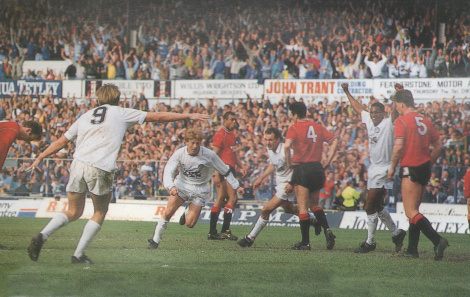
Time was ebbing away fast now, as Leeds hurled themselves time and again into the defensive barrier of red Leicester away shirts. Panic was setting in, the biggest enemy of constructive football. It was looking like a draw, which would not be enough. Then, a throw halfway inside the Leicester half in front of the West Stand, under the eyes of a bleakly worried Wilko. Sterland gathered himself and hurled a massively long throw deep into the away penalty area, only for it to be headed out from around the near post. McAllister attempted to complete the clearance with an overhead effort to get rid, but the ball hit Gordon Strachan to bounce back into the box. And there was Gary Speed to lay that ball back instantly to the still-lurking Strachan who simply lashed it, left-footed, into the net. The ball had gone in like a bullet; Strachan – too tired to control it and try to work a yard of space to dink one of those cute little far-post crosses as he might normally – settled instead for catching the ball right on the sweet spot and it arrowed home to a positive explosion of noise from all around Elland Road – the sudden release of what had been unbearable tension produced a massive roar to buffet the ear drums of innocent bystanders miles away.

It was one of those occasions when several things seem to happen at once. The crowd behind the goal at the South Stand end seemed to boil with passion and relief, a maelstrom of delighted celebration which was echoed across the whole stadium. Strachan himself ran to the byline, face contorted, weary limbs pumping in triumphant exultation as he took the plaudits of the faithful. A lone copper is visible on the TV footage between Strach and the cavorting hordes, a grin on his face as he moves to quell any ambitious pitch-invaders. In the commentary box, John Helm unwittingly propelled himself into immortality, not for the last time that afternoon. “Have you ever seen a better goal?” he demanded. “And have you ever seen one better timed?” It was a good question, and right then, right there, I doubt you’d have found a Leeds fan to answer “yes” to either part of it. The rest was a blur; Leeds held out, and we had won – and seemingly gained promotion. Rumours were flying around that Newcastle had failed to win, sending us up. But John Helm was at it again, more iconic words: “Is that confirmed…?” When the confirmation arrived, it was of a late Toon win; we still had it all to do at Bournemouth the following week. But Strachan’s late cracker had kept us in a race that we were ultimately destined to win.

My final memory of that day is of walking down off the Kop and onto the pitch as the masses there were starting to disperse. We crossed the hallowed turf from goal-line to goal-line, eventually exiting the ground into Elland Road at the south-west corner, where the big screen now stands. I can still remember the heady scent of stud-holed mud and trodden turf, my head was still buzzing as I walked over the spot where wee Gordon had made that perfect half-volley contact to send us all into delirium. It had been an atmosphere the like of which I have rarely seen before or since, only the mayhem at Bramall Lane when Gayle scored that own-goal title-clincher coming anywhere near, or maybe that ankle-busting semi-riot of a celebration when Dave Batty broke his long goal drought against Man City in 1991.

For the sheer relief of it however – the absolute nerve-shredding, tension-breaking release of it – this was definitely THE one. Without Strachan’s sublime strike, we could well have missed out on automatic promotion, and we all know only too well that there’s a law against us succeeding in the play-offs. Gordon’s Golden Goal had kept the dream alive and made possible all that followed up to the League Championship triumph two years later. Make no mistake – it was THAT important.

Thanks, wee man, for the brilliant memories. Have a brilliant birthday.

Happy Birthday to the Last English Champion – by Rob Atkinson

Howard Wilkochamperscap-300x193

Sgt Wilko – Champion

Another Leeds United birthday to mark with an appropriate tribute for all the man did for our great club. This time it’s someone who is a contemporary of those 70-somethings who have celebrated recently – the likes of Paul Madeley, Norman Hunter, Paul Reaney and Johnny Giles – but who was never, by his own acknowledgement, anything more than mediocre as a player himself. In the managerial arena though, Howard Wilkinson – 72 years old today – has outstripped virtually all of the Revie greats, winning the last ever Football League Championship, going down in history as the last Englishman to win the league in the 20th Century and masterminding the second incarnation of a winning Leeds team from a starting point remarkably similar to that which Don Revie inherited in the early sixties.

Wilko’s career after his playing days ended was an upward graph of coaching success from humble beginnings, but he went on to have two stints as caretaker-manager of England, as well as spells with Sunderland, Sheffield Wednesday and Notts County. It is for his time at Leeds United, though, that he will be remembered as a football manager who walked into what had become a poisoned chalice of a job, a club with a revolving door on the manager’s office and one which had signally failed to recapture the magic of its one great period at the top of the game. Wilkinson came in with the air of a man who was going to put a stop to all the nonsense and set matters straight. Let the record show that he succeeded, beyond the wildest dreams of any Leeds fan at the time he was appointed.

In TV interviews at that time, he could be seen by the side of chairman Leslie Silver, regarding his coffee cup with little enthusiasm and mildly joking that he hoped we’d be able to afford better crockery when he got us winning. Leeds were treading deep water at the bottom end of the old Second Division, and had been looking more likely to proceed downwards from that point than up; a situation uncannily similar to the one Don Revie found in 1961. Both men would be able to count on the bounteous fruits of a productive academy, though Revie felt able to blood his precocious youths somewhat earlier than Wilko could in his reign. But where Don found his Bobby Collins, so Howard was able to persuade Gordon Strachan to step down a league and be the catalyst for a revival that may not have been as enduring as Revie’s, but was arguably even more meteoric and spectacular.

Wilko joined for the still fairly new 1988-89 season, and spent the rest of that campaign overhauling discipline at the club and bringing about his own type of working environment. The graph spiked upwards from there. In his first full season, with a batch of good, solid recruits added – and after an uncertain start – Leeds went top of the league and hardly faltered until promotion and the Championship were clinched on a sunny day in Bournemouth. A season of high achievement followed as Leeds swiftly found their feet back in the top flight after an eight year absence. United did far more than consolidate, battling away at the top end to finish an eminently respectable fourth, as well as reaching two domestic semi-finals. The following season was the last of the old-style Football League, and Wilko’s Leeds achieved immortality by winning the Title by four clear points to become the Last Champions. Less than four years after joining a club going nowhere but downhill, Howard Wilkinson had restored Leeds United to the very pinnacle of the game. It had taken Don Revie twice as long to win his first League Title.

While all this had been going on, Howard and his staff had been overseeing the development of an Academy setup which would go on to produce many stars towards the end of the century; many players who are still flourishing at the top level had their start in what was rightly famed as a world-class breeding ground for football talent.

One of the main regrets of the Wilkinson era at Leeds is that he did not survive long enough in the job to introduce these home-grown prodigies into the first team himself. But Wilko’s later years at Leeds coincided with boardroom uncertainty and financial mismanagement, both of which had their effect on sales and recruitment policy. So, we lost a Speed here and a Batty there and the likes of Carlton Palmer and Nigel Worthington came in; the club was reduced to offering pre-retirement homes to such as Ian Rush and David O’Leary. O’Leary it was, after a George Graham interregnum, who gained the most from Wilkinson’s enlightened youth development programme. Looking back, it’s clear that things could have worked out differently – quite probably the seeds of our 21st Century disaster were sown in Wilko’s 1996 sacking.

Howard Wilkinson stands alone behind Don Revie as Leeds United’s second-greatest manager, and probably as one of the more wronged men to have lost his job when so much of it had already been done to ensure the club’s own crop of major stars. As before, Leeds lacked the courage and patience to see it through; but these things are always clearer with the benefit of 20:20 hindsight.

Happy Birthday, Sergeant Wilko – you’ll always be remembered fondly at Elland Road, and your place in the history of English football is secure.

Three Top, TOP Leeds United Away Trips – by Rob Atkinson

We all have our favourite LUFC memories, and many will relate to games away from LS11.  Here, in reverse order, are my three favourite road trips following The Whites.

3. Sheffield Wednesday 1, Leeds United 6 12.1.1992
Image

Sergeant Wilko

This was Sergeant Wilko’s first return to Wednesday since he had quit Hillsborough to become Leeds boss in 1988.  It would also be Lee Chapman’s last game before his season-threatening FA Cup injury, which resulted in the drafting in of one Eric Cantona – with all the long term consequences that would entail.  But Chappy was destined to be sidelined only temporarily, and he went out in the most emphatic style.

There was a crowd of 32228 at Hillsborough, the usual vociferous contingent of travelling Leeds fans rivalling the home crowd for noise from the outset, and completely drowning them as the game went on.  Leeds United were weakened, so it seemed, by the absence of the injured Gordon Strachan and suspended David Batty, half of their legendary midfield Fantastic Four.  Any side, surely, would miss performers of such calibre.  Leeds, though, seemed determined to make light of the problem, and tore into their hosts from the start.  Full-back Tony Dorigo made an early darting run, cutting in from the left and making good progress down the centre of the pitch, before unleashing a right-foot thunderbolt that Wednesday ‘keeper Chris Woods had to tip over.  From the resulting Gary MacAllister corner, Chris Fairclough rose to head downwards, and found Chapman in splendid isolation four yards out; his finish swift and deadly for 1-0.

For a local derby, the contest had been decidedly one-way traffic – Chapman was to send two towering headers just wide before Carl Shutt had a scuffed shot smothered by Woods in the home goal.  Then, a true champagne moment as Mel Sterland fed the ball to Chapman on the right.  In a completely untypical burst of pace and control, Chappy surged between two hapless Wednesday defenders, raced into the area, and unleashed a shot that beat Woods completely, just clipping the frame of the goal to rapturous applause from the Leeds fans at the Leppings Lane End.  I remember thinking at the time that anything was possible now, if Lee Chapman could do something so utterly out of character.  And so it proved as, from a free kick awarded just right of centre some ten yards outside the box, Dorigo stepped up to absolutely hammer a left foot drive past the helpless Woods.  Cue mayhem and cavortings as the Leeds hordes behind the goal, celebrated as clean a strike as you could ever wish to see, the ball a blur as it arrowed into the far corner with deadly precision and power.

At 2-0 down, the home side were making increasingly desperate attempts to gain some sort of foothold in the match.  This desperation was adequately demonstrated when, from a harmless-looking ball into the Leeds area, Wednesday striker Gordon Watson ran in front of Chris Whyte, continued on for another step or two, and then hurled himself into the air, landing in agonised paroxysms of simulation between a bemused Whyte and Leeds ‘keeper John Lukic.  Such obvious fraud and villainy could have only one outcome, and the stadium held its collective breath for sentence to be passed on the miscreant.  Instead – amazingly – referee Philip Don pointed to the spot.  Whether none of the officials had seen the extent of Watson’s ham-acting, or whether they were moved by sympathy for the mauling Wednesday were taking from a rampant Leeds, it’s impossible to tell.  The outcome was the same either way.  Ex-Leeds hero John Sheridan stepped up, saw his penalty brilliantly saved as Lukic tipped it against his right-hand post, and then gleefully belted home the rebound to give Wednesday a massively unmerited lifeline.

This act of base and scurvy treachery required nothing less than a riposte of the utmost nobility and beauty, so we said to ourselves, though probably in more Anglo-Saxon terms.  And, happily, that’s just what came to pass.  Only six minutes after the home side’s ridiculous blagging of a comically unfair route back into the game, Leeds took effortless control again with a goal sublime in both its conception and execution.  Lukic bowled the ball out to Dorigo on the left flank; he sent it first time down the line to Gary Speed, who took one steadying touch before sending a beautiful flighted cross into the Wednesday area.  And there, inevitably, was Chapman, horizontal in mid-air, neck cocked to hammer the ball unanswerably past Woods, the perfect counterpunch to Watson’s knavish low blow.  It was a gorgeous goal, sweeping the length of the left side, taking the entire home team right out of the game, and re-establishing the two goal margin which was the least Leeds United deserved at half-time.

The second half that ensued was simply a story of how a blood-and-thunder Yorkshire derby turned into a stroll in the park for Leeds United.  It seemed as if all the life had been sucked out of the home team – a Wednesday side who, let’s not forget, were unbeaten at home since the opening day of the season, and who would go on to finish third in the table.  So they were no mugs, but Leeds United were absolutely irresistible on the day, and would have hammered far better teams than the hapless, bewildered Owls.

It’s possible that Wednesday were simply embarrassed about that cringe-worthy penalty, possibly they were dog-tired, having been run ragged since the start.  Whatever the case, their heads dropped steadily further and further as the game progressed, and they offered little resistance as Leeds proceeded to throttle the life out of them.  Chapman completed his hat-trick five minutes after the hour, heading in after Speed had struck the bar from a corner.  Poor Speedo was looking the other way, bemoaning his bad luck when the ball hit the back of the net after all, turning his frustration to joy.  Then, perennial bit-part player Mike Whitlow ventured forward, just because he could, and rose unchallenged to meet Rod Wallace’s right-wing cross and head easily over a stranded Woods.  It was left to little Wallace to administer the coup de grâce, striding clear after a shimmering exchange of passes in midfield to dink the ball over the advancing ‘keeper, and put the suffering home side finally out of their misery.  A highly satisfactory awayday slaughter of the Wendies.

2. AC Milan 1, Leeds United 1 8.11.2000
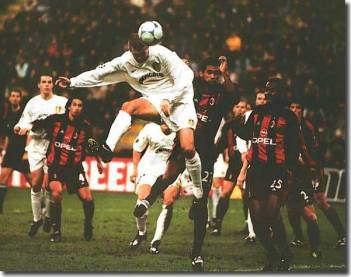
Dom Matteo....Scored A Very Good Goal....In The San Siro...

Dom Matteo….Scored A Very Good Goal….In The San Siro…

This match is so famous that I barely need to recount the action kick by kick.  The Leeds fans at one end of the San Siro were in fully, throaty voice for most of the proceedings, drawing incredulous glances from the attendant Carabinieri who were in full-on riot gear but friendly enough, muttering to each other about lunatic English tifosi (hooligans.)  The first half was a decent contest – Milan were through already, but not disposed to give Leeds an easy ride – especially after paranoid noises emanating from Barcelona, who – nervous about their own prospects – had done their best to warn Milan off taking it easy against Leeds.  So Milan pressed in front of a crowd of 52289, and their winger Serginho was causing Gary Kelly plenty of problems.  In the 26th minute, a slightly soft penalty was awarded to Milan at our end of the stadium, and 6000 Leeds fans held their collective breath as Andriy Shevchenko took careful aim only to rap Robinson’s right-hand post, the ball bouncing away to safety as the masses behind our goal celebrated as if we’d actually scored.  And then, miraculously, as the first half ebbed away, we did score.  A Lee Bowyer corner from the right found Matteo rising majestically at the near post to meet the ball with a punchy header which soared high into the net.  Cue utter pandemonium at the Leeds end as all the tension, passion and belief exploded in one almighty roar which almost lifted the hi-tec roof off the famous stadium.

The party went on throughout half-time and into the second half, drawing more bemused glances from the Italian police; there was only a brief hiatus in the 67th minute when the superb Serginho deservedly equalised, but then it was mounting fan fever again all the way to the final whistle and beyond as Leeds held out to qualify for an equally difficult second phase of the competition.  The scenes after the game are at least as famous as the events of the ninety minutes; the team coming back out onto the pitch in response to the demands of the faithful who were held back in the interests of crowd safety.  What followed was described by respected football commentators (as well as Alan Green) as the best example of team/fan bonding they’d ever seen.  Fans and players – even a certain Chairman – swapped chants and songs in a spontaneous celebration of a joyous night.  Even the uncertain musical efforts of Lee Bowyer were greeted by a blast of friendly derision.  It was a unique experience, and the Latin cops were clearly by now utterly convinced that these English people were absolutely barking mad.  As football nights go, you’d have to travel a long way to find one more worthy of memory – only a trophy could have improved it, but the spectacle of the game and its aftermath is one I have seen imitated but never repeated.

1. Sheffield United 2, Leeds United 3 – 26.4.1992

Jon Newsome, Superstar

Jon Newsome, Superstar

If you’re a Leeds supporter, you’ll have seen the goals from this game hundreds, thousands of time.  It plays through now, all these years later, in the Football Highlights studio of my mind; joy for the home side as Alan Cork, gleaming of bald pate, pokes the ball home to give Sheffield the lead.  Then, a midfield tussle in the swirling wind, as Leeds try valiantly to come back.  A late first-half free kick, which Gordon Strachan races to take before the home defence can set themselves, he finds Rod Wallace in the area who tips the ball past home keeper Mel Rees’s attempt to save, defenders scramble to clear, only to hit Gary Speed who bounces the ball back to ricochet off Wallace – into the net.  Pandemonium in the away end.   Level at half time, we’re breathless with drama and the hurly-burly of it all, raucous with United anthems, nervous of what’s yet to come.

The crazy game continues crazily.  A dangerous ball across the Leeds box is retrieved by home defender and future Leeds man John Pemberton, who turns it back towards the goal-line where Lee Chapman sticks out a leg for an own-goal greeted with horrified stupefaction by the Leeds fans behind the goal and we’re level again.  Then enfant terrible Eric Cantona enters the fray, and within a few minutes he is chasing a loose ball into the Sheffield half, with Rod Wallace scampering alongside and home defender Brian Gayle lumbering back in a desperate attempt to clear the danger.  And it’s Gayle, former Man City man, who finally slays Man United.  From my vantage point at the opposite end of the ground I see him get his head to the ball, and the action is suddenly slow motion.  Gayle has headed the ball, poor Mel Rees is stranded far out of his goal, the ball goes over his head in a slow, slow loop, and bounces tantalisingly towards the unguarded net…

Then I’m watching at full speed from the far end as Cantona and Wallace raise their arms in triumph, wheeling away in delight, and even as I wonder what they’re up to I realise that the ball has nestled in the Sheffield United net.  A red mist descends, and I am utterly outside of my skull and beside myself in delirious joy and fevered madness, looking around me, roaring like a demented bull, face congested with blood, eyes bulging; I grab a helpless wee St John’s Ambulance man by his lapels and scream beer and spittle into his terrified face “Get me some oxygeeeennnn!!!  I’m going to have a heart attaaaack!!!”  The mad moment passes, I drop the ashen medic and some measure of sanity returns, but we’re still cavorting and diving all over each other, a seething, sweating mass of Leeds, because we know it’s over, we know that Sheffield are beaten, and we know that Man U don’t have an earthly at Anfield, not a prayer.  We were going to be Champions; on that windiest and gustiest of days, a Gayle from Manchester City has blown the Scum away and decided in an instant the fate of all three Uniteds from Manchester, Sheffield and Leeds.

And so, of course, it panned out.  Later I watched mesmerised on TV as Liverpool beat a demoralised Man U, Denis Law and Ian St John trying to put a brave face on it, Elton Welsby’s foot bobbing away in thwarted anger as the script turned out just as none of them wanted.  Ian Rush scored his first ever goal against Them, and it was settled late on as Man U concede a second.  “And now the title goes to Leeds without any doubt at all” intoned Brian Moore in the ITV commentary as I sat there with tears of joy streaming down my unashamed face.  Gary Lineker had called into the studio earlier to complain that Rod Wallace’s goal had been offside (it was).  St John and Moore bemoaned that Man U had had no luck at all, and Welsby ground his teeth in the studio as the Man U fans outside hurled abuse at him, heedless of the fact that he shared their bitter disappointment.  All was frustration in the media and the rest of football and Leeds fans everywhere utterly failed to give a toss.  My finest hour as a Leeds fan, and my greatest ever awayday.

-oO0Oo-

Two from the same season, and one abroad that was “only” a draw – but each had a special appeal for me among the many away games I’ve seen.  I could have chosen so many others, going right back to my first ever away game, a 3-1 League Cup win at Bolton in 1977.  Still in the League Cup, there was that 6-0 win over Leicester City at Filbert Street, on a night when Robbie Savage never gave up, but proved that he was even worse than we thought.  How could we have known that he’d be worse yet as a pundit?

The golden memories are so many, I could possibly have managed a top ten quite easily.  I’d love to hear which away games others rank as their best memories.
Byram Is a Realisable Asset, NOT a Leeds United Necessity – by Rob Atkinson

Boy Wonder Byram

Boy Wonder Byram

Everywhere you look within the Leeds United blogosphere at the moment, people are gnashing their teeth, tearing their hair, rending their clothes and exhibiting other biblical signs of anguish and angst – and all over one slip of a lad. Sam Byram was an unknown to 99% of the support three short years ago. Then he had a dream pre-season, started off the Championship campaign in the first team – and stayed there, producing displays of a maturity and confidence far in excess of his tender years.

Naturally, being Leeds, this seeming success story is a double-edged sword. The presence of a boy wonder in the first team (otherwise known in LS11 as “the shop window”) more usually produces feelings of rampant insecurity among the Leeds faithful, rather than the warm glow that should accompany the sight of a youthful prodigy in the famous white shirt. We know our place in today’s scheme of things, and it is very much that of “feeder club”. Each successive hero has played his way into our hearts, prospered briefly in front of our adoring eyes and then departed for pastures greener, or more likely Canary yellow, with no sign of any adequate replacement.

It’s happened with Beckford, Howson, Snoddy, Becchio and Uncle Tom Cobleigh and all.  Local hero status is no protection from the Lure of Elsewhere. Howson supposedly had Leeds tattooed on his heart, but it seems to have been erased easily enough, and our last sight of him was as he wheeled away after scoring a winner against us. Byram could so easliy have followed the well-trodden path out of Elland Road a year ago; Southampton, awash with Liverpudlian money from their fire sale of last summer, were rebuffed after an offer of £4.5 million or so for Byram – but there are now rumours that more serious suitors might be willing almost to double that sum.

Sam is quite possibly the jewel in the crown of the Leeds Academy production line. Despite an injury-affected and form-blighted last year or so, he really is that good. It’s natural then that worries over his short-term future should be particularly unwelcome at a time when a maverick owner and the latest in a long and dismal line of “head coaches” are supposed to be building for the club’s eventual re-admission to the Promised Land of the Premier League. But really – should we be worrying at all?

We need to take a long, hard look at what is necessary to get us out of this division in the desired, upwards, direction. That list will include strikers who know where the goal is (Chris Wood?) and are proficient at sticking the ball therein; midfielders and wingers – all very much according to the prescription of our former gaffer Dr. McDermott, who had seen this treatment work wonders at Reading. We also need tough, all-action ball winners who are preferably not in the superannuated class (Tom Adeyemi??), and a solid defence who will be mean enough at the back to make sure that increased productivity up front results in a net force taking us a lot higher up the league.  What we probably don’t actually need, and won’t until it’s time to start plotting our approach to the top flight, is a potentially world-class performer on the right flank. It’s superfluous to our current requirements; we’re casting pearls before swine.

It would be OK, of course, if Sam did stick around.  It might even be better for the lad himself – too many fledgling superstars have gone up a level and struggled to stay afloat, look how Fabian Delph initially struggled at Villa.  He’s only now beginning to look the player that seemed likely to be evolving under the guidance of Gary McAllister – and he may be about to disappear into the black hole that is the fringes of City’s 1st team squad.  Byram might well benefit from another season at least of learning his trade at Leeds, or so the conventional wisdom goes. 

Looking at things realistically though – if there WAS an offer of £8 million for the youthful and richly promising Sam, and if that £8 million were to be made (don’t laugh, now) available for the construction of a team that would challenge strongly this season – might not that be a good option for Leeds? It’s the kind of money that, as was said about the fortune we mugged Fulham out of for McCormack, could easily fund the four or five quality additions that we realistically need to propel us into the very top echelons of the Championship. Whether such investment would actually be made is, of course, another matter entirely – but that still doesn’t make the case for hanging onto a valuable, possibly wantaway player. Once promoted, it’s a different ball game, but in the here and now the priority is actually getting there, and a lavishly-gifted Byram in a team consisting otherwise largely of uninspiring plodders doesn’t look like being enough to realise the dream.

A lot will depend on the attitude of the lad himself, and historically no sentimental feelings of attachment to the club that has nurtured their talent have persuaded previous uncut diamonds to hang around and be polished at Elland Road. So if Sam wanted to go to a Premier League club, would we, could we, should we, stand in his way?  My view is that you don’t sacrifice a lad’s ambition and desire to mix it with the best, on the altar of narrow club interests – such a policy is liable to blow up in your face, leaving you with a disaffected and depreciating asset on your hands. No, if Byram does want out – especially as his current deal is fast running down – we’re better off gritting our teeth, securing the very best deal for Leeds United – don’t forget that sell-on clause, Massimo! – and getting on with reinvesting the loot in a team that will do the job at this level. We can leave worries about how we cope in the Premier League for such time as it becomes a live issue, rather than the distant prospect it is right now.

We need to cast off that “Feeder club” image as the mortally humiliating insult it is. We Are Leeds, after all. But in order for that to happen, we may need to embrace the unwelcome label in the shorter term, and speculate to accumulate. And at least these days we seem of a mind to drive a very hard bargain, unlike previous years when the attitude has been disgustingly meek and humble as we accepted pittances for valued assets. If the departure of Sam were to provide the funds to finish the job, then that sad loss will turn out to have been a worthy sacrifice.

The ugly truth of the matter is that a stubborn desire to keep a luxury we can’t afford, and frankly don’t really need in our current situation, could turn out to be the ultimate example of short-termism, to the detriment of our longer-term prospects of life at the top.

Bradford Fire Disaster 30th Anniversary – by Rob Atkinson

Image

Horrific scenes as the Bradford main stand burns fiercely

30 years ago today, I went to watch Leeds United play at St Andrews, Birmingham City‘s ground, in order to support the United lads, who still had a faint mathematical chance of promotion. These were the bad old days, when football violence was still highly fashionable, and it was predictable that things would get out of hand given the slightest excuse. Well, Leeds went one down, it was a crap game, and get out of hand things certainly did. There was a mass riot, invasions of the pitch from both sets of supporters, police horses tried to get between the warring groups and general mayhem ensued for quite a time. Inside the ground, a 12 foot wall collapsed and a young lad was crushed to death. It was a tragedy of the times, crowd disturbances were commonplace and only 18 days later, trouble at the Heysel Stadium in Belgium would cost the lives of 39 Italian fans as the European Cup Final between Liverpool and Juventus was fatally marred by ugly scenes of violence.

As the Leeds fans emerged from Birmingham’s ground though, we were totally unaware that an event had been unfolding back home in Yorkshire that would cost 56 more lives, leave hundreds injured and traumatised and form another catastrophic part of that dreadful month of May 1985. At Valley Parade, the antiquated home of Bradford City, a fire had broken out in the main stand, a ramshackle construction of timber with an oft commented-on build-up of litter beneath the wooden seats – a calamity waiting to happen. On that Saturday afternoon, as spectators packed the old stand to greet their promotion-winning Third Division Champions, the calamity did happen, and with unbelievable speed and ferocity.

At about 3:40 pm, ITV commentator John Helm noted that there appeared to be a small outbreak of fire in the main stand. Within four minutes, on a dry and windy day, the fire had engulfed the whole of the stand, trapping many in their seats. People dashing to the back of the stand for fire extinguishers found none – they had amazingly been removed for fear of vandalism – and the fleeing crowds were forced to break down locked exits in order to escape. Others escaped forward onto the pitch, and within the burning stand there were acts of outstanding heroism as some people tried to assist those less able, without regard for their own safety. The design and build of the ancient stand conspired in its swift destruction; the roof was of wood covered with tarpaulin and sealed with asphalt and bitumen. The whole structure was, in effect, one big incendiary bomb which had been waiting to go off for years.  Now, a single lighted match or cigarette, dropped under the seats onto the accumulated litter below, had started a conflagration that raged out of control before anyone could summon help. It was a miracle, aided by the selfless bravery of many of the spectators who rescued their neighbours, that more weren’t killed.

As it was, 56 deaths and hundreds injured left its mark on the game, and rightly so. The Popplewell Inquiry led to the introduction of new legislation to improve safety at sports grounds, and construction of new stands from wood was banned at all UK sports venues. Thankfully, the death toll had been somewhat limited by the absence of perimeter fencing around the pitch, a lethal factor in the 96 deaths at the Hillsborough disaster 4 years later. Bradford City’s ground now is unrecognisable from the ramshackle stadium I remember as a student in the city in 1981, when I attended a League Cup tie against Ipswich and marvelled from the open Kop at the sheer age and dilapidation of the wooden stand to my right. A magnificent state-of-the-art main stand now crowns the development which has taken place on all four sides of the arena – a credit to the City, to the Football Club and to the memory of those fans who died – 54 from Bradford City and 2 from their opponents that day, Lincoln City.

Later that year, in July, I attended a Bradford City memorial game at Elland Road when the majority of the 1966 World Cup Final teams, England and West Germany, turned out for a rematch. England won again, 6-4 with Geoff Hurst scoring another hat-trick, Uwe Seeler scoring a quite magnificent goal at the Kop End, and the late Alan Ball notching for England too, as did Martin Peters – the other Three Lions scorer in ’66. England were captained by the late, great Bobby Moore, and our own Jack Charlton appeared with lesser-known brother Bobby. It was a wonderful occasion and a fitting tribute to the dead and injured of the Valley Parade fire, raising many thousands towards an eventual total of £3.5 million for the Bradford Disaster Appeal Fund.

On this pleasant late spring day, when the memories of that awful summer of 1985 are receding further and further into the past, let us pause and remember those who died this day 30 years ago, as well as the victims of the Heysel Tragedy – and not forgetting young Ian Hambridge who died when that wall collapsed at St Andrews while football fans unknowingly rioted all around. Ian would be 45 now; he and 56 others at Bradford were robbed of their lives by the events of the day. Rest in peace, all of them – and let’s be thankful that we’ve seemingly moved on from that dark period in football and stadium history.

Sunderland v Newcastle Rivalry Not in Same League as Leeds Against Man U – by Rob Atkinson

Hate Man Utd - We Only Hate Man Utd

Hate Man Utd – We Only Hate Man Utd

Football rivalry – the antipathy between fans of rival clubs with a keen edge of hatred in extreme cases – has been going on for as long as two teams of eleven players have gathered together to dispute possession of an inflated bladder over a green sward. And I will proudly say here and now: Leeds United is an extreme case. We are top four material when it comes to despising our foes. But we like to think we’re quite picky about it. None of this “regional rivalry” nonsense for us.

Let’s face it, hating another team and its supporters for mere reasons of geographical proximity is pretty silly. I can understand it to a certain extent where two clubs share a very small area, like a town or adjacent districts of a city. There’s a territorial thing going on there that recalls the days when a team’s support was derived largely from its immediate locality, though that’s not really the case any more now with the mega clubs who have fans all over the world. After all, why would a Man U glory-hunter in Singapore or Seattle really care if Man City are based only a few miles away from “his” club? He’s more bothered as to whether or not his favourites can buy more trophies than anyone else, City, Chelsea, Arsenal, anyone.

At Leeds, hatred tends to be reserved for those who have earned it, and who are – by independently verifiable standards – intrinsically despicable. Man U pass both tests with flying colours, and it’s certainly woven into my DNA to detest them. Call me a blinkered bigot (guilty, m’Lud) but I can never really understand why Sunderland and Newcastle, who meet in derby-day combat this afternoon, share such mutual loathing when quite frankly both would be better off directing their energies towards hating someone who deserves it.

Many at Leeds have the time and energy to revile other clubs, Chelsea prominent among them. The Ken Bates era at Leeds was an uncomfortable time for these types in particular – they hated Bates for his Chelsea connections (I hate him too, but mainly for his own not-so-sweet self.) Bates never seemed keen on Leeds either, not since – during his reign at Stamford Bridge – a group of freelance demolition contractors from Yorkshire travelled down to SW6 and saw off his scoreboard. But for me, Chelsea (and Man City, Arsenal, Liverpool and the rest) are only relevant insofar as they have teams that can beat Man U for much of the time, and as long as they do that, they’re just fine and dandy as far as I’m concerned.

In Yorkshire the situation may best be summed-up as follows. All other Yorkshire clubs hate Leeds United, and Leeds United regard all other Yorkshire clubs as beneath our notice – except on those annoying occasions when temporarily reduced league status means we have to soil our boots by playing them. This attitude does nothing, of course, to endear Leeds to the likes of Bratfud, Barnsleh, Uddersfailed and the Sheffield dee-dahs – but really, who cares?

I have more respect for fans of clubs like Birmingham or Everton or – yes, even Man U, who hate Leeds for reasons other than just sharing a county with us. That fits better with my world view. Ask a Newcastle fan why he hates the Mackems, and he might blither incomprehensibly for a while (well, they just talk like that up there) – but no rational reply will emerge. I could talk your ears off about why I hate the scum, and I know many Man U fans who can do the same when invited to say why they hate Leeds, which is more than many other Leeds haters can say.

The fact is – whatever the pious purists and holier-than-thou types might say – there’s nothing wrong with football hatred, properly expressed and stopping comfortably this side of actual violence – as I’ve previously written here. It adds some passion to a crowd and to a football occasion, and football would die a lingering death in the sort of sterile atmosphere some of these self-righteous hypocrites seem to want. All I’d say is: if you must hate, then hate for a good reason.

Read my other articles, and you’ll find my reasons for hating Man U – the reasons why I firmly believe anyone might reasonably hate them – are a regular feature in the occasional rants to which I’m prone. They’re nothing to do with why Southampton hate Pompey, or why Forest hate Derby (although I CAN see the Clough factor in the latter case.) Pure regional tribalism is at work there, and I suppose there’s a place for it. But that sort of thing is slightly irrational to me, while hatred based on facts and history is not. Hatred is a genuine human emotion, and the football variety is a safety valve which is useful in diffusing a lot of the negative emotions in society at large. It’s a therapy of sorts. So chew on that, you pious, pseudo-intellectual gits who preach at rabid football fans and utterly fail to understand what’s going on.

I’m happy to admit that I have a healthy hatred for the scum, and I’m equally happy that it’s so lustily reciprocated – with any luck the depth of these feelings will see the game of football, still so dependent on the atmosphere generated by its match-going followers, survive for a good long time to come.

The Top Three Leeds United Transfer Rumours Ever – by Rob Atkinson

Image

Well, another transfer window is flapping wide open in LS11 just as it is in less crisis-torn football outposts and, embargo notwithstanding, a couple of Serie A fringe performers have breezed into Elland Road and signed for Leeds. Possibly there are more to come, maybe an outgoing or two as well. It’s certainly different, in a good way too, from some of the depressingly inert United transfer markets of the unlamented Bates era – but it hardly compares with the wheeling and dealing we did in more halcyon days. And, if anything, some of the rumours that never came to fruition down the years were more exciting and entertaining than certain signings that actually did happen (take a bow, Messrs. Sharpe & Brolin).

There have been so many players linked with transfers to Leeds United over our chequered history and, in the nature of these things, only a small proportion ever actually pulled on the famous white shirt.  Of those who never arrived, it would probably be easy to name at least two world-class International sides comprising players who were rumoured to be signing for United, but missed out on that pinnacle of honours and finished their careers tragically unfulfilled – apart from the odd cartload of silverware. The likes of Tomáš Skuhravý, Rainer Bonhof, Peter Shilton, Trevor Francis and even Dean Saunders have all, at one time or another, been tipped as Leeds United players, only to remain trapped in dreadful anonymity at the likes of Liverpool, Bayern Munich or Nottingham Forest.  Here – in time-honoured reverse order – are my top three exciting but unrealised rumours – you may well have candidates of your own, so please feel free to comment.

3. Duncan Ferguson
In 1994, it really did look as though this one might happen. The wonderfully talented if ever so slightly thuggish Scottish Imagestriker, looking to move south to England from then mighty Rangers FC, seemed nailed-on for a transfer to Leeds in the region of £4million, but ended up at Everton where he prospered before moving on to Newcastle.  Ferguson had a bit of a “reputation” on and off the field as a nutter – in fact he did time in Barlinnie for over-generous use of that nut in a dispute with Raith Rovers defender John McStay.  A little prone to over-exuberance when he’d had a drop or two (he was known as Drunken Ferguson or alternatively Duncan Disorderly) he had previous convictions for nutting a policeman and punching and kicking a supporter on crutches. Nice.

2. Peter Beardsley
This was one of those “definitely happening, mark my words and get your money on it” rumours Imagethat you’d have so loved to be true.  Beardsley was a wonderful player, class, poise and jinking speed all rolled into one dynamite package of energy and skill. I’d first noticed him in rather abbreviated TV highlights of a Cup game he played for Carlisle United, when he stood out as the real deal among a load of dross.  After a spell in Vancouver, he moved briefly to Man U – but the other thing about Beardsley was that he was such a nice, modest guy – not really the type of player for the Theatre of Hollow Myths at all.  Leeds could have signed him whilst he was at Vancouver – Peter Lorimer recommended that they do just that – but we couldn’t raise the cash (some things never change).  Beardsley made his name at Newcastle, in the same side as a veteran Kevin Keegan and emerging Chris Waddle. From there, a big money move to Liverpool, and it was whilst unaccountably out of favour at Anfield that the Leeds rumour surfaced again – he was buying a house locally, he’d been seen at Elland Road – there really did seem to be something in it. Sadly, Beardsley was The One Who Got Away – Twice.  A great shame, as any club would have been improved by the addition of Beardsley, a phenomenal talent you could have built a team around.

1. Diego Maradona
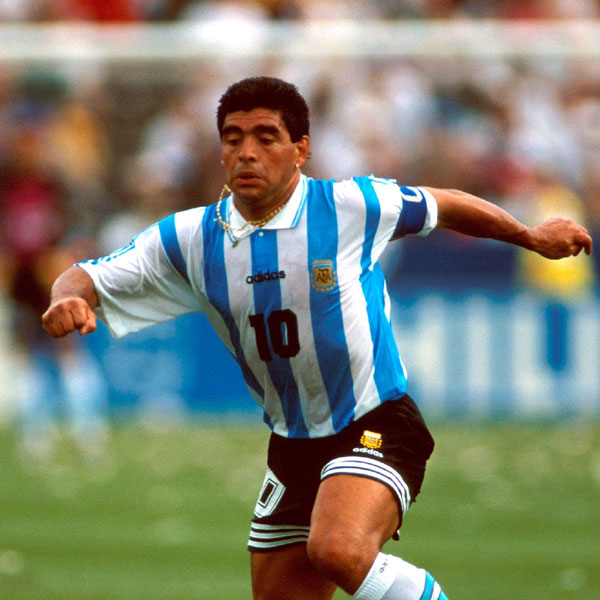
Surely the craziest rumour ever, bar none. In 1987, Leeds had just missed out, under Billy ImageBremner, on an FA Cup Final and promotion to the top flight in the first-ever play-offs. We were doomed to a hangover season in 87-88 and the fans’ mood and expectations were dulled. Then sensational whispers emerged that managing director Bill Fotherby, a larger-than-life used-car-salesman of a bloke, had managed to persuade the agent of Diego Armando Maradona to enter into talks with Leeds United over the proposed signing of the Argentine superstar. This was only just a year after Maradona had just about single-handedly (geddit?) won the World Cup for the Argies, and his stock could hardly have been higher on the global football scene. Strangely, he had very nearly signed for Sheffield United as a youngster, and for a measly £250,000 at that. The Blunts got Alejandro Sabella instead, who actually did end up briefly at Elland Road. But Maradona was different – astoundingly different to just about anyone else – people compared him favourably to Pele. He was even compared – unfavourably, and by the ever modest and unassuming George Best himself – to self-proclaimed greatest player ever, G. Best. It was a signing that was never going to happen, and surely the Number One Daft Rumour of all time.

-o0o-

It’s tempting to wonder how the history of Leeds United might have differed if we’d signed Trevor Francis and Peter Shilton in 1974, or Peter Beardsley in 1990, or even the “Hand of God” himself in 1987. The story of any major club is littered with “what ifs” and this certainly applies to our beloved Leeds. Of course our sights are set lower these days – although we’re now roughly about where we were in ’87 when an enterprising director started that Diego rumour, with a view to putting us back on the map.

Perhaps somebody in the Elland Road corridors of power will try to get the excitement going this time around with an audacious loan-with-a-view-to-permanent swoop for the undeniably promising prospect Lionel Messi? Watch this space…

Leeds’ Master Blaster Tony Yeboah – Which Scorcher Was His Best?

Tony "Master Blaster" Yeboah

Tony “Master Blaster” Yeboah

Mention the name Tony Yeboah to any Leeds fan – in fact to any football fan with a memory long enough to stretch way back to the mid-nineties, and you can bet that a faraway look will come into their eyes, and they’ll say “Ah, yes – that incredible goal against Liverpool.  Goal of the season, that.”  It’d be difficult to find anyone to argue the point.  But as a fanatical Leeds United fan who has a very special place in his Hero File for Anthony Yeboah, I’m going to try.

The Liverpool goal certainly was a brilliant technical piece of finishing; volleys from outside the box against a class goalkeeper invariably have to be.  At Leeds over the years, we’ve been lucky enough to see a fair few of these bazookas, and Yeboah’s late effort against the Anfield men stands comparison with any of them.  The fact of the goal being at the Kop End of Elland Road was of some assistance to the spectacle, but any way you look at it, this was a hell of a strike.  It wasn’t the first goal of this type in front of the Leeds Kop and against the Reds though.  A few years before, Gary MacAllister, a future Anfield hero, scored another fizzer, the ball being played to him in mid air from the left; he let it go across his body before wrapping his right foot round it to thunderous effect, the ball scorching into the net before the ‘keeper (the same David James beaten by Yeboah) could even move.

Yeboah’s strike though was probably marginally better.  It came from a headed knock-down forcing the Ghanaian to adjust his body shape slightly as the ball descended towards him, and he caught it so sweetly and with such ferocity that James was probably slightly lucky he didn’t get a hand to it; broken wrists have been known in similar situations.  It was a violent, arcing shot, the ball dipping slightly in its trajectory and just clipping the underside of the crossbar before bouncing down to rest, relieved, in the back of the net.  David James can perhaps count himself unlucky to have been beaten by two of the finest volleys I’ve ever seen at Elland Road, then again he might reflect they’d probably have beaten any two keepers on Earth.

The thing is though – tie me up and burn me for a heretic, but I don’t think Yeboah’s howitzer against Liverpool that balmy August night was his best goal for Leeds.  In my humble opinion, that came a few weeks later at Selhurst Park, temporary home of Wimbledon FC, when the phenomenal Yerbugger struck an even more vicious blow.  Reliable witnesses, standing close by as the man from Ghana hit his shot, swore blind that they actually heard the ball squeal in pain.   I am supported in citing this strike as Tony’s best by Guardian writer Dominic Fifield who, writing in 2011, saw it as his favourite Premier League goal.  He described it thus:

“Watching the ball cannon up from a series of scrappy headers and attempted clearances clearly tested the Ghanaian’s patience. Yeboah snapped on to the loose ball, controlled it on his chest then instep, exploded away from an opponent and lashed a glorious half-volley in off the underside of the bar from distance. It is the ferocity which is most impressive; a blistering effort.”

Sadly, I only saw this goal on television, though I’d planned to attend the match at Selhurst as I was due to be in London that weekend.  Four days previously though, I’d seen a pallid performance against Notts County in a 0-0 League Cup draw – and I just thought, well sod it, I’m not wasting my London time and money watching that sort of crap.  So I was exploring the delights of Selfridges when Yeboah broke Sky TV’s velocity-measuring equipment, and serve me right for a lapse of faith.  At least my wife found it funny, but I was understandably not amused.  Leeds won 4-2 as well, with Yeboah completing a hat-trick, and Carlton Palmer scoring a goal that might well have been Goal of the Month any other day, but which paled into insignificance next to the awesome might of Yeboah.

There are several YouTube videos devoted to paying tribute to Tony’s goals in his too-brief stay at Elland Road, and I’d heartily recommend a search, they’re well worth watching over and over.  I’d be interested to know what others think – I suspect that most will feel his effort against Liverpool was the best; it was a late winner after all, and scored in front of a packed Kop.  I should think this really, because I was actually there, stood right behind the line of the shot as it ripped past the startled James.  But I just can’t help harking back to what I think was an even greater goal, albeit in humbler surroundings.  How I wish that I’d been there for that one.  Tony Yeboah: thanks for the memories – and a belated Happy 48th Birthday from last Friday.