Tag Archives: FA Cup

Just As Things Seem Bleak, Moyes’ Man U Cheers Up Leeds Fans – by Rob Atkinson

Image

Moyes – just not scary enough

There’s a new factor in play this season – something that can cheer you up, relieve the pain of a defeat, make things seem brighter in dark hours.  It’s a beautiful thing, a gift from divine providence – the kind of phenomenon that can make you believe that there is some benign quality to whoever it is that’s running things in this crazy world.  It only really applies to football so far – but maybe it’s the kind of thing we need to act more generally in a country suffering under the cosh of the coalition.  But it’ll do for the moment – it’s certainly made me feel better.  The name of this feel-good factor?  It’s David Moyes’ Man U.  What a wonderful Man U manager Moyes is making.  Long may he reign.  Today, his latest gift to me is a last-minute defeat at home to Swansea, knocking the media darlings out of the FA Cup – and a tasty red card into the bargain.  Delicious.

I’m not being wise after the event here.  I am on record as predicting that Moyes would not be able to carry off the Fergie act that brought Man U far more success than their various teams’ qualities merited.  It looks very much as though I was right as a veritable dynasty – albeit one founded on fear and oppression – is fading away, and we can but hope it will be replaced by something more admirable.  Yes, Arsenal, I mean YOU.  But the main thing is that the Evil Empire appears to be on the wane.  I thought that a failure to qualify for the Champions League was too much to hope for, but it looks as though even this may well be about to happen.  And if it does – then the shift in power at the top of the game will be of seismic proportions.

For a Leeds fan, the current problems afflicting Man U come as balm in Gilead.  For many years now, the state of our club has been a matter for concern and occasionally despair.  The odd calamity for Man U came as an infrequent but welcome relief from this pain.  Now – even at a time when disasters like Rochdale can happen, the comical collapse of the edifice Fergie built on foundations of threats and bullying, acts to cheer the soul of anyone with Leeds in their heart.  It’s a tonic, it really is.  At a time like this when the Leeds team is misfiring but there appear to be exciting developments off the field, this latest flop by the Pride of Devon has come like a ray of sunshine on a stormy day.  Believe me, I’m not ungrateful.

There’s quite a lot of this season still to go, and it is of course possible that – with the help of the usual outside forces – Man U may yet struggle back and secure at least a top four place to save themselves from meltdown.  And yet it’s difficult to see how even a return to form for the likes of Howard Webb can see them overhaul any of what are looking like the natural occupiers of those top four places, City, Chelsea, Arsenal and Liverpool.  All look streets ahead of Man U so far – and below that fantastic four, there are the not inconsiderable merits of Spurs and Everton.  Both of these latter two have won at the Theatre of Hollow Myths this season, and both would currently back themselves to finish above the ailing and seemingly plastic champions.

For a Leeds United fan such as myself, this was shaping up as a weekend to be crying into our beer and staying inside to sulk.  Thank you Swansea for your help and what you’ve done to the myth today.  Thank you Mr Moyes for essaying a Fergie-Lite style of management that appears to be working just as we anti-Dark Side sympathisers might wish.  Most of all thanks to the Man U owners for such an enlightened appointment.  Stick by Agent Moyes; hopefully he has much more to achieve yet in the dismantling of Man U.

Leeds Humbled in Cup: The “Soccer Saturday” Experience – by Rob Atkinson

Merse at the back, looking “fick”

So, it was FA Cup time again – a competition where we’ve actually done OK these past few years, as a bit of light relief from generally mediocre league form. This year, the Cup Magic was to be non-existent, the Cup run very short and not so sweet. Out we went, humbled by League Two Rochdale, of whom it must be said: they deserved it. 5-0 would hardly have flattered them. Leeds played like a side who felt they had only to turn up to win; the thing is, they didn’t really even turn up.

But are we downhearted? Well, yes – some of us are. But not me. I’ve grown out of disappointment at cup exits. They’ve happened every year, twice a year – sometimes more in really good seasons when we’ve qualified to be beaten by some continental team – for all of the forty-odd years that I’ve actually cared. You become immune – and that helps, especially when our league status argues that we’re never going to have a chance of winning the bloody thing anyway. Let’s worry about cups when, on form, we should beat pretty well anybody. When those days return, the cups will look a lot more likely and a lot more attractive.

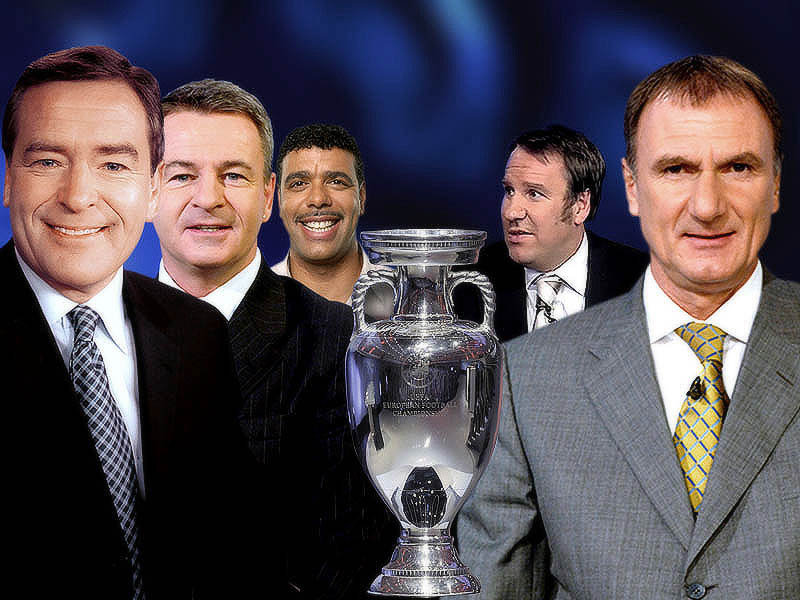
Today, without a match ticket and with no live TV coverage, I gave myself over to the tender mercies of the Sky Sports “Soccer Saturday” team.  It was an enlightening experience, confirming for me that, yes, we played terribly and that, yes, they still hate us.  We’re still the Damned United.  At one point, Jeff Stelling told us that he’d been told to stop referring to us as “the Mighty Leeds”.  He didn’t say by whom – I had it narrowed down to Phil Thompson (still bitter over some ribald jibes at his Manilowesque nose from the Gelderd End back in the day) and Paul Merson who, as the token Fick Cockney, simply doesn’t know any better.

Stelling got more excited as the afternoon went on, returning frequently to Spotland for reassurances that Leeds weren’t threatening to get back into the game (we weren’t, either).  His references to our glorious Cup history, for the purpose of contrasting today’s dismal display, seemed a little forced as we’ve only won it once – 42 years ago.  But Jeff wanted this to be the Marquee Giant-Killing, and he bigged it up accordingly.

It’s not as if there weren’t other shocks.  Villa lost at home to third division Sheffield United, much to the joy of their Cup-hating manager Paul Lambert.  Donny lost to little Stevenage – and the excitement of this game was enough to bring on earache, as the reporter at the Keepmoat was one John Gwynne.  He has one of those “rich north country” voices which sound like a goose farting through a foghorn, and many were the updates he loudly bawled, with scant regard for the sensitivities of the more delicate viewer.

Soccer Saturday sets its stall out to entertain as well as inform – which is presumably why they employ clowns like Merson (How’s it going Merse?  Still free-nil, Jeff.)  One of their comedy themes lately has been the appalling record of Hyde in the Skrill Premier League.  They’ve gained only three points all season and have a goal difference of minus 51.  Today, they lost 4-0 at Gateshead – one of their better results of this campaign.  But on this FA Cup day, the chance was missed to mention that Hyde are record breakers themselves, having once lost 26-0 to Preston in the 1887-88 competition.  Surely, they could have got a bon mot or two out of that?  But no, sadly they were too ill-informed – unless I missed it in listening out for a Leeds recovery.

Back at Spotland, it was becoming ever more obvious that our beloved United were merely going through the motions and that the mighty Rochdale were having it easy.  A richly-deserved second goal arrived, and we were well and truly Out – much to the malicious satisfaction of the United-Damning hacks in the Sky studio.  The Leeds fans packed behind the goal at Rochdale’s ground took it all in good part.  “We’re shit, and we’re sick of it,” they bellowed, displaying a keen sense of observation as well as a powerful collective ability to convey angst.  Sad to report, they gave Brian McDermott a pretty frosty reception at the end of the game.  It is to be hoped that the resolve of that gentleman was stiffened, rather than shattered.  My money is on him; he’s a never-give-up type.  He’ll have to be.

Worse things happen at sea – or, indeed, at Histon.  Rochdale have done well at home this season and in Keith Hill they have a manager who’s used to slaying the Whites with a nominally inferior team – he did it all the time at Barnsley.  His side played football today that put to shame the more direct approach of Leeds, but there is a lesson to be learned and it’s to be hoped the players learn it.  No league points were lost today, as Brian McDermott, looking for scraps of consolation, ruefully remarked.  And of course it seems likely that big changes are afoot.  For all the hysterical reaction over this defeat, you’d think that people out there actually thought we might have gone on to win the Cup.  Truly, that was never going to happen.  So, what have we lost, after all?  Only the chance to be beaten in the next round or two, possibly by someone against whom we’d simply hate to lose.  What should we do, then?  Why, we should draw a line under it sharpish, and move on.

This season is not going to be a season of on-field achievement – I will confidently predict that here and now.  The progress made this season will be mainly off the field, as a hideously-neglected scouting network comes online, and investment makes possible the instigation of a more progressive transfer policy.  Plans are afoot for Elland Road too, to brush up some of the tired old fabric of the place.  It’s long overdue – and I know people will say “Get the team sorted first”.  But there’s no reason why both areas can’t be addressed at the same time, if the right levels of investment are – as rumoured – shortly to be available.

The baseline requirement for this season, football-wise, is not to go down.  Making the play-offs would be a massive bonus; actually going up, little short of a miracle.  We’re currently just too far behind the teams that have invested properly for this level – they will likely pull away as the months go by.  Going up next season, on the other hand, is a reasonable ambition; there are three transfer windows to do the necessary work.  I would happily settle for that as the immediate aim – if next season is to be the Big Push, then there’s a lot of excitement in store.

Who knows?  Perhaps in a year or two, we really will be “Mighty Leeds” again, and maybe Jeff Stelling will even be allowed to admit it.  Won’t that be a glorious day?  And as for Paul Merson – well, he can bladdy-well stick his hard-of-finking objections where the sun don’t shine, squire.

Theo Secures Arsenal Legend Status With Two Fingers Up at Spurs – by Rob Atkinson

Two nil, chaps...

Two nil, chaps…

Another day, another North London derby win for Good Old Arsenal, who didn’t have to exert themselves unduly to knock pallid Spurs out of the Cup.

In the end, the difference between the teams was the quality of the finishing. Two sublime strikes saw off Spurs, one in each half. First Cazorla lashed a first time effort past Lloris from Gnabry’s perfectly-weighted pass. Then in the second half, Rosicky mugged Rose in the Spurs half before running on to execute a beautiful chipped effort – job done.

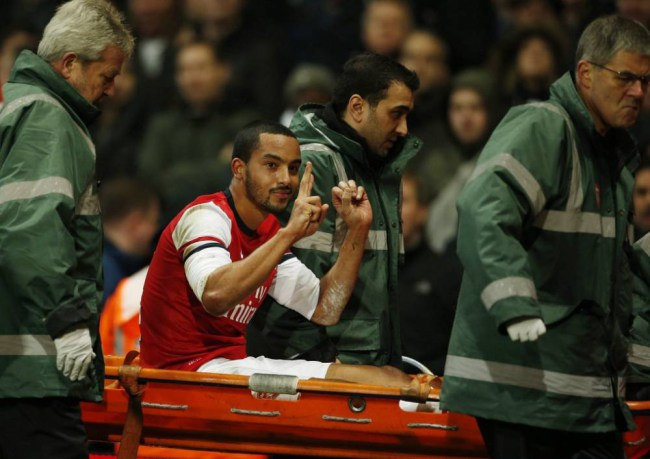
The remaining highlight of the game came out of a worrying moment as Walcott seemed to jar his left knee. A stretcher was called for, and it may well be that young Theo has sustained some damage. The incident took place right in front of the sullen mass of away fans, and they naturally proceeded to give the stricken Arsenal player dogs’ abuse. Encouragingly though, Theo felt well enough to sit up on his stretcher and, by means of hand signals, remind the Spurs contingent of the score.

It was a brave, possibly foolhardy thing to do. The stretcher bearers may not have thanked their patient for inviting a hail of missiles, but the Gooners clearly loved it. Theo left the arena in triumph, festooned with Arsenal scarves thrown in tribute by his adoring fans. In adding insult to Spurs’ two-goal injury, the likeable Walcott had put the seal on Arsenal’s joy as well as the misery of Spurs.

A good day for the Gunners, who march onwards and upwards. For Sherwood’s hapless troops, it was an unwelcome reminder of just how far they remain behind the Kings of North London.

Chester Friendly to Blood New Leeds Recruits? – by Rob Atkinson

Image

Friendly fixture to give game time to signings?

It’s a slightly odd and faintly unusual thing to do – arrange a friendly fixture right in the middle of the hurly-burly of a busy league campaign and just as the FA Cup starts up for another year (for the big lads of the top two leagues).  The match at Chester’s Swansway Chester Stadium will take place next Tuesday (k.o. 7pm), right in the middle of what would otherwise have been a welcome blank week for the club’s “leg-weary” players.  What could be the motivation for such a match?

Well, it could of course be simply a reserves friendly, an addition to the development squad’s calendar, perhaps top give an opportunity to try out some trialists.  Such things do happen, though they’re normally behind closed doors affairs at Thorp Arch.  Interestingly though, Brian McDermott has been emphatic in the press just lately that he wants to get any incoming transfer business done early in the window, and that he’s confident of board support, despite the fact we’ve heard nothing officially about Football League approval of the mooted Haigh-led takeover.  Perhaps we need a #Pen4Shaun campaign?  Other gossip has seen it opined that Luciano Becchio would be a poor signing as he’d be nowhere near match-fit, having spent his time at Norwich warming the bench.  This Chester game has a whiff of intrigue about it, and I suspect that it’s not unconnected with the possibility of some inward transfer movement over the next couple of days or so.

What the composition of the Leeds team will be next Tuesday night is a matter for speculation.  With Sheffield Wednesday at Hillsborough waiting for us next weekend, and then Leicester, Brighton and Ipswich coming up in the rest of January, together with possibly a couple more FA Cup games, it’s unlikely that a friendly would call on the services of many of our regulars this season – depending of course on who actually plays at Rochdale in the Cup this weekend.  It’s really all quite intriguing.

I don’t expect to see Thierry Henry in a Leeds shirt at Chester – but there may well be a couple of names in there making their bow for Leeds in an effort to make an early impression.  Billy Sharp?  Luciano Becchio?  Maxi Gradel even?  We’ll have to wait and see – but given the timing of this game, the biggest surprise would be if there were no surprise inclusion at all.

That Was The Leeds United 2013 That Was – by Rob Atkinson

Image

A look back before we look forward…

It was the best of times, it was the worst of times.  January 2013 at Elland Road saw Leeds United in the throes of transition from the misery of life under Bates to a newly-budding optimism surrounding what was still technically, for the time being, life under Bates.  The long-awaited takeover had finally happened, but many were unable to see beyond the strings which were clearly attached.  After daring to dream, it seemed as though the old nightmare still had its final act to play out.  We were stuck with Ken Bates until the end of the season as Chairman – and then for three years beyond that as President, threatening to sully an office previously held with honour by the late Earl of Harewood.  Still, it was better than Bates owning the club.  So, modified rapture.

January was a mixture of indifferent league form relieved by significant Cup success.  Neil Warnock’s charges had ended the old year with a thorough drubbing at Hull; though the final score was only 2-0, the Whites had been taught a sobering lesson in how the game should be played at this level, and the score-line distinctly flattered them.   Sadly, another 2-0 defeat at Barnsley on January 12 showed that the lesson had not been learned.  How a team so humbled in two league fixtures could possibly knock out the mighty and Bale-inspired Spurs from the FA Cup was puzzling to say the least.  But that’s what happened – Spurs went the way of Birmingham whom United had beaten after a replay in Round Three, and we were through to face the daunting task of playing Champions Man City away in Round Five.

Leeds took an uninspiring single point from the opening three league games of February and then bowed out of the FA Cup at the Etihad, the 4-0 spanking again not really reflecting the lopsided balance of play in City’s favour.  Able to, as they say, “concentrate on the league”, Leeds beat Blackpool 2-0 and played out a goal-less draw at Blackburn to enter March, which turned out to be the last full month under Neil “Colin” Warnock.

Colin had looked ever less capable of fulfilling the United dream of promotion, and March was the month that broke the back of that ambition.  A scratchy win over Millwall was followed by three draws and then two defeats and, as April rolled around, Colin’s tenure ended after two further losses – at home to Derby and then at the Valley against Charlton Athletic.  And then, it all changed – though too little and too late.  By this time, the hopeful peering upwards at the playoff zone had been replaced by anxious glances over our shoulders at the relegation tussle.  When Brian McDermott was appointed, he immediately said all the right things as new managers tend to do – except he managed to imbue his words with a sincerity and meaning that marked him as somebody we might actually want at the helm.

Brian’s first match was a 2-1 defeat of Sheffield Wednesday, a badly-needed and richly satisfying victory after the previous chelpings of then Wednesday manager David Jones.  A win over Burnley followed, hoisting Leeds to mid-table security before two successive defeats re-awakened those nagging worries.  But all was well by the last day of the season as we travelled to Watford and won 2-1, successfully pooping their intended promotion party and sending Hull up instead.  Ah, well.

So that was it for the season.  During the summer, big changes were afoot at boardroom level, including the welcome early termination of Bates’ connections with the club, a £1 million-ish signing for the first time in absolutely yonks, and generally increased optimism and morale.

The story of this season so far has been “steady as she goes” with new players bedding in, plenty of our familiar flaws still in evidence, but overall a much brighter and happier atmosphere about the whole place under Brian McDermott, who has continued to forge a great relationship with the fans as he displays a quiet determination to succeed in this job, regardless of distractions elsewhere – the Ireland job, for instance.  McDermott is known to have ambitions in this direction, but he swiftly distanced himself from speculation, stating firmly that he had a job to do at Elland Road.  In fact, McDermott’s hand on the tiller has resulted in an identical position at the turn of the year as compared with previous seasons.  Leeds have fallen away in the past – can they now build on what looks certain to be yet another fresh start under the Haigh-led consortium?

2014 looks as richly promising as any year in recent memory.  Our arguably top performer over recent games, with due deference to the prolific Rossco, has been Marius Zaliukas, signed initially on a short-term deal.  That deal has now been improved and extended to the end of the 2014/15 season – surely a cause for celebration.

More signings are promised in this window following the expected ratification of the takeover by the Football League.  There is the possibility of a winger, maybe another striker too to take some of the burden of McCormack.  These could at last be exciting times.  2013 was a year in which we have moved from one takeover watershed to another, with no great change in league position but with a massive improvement in the whole atmosphere of the club since Bates was shown the door.  What we have now is a solid foundation to build upon, with a club that seems likely to be relatively well-funded, ahead of Financial Fair Play regulation, and able to exert some buying power in the transfer market to supplement the good players we already have at the club – including promising youngsters such as Byram and Mowatt as the Academy production line continues to flourish.  It’s impossible of course to speculate about what an article penned next New Year’s Eve would say – will it reflect on solid achievement, steady progress or dashed hopes?  All are possibilities.  That story will unfold in the next twelve months.

Meanwhile, let’s raise a glass to 2014 and all it might bring to fans of Leeds United AFC in terms of progress, excitement, maybe even glory.  Happy New Year to #LLUUE readers everywhere, to all Leeds United fans and to everybody else.  Let’s see where it takes us!

Can Brian McDermott Emulate Leeds Utd Hero Simon Grayson? – by Rob Atkinson

Image

Simon Grayson: became United manager 5 years ago

Being the realistic and fair-minded character he undoubtedly is, United manager Brian McDermott would doubtless acknowledge the task he faces in matching the achievements of his last-but-one predecessor at Elland Road, Simon Grayson.

Grayson moved into the United hot-seat just before Christmas of 2008 after an acrimonious parting of ways with his former employers Blackpool – coincidentally United’s next opponents on Boxing Day.  His record at Bloomfield Road had been one of success, attaining promotion to the second tier for a famous old club which had been in the doldrums for far too long.  If that sounds familiar, it’s because the description could just as easily have been of Leeds United, and Grayson was destined to repeat his promotion feat at Elland Road, dragging comatose giants Leeds out of their humiliating third division berth in his first full season – despite having to work under the strictures imposed by a certain Master Bates.

There are some who seek now to belittle the scale of Grayson’s achievements, preferring to point at the lows of life in the Championship where Leeds had started so brightly.  But they haemorrhaged talent, failed to strengthen and fell rapidly by the wayside over the next couple of seasons, amid a welter of huge defeats.  That looks bad on any manager’s CV – but account has to be taken of the way in which Simon Grayson’s hands were tied in terms of his ability to improve the squad.   His career after Leeds has encompassed a third promotion from the third level of English football as he took Huddersfield up at the first time of asking.  Currently, he looks to be on course for a fourth such success, his current charges Preston North End lodged comfortably in the play-off zone despite a heavy loss to rivals Brentford at the weekend.

But it is for his success in reviving a moribund Leeds United, despite the Bates factor, for which Simon Grayson remains best-known.  To turn around a situation of seemingly terminal decline – after a succession of managers had failed to impose a big-club resilience on a lowly league – is the jewel in the crown of Grayson’s coaching career, especially as his promotion success was gilded with the fantasy-football type achievement of dismissing the champions from the FA Cup, at their own ground, in the third round.  For this alone, he would merit a prominent place in Leeds United’s turbulent but occasionally glorious history.

Simon Grayson lifted Leeds out of League One, elevating us to the Championship, in only his first full season.  It’s the only promotion he’s achieved outside of play-off football (note to Messrs Haigh and McDermott: Leeds United just don’t do play-offs) – and it’s clearly something still very close to his heart.  To win promotion with your boyhood favourites as well as slaying that club’s most despised dragon in its own lair – that’s the stuff of Boys’ Own fiction, made reality by a man as modest and dedicated as any we’ve been lucky enough to have associated with Leeds United AFC.

If Brian McDermott is to emulate Grayson’s first-full-season achievement, then it would have to be this season.  That. perhaps, would be unrealistic – given the fact that Brian has had his own problems of ownership and finances to deal with since moving in at United last April.  Clearly, whenever McDermott manages to guide Leeds back into the top flight, he will be hailed a hero and rightly so.  Until that happens, Simon Grayson remains, for me anyway, the third-greatest Boss at Elland Road behind the unassailable Don and his nearest rival Sergeant Wilko.  Some will disagree with that assessment – but really, the job of hoisting Leeds back from their lowest ebb was so massively important to us all that the person who managed it deserves appropriate recognition.

As Brian McDermott heads towards his first anniversary as Leeds boss in April, he might reflect that by then he’ll have a very good idea of what is possible in this current campaign.  A lot will depend on the currently-mooted takeover being approved by the Football League in time for Leeds to strengthen ahead of the run-in.  If they do that, and if the admirable “McDermott effect” continues to guide the club’s progress, then maybe – just maybe – he pull off a promotion that would see him elevated into the company of United’s greatest managers: Revie, Wilkinson – and Simon Grayson.

Video

Clarke……One Nil! Hear the Late, Great David Coleman as Leeds Utd Win the Cup

David Coleman died today, and with him went another piece of our youth for all those of my generation who grew up listening to him describe Cup Finals, historical athletics achievements and so much more, all in that distinctive, much imitated voice – the voice of the seventies, surely.

This video shows highlights of the Centenary FA Cup Final at Wembley on 6th May 1972, a game whose only goal will forever be remembered in terms of Coleman’s memorably laconic description. As the ball winged in from the right, crossed by Mick Jones, Coleman simply intoned: “Clarke ……… one-nil!” There was the implication that a goal followed such a chance for Sniffer as surely as night follows day – and so it most usually did. But this was a special, historic day, the only time to date that Leeds have ever won the FA Cup, and so the commentary has a special resonance, much as Kenneth Wolstenholme‘s did for the World Cup Final of 1966. As Coleman recapped the Clarke goal at Wembley that day, he added that it was “an example of the Leeds one-two”. He usually had the right words for any occasion, and his unique voice always enhanced whatever game he was describing.

A marvellous commentator and a giant of sports coverage over many years, he even saw a new term introduced into the language courtesy of Private Eye magazine. “Colemanballs” was an affectionate reference to his occasional lapse – and it’s as much a tribute to him as anything else that will be said on this sad day of his death at the venerable age of 87.

David Coleman, 1926 – 2013 RIP  A sad loss who will be much missed – thanks for the memories.

Happy Birthday to Andy Ritchie: A Shining Light in Leeds’ Wilderness Years – by Rob Atkinson

Image

Andy Ritchie: post-Revie hero, 53 today

Happy Birthday today to one of the real stars of a fallow period for United: Andy Ritchie, a terrific striker who – from humble beginnings – made it as a hero of the Gelderd End at the One True United.

You could say of Andy that, by the time he arrived at Elland Road, he owed us a favour or two.  At the age of 18 while playing for man u, he had knocked in a hat-trick against Leeds in a 4-1 win for the Pride of Devon.  Not content with such precocious achievement, he did it again the following year, this time against Spurs.  Two top flight hat-tricks whilst still in your teens would seem to be a sign of real talent and the potential to succeed at the highest level – yet, in line with the brilliance of the managerial policy at the Theatre of Hollow Myths in those days, Ritchie was deemed surplus to requirements for “The Biggest Club In The Universe™”.  He was surprisingly sold in 1980 to Brighton and Hove Albion – doubtless to make room for some real talent at man u – such as Garry Birtles, Alan Brazil and Peter Davenport.

At Brighton, Ritchie again showed his worth as a striker to be respected, clocking up 26 goals in 102 appearances in what was always a struggling team.  Somewhat typically for his career, which turned out to be a bit of a saga of missed opportunities, he then moved on to Leeds United in 1983 in a swap deal which saw Terry Connor heading south to the Goldstone Ground.  The missed opportunity in question was the 1983 FA Cup Final which saw Brighton draw 2-2 with man u at Wembley.  This game was famous for the last minute of that draw, when one Gordon Smith was clean through with only Gary Bailey to beat.  “And Smith must score…!” shrieked the commentator.  Well, he didn’t – and Brighton let the country down by losing a replay 4-0.  The incident has gone down in Brighton folklore, they even had a fanzine with the title “And Smith Must Score”.  No disrespect to the hapless Gordon, but you suspect that Andy Ritchie would have scored. And how different might history have been then?

At Leeds, Ritchie settled down well and won the hearts of the fans he’d miffed with that hat-trick years earlier.  He was a solid performer for United in an era when they were few and far between, leading the line well and always reliable in front of goal.  He scored two hat-tricks for the club in season 1984-85, and played a prominent part too in the 1986-87 season, which saw Leeds under Billy Bremner reach the FA Cup semi-final and a Playoff Final replay, only to miss out narrowly on both fronts.

Ritchie’s career after Leeds saw him head back to lancashire, becoming a folk hero at Oldham as a player and later as manager.  With Oldham, Andy at last returned to the top flight, helping keep an unfashionable and poorly-resourced club there for a respectable three years, becoming founder members of the Premier League.  There was time at Oldham, too, for Ritchie to add to his unfortunate list of FA Cup near-misses.

Ritchie wound down his playing career at Scarborough, and then entered management and coaching at a number of clubs, including Oldham and Leeds United.  He is currently doing some football punditry with BBC Radio Leeds – he was the summariser for the win over Middlesbrough last weekend – and his name still crops up when lower league managerial jobs are vacant.

Andy Ritchie will probably go down in history as one of Oldham Athletic’s finest ever players – but he was a significant part of a generally bleak time in Leeds’ history too and is fondly remembered as a fine striker that we should probably have done more to hang on to.  Happy Birthday, Andy – thanks for some golden memories that lit up some very grey and dismal years for Leeds United.

United Flashback: Wembley 1992 as Leeds Put Four Past Liverpool – by Rob Atkinson

leeds_united_win_the_charity_shield_in_1992_5861482

Leeds United – Wembley Winners

For all the rival claims of the FA Cup and (don’t laugh) the variously-sponsored League Cup, there’s little doubt about the Wembley occasion it’s hardest to reach, the honour it’s toughest to compete for.  Yes, ladies and gentlemen, I give you the FA Community Shield, or the Charity Shield as it used to be known in less politically-correct times.  This is not an event you get to be part of merely by winning a few games at home against the likes of Orient and Norwich, with maybe a semi-final against Aston Villa to spice it up.  It’s not a trophy you can win simply by the luck of the draw.  This is an event for winners, although League runners-up sometimes get a look-in if one club has been greedy enough to win the “Double”.  The Charity Shield is billed as the clash between reigning Champions and FA Cup-holders and as such it has the stardust of success and glory sprinkled all over it.

The Battle of Wembley '74

The Battle of Wembley ’74

Some will demur, saying it’s just a pre-season friendly.  Well, it does take place pre-season – but a friendly?  Before we look at this 1992 meeting of old foes Leeds and Liverpool, let’s cast our minds back to 1974 when the two sides met in the very first Wembley Charity Shield.  Kevin Keegan and Billy Bremner sent off, Giles displaying the art of the left hook on the ref’s blind side to dislodge Keegan’s perm – and all manner of malicious goings-on besides as Cup-holders Liverpool edged out Champions Leeds on penalties after a 1-1 draw for which “combative” is a hopelessly inadequate description.  Ray Clemence conning David Harvey over the ‘keepers taking the last two penalties, then grinning broadly as he reneged on the deal.  The violence and then the discarded shirts of the guilty as they walked off, dismissed by the schoolmasterly Bob Matthewson, a ref who towered over the pocket battleships in the opposing midfields.  The fuss and bother afterward as the FA decided examples should be made, long bans handed out.  A “friendly” it most definitely was not.

This 1992 match though was played out in a much lighter and more entertaining vein.  There was an air of conspiratorial glee around the old ground; Liverpool had administered the fatal blow to Man U’s title challenge at the end of the previous season with a 2-0 victory, the faithful of the Anfield Kop taunting their misery-stricken rivals with chants of “Leeds, Leeds, Leeds” as the last hopes of Man U and media alike drained away.  The real Reds then went on to Wembley and routinely won the Cup against Leeds’ old Nemesis Sunderland, so that this “Traditional Curtain Raiser to the Season” had about it a faintly gloating atmosphere – mutual congratulation was in the breeze as we all celebrated the discomfiture of the Mancunian and Mackem scum.

The game itself was a crazy mixture of potent attacking and Keystone Kops defending which foreshadowed the season both clubs were to experience, but which was avidly lapped up by both Kops at either end of Wembley.  Leeds opened the scoring when Rodney Wallace scampered into acres of space on the left before squaring for one Eric Cantona to finish confidently past Grobbelaar in the Liverpool goal.  That was on 25 minutes, but only ten more were to elapse before Liverpool were level.  A deep cross from Ronnie Rosenthal found Ian Rush with enough far-post space to plant a header past John Lukic.  This was at the Leeds fans’ end, and I remember at the time thinking that Liverpool would now go on to win, but what a cracking day we were having anyway.  But shortly before half-time, Leeds were ahead again, Tony Dorigo sending a deflected free kick beyond Brucie into the left hand corner of the net.

The second half saw the game continuing to see-saw as both sides went for it.  Liverpool contrived a second equaliser when Dean Saunders fastened on to a loose ball and powered it past Lukic in the blink of an eye.  Again that feeling of slight resignation and again Leeds blew it away, regaining the lead after 75 minutes when Cantona headed a cross ball down for Wallace to tap back to him.  Cantona looked up and calmly directed the ball wide of Grobbelaar for 3-2.  The joy among the Leeds fans at this cherry on the icing of last year’s title triumph raised itself to a still higher level when the match seemed to have been decided 4 minutes from the end.  Wallace chased a ball out wide which, instead of trickling out of play, bounced off the corner flag and gave the live-wire Rodney an ideal chance to put in a telling cross.  And there was Cantona again, lurking at the far post as Grobbelaar flapped ineffectively for the ball, watching it all the way and planting a header into the empty net.  4-2 up against Liverpool at Wembley!  Eleven months before the birth of my daughter, this was probably just about up there with the Title decider at Bramall Lane for the most joyous events of my life to that point, and for a few delirious moments I didn’t rightly know where or who I was.

Sanity had barely returned when, way down at the other end, Gordon Strachan scored what must be the comedy own-goal of all time, executing a singularly ungraceful backward stagger as he tried to clear from the goal-line but succeeded only in trickling the ball over it.  Some cheered, some laughed; nobody was downcast except perhaps wee Gordon himself who looked distinctly pissed-off.  Leeds had won though, the occasion had lived up to and beyond expectations for me and my happy band and we waited joyously to watch the lifting of silverware at Wembley.

Before that happened, another display of respect and gratitude as the defeated Liverpool players trooped off into the tunnel at the United end of the ground.  The jubilant Leeds fans as a body stood to applaud their old enemies, the chants of “Liverpool, Liverpool, Liverpool” drawing reciprocal if shattered applause from the bemused players in red, honour satisfied, tributes paid.  Then the Leeds players going up the thirty-nine steps to hoist the Shield high, and cheers echoing anew from our throat-sore and ecstatic hordes.  Leeds United: Champions of England – the Last Champions – Charity Shield winners and the only team ever to score four against Liverpool in all of the Anfield giants’ numerous Wembley appearances.  Vivid memories of a truly wonderful day.

What’s Really Wrong at Man U: the Fear Has Gone – by Rob Atkinson

The Tyrant is Gone

The Tyrant is Gone

It’s difficult not to sympathise with the current plight of Man U.  Well, apparently it is for BSkyB, anyway.  Others seem to manage OK.  Gary Lineker, introducing Match of the Day, promised action featuring “all of the top four”. Then, smiling at the camera really quite maliciously, he added “And Man U as well.”  There appears to be an insidious tendency to poke fun at the wounded Champions, and it begs the question why.  As someone myself who never feels quite so alive, never quite so full of the sheer joy of living as when Man U are having their noses well and truly rubbed in it, I have an answer to offer.  The fear has gone.  It went with Ferguson, and people now feel happy to laugh at Man U.  All very petty, you might think – but this absence of fear might have far-reaching consequences for The Pride of Devon.

Steve Clarke, West Brom’s talented young(ish) manager, made for an interesting listen in post match interviews after his team’s 2-1 victory at the Theatre of Hollow Myths. Firstly, he demanded credit for his team’s marvellous display, based on self-belief and a determination to show little respect for reputations, rather than lazily blaming the under-par display of Man U.  He went on to say that he had spent four days talking to his team about the mind-set required to play away against Man U; advice on not sitting back, seizing the day, going for the throats of the opposition, showing no fear.  And West Brom responded to their manager’s mantra, tearing into a startled Man U from the off. Unlikely as it seems, and despite a late home flurry, this could have been one humbling home defeat for Man U.  The last time they lost at home in the league to West Brom it was a 3-5 reverse in 1978.  On this occasion, a 5-2 or 6-2 victory would not have flattered the away side.

The thing is, that advice may well have been given to teams visiting Salford before, but it has rarely produced such positive gains for those teams down the years.  I remember well the performance of third-tier Leeds United in the den of the Champions in January 2010 for the FA Cup 3rd Round.  My favourites took the field as if they owned it, backed by 9000 raucous away fans and proceeded to out-play, out-fight and out-manoeuvre a team stratospherically above their humble level, winning 1-0 and rather unlucky it wasn’t 3-0. Leeds showed self-belief, faith in their own ability to dictate play and absolutely no fear or respect whatsoever.  It was the kind of display seen far too seldom by teams facing Man U, who tended over many seasons to be beaten before their boots had touched the turf at the start of the game.  And it’s this ingrained fear, this subconscious feeling of being beaten before a ball is kicked that has exaggerated the achievements of a club who, until Ferguson embarked upon his reign of terror, could only dream of Title success.

Football success, they say – or even football dominance – is cyclical.  Nobody stays at the top forever, the best of dynasties crumble and fall eventually.  This will not be a welcome concept for the bulk of the Man U support, who have long journeys from the south to justify somehow, who have only attached themselves to the embodiment of success and who will protest loudly if the run of glory ends.  But they can always seek their glory elsewhere – many of them will.  It’s in the nature of the beast.  Man U fans tend to be slightly inadequate and in Freudian need of the reassurance that identification with perceived size and success provides for them.  So off they’ll go and support Chelsea or Spurs or someone – the travel costs will be greatly reduced, anyway.  But what of those left behind?  What of the legions of armchair fans?  What of poor David Moyes, looking more and more like a latter-day Wilf McGuinness?  What, even, of the legions in the Far East who will find the whole reason for their devotion to Man U has dissipated – if they stop winning.

Then we have to look at the consequences for merchandising, the awful possibility that there might be a Champions League qualification failure, the chilling realisation that there is still all that debt.  The debt would have been even higher if Moyes hadn’t been so singularly ineffective in the transfer window.  The potential for things to get worse for Man U seems endless – and endlessly amusing.

None of this seemed remotely likely whilst Ferguson’s brooding presence was there, haunting the nightmares of referees and officials, causing ulcers in the FA Boardroom as they invented ever more specious reasons for failing to file disrepute charges, terrifying the hacks of the gutter and quality press alike with threats of cutting them off from the media circus that is Man U.  All Ferguson wanted was his own way, all the time and he set about getting it via the longest continual process of widespread intimidation the game has known.  Aided by the favourable market conditions provided when Murdoch bought the game, Man U flourished by this tyrannical dynasty – and the results are there in the trophy room where thirteen plastic replicas of Thunderbird One attest to a total domination of the Plastic Premier League.  Only Castro in modern times has out-done Ferguson as a successful tyrant and dictator.
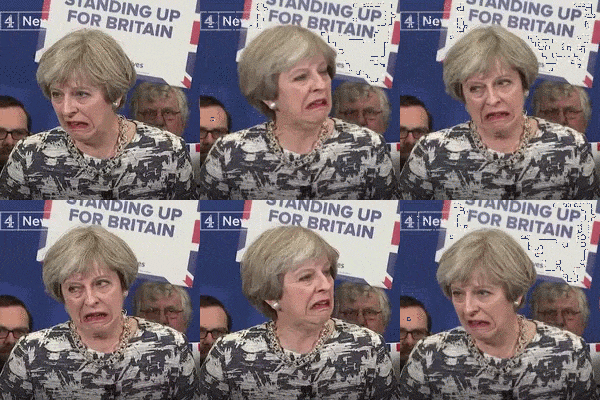
But now Ferguson has gone – at least for the time being.  He may yet, of course, reappear on a Busby-like comeback rescue mission if Moyes is sacked as a failure – shades of the early seventies.  For now though, the tyrant is rendered impotent to assist Man U as they flounder and the whole atmosphere of the top flight has changed.  Referees feel empowered to be fair instead of giving every bloody 50-50 decision to Man U.  Opposition managers feel their charges freed from that psychological monkey on the back.  Press hacks – despite Moyes’ pallid efforts to ape the Ferguson abrasive approach – are not fooled; they know that a crabby old lion has been succeeded by a querulous pup.

All of these factors have conspired to reduce the advantages enjoyed by Man U these many years since Ferguson headed south.  It’s always been a game of fine margins, and any reduction in advantage tends to have a disproportionate effect on performance.  This is what is happening to Man U – and it’s like a breath of fresh air.  Not everyone will be happy, not everyone will want to see the dominant force of the past two decades rendered impotent.  But for many – if only it can last – this new Fergie-less era could be the very best of times, after the very worst.