Tag Archives: Leeds United

Kenyan Man U Fan’s Suicide Harks Back to Famous Shankly Quote – by Rob Atkinson

Image

Shanks – didn’t really mean it

There are many famous sayings attributed to the late, great Bill Shankly that are still quoted to this day.  Some of them, he even actually said.  The one in the image above seems likely to have been genuine, actually uttered by the great man.  But wherever you hear it quoted, you’ll usually hear a hastily-added qualification too: “He didn’t actually mean it, of course.  It was part of his football-daft image…”  Quite so.  Shankly was football-daft – many are the anecdotes to illustrate this, and again, some of them are based on fact. But Shanks wasn’t daft in the wider sense and, certainly, if he did utter the words above, they’ll have been uttered with tongue firmly in cheek.

All of which sheds awfully little light on the baffling and tragic death in Kenya of local Man U fan John Jimmy Macharia, 23 or 28 (depending on which report you read), who plunged to his death from a multi-storey apartment block in Nairobi after David Moyes’ men suffered a second home defeat in four days, further denting the champions’ chance of retaining the Premier League title. “Macharia jumped from the seventh floor of an apartment at Pipeline Estate after realising that his team Manchester United lost 1-0 to Newcastle at Old Trafford and committed suicide,” Nairobi’s County Police Commander Benson Kibui told Reuters.

Commander Kibui went on to bemoan the role of the English game in this and at least one other suspected suicide in Kenya over the past few years. “All witness accounts suggest he committed suicide because the team lost but officers are still talking to those who were with him as part of the investigations into the incident”, he said. “It is not the first time we are losing a young man because of the football in England, which is far away from us. The football fans should enjoy the matches… but they need to know that is just a game and they should not commit suicide, since life is very precious.”  Undeniably true.

The fact that even one fan, anywhere in the world, could actually be moved to take his own life on the back of a pair of home defeats for a team thousands of miles away, seems mind-boggling.  It seems also to give an uncomfortable resonance to Shanks’ famous quote – but a soundbite nearly fifty years old can have little to do with what is an extreme phenomenon, born of a different type of football support to that tribal devotion typical of Shankly’s day.

As I wrote yesterday, this newish, different type of support has grown apace in the past decade or so.  Some call it “glory-hunting”, some merely refer to “global fanbases”.  But at its extreme margins, where tragedies of this sort are liable to occur – however infrequently – the motivations behind choosing to support a “megaclub” stand some examination.  Why, exactly do far-flung people choose to do this?  I believe that the answer to that depends on the type of club involved – but by far and away the most common reason is the wish to be identified with some perceived example of size, power and success.  This is “gloryhunting” in the raw, where a person of questionable self-esteem, lacking any other readily-apparent avenues for self-aggrandisement, will latch on to an institution regularly “bigged-up”  by the media, held up and put on a pedestal by such media as an example of success, something to be worshiped and revered, an institution which will reflect honour and glory onto its adherents, wherever they might come from.

There is seen to be some social cachet, therefore, in being recognised as a supporter of, say, Man U.  The opportunity is seemingly there for the otherwise pallid and ill-defined individual to bask in some reflected glory. For certain people of a perhaps less robust personality, this represents a relief from the humdrum routine of unregarded anonymity – it provides an escape route from their own feelings of inadequacy.  In extreme cases though, the pedestal that such a needy person builds for him or herself is more like a house of cards that can too easily come tumbling down, bringing with it the hapless fan who has pinned so much carefully-nurtured self-esteem on a seemingly invincible team that turns out, after all, to be fallible. The shock of this will be too much for some to bear; as they witness the downfall of their heroes, icons they had thought utterly reliable, what are they left with?  For the tragic few – seized upon as merchandising fodder by a voracious world game…and then let down with a bump – the answer would seem to be: nothing.

Better then, by far, to use football as a channel, not for some hopeless yearning for a boost in self-esteem, but rather for the kind of grisly defiance and bloody-mindedness that characterises – for instance – Leeds United fans. If there’s one thing you can be tolerably certain of, it is that, by and large, Leeds fans need to be made of stern stuff.  Not for them the lure of glory and triumph, not for them the warm glow of media hype and approval, or widespread cultural adoration.  The Leeds fan – especially the Leeds fan from far afield – has different motivations of an earthier and more non-conformist character.  Why else would so many travel literally thousands of miles per season, pay Premier League prices for what has been decidedly indifferent fare this past decade – and all of this to a background of contempt, disapproval, even hate?  It’s a conundrum – but some answers may well lie in some of the illuminating responses I received to yesterday’s article.

Whatever the reasons – and on the evidence of those replies, I would venture to suggest that most of them have to do with a desire to kick-out against the Establishment, the accepted way of things – the requirements to be a Leeds fan include a thick skin, strong shoulders, a philosophical personality and – above all – an unshakeable inner conviction that, against all visible evidence, they are right and the rest of the world is wrong.  Thus equipped, the Leeds United fan is able to roll with the punches, go with the flow and still feel able to hold their head up high and proclaim “We are Leeds and we are proud.  Marching On Together.”  This is not the stuff of which potential suicides are made – or at least not for such mundane reasons as a football result.

It’s the kind of inner serenity that fans of many clubs might well wish they could trade for a trophy or two.  It’s a state of mind, and not one that can simply be assumed.  It’s often said that fans don’t pick clubs – rather clubs tend to select fans of the mettle required to be worthy of supporting them. The media have a role to play in all of this, and it’s by no means a blameless one.  In their decades-long campaign of advancing the interests of one club – Man U – above all others, they have inflicted a certain amount of collateral damage, whilst at the same time strengthening the sinews of those already sinewy individuals who dare to swim against the tide and aspire to be Leeds United fans, or followers of other similarly proud but unregarded, unhyped clubs.

The damage done by the media to the weaker vessels who have opted to cling to the coat-tails of the mighty Man U has not been done intentionally. But suggestibility and the capacity to be brain-washed are functions of the strength, or lack thereof, of the human personality, the human ego.  It is the weaker ones who will be vacuumed up, wholesale by such a leviathan as Man U, with their publicity operatives in the press and media acting as recruitment agents.  Only the strong of character can resist such a siren call, only the willfully-defiant will survive the propaganda and tempting blandishments to be seen and read everywhere.  From these ranks – the ranks of the strong and the pugnacious – will emerge the Leeds United fans from every corner of the globe.  These are not people who will launch themselves off a high building after a couple of home defeats.  And fortunately so, as otherwise there might by now be sadly few of us left.

The tragic young man in Kenya who died last weekend can be seen as an extreme example of a victim of the myth that has grown up around the likes of Man U – and they are not alone.  A few years back, another Kenyan fan, this time of Arsenal, also took his life after a poor result, in the Champions League – ironically against Man U.  Never can the essential wrongness of that famously ironic Shankly quote have been more vividly illustrated than in these two wasteful and needless deaths, precipitated – almost certainly – by the meaningless outcome of mere games of football on foreign fields that neither victim would ever have visited.  This is when you start to question the degree to which football is hyped, when at bottom it remains mere sport, paling into insignificance besides the great issues of today or any other age.  It’s a pastime, a preoccupation – something to talk about or argue over in a bar or on a tea-break.  It beguiles many an idle hour, but it’s not – of itself – all that important.

Of course, there is always a place for pride in football, and even for people to use it as a vent for emotions that can’t find an outlet elsewhere.  But we must retain a sense of proportion, which is what that bemused police chief in Kenya was saying.  Passion and commitment must be tempered by realism and a sense of proportion.  The media should be playing a leading part in this, instead of grossly exaggerating over long periods the significance of games and competitions, or the standing and supposed invincibility of certain favoured clubs.  To perpetuate these hollow myths is to act irresponsibly, as there will always be fragile personalities that cannot define for themselves a sense of proportion, and to whom, ultimately, something as silly as a game of football might actually become as important as life or death itself – all at the behest of irresponsible journalists selling a commercially-motivated fairy-tale.  And when the ultimate tragedy happens, we’re all of us the poorer for it, even though it’s likely to affect fans directly only at that over-hyped and ridiculously puffed-up elite end of the world game.

As Bill Shankly would doubtless have been the first to admit, the whole institution of football everywhere on the planet is not worth even a fraction of one life.  It’s time that those responsible, in media and megaclub marketing departments, for pushing the hype, the hard-sell and the lies, got real, got back to what the game used to be all about and got back to reporting what happens instead of trying to lead the game by the nose in the direction of success and glory for the few and Devil take the hindmost.

Because when all is said and done – it’s only a game.

Don’t Tar Leeds United Fans With the Man U Gloryhunters Brush – by Rob Atkinson

Image

Oh, dear…

A lot of Man U fans have to face quite a bit of stick for being southern-based gloryhunters who’ve hardly ever visited the Theatre of Hollow Myths, because – well, because they’re southern-based gloryhunters who’ve hardly ever visited the Theatre of Hollow Myths.  Fair enough then, really – for it does seem from all available evidence that these sorry types make up a significant portion of the fallen champions’ “support”.   Tune into any biggish Man U home game and, during Sky’s feverishly-excited build-up, you’ll probably see some home fans being interviewed outside the ground, making predictions for the match ranging between anything from a 4-0 win to a 7-0 win.  It’s the accents that strike you.  A thick Ulster brogue here, a lugubrious Brummie yow-yow there.  Norfolk, Suffolk, take your pick of the Home Counties, most will be represented.  North-easterners, Devonians, the distinctive sound of Cornwall.

gloryhunterShamefully, there will also be the familiar tones of Yorkshire here and there, South Yorkshire mainly, but you do get the hideous experience of warm, West Yorkshire dialect emerging from a smug face surmounting one of those awful red shirts.  It’s shudderingly disgusting. You get the obvious cockneys – and last (and distinctly least) you’ll get a smattering of Lancastrians.  And really very, very few actual Mancunians, who are normally identifiable by their distinctive speech defects – “lickle” for “little” – hosspickle, for hospital, keckle for kettle, and so on.  For anyone seeking justification for his or her own instinctive antipathy towards Man U, it’s a rich vein of compulsive, repulsive viewing – and as a sort of straw poll, it shows that the oft-quoted charge of Man U fans being largely out-of-town gloryhunters has plenty of merit.

The important thing here is not simply where all these fans come from, but wherein lies their motivation for following the team they follow.  The fact is that Man U are not the only club with a large proportion of fans from outside of their own city limits.  My own Leeds United also have a large and faithful body of support from all over the country, indeed, all over the world.  This leads many of a Man U bent to do their research and emerge, flushed and excited, with what they feel is a cast-iron rebuttal of the “Man U gloryhunter” stereotype, arguing that it’s a phenomenon common to many higher-profile clubs.  On the face of it, this is true.  But as regards the question of proportion, it’s undeniable that Man U have a greater degree of support from outside of its own immediate area than almost any other club you could name.  And, in any event, the “where” of it is really just a basic fact.  The interesting question is the “why” of it.  What motivates these eager aliens to travel so far to follow their club – or at least to lash out so much on a Sky subscription and a comfy armchair?  And this is where the “gloryhunting” factor can be seen in full play.  Moreover, the “glory” that’s being hunted is not just a matter of trophies and medals – a lot of it has to do with the “Love us because of Munich” line so relentlessly pushed by the Man U club itself over the past 55 years.

Other clubs have been successful in this period, during which the game has reached saturation point in the media, compared with the pre-Munich era when interest was confined largely to the cloth-capped working classes and the back page of the daily newspapers.  But no other club was adopted by the media to the extent of Man U after Munich, a relationship that started out with shock and compassion but has evolved and warped over the years so that – stronger today than ever – it is now more about the protection and exploitation of markets than it is about the mystique that allegedly surrounds the legacy of Munich.  Whatever the rights and wrongs about the furore that has ALWAYS surrounded the Munich disaster – leading many to believe that it was unique and the worst sporting disaster ever – there can be little doubt that many Man U supporters with no remote connection to the Manchester area can trace back the origins of their support to Munich, either directly or through a parent.

The out-of-town support of other clubs, most particularly Leeds United, have not had anything like the cushy ride accorded to the Man U gloryhunters. Whereas those of a red persuasion have read reams of copy glorifying their chosen club and giving them what might truthfully be described as an overwhelmingly positive press, the Leeds fans have had the opposite experience going back fifty years.  Hating Leeds in the press has been a national pastime for decades now, and it is against this background – and without the long periods of sustained success achieved, by hook or by crook, over at Man U – that Leeds fans of all backgrounds, from whatever point on the globe, have somehow sustained the fanatical and feverishly proud nature of their support.

No, there is no gloryhunting for those who make the pilgrimage to Elland Road.  A few peaks of success in fifty years, besides which all has been humdrum with spells of blackest despair as their beloved club plumbed the depths of the third tier, with long spells away from the top-flight limelight. For a Man U fan – feeling themselves slighted by accusations of gloryhunting, coming as they do from Torquay – to level a counter charge of gloryhunting at a Leeds fan from Norway or from East Anglia, is a shot in the dark, a wildly inaccurate attempt at a counterpunch which serves only to emphasise their own desperate culpability.  The Man U fan who has supported them from an armchair in Milton Keynes since 1993 – and there are many such – is bang to rights as a gloryhunter.  A “plastic”, as we say in the argot of football vitriol.  They may harp on about the Busby Babes, about the thirteen plastic titles on the sideboard since Uncle Rupert bought the game and gift-wrapped it for them – but their motives are transparently obvious and their local clubs look at them with contempt as traitors to the region.

It takes a certain sort of character to follow such a path, for such reasons. Some will be motivated by the need to be associated with perceived size and success, for whatever is lacking in their own lives that has left them with such a need.  Dr. Freud, it’s over to you on that one.  Some are best summed-up by a lady with a penetrating voice who rang in angrily to BBC 606 after a rare Man U defeat at the Theatre of Hollow Myths.  “That’s not what I buy my season-ticket and travel up from London for!” she screeched in indignant tones of equine distress. “Any more of that and I might as well follow Spurs.”  She’s not alone in her rage and dissatisfaction, and one can only hope on her behalf that wherever she ended up, the prawn sandwiches were adequate.

It takes a certain sort of character too, to support Leeds, to tread that difficult path in the face of virtually universal hatred with very little in the way of tangible reward, team success – anything that might be described as glory.  For those who follow this rocky path from afar – the stalwart supporters from Scandinavia, the Leeds nutters from Norfolk, from Ireland, from pretty well everywhere you can stick a pin into the map of the UK – and much further afield – that takes a character rich in dedication and the ability to keep going in adversity.  There isn’t one Leeds fan I know who isn’t proud to be Leeds, and that pride, that passion, has survived some incredibly frustrating times when the future looked bleak – even at one point, non-existent.  And there are many Man U fans of pride and passion too – misguided souls of course, but still – proud.  Respect to them, but there are many, many who are more like that angry caller to 606, who throw a tantrum every time the club has a blip, who threaten to desert the ship with other, similarly morally bankrupt rats, before that ship shows even a sign of foundering.  Their current situation may well turn into more than a blip; the ship may not be buoyed up by quite as much media support and official wariness as in Ferguson’s reign – and it will be interesting to see how many fall by the wayside if Man U do fall away.

The comparison in the two basic characters of support highlights the bizarre ridiculousness of Man U fans throwing the “gloryhunter” charge back in the faces of Leeds fans for whom the glory lies in following their team through thin and thinner, and in simply being proud to be Leeds.  Gloryhunting is not primarily about geography, it’s about motivation too, and perhaps most of all, it’s about your own innate character and what you expect of yourself. If Leeds United won promotion this year, the “Double” next year and then the “Treble” the year after, I’d have a hell of a lot more to crow about – but I couldn’t be more proud to be Leeds than I am right now.  And I’m a local boy – and yet I know, with utter certainty, that those lads and lasses from further afield feel as I do, that the hairs on their necks stand up when they see the ground or hear the songs – and most of them have never seen us win a thing, but they’ll always be there and always proud.

The Man U gloryhunters, on the other hand, have seen them win a lot – that’s why they’re there.  But what will happen if the glory dries up, as well it might?  Where will the Man U gloryhunters be then?  They could easily be at Stamford Bridge or White Hart Lane, that’s where – or at least be wearing a different replica shirt whilst ensconced in their Home Counties armchairs. That’s the the character of those who attach themselves to the most convenient example of success, and it’s also the difference between them – the gloryhunting, plastic legion of the damned – and the proud and defiant Marching On Together brigade of Leeds United.

Video

Leeds United – “The Best Ever” for Malcolm Allison – by Rob Atkinson

Malcolm Allison – “Big Mal”, as he was known – knew a thing or two about football. An innovative coach and tactician, he achieved great success at Manchester City, working in harness with Joe Mercer in one of the great coaching partnerships. I was lucky enough to meet him once – without his fedora hat – when I attended the launch of a book on Billy Bremner. Talking about football, who he hated and who he rated, he was mesmerising.

For Big Mal, Leeds United were simply The Best. Jimmy Greaves and Co may have thought differently – but you didn’t see Jimbo getting far in coaching – did you?

Leeds Remain “The Damned United” for Jimmy Greaves and the BBC – by Rob Atkinson

Image

Super Leeds – simply the best

A couple of weeks ago, I came not to bury Greavsie but to praise him.  The article I wrote was a thrilled response to the fact that Jimmy “Jimbo” Greaves – a known Leeds-hater from way back – seemed to have seen the light, acknowledging United legend John Charles as the greatest British footballer of all time, ahead of George Best, Bobby Moore and – well, everyone else on a list of fifty.  It was such a surprise, such a welcome oddity coming from Greaves’ usually poisoned pen where the Whites are concerned, that I failed to look beyond the headline. Silly me.

When I finally did read the rest, I was less surprised – but I was utterly disgusted and amazed that somebody who had the honour to share a pitch with (and be heavily defeated by) Don Revie‘s Super Leeds could be so bitter, such a small-minded little man. For genial Greavsie, that impish cockney bundle of fun, had included in his Top 50 British Greats not one member of that fabulous Super Leeds side which dominated football for a decade and which regularly finished above the teams for which so many of Greaves’ Chosen Ones had played.  And there I was, just a few short weeks ago, saying nice things about the little bugger.  Well, I take it all back. Today I come, not to praise Greavsie, but to bury the sod.

It simply makes the mind boggle.  Not one Leeds player from that Glory era of Bremner, Giles, Gray, Clarke, Lorimer et al.  Not a single, solitary one. John Charles, of course, the Jimmy Greaves choice for number one, played at Elland Road in his first spell with Leeds before the Revie years, making a brief but only moderately successful comeback in the early part of the Don’s reign, before heading back off to la dolce vita.   King John’s honours were won on foreign fields; he was not part of the Leeds success story.  Did this exempt him in Greaves’ tiny and still semi-pickled mind from the hatred and disrespect with which he has always referred to the great Leeds side?  Was there some envy there?

Greaves, let us not forget, for all the praise heaped on him as a natural finisher, didn’t win all that much in his career.  You could fairly say he bottled it.  No League Titles, just a cup or two.  He missed out on the World Cup Final in 1966 due to injury, making way for one Geoff Hurst, who fortunately had a fair old game that day. You have to admit that Leeds, for all their talent, were underachievers (largely due to some corrupt refereeing) – but Greavsie out-shone them in that. Perhaps this explains some of that elderly bile and bitterness?

It’s not an unknown phenomenon, this steely determination to ignore Leeds United when the plaudits are being handed out.  It’s sadly quite common and, despite the fact that it reflects ill on those who perpetrate the omissions, exposing them for the petty, shallow revisionists that they are, still they queue up to overlook that great side, and to be seen doing so.  It’s as if there are brownie points to be collected somewhere for the person or persons who can show that they possess the biggest pair of anti-Leeds blinkers in the whole media.  What a sad indictment of supposedly impartial coverage – and the ostensibly most impartial of them all, the good old BBC, are among the worst offenders.

A little while ago, I wrote – well, ranted – about the BBC’s determined stance on ignoring Don Revie when they put together a montage of legendary managers.  It was laughable.  There were managers in there who’d hardly won a bean – good sound men, but not in the same class as the Don, a man who built a European superpower from a provincial nonentity of a football club, scorned by many in a city devoted to Rugby League.  The worldwide fanatical following that United have, even today, have their roots in the miracle wrought by Revie, the greatest manager of all time.  So, I complained to Auntie Beeb, and got the standard fob-off response, naturally. The complacent pillars of the media don’t like being challenged in their cosy little ivory tower funk-holes, they would rather you just concentrate on what they’re saying and not try thinking for yourself too much.

There’s no need for me to start in on correcting Greaves’ list, or indeed the BBC’s laboriously-constructed montage of managers – either would be an exercise in the bleedin’ obvious.  I’m simply happy to get this off my chest, to point out what smug, self-satisfied hypocrites and charlatans these people are, who feel that they really can reinvent history and expunge a whole, massively-significant part of it from the public consciousness.  It’ll never happen, too many of us out here remember all too well who the top dogs were back in the day – and more and more of us are stomping our way into print, the better to emphasise exactly what was what.  So you may take your heavily-edited version of history, Messrs Greaves, Lineker, Hansen and Shearer, and you may stick it where the monkey stuck its nuts.

The truth after all is out there, the evidence is easy to find, and even though some of the men so cruelly overlooked – Bremner and Revie for very obvious examples – are no longer around to defend themselves, there are plenty out here only too eager to do it for them.  Say what you like, Greavsie, but we were there too, we remember and we know better.

New Leeds Deal for Alex Mowatt a Sign of the Times for Resurgent United – by Rob Atkinson

Image

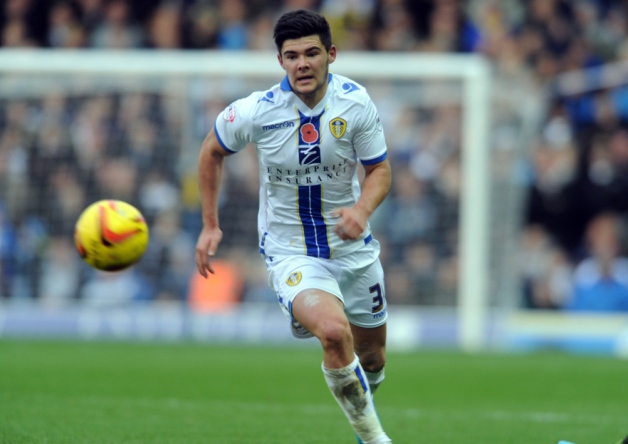
Young prospect Alex Mowatt: new long-term deal at Leeds United

The news that young Alex Mowatt has signed a contract extension with Leeds United, only eight months or so after turning professional, is another massively positive sign that this is a club that is going places.  Mowatt, 18, has seized his chance this season and has turned in a series of fine displays, nailing down for himself a regular first team spot well ahead of schedule. His is a classic example of the old saw “If you’re good enough, you’re old enough”, and Leeds have acted fast to tie the youngster to a deal that now extends until 2017.

Mowatt himself is enthusiastic about his situation at Leeds: “I’m really pleased to have signed,” he said. “I’ve been at the club since I was six and this is where I want to play my football.  This season has gone really, really well so far and I just want to keep working hard, keep improving, and play my part in helping Leeds United get where we want to be.”  As it seems certain that there would be no shortage of interested parties, Premier League clubs among them, if Mowatt were to fancy a change of scene, it’s vastly encouraging for United and the club’s fans that such a hot prospect has no qualms about committing himself for the long term.

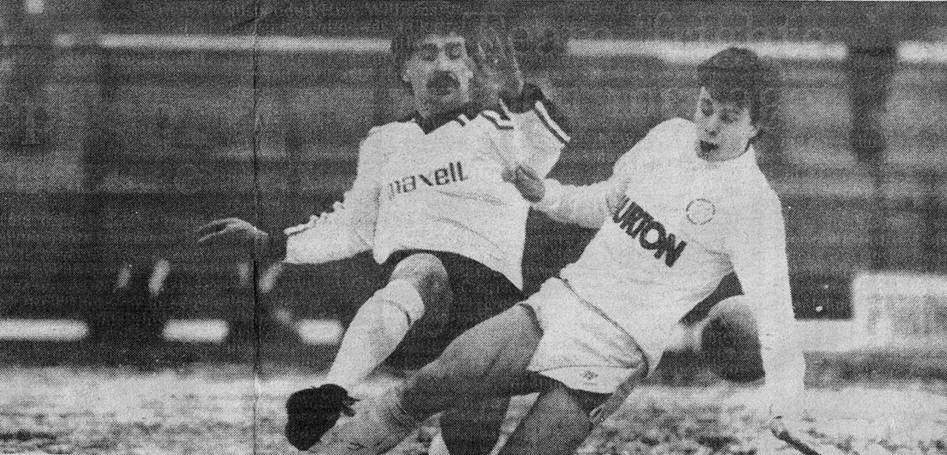
As with Sam Byram and to a lesser extent Chris Dawson before him, Alex Mowatt has emerged from the shadows of junior and development squad football at Elland Road and has immediately looked like the real deal.  In looks and playing style, he has reminded many good judges of a young Gary Speed.  Ex-United skipper Brendan Ormsby has said of him: “He reminds me of Gary Speed with the way he moves and uses his left foot.  I like the look of him. Although it’s a silly thing to say, he looks like he can play!  At 18 years old, Alex looks like he has a good future ahead of him. He will be a very good player if he carries on this way.”

Looks-wise, Mowatt reminds me more of Lyndon Simmonds, a young lad who shone brightly for a short while nearly thirty years ago, but who then faded away, moving on to Swansea and then Rochdale.  Ormsby’s judgement commands respect though, and you can see what he means in terms of the similarities of paying style, based in both cases on a fabulous left foot.  But Speed’s are big shoes to fill, and the lad will doubtless prefer to be recognised as the first Alex Mowatt, rather than the next Gary Speed. As comparisons go, though, it’s not a bad or an unflattering one, is it?

Leeds United is a bit of a good news factory at the moment.  These things are strictly relative, of course, and after some of the bad times we’ve had over the past decade or so, the mere absence of calamity and disaster (and Ken) are ample justification for dancing in the streets.  But it does rather feel as though better times are on their way back to Elland Road.  The laughter and chat, audible behind Jason Pearce‘s post-match Radio Leeds interview after the Wigan victory, spoke of a good atmosphere around the squad and a bond between the players.  These are essential ingredients for a successful squad, and it seems that manager Brian McDermott is wisely nurturing a feeling of unity and positivity in a tight-knit group of players.  He’s been there and done it all before has Brian, and it would take a rich and foolish man to bet against him doing it again.  With bright young stars like Byram, Dawson and Mowatt once again rolling off the Elland Road production-line, his task will be easier than if he were just to rely on the transfer market. But if that, too, can be exploited to United’s benefit in the January window, then the club might just really be going places – and sooner rather than later.

Good Day at the Office as United Beat Wigan and the Pride of Devon Lose to Everton – by Rob Atkinson

Image

Ross “Magic” McCormack scores again

Carlsberg don’t make Wednesday evenings, but if they did…

Victories don’t come much sweeter than a triumph over the Cup holders, with the decided bonus of a home defeat for the champions thrown in.  Like it or not (and I’m aware to my bafflement that taking pleasure from a Man U defeat is scorned by some of my more joyless fellow Leeds fans) – any Leeds win is a heightened pleasure when it’s accompanied by a defeat for Them.  When they lose at home, to their new manager’s and “star” striker’s former team, to the misery of their legion of armchair fans from Torquay to Singapore and back to Milton Keynes, then it’s several shades of sweet.  So slag me off all you like, you puritanical killjoys, I couldn’t care less. I was in a fine mood at United’s victory over Wigan – historic in its own right as we shall see – but news of a defeat for The Greatest Club in the Universe™ at the Theatre of Hollow Myths itself – that was the cherry on the icing on the cake.

Back to Leeds’ own fine win, and several “firsts” came along all at once tonight at Elland Road.  Our first league goal against Wigan Athletic, scored by – who else? – Ross McCormack.  The first time we’ve avoided defeat against the FA Cup winners, having lost our only two previous league meetings to nil.  And obviously, our first league win against the lancastrians, ending a 26 year wait for a victory of any sort since goals from Micky Adams and John Stiles (now, as then, a comedian) gave United a 2-0 win at the dilapidated old Springfield Park on the way to the 1987 FA Cup semi-final.

So, it was a great night at Elland Road, the fifth home win on the trot as United seek to make Elland Road the fortress it will have to be if we’re to challenge seriously this season.  It had been a worrying midweek thus far, a trend being established of clubs who have just sacked their managers achieving unlikely wins.  Wigan of course had just dispensed with the services of Owen Coyle.  Could they, wondered the football world hopefully, maintain the pattern and win at Leeds?

In the event, Leeds won decisively, before a decent midweek crowd of 25,888, although not without having to deal with a fair amount of pressure from visitors who had more than a fair share of possession.  But they didn’t have a Ross McCormack and that was the difference.  One goal in the first half and at the very least an assist for the winner after the break, and McCormack continues to demonstrate just how vital he is to this Leeds team.  One priority in January has to be the recruitment of an alternative source of goals – just in case disaster should strike and our major threat should be unavailable, whether through injury or suspension.  As for the possibility of losing Rossco in that transfer window – well, it just doesn’t bear thinking about.  His recent form will have seen his price rocket skywards, but it might be a price some are prepared to pay.

But enough of such paranoid gibberings.  McCormack must know he has the chance to write himself into the Leeds United history books as the natural successor to Jermaine Beckford, architect-in-chief of our last promotion. And now – in stark contrast to earlier in the season – the league table demonstrates quite clearly that it’s all up for grabs for Leeds, only a whisker outside the play offs and, with 28 games to go, a mere nine points off the very top of the league. Whatever the doom-and-gloom pessimists might say, that is not an unbridgeable gap, and there will be a few anxious glances being cast back over shoulders by the top few clubs as they hear the sound of Leeds United on the charge from the rear of the field.

After the “blip” at Blackburn, this win was as badly needed as it was efficiently executed.  Now, attentions must switch almost immediately to a Watford side who have lacked this season the con brio approach they showed last, when they were operating as the Italian B side in the English second tier – only to suffer the play-off disappointment so familiar to us Whites.  Beat Watford, and we’ll be looking well set.  This group of players is showing all the signs of togetherness and good team spirit and, all of a sudden, Elland Road may be seen as the place to be for good players looking for a good move in January.  That promises to be a very interesting month, but the priority now must be to make sure that December continues in the way it has started.

Whisper it softly – Leeds United are on the promotion path.  This could yet be a memorable and historic season.

Should Leeds Keep Hold of Maverick El-Hadji Diouf? – by Rob Atkinson

Image

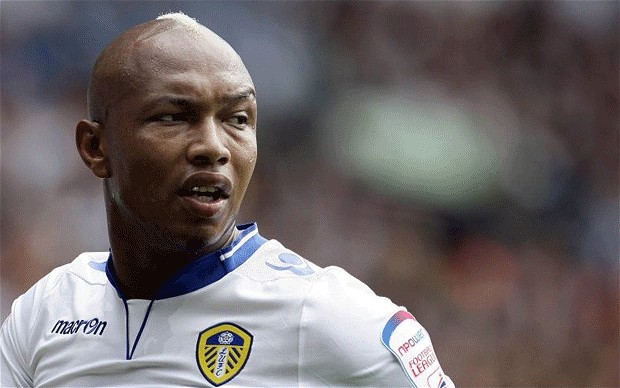
Regular all-round nice guy Dioufy

He’s a rum cove, that El-Hadji Diouf.  You don’t get many like him to the pound.  At first glance, his link-up with Leeds United seemed like a match made in hell.  He was signed by a manager in Neil Warnock who had previously referred to Diouf as “lower than a sewer rat.” Well, I don’t know about you, but I’m sure I’ve heard more sparkling endorsements than that – even from the notoriously uncouth Colin.

For a while there, we very probably had the most gleaming, five-star example of the full set hate-wise.  The most hated club, with the most hated Chairman, the most hated manager, the most hated fans and the most hated player.  It rather made your heart swell with pride, and you felt that if Dioufy could be taken to anyone’s hearts, then perhaps Elland Road was the most likely place.  We are rather fond of our villains down Beeston way.

The down side of the former Liverpool man – other than his alarming tendency to get involved in trouble at the drop of a blob of phlegm – is that he doesn’t look the fittest of lads.  He’s not yet 33, and he’s got undeniable pedigree – but you’re not going to see him running past opponents too often. His main contribution to the Leeds team last season seems to have been an ability to hold the ball up in confined spaces, draw a foul and win a free kick.  There was an early flurry of goals, but it was this ball retention ability that really shone in a team which appeared quite inept in that regard.

Sadly, a few live games in the first half of the season were characterised by the commentator making a fuss about this facet of Diouf’s play, and refs seemed to be on the lookout for any possibility of being hoodwinked by the wily Senegalese schemer.  Give a dog a bad name, eh?  There were certainly quite a few occasions that I noticed where Diouf would go down with a pained expression on his face, only for the ref to airily wave play on, to approving noises from the gantry. This detracted greatly from his general effectiveness, but he still contributed to some reasonably encouraging performances in that pre-Christmas part of last year’s league programme.

Overall, I think I would say that it remains doubtful we have anyone else on the books who can use the ball in a confined space, under pressure from close markers, as Dioufy can.  Time and again, he can either slip the attention of a couple of defenders to find a man in relative acres of space, or (more often) he would gain one of those free-kicks.  Both of these gifts were invaluable to last season’s Leeds side which otherwise appeared to regard the ball as a bit of a hot potato. It’s only that telling lack of pace which limited his overall contribution.

In the home match against Brighton late in the last campaign, Diouf managed to get himself sent-off in the aftermath of a successful penalty conversion.  It appeared that he’d taken some stick from Brighton’s rather over-sensitive away support, and responded in sign language involving a too-public manipulation of his genitals, to shocking effect as far as the away crowd and sadly also the ref were concerned. A little surprisingly, this was Diouf’s first dismissal since he joined the club.  We were told that he was sorry, and that he remained committed to the Leeds United cause coming into this season (but as it’s turned out, we’ve hardly seen him since.)

So should we hang on to this mercurial talent, or not?  He’s been this season’s forgotten man and yet, since signing an improved contract, he’s taking more out of the club by far than when he was making a real impact on the first team. I would cautiously vote to retain him, unless the rumoured influx of cash really does turn out to be enough to buy someone as good as Dioufy – and maybe younger and faster.  If that turns out to be the case, then sadly it’ll be a no-brainer.  All’s fair in football and war – and there’s precious little room for sentiment.

What do other people think?  Keep him or get rid?  And if he goes – just who are the likely candidates to replace him, depending on whether we have a Red Bull sized budget, or just a tidgy little David Haigh one? Answers on a virtual postcard, please…

Two Years Ago Today, Elland Road Bids Speedo an Emotional Farewell – by Rob Atkinson

Image

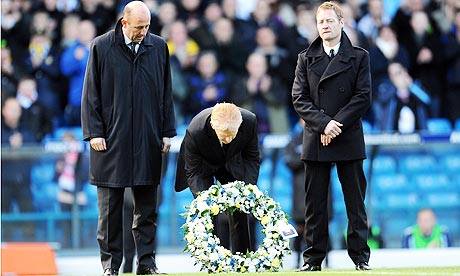
McAllister, Strachan and Batty pay tribute to Gary Speed

Leeds United 2 (Snodgrass 2), Millwall 0  Elland Road 3rd Dec, 2011   Att. 27,161

A fairly routine win against Millwall wouldn’t normally be the stuff of reminiscence, but this was no ordinary match.  On this Saturday, we were at Elland Road to say “Goodbye” to Gary Speed, who many of us remembered as a bright new talent, nobbut a lad mind you, but promising plenty as he made his mark on United’s promotion charge in 1990.  The memories he left us with from that point on are many, and they’ve been relived over and over in the two years since his untimely death.

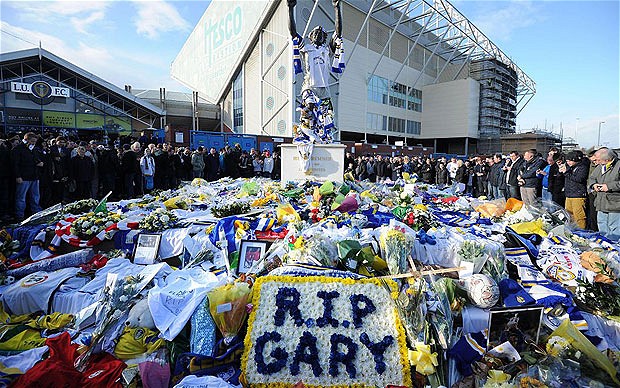
Enough, surely, has also been said about the circumstances surrounding the manner of Speedo’s departure – so here I’ll just remember how it was when the crowds gathered early by Billy’s statue, which was festooned with flowers, shirts, flags, toys, all manner of tributes to a great man taken far too soon.  It was a spectacle alright, a reverential throng stood there around the statue, deep in thought, each still struggling to come to terms with the enormity of what had happened.  The atmosphere was eerie and yet respectful, sad and yet full of memories and the hushed talk of happier times.

Image

Tributes to a late hero

The match that followed happened to be against Millwall, normally a lively encounter on and off the pitch when the Londoners bring anything like decent numbers.  That doesn’t happen often these days, security concerns having led to a reduction in the away support due to the annoyances surrounding Police restrictions on how the stadium may be approached.  But whatever the history between United and Millwall, it should be said that those fans who had travelled north conducted themselves impeccably, both during the pre-match on-field ceremony when the remaining three of that fabulous early nineties midfield quartet laid a wreath in memory of Speedo, and afterwards during a game which seemed like a meaningless appendage to the sad, real business of the day.

For the record, Leeds won the game 2-0 with second-half goals from Rob Snodgrass – one special shot and one very good header. Good as the goals were, welcome though the three points undoubtedly felt on the day, I had forgotten the details of the game itself. The images that remain in my mind are those in the images that accompany this article, scenes I’ll never forget. Some things transcend mere sport and mere tribal rivalry.

After all, the sudden shock of Speed’s death had left its mark on fans everywhere, not just at the clubs he had served with such distinction. Everywhere.  You only had to look at the bewildering array of tributes around Billy’s statue to know that,  Leeds, Newcastle, Everton and Bolton, naturally they were represented.  Sheffield United and the proud national colours of Wales, too.  But also Man United, Liverpool, Chelsea, Sheffield Wednesday, Barnsley, Huddersfield – the list of old foes grew as you walked around the flower-strewn base of our late, great skipper’s statue.

When you think about it; what a great addition that legendary figure of Billy Bremner has been to Elland Road, what a proud focus for everything that Leeds means to its fans – and significantly, what a natural place to gather when we have good news to celebrate or bad news to mourn.  Billy is always there when he’s needed, frozen in time, arms raised in triumph as when he walked off the field at the Nou Camp in Barcelona, knowing that he was in the greatest club game of all, at long last.  It’s an inspiring, iconic work of commemorative art, and it provides such an appropriate backdrop when, as two years ago today, we had a more recent hero to pay our respects to, and for whom we had gathered to say our last farewells. It’s a place that conjures up a feeling of immense togetherness and solidarity, of what it means to be Leeds, in glory and in tragedy.  It’s a sacred place, like that.

I’ll forget all about that game again, now that this piece is done.  It was just another result, albeit one we’d normally savour, with fierce rivals beaten convincingly.  But the atmosphere that day, the tangible tributes left by so many fans of so many other clubs, the dignity of the pre-match proceedings, the laudable and much-appreciated respect shown by the away fans – all of that will stay in the memory long after Snoddy’s two cracking goals have faded away.  It was a sad but a special day, and surely Speedo could not have wished for a better farewell at what was his spiritual football home, the place that made him one of the Last Champions.  It was tragic, awful, a needless waste the way Gary died.  But when it came to saying goodbye to him, on this day two years back, Leeds United – and Millwall, and all the other clubs and fans – did it right.

RIP Gary Speed – never forgotten.

Leeds Look to Bounce Back Against Troubled Wigan – by Rob Atkinson

Image

John Stiles: scored the only time Leeds beat Wigan Athletic

Next up for Leeds after the disappointment at Blackburn is a team we’ve met in the league before – but we’ve never beaten them, we’ve never actually managed a draw – we’ve never, shameful though it might seem, even managed to score a league goal against these giants of the game. Then again, we’ve only played them twice in league games.

It is of course the mighty Wigan Athletic we’re talking about, denizens of a town best-known for pies and rugby league, in that order – with the football club still the poor relation of those three preoccupations. Still, the Latics are not to be sniffed at these days – they come to Elland Road as FA Cup holders, still campaigning on the continent in the rarefied atmosphere of European football and of course they’re one of those big boys lately of the Blessed and Stardusty Premier League, with playing staff and parachute payments to match. So we’d better not under-estimate them then, right? Right.

Wigan have actually been a little disappointing so far this season, given high expectations of a swift and trouble-free return to the top-flight. The early optimism seemed justified when they travelled to Barnsley on the opening day and stuffed them 4-0. The Championship settled back and prepared to watch the Cup-holders disappear over the horizon at the top of the league, but it hasn’t worked out like that. Results since then have been patchy with bright spells and Wigan will need to buck up their ideas soon if they’re not to endure a long and frosty winter. The bleak situation culminated this week with the dismissal of manager Owen Coyle, so yet again Leeds are to face a team bereft of a permanent manager, and looking to prove a point or two perhaps.

Leeds have historically fared best against the Latics in Cup competitions, winning at the old and decrepit Springfield Park in the FA Cup 6th Round of 1987 and then achieving two creditable draws against notionally superior opposition in the 2006 competition, Wigan going through on penalties after the Elland Road replay. But all was misery in the league for United in our only season of level-par competition with the Lancastrians, the Pie-munchers running out 2-0 winners in LS11, and dismissing us 3-0 in the return. The aim will have to be the old Wilko battle plan for every campaign – let’s get our first goal, first point, first win – ideally all of them in the same game. Such will be the objective on Wednesday night when a crowd swelled by some freebie tickets should provide plenty of vocal backing – nothing gets a Yorkshireman (or woman) so ready and raring to go as summat for nowt.

I have a sneaking suspicion that Leeds may well have just a little too much for their trans-pennine foes in this latest meeting. Late injury/recovery news will have a big say in how matters turn out – but barring any unforeseen calamity (fingers crossed Rossco is fit) – I can see Leeds winning by the odd goal in three. And who knows – as that seasonal magic begins to gather about us all, maybe Luke Varney will grab a goal as he did at Bolton, to win another Roses battle. Stranger things have happened.

Happy Birthday to Batts, Leeds United’s 90s Midfield Enforcer – by Rob Atkinson

Image

‘Ave it

Many Happy Returns to David Batty, who celebrates his 45th birthday today and who is fondly remembered by his fans as one of Leeds United’s very favourite sons of the recent past.  Batts was the archetypal Yorkshire Terrier of a midfielder, snapping away in the tussle for possession of the ball, exploiting seemingly endless reserves of energy as he harried his opponents, closing down and chasing – and when he got the ball, he could certainly use it too.  Best remembered for those ferocious challenges, Batty was no mean interceptor of the ball either, and I well remember one time when he nipped in to take the ball neatly off the toes of an opponent, sliding it first time to a White shirt in the enemy area to set up another goal for Leeds.  The creative side of his game was frequently under-estimated by those who saw him as merely a demolition man, but his fellow pros knew better.  Batts commanded respect for his technical ability as much as the granite-hardness of his approach to the game.

ImageIt has to be said that goals weren’t exactly David’s business, although he had a ferocious shot on him with the ability to strike the ball cleanly – “pinging it” as they say in the game.  This talent was sadly seen most often on the training ground, but occasionally he’d catch one in a real game – and when he hit the ball properly, it stayed hit.

The goal I best remember him for was not a spectacular strike, nor did it involve him in an Eddie Gray-style mazy dribble through bewildered opposition defenders.  But it was nonetheless memorable when it happened, because it came at the end of an epic goal drought that had lasted fully four seasons since his last goal for Leeds, ironically against the same opposition in Manchester City.  This gave rise to my favourite Batts quote: “I don’t score many,” he remarked laconically, “but against Man City, I’m prolific.”

The goal that broke the drought saw possibly the wildest celebration for any one goal at Elland Road for many years – with the possible exception of Gordon Strachan’s fabulous and crucial strike against Leicester City in the promotion run-in of 1990.  Even then, Strachan’s goal did not carry the injury toll of Batty’s, the celebration of which reputedly caused broken ankles and concussions as the Gelderd End completely lost its collective head in disbelief. It was simply enough executed: Strachan on the right played a short pass inside to Batty, who was probably only in the area because we were already comfortably in front – and he took one touch to control before finishing clinically to take the roof off the stadium.

ImageThe man himself remarked afterwards that he was taken aback at the sheer intensity of the celebrations – he was mildly chuffed to have scored, of course, but the joy of the Kopites at seeing their long wait ended and their local hero get one at last – it was something to behold.  It’s worth a moment or two to watch it again – click here to do just that. Tony Dorigo’s sumptuous connection on the half-volley for a top-class, top-corner first goal is almost forgotten now, but in any other context we’d still be raving about it. Just look at the crowd behind the goal when Batty’s effort goes in – no wonder there were injuries, and yet you can bet that the afflicted weren’t feeling any pain. Happy memories.

Batts went on to serve with distinction at Blackburn Rovers and Newcastle United after leaving Elland Road; under the misguided transfer policy of the time we replaced him, in effect, with Carlton Palmer – not the best deal ever done.  He came back eventually of course.  It’s widely-known that towards the end of his Newcastle days his team-mates there would point at Elland Road as the coach passed by on the way back to the frozen north, and ask Batts when he was off “home”.  It didn’t last long enough, but it felt good to have the prodigal return.

Happy Birthday, Batts and thanks for the memories of a local lad who made good and wore the colours of Leeds United with pride and passion – a top professional and a Leeds legend.