Tag Archives: Liverpool FC

Kenyan Man U Fan’s Suicide Harks Back to Famous Shankly Quote – by Rob Atkinson

Image

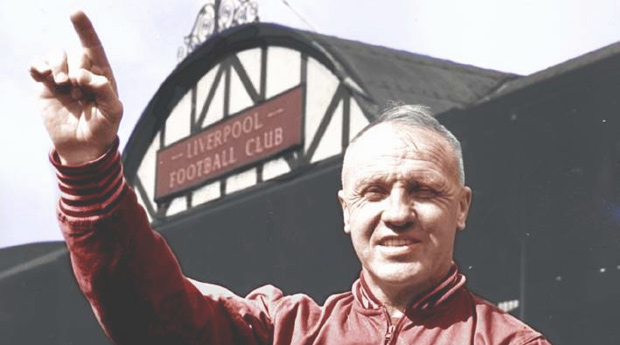
Shanks – didn’t really mean it

There are many famous sayings attributed to the late, great Bill Shankly that are still quoted to this day.  Some of them, he even actually said.  The one in the image above seems likely to have been genuine, actually uttered by the great man.  But wherever you hear it quoted, you’ll usually hear a hastily-added qualification too: “He didn’t actually mean it, of course.  It was part of his football-daft image…”  Quite so.  Shankly was football-daft – many are the anecdotes to illustrate this, and again, some of them are based on fact. But Shanks wasn’t daft in the wider sense and, certainly, if he did utter the words above, they’ll have been uttered with tongue firmly in cheek.

All of which sheds awfully little light on the baffling and tragic death in Kenya of local Man U fan John Jimmy Macharia, 23 or 28 (depending on which report you read), who plunged to his death from a multi-storey apartment block in Nairobi after David Moyes’ men suffered a second home defeat in four days, further denting the champions’ chance of retaining the Premier League title. “Macharia jumped from the seventh floor of an apartment at Pipeline Estate after realising that his team Manchester United lost 1-0 to Newcastle at Old Trafford and committed suicide,” Nairobi’s County Police Commander Benson Kibui told Reuters.

Commander Kibui went on to bemoan the role of the English game in this and at least one other suspected suicide in Kenya over the past few years. “All witness accounts suggest he committed suicide because the team lost but officers are still talking to those who were with him as part of the investigations into the incident”, he said. “It is not the first time we are losing a young man because of the football in England, which is far away from us. The football fans should enjoy the matches… but they need to know that is just a game and they should not commit suicide, since life is very precious.”  Undeniably true.

The fact that even one fan, anywhere in the world, could actually be moved to take his own life on the back of a pair of home defeats for a team thousands of miles away, seems mind-boggling.  It seems also to give an uncomfortable resonance to Shanks’ famous quote – but a soundbite nearly fifty years old can have little to do with what is an extreme phenomenon, born of a different type of football support to that tribal devotion typical of Shankly’s day.

As I wrote yesterday, this newish, different type of support has grown apace in the past decade or so.  Some call it “glory-hunting”, some merely refer to “global fanbases”.  But at its extreme margins, where tragedies of this sort are liable to occur – however infrequently – the motivations behind choosing to support a “megaclub” stand some examination.  Why, exactly do far-flung people choose to do this?  I believe that the answer to that depends on the type of club involved – but by far and away the most common reason is the wish to be identified with some perceived example of size, power and success.  This is “gloryhunting” in the raw, where a person of questionable self-esteem, lacking any other readily-apparent avenues for self-aggrandisement, will latch on to an institution regularly “bigged-up”  by the media, held up and put on a pedestal by such media as an example of success, something to be worshiped and revered, an institution which will reflect honour and glory onto its adherents, wherever they might come from.

There is seen to be some social cachet, therefore, in being recognised as a supporter of, say, Man U.  The opportunity is seemingly there for the otherwise pallid and ill-defined individual to bask in some reflected glory. For certain people of a perhaps less robust personality, this represents a relief from the humdrum routine of unregarded anonymity – it provides an escape route from their own feelings of inadequacy.  In extreme cases though, the pedestal that such a needy person builds for him or herself is more like a house of cards that can too easily come tumbling down, bringing with it the hapless fan who has pinned so much carefully-nurtured self-esteem on a seemingly invincible team that turns out, after all, to be fallible. The shock of this will be too much for some to bear; as they witness the downfall of their heroes, icons they had thought utterly reliable, what are they left with?  For the tragic few – seized upon as merchandising fodder by a voracious world game…and then let down with a bump – the answer would seem to be: nothing.

Better then, by far, to use football as a channel, not for some hopeless yearning for a boost in self-esteem, but rather for the kind of grisly defiance and bloody-mindedness that characterises – for instance – Leeds United fans. If there’s one thing you can be tolerably certain of, it is that, by and large, Leeds fans need to be made of stern stuff.  Not for them the lure of glory and triumph, not for them the warm glow of media hype and approval, or widespread cultural adoration.  The Leeds fan – especially the Leeds fan from far afield – has different motivations of an earthier and more non-conformist character.  Why else would so many travel literally thousands of miles per season, pay Premier League prices for what has been decidedly indifferent fare this past decade – and all of this to a background of contempt, disapproval, even hate?  It’s a conundrum – but some answers may well lie in some of the illuminating responses I received to yesterday’s article.

Whatever the reasons – and on the evidence of those replies, I would venture to suggest that most of them have to do with a desire to kick-out against the Establishment, the accepted way of things – the requirements to be a Leeds fan include a thick skin, strong shoulders, a philosophical personality and – above all – an unshakeable inner conviction that, against all visible evidence, they are right and the rest of the world is wrong.  Thus equipped, the Leeds United fan is able to roll with the punches, go with the flow and still feel able to hold their head up high and proclaim “We are Leeds and we are proud.  Marching On Together.”  This is not the stuff of which potential suicides are made – or at least not for such mundane reasons as a football result.

It’s the kind of inner serenity that fans of many clubs might well wish they could trade for a trophy or two.  It’s a state of mind, and not one that can simply be assumed.  It’s often said that fans don’t pick clubs – rather clubs tend to select fans of the mettle required to be worthy of supporting them. The media have a role to play in all of this, and it’s by no means a blameless one.  In their decades-long campaign of advancing the interests of one club – Man U – above all others, they have inflicted a certain amount of collateral damage, whilst at the same time strengthening the sinews of those already sinewy individuals who dare to swim against the tide and aspire to be Leeds United fans, or followers of other similarly proud but unregarded, unhyped clubs.

The damage done by the media to the weaker vessels who have opted to cling to the coat-tails of the mighty Man U has not been done intentionally. But suggestibility and the capacity to be brain-washed are functions of the strength, or lack thereof, of the human personality, the human ego.  It is the weaker ones who will be vacuumed up, wholesale by such a leviathan as Man U, with their publicity operatives in the press and media acting as recruitment agents.  Only the strong of character can resist such a siren call, only the willfully-defiant will survive the propaganda and tempting blandishments to be seen and read everywhere.  From these ranks – the ranks of the strong and the pugnacious – will emerge the Leeds United fans from every corner of the globe.  These are not people who will launch themselves off a high building after a couple of home defeats.  And fortunately so, as otherwise there might by now be sadly few of us left.

The tragic young man in Kenya who died last weekend can be seen as an extreme example of a victim of the myth that has grown up around the likes of Man U – and they are not alone.  A few years back, another Kenyan fan, this time of Arsenal, also took his life after a poor result, in the Champions League – ironically against Man U.  Never can the essential wrongness of that famously ironic Shankly quote have been more vividly illustrated than in these two wasteful and needless deaths, precipitated – almost certainly – by the meaningless outcome of mere games of football on foreign fields that neither victim would ever have visited.  This is when you start to question the degree to which football is hyped, when at bottom it remains mere sport, paling into insignificance besides the great issues of today or any other age.  It’s a pastime, a preoccupation – something to talk about or argue over in a bar or on a tea-break.  It beguiles many an idle hour, but it’s not – of itself – all that important.

Of course, there is always a place for pride in football, and even for people to use it as a vent for emotions that can’t find an outlet elsewhere.  But we must retain a sense of proportion, which is what that bemused police chief in Kenya was saying.  Passion and commitment must be tempered by realism and a sense of proportion.  The media should be playing a leading part in this, instead of grossly exaggerating over long periods the significance of games and competitions, or the standing and supposed invincibility of certain favoured clubs.  To perpetuate these hollow myths is to act irresponsibly, as there will always be fragile personalities that cannot define for themselves a sense of proportion, and to whom, ultimately, something as silly as a game of football might actually become as important as life or death itself – all at the behest of irresponsible journalists selling a commercially-motivated fairy-tale.  And when the ultimate tragedy happens, we’re all of us the poorer for it, even though it’s likely to affect fans directly only at that over-hyped and ridiculously puffed-up elite end of the world game.

As Bill Shankly would doubtless have been the first to admit, the whole institution of football everywhere on the planet is not worth even a fraction of one life.  It’s time that those responsible, in media and megaclub marketing departments, for pushing the hype, the hard-sell and the lies, got real, got back to what the game used to be all about and got back to reporting what happens instead of trying to lead the game by the nose in the direction of success and glory for the few and Devil take the hindmost.

Because when all is said and done – it’s only a game.

Suarez Showing Why He’s Vital for The EPL – by Rob Atkinson

20131205-004927.jpg

Suarez – magician

As a Leeds United fan, it amazes me that a player of the sheer quality – and breathtaking ability to entertain – of Luis Suarez hasn’t been better appreciated in the country where he plies his trade. Last night at Anfield, he gave a performance in Liverpool’s 5-1 demolition of Norwich City to make any fan of the game thank their lucky stars that certain parties didn’t manage to drive the Uruguayan from these shores. It must have been a mighty close thing, such was the vitriol poured upon his head by various holier-than-thou types who would evidently be quite willing to see such virtuoso talent lost to English football. And this, mainly, because a silly molehill was made into a ridiculous mountain called Evragate.

The issues surrounding that shoddy affair have been gone into, not wisely but too well. A lot of ignorant and uninformed opinion conspired to have Suarez painted as an out-and-out villain and a racist to boot, whilst anointing Patrice Evra, Man U’s typically dislikable defender, as Saint Injured Party of Dakar. Neither conclusion stands up to intelligent analysis. The cultural mores of Uruguay make Suarez difficult to convict on the evidence of what happened in this case, while Evra’s tendency to make trouble and exploit situations will invariably speak for itself.

Less easy to dismiss was the bizarre incident when Suarez decided to take a chunk out of the arm of Chelsea defender Branislav Ivanović. Any supporter of Suarez would have shaken his head despairingly at that one – it was inexcusable. But by this time, Suarez was cast ineradicably in the public eye as A Nasty Man – and sometimes that kind of thing can become a self-fulfilling prophesy, with the subject of all the negative attention liable to crack under the strain.

I have to confess that I would instinctively defend Suarez over Evragate, even if the deeper issues didn’t support the view that he’s not quite the despicable git he’s been painted. Evra is an unpleasant individual with a track record of winding up opponents in the approved Man U manner. As a Leeds fan, that is anathema to me. But the way in which Suarez was hung out to dry, vilified by people who evidently couldn’t have cared less about the positives the little South American brings to our game – to me, this was shocking and uncalled-for. I felt then and I still feel now that he should have been cut some slack and certainly not hounded as he was. Maybe then there’d have been no biting incident. Who knows? Luis Suarez is a volatile character. It’s part of his make-up, and he’s most definitely not alone in that. But so is sublime talent an integral part of the Suarez package, as he so extravagantly demonstrated last night.

Players score great goals sometimes, occasionally hat-tricks and sometimes even more. Our own Ross McCormack rattled up a four goal haul at Charlton recently and that was an outstanding performance. But it was as water unto wine when compared to the Suarez Masterclass which saw Norwich slaughtered by the world-class talent of a Latin magician.
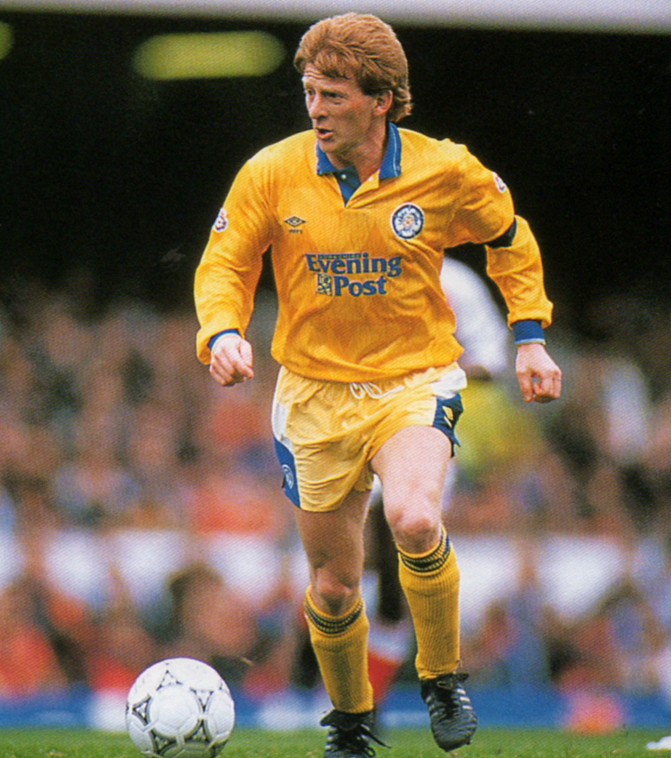
You’d have to go a long way to see goals of greater quality than three of the four that Suarez scored last night. The fourth was merely very good, and Liverpool’s fifth was served up on a plate for young Raheem Sterling by … Luis Suarez.  If ever a man took on and routed an opposing team of eleven helpless men, with only incidental help and support from the ten bit-part players on his own side, that man was Suarez.  He was that good.

Looking at the four goals he scored, all showed exemplary technique, reflexes, balance, artistry, sheer star quality. Three were blinding efforts that would have graced any game of football ever played, any time, anywhere. The body shape of the man as he dispatched each chance with exactly the right contact to send the ball fizzing into the Norwich net told of a very special talent in the person of a natural athlete and superb technician. These were special goals in a fabulous performance; Suarez has been building up to this ever since the delayed start to his season, after suspension for the Ivanović incident and a summer of speculation as to whether he would be part of the English game this season. Even when it seemed that the danger of him being lost to our game was past, speculation was still rife about interest from Arsenal – and what an addition the Uruguayan would have made to that outstanding team.

What was made finally, undeniably clear at Anfield last night was that to even risk harrying Luis Suarez out of our game would have been the most arrant folly. Players like that come along once a generation; the Evras of this world are ten-a-penny stuff by comparison. The goals that Suarez scored against Norwich will be talked about, admired and replayed for years – decades. You don’t ever forget quality, genius like that. And that quality, that genius, could so easily have been lost to the game, just because an ignorant cabal of self-appointed judges got bees in their bonnets when they felt that precious Patrice Evra had been insulted. It was a disproportionate, foolish and unwarranted reaction and – in talent and entertainment terms – it could have cost us dear.

Look at those goals, and marvel. Watch them a few times over – you won’t regret it. Luis Suarez, Superstar. It’s about time we all focused on the immense positives he has brought to our game, and started to appreciate the worth of the man. He sparkles, he entertains – he even plays the game with a smile on his face – mostly. There’s plenty you can’t say that about. Thank heavens that Anfield’s magician was not lost to the game of football in England.

United Flashback: Wembley 1992 as Leeds Put Four Past Liverpool – by Rob Atkinson

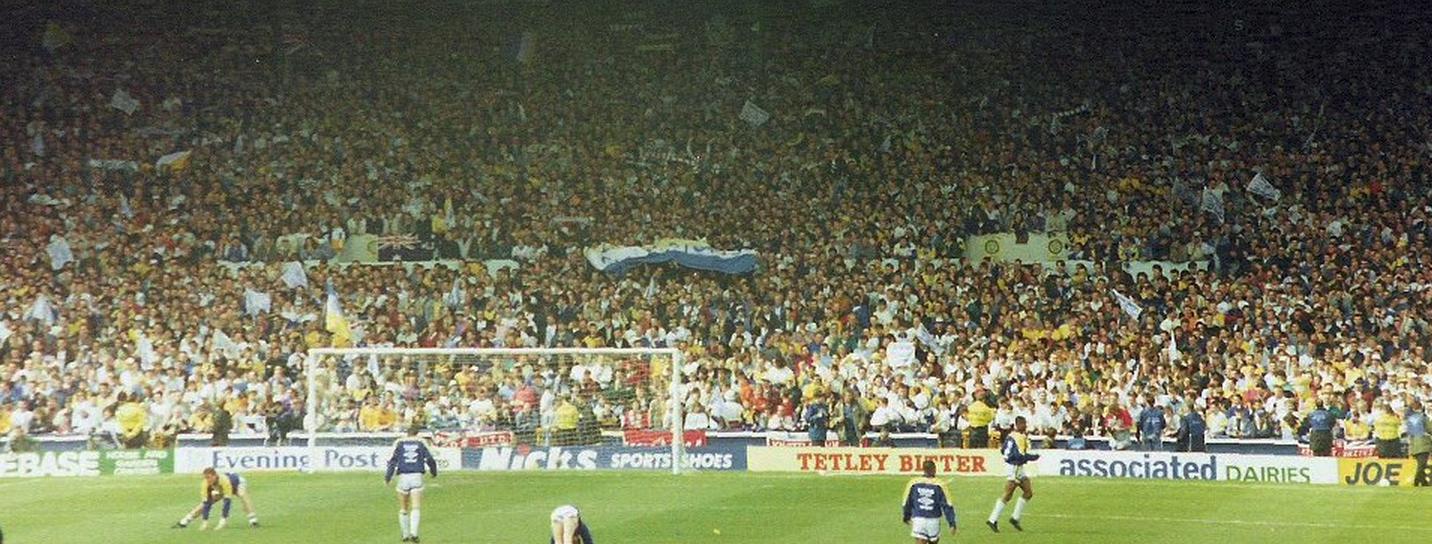
leeds_united_win_the_charity_shield_in_1992_5861482

Leeds United – Wembley Winners

For all the rival claims of the FA Cup and (don’t laugh) the variously-sponsored League Cup, there’s little doubt about the Wembley occasion it’s hardest to reach, the honour it’s toughest to compete for.  Yes, ladies and gentlemen, I give you the FA Community Shield, or the Charity Shield as it used to be known in less politically-correct times.  This is not an event you get to be part of merely by winning a few games at home against the likes of Orient and Norwich, with maybe a semi-final against Aston Villa to spice it up.  It’s not a trophy you can win simply by the luck of the draw.  This is an event for winners, although League runners-up sometimes get a look-in if one club has been greedy enough to win the “Double”.  The Charity Shield is billed as the clash between reigning Champions and FA Cup-holders and as such it has the stardust of success and glory sprinkled all over it.

The Battle of Wembley '74

The Battle of Wembley ’74

Some will demur, saying it’s just a pre-season friendly.  Well, it does take place pre-season – but a friendly?  Before we look at this 1992 meeting of old foes Leeds and Liverpool, let’s cast our minds back to 1974 when the two sides met in the very first Wembley Charity Shield.  Kevin Keegan and Billy Bremner sent off, Giles displaying the art of the left hook on the ref’s blind side to dislodge Keegan’s perm – and all manner of malicious goings-on besides as Cup-holders Liverpool edged out Champions Leeds on penalties after a 1-1 draw for which “combative” is a hopelessly inadequate description.  Ray Clemence conning David Harvey over the ‘keepers taking the last two penalties, then grinning broadly as he reneged on the deal.  The violence and then the discarded shirts of the guilty as they walked off, dismissed by the schoolmasterly Bob Matthewson, a ref who towered over the pocket battleships in the opposing midfields.  The fuss and bother afterward as the FA decided examples should be made, long bans handed out.  A “friendly” it most definitely was not.

This 1992 match though was played out in a much lighter and more entertaining vein.  There was an air of conspiratorial glee around the old ground; Liverpool had administered the fatal blow to Man U’s title challenge at the end of the previous season with a 2-0 victory, the faithful of the Anfield Kop taunting their misery-stricken rivals with chants of “Leeds, Leeds, Leeds” as the last hopes of Man U and media alike drained away.  The real Reds then went on to Wembley and routinely won the Cup against Leeds’ old Nemesis Sunderland, so that this “Traditional Curtain Raiser to the Season” had about it a faintly gloating atmosphere – mutual congratulation was in the breeze as we all celebrated the discomfiture of the Mancunian and Mackem scum.

The game itself was a crazy mixture of potent attacking and Keystone Kops defending which foreshadowed the season both clubs were to experience, but which was avidly lapped up by both Kops at either end of Wembley.  Leeds opened the scoring when Rodney Wallace scampered into acres of space on the left before squaring for one Eric Cantona to finish confidently past Grobbelaar in the Liverpool goal.  That was on 25 minutes, but only ten more were to elapse before Liverpool were level.  A deep cross from Ronnie Rosenthal found Ian Rush with enough far-post space to plant a header past John Lukic.  This was at the Leeds fans’ end, and I remember at the time thinking that Liverpool would now go on to win, but what a cracking day we were having anyway.  But shortly before half-time, Leeds were ahead again, Tony Dorigo sending a deflected free kick beyond Brucie into the left hand corner of the net.

The second half saw the game continuing to see-saw as both sides went for it.  Liverpool contrived a second equaliser when Dean Saunders fastened on to a loose ball and powered it past Lukic in the blink of an eye.  Again that feeling of slight resignation and again Leeds blew it away, regaining the lead after 75 minutes when Cantona headed a cross ball down for Wallace to tap back to him.  Cantona looked up and calmly directed the ball wide of Grobbelaar for 3-2.  The joy among the Leeds fans at this cherry on the icing of last year’s title triumph raised itself to a still higher level when the match seemed to have been decided 4 minutes from the end.  Wallace chased a ball out wide which, instead of trickling out of play, bounced off the corner flag and gave the live-wire Rodney an ideal chance to put in a telling cross.  And there was Cantona again, lurking at the far post as Grobbelaar flapped ineffectively for the ball, watching it all the way and planting a header into the empty net.  4-2 up against Liverpool at Wembley!  Eleven months before the birth of my daughter, this was probably just about up there with the Title decider at Bramall Lane for the most joyous events of my life to that point, and for a few delirious moments I didn’t rightly know where or who I was.

Sanity had barely returned when, way down at the other end, Gordon Strachan scored what must be the comedy own-goal of all time, executing a singularly ungraceful backward stagger as he tried to clear from the goal-line but succeeded only in trickling the ball over it.  Some cheered, some laughed; nobody was downcast except perhaps wee Gordon himself who looked distinctly pissed-off.  Leeds had won though, the occasion had lived up to and beyond expectations for me and my happy band and we waited joyously to watch the lifting of silverware at Wembley.

Before that happened, another display of respect and gratitude as the defeated Liverpool players trooped off into the tunnel at the United end of the ground.  The jubilant Leeds fans as a body stood to applaud their old enemies, the chants of “Liverpool, Liverpool, Liverpool” drawing reciprocal if shattered applause from the bemused players in red, honour satisfied, tributes paid.  Then the Leeds players going up the thirty-nine steps to hoist the Shield high, and cheers echoing anew from our throat-sore and ecstatic hordes.  Leeds United: Champions of England – the Last Champions – Charity Shield winners and the only team ever to score four against Liverpool in all of the Anfield giants’ numerous Wembley appearances.  Vivid memories of a truly wonderful day.

Can Man U Finish Above Everton & Spurs and Make the Top Six? – by Rob Atkinson

City beat scum

Man U – also rans?

The longer this Premier League season goes on, the clearer it is that there is a mini-league, right at the top, of teams who are frankly in a different class to the rest.  The question is – how big is this league within a league?  The thoroughbreds appear obvious – Arsenal, Chelsea, Manchester City and Liverpool.  But coming up on the rails, we seem to have decent stayers in Everton and Spurs.  These latter two appear destined to create a buffer-zone – a sort of No-Man’s Land – between the Champions League qualifiers above them and the rest below.

It’s been the kind of weekend to reinforce such impressions.  Arsenal were below their fluent best and reduced to ten men, but won competently at Palace 2-0.  Chelsea and Manchester City served up a gourmet’s delight of a match that looked likely to be a top-drawer draw until Joe Hart’s late cock-up presented Torres with a winner.  Liverpool with Suarez irresistible and Sturridge’s sublime finish look as if they are intent on returning to the top table.  Spurs and Everton won as well, without the shimmering class of the top four, but hanging in there.

But what of Man U?  What indeed.  The media are still liable to get into a heck of a froth about them, given the least encouragement.  One TV commentator yesterday was screaming “Never write them off!” as they came from behind to beat ….. Stoke.  At home. Ring-a-ding ding.  The gulf between the formerly dominant Pride of Devon and the cream at the top of the pail, though, is currently a yawning chasm.  On today’s form, Man City and Chelsea, engaged in a titanic struggle at Stamford Bridge, would have had no trouble sweeping aside the fragmented resistance and feeble assaults that were in evidence at the Theatre of Hollow Myths.

If I were a Man U fan, I’d be worried.  Actually, if I were a Man U fan, I’d be utterly disgusted with myself and would probably curl up and die of self-loathing, but you take my meaning.  Man U fans should be worried.  Their edifice is built on perpetual Champions League qualification, and that must be in severe doubt as things stand.  If they don’t qualify for Europe’s premier competition, and all the oodles of millions that go with it, how will the Glazers’ balance sheet look then?  “More than a bit sick” is a very educated guess.

Indeed, far from trying to figure out which of that likely top four they might hope to displace, the money men at Man U should be scratching their heads and wondering whether they can realistically hope to out-perform Spurs and Everton – because if they can’t, then a finish outside the top six beckons, with no European competition at all. Then that Glazer-inspired leveraged buyout, with all the debt it has accrued, starts to look seriously scary.  But, as you’d currently expect either Everton or Spurs to beat Man U, this is a real prospect – the ailing champs have no divine right to a European berth (although I’d bet good money they’d get a wild card through winning the Fair-Play League, or the Refs’ Best Mates League, or something).  The bottom line is, though – the immediate prospects for Man U look as bleak as they have for a while.

You don’t have to look far for the reason behind this.  The tyrant is no longer on his dictatorial throne – Fergie is gone.  Instead, you have a middling sort of chap in Moyes, about whom the current joke runs that he’s wanted to get Everton above Man U for ten years, and has only now managed to achieve it.  With Fergie went Man U’s edge – the fear of the wattled Glaswegian’s wrath which was the best motivation tool of all.  Try though the media might – driven by their concerns over markets and reading/viewing figures – you cannot, as they say, polish a turd.  Trying to talk up Man U’s chances of league success this season is a futile attempt to do precisely that.

So, the Kings are dead – long live the Kings.  But which Kings?  Who will be ascending the throne?  It’s difficult to say, because the clutch of class at the top of the Premier League is closely-matched indeed, and all the more thrilling and entertaining for that. My heart says Arsenal, because I love their football – but sadly the virtuoso moments like Wilshere’s finish, on the end of a quicksilver three-man dance through Norwich’s defence, sometimes lack for the requisite steel to back them up, as Dortmund demonstrated last week.  But Arsenal will be up there.

Liverpool will be there too.  But I fancy Arsenal and Liverpool to be third and fourth at the end of the campaign.  Chelsea and City should fight it out, and out of those two, it’s just a case of “may the best team win”.  With my arm twisted up my back, I might just go for City – if they can cut out those suicidal mistakes.

And it might just be worth a punt on Man U to finish behind Everton and Spurs at seventh or below.  You’ll probably get good odds – try BetFred, if he’s not already paying out on bets for the Pride of Devon to win the league.  For some, the New Order will take a bit of getting used to…

Proud Dad Suárez Bites Back at the Double as Liverpool Resume Premier Challenge – by Rob Atkinson

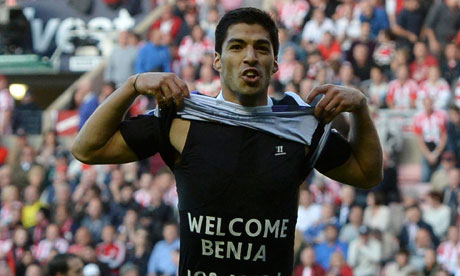
Suárez dedicates goal to new baby son Benja

Suárez dedicates goal to new baby son Benja

The footballer so many love to hate, nasty Suárez, “racist” Suárez, mad-dog Suárez, call him what you like (and the sanctimonious tendency among football fans need no undue persuasion) showed a soft and squishy side to his nature after his comeback goal on Sunday, the first of a brace which helped resurgent Liverpool dispatch rock-bottom Sunderland.  After tapping the ball into the Wearsiders’ net to make the score 2-0 to the Reds, Luis Suárez raised his Liverpool top to reveal an undershirt with the legend “Welcome Benja” inscribed thereon; a warm “Hello, son” to his new baby boy, born last Thursday.

It’s a heart-warming tale, but nevertheless many will maintain the set of their lips in a thin, disapproving line.  Bad boy Luis has been a sinner many times since his entrance into English football, but it’s also the case that he’s provided many illuminating moments of skill amounting to genius.  The more tolerant in the football family might find it in their forgiving natures to concede that the balance is marginally on the credit side of the ledger.  Though his sins are like scarlet, or at least like a Liverpool red, yet shall they be as white as snow.  Or so the Good Book sort of says.

It was the striking partner of Suárez who came closest to “sinner” status at the Stadium of Light, the ball flying in for Liverpool’s opener, not as intended off Daniel Sturridge’s head, but rather off the top of his arm.  It was deemed an accidental contact, the goal stood and Liverpool were on their way to a victory that became less comfortable the longer the match went on.  Sturridge it was who provided the cross for the second goal, darting into a half yard of space near the goal-line to spear a low cross which Suárez, Johnny-on-the-spot, buried with ease.  Sunderland had contributed plenty of effort to the first half, playing a high pressing game, and the two incisions which saw them behind at the interval were perhaps slightly rough justice.

In the second half, Sunderland’s hard work continued and eventually earned them a glimmer of hope when ex-Black Cat Simon Mignolet in the Liverpool goal could only parry a stinging shot from outside the area. Emanuele Giaccherini snapped up the resulting rebound chance with glee and Sunderland were back in business.  The home side were reinvigorated by the breakthrough, as tends to be the case and a new purpose showed in their attacking play. Liverpool were pressed back for a spell and endured their most worrying period of the match, until a swift break saw Sturridge in space on the left, enabling him to pull the ball back from the byline for that man Suárez to apply a deadly finish and wrap the proceedings up at 3-1.

Of the main title contenders, it’s been a good weekend for Arsenal and Liverpool, not so good for Spurs and Chelsea and pretty disastrous for Manchester City.  Unbeaten Everton still lurk around unbeaten, threatening to gatecrash the elite pack.  It promises to be a tight race for the honours at the top of the Premier League – and Liverpool, with Suárez ebullient, seem determined to have a big say right to the end, just as in the old days.  For managerless Sunderland, rooted to the top-flight basement with just one solitary point to show for the season so far, the future looks a whole lot bleaker.

Leeds United Needs Another Vinnie Jones – by Rob Atkinson

Sir Vincent Peter Jones

Sir Vincent Peter Jones

The men who took Leeds United back into the top-flight the last time it happened in 1990 are, of course, legends now.  They rank alongside some of the Revie boys because they rescued the club from eight years in the wilderness and restored us to the big time.  We had our own diminutive red-haired midfielder as a sort of latter-day homage to Billy Bremner – mighty atom Gordon Strachan, who played a crucial role in the renaissance of Leeds with his leadership and goals.  It was a team effort though, and it was as a team that they succeeded – Strachan apart there was no major star, but the guts and drive of the collective effort eclipsed all rivals by the end of that fantastic season, when we were crowned Second Division Champions in sun-drenched and strife-torn Bournemouth.  And nobody in the whole club at that time epitomised guts and drive, as well as sheer fist-clenched, vein-throbbing commitment and fight, better than Mr Vincent Peter “Vinnie” Jones.

I’d been aware of Vinnie, of course – who hadn’t?  His Crazy Gang antics were legendary and he’d lifted the FA Cup, but he was regarded as a bit of a maverick – still more hod-carrier than footballer, famous for a ten-second dismissal and for his promise to Kenny Dalglish before the 1988 Cup Final against Liverpool to “tear off his ear and spit in the hole”.  Still, despite these immaculate credentials, marking him out as a potential Gelderd hero, never in my wildest dreams did I imagine him as a signing for Leeds United, where stirrings had been going on ever since Sergeant Wilko marched in and started shaking the place up.  The “marquee signing” – you didn’t actually hear that phrase in those days – was Strachan, plucked from under the nose of his old Man U mentor Ron Atkinson at Sheffield Wednesday to provide the quality at the heart of the Leeds engine room. Now that was the sort of signing I’d hoped and prayed for, and with the likes of Chris Fairclough joining Gordon at Elland Road it seemed to bode well for a real challenge as the close season wore on and 1989-90 loomed closer.

I was in a caravan on the east coast when I heard on the radio that Vinnie was signing for Leeds for around £650,000.  I frankly didn’t believe it, but when the reality sank in, my initial reaction was to think – bloody hell, Wilko, what are you playing at?  The signings of John Hendrie and Mel Sterland reassured me somewhat, but I was still having trouble seeing what the Jones Boy would bring to the United table, although our lunatic-fringe fans seemed well suited.  The early signs were not encouraging.  Strachan tells of an incident in a pre-season game against Anderlecht, where he saw an opposing player go down with his nose spread halfway across his face and blood greatly in evidence.  Vinnie had casually “done” him en passant before sidling off looking innocent, and Strach recalls thinking: my God – what have we signed here?

Vinnie himself remembers his early days at the club, and being moved to violence by the negative attitudes of some of the players being edged out as Wilko’s new broom started to sweep clean.  Among this disaffected few was John Sheridan, something of a Leeds legend – but Jones stood for no nonsense, and there were punches thrown and people seized by the scruff of the neck as he explained his views on solidarity and team spirit.  Vinnie was obviously going to be a kill or cure measure – there were signs he might have much to contribute to the collective effort, but equally that he might turn out a loose cannon which could blow up in all our faces.  Yet Wilko had a magic touch in those early years, and generally it was proved that he knew what he was doing.

In the event, and despite an uncertain beginning, Vinnie played a massive part in our promotion that year.  The fans took to him from the start – the sight of him coming on as a sub in the first home game against Middlesbrough will live long in my memory.  I can see him now, in the middle of the park with the game poised at 1-1, shouting and screaming as he conveyed encouragement and instruction in equal measure, arms pumping in an ungainly, baboon-like way, team-mates and opponents alike staring at him aghast.  And then he frightened a Boro’ defender into scoring a late, fluky own-goal and we had won, setting us on our way after a disastrous opening-day defeat at Newcastle.

Vinnie just carried on making a difference.  He worked and worked, encouraged and exhorted, fought for the cause and put the fear of God up the enemy wherever he encountered them.  He scored spectacular goals, important goals.  He showed flashes of genuine ability and some of his passing was sublime.  He avoided disciplinary trouble to an amazing degree, given his lurid past.  He sold himself to no less a judge than Strachan as an honest performer who could “play a bit”.

Vinnie also created a rapport with the crowd I’ve rarely seen before or since, chilling and joking with the wheelchair-users at the front of the West Stand before games, and smoking imaginary cigars as he took the plaudits of the adoring masses after finding the net against Ipswich.  In the warm-up before the Wolves match at Elland Road, he provided one of the great moments of humour in a tense campaign, bringing down five year-old mascot Robert Kelly in the area with a signature sliding tackle, much to the delight of the Kop – and of young Robert himself.

Vinnie loved Leeds, the players and fans loved Vinnie and the partnership proved fruitful.  Up we went, and when Vincent Jones finally took his leave for the humbler surroundings of Bramall Lane and Stamford Bridge, it was with a tattoo: “LUFC Division Two Champions” proudly inked onto his expensive leg, a partner for the “Wimbledon FA Cup Winners” one on the other limb.  He was a Leeds United legend in only a little over a year at the club, a larger-than-life personality of massive ebullience and impact – and he is held in the highest of esteem in LS11 even to this day, when he mixes effortlessly in the rarefied, glitzy atmosphere of Hollywood.

So what do we need more right now than another Vinne type, as we hope to secure another long-overdue return to the top table?  Those Jonesy ingredients of passion and power, guts and gumption, are just as important in this league today as they were in those far-off times as the eighties became the nineties.  Who could possibly fulfil that role now?  Joey Barton maybe?  Even he could hardly be a greater culture shock than Vinnie was 25 years ago, but Barton is back in the QPR fold and far beyond our purse anyway – also, quite frankly, he lacks Vinnie’s essential honesty and sheer bad-boy charm.  It’s difficult to say who if anyone we might now secure to play the Vinnie part – but if it were possible, in time for the next transfer window, to distil essence of Jones, or to clone him right from his bloodstained boots and tattooed ankles up to his fearsomely-shaven head, then I’d do it, and I’d present the result gift-wrapped for Brian McDermott to deploy as he saw fit.

A man in the mould of Vinnie Jones would be just the shot in the arm our club needs right at this point in time, just the incentive for the crowd to roll up its sleeves and get behind the team for the remaining battles in this 46 game-long war of attrition.

Just imagine the fillip that our season, our whole club would receive – if only we could have our Vinnie back now.

Moyes Faithfully Following Fergie Methods to Achieve Success – by Rob Atkinson

Image

One thing stood out plain and clear from today’s insipid victory for Man U over newly-promoted Crystal Palace – it’s going to be the tried and trusted route to success for Devon’s finest, especially at the Theatre of Hollow Myths.

It was the classic Man U home game against stubborn opposition bent on making things tough for the media’s darlings. Batter away, secure a dodgy penalty and if at all possible, have a complaisant ref who’s well-briefed enough to be aware of his responsibilities and who will obligingly reduce the away side to ten men, consigning the rest of the game to the status of a non-contest. It’s a reliable enough game plan, though depending heavily upon Ashley Young’s talent for ending up prone in the penalty area, regardless of where the alleged foul took place. It’s happened time and time again, prompting embarrassed “hem hems” in the commentary box, and a general air in the press of hoping that people won’t notice, no matter how often the same scenario plays itself out. It’s depressing, but modern football is modern business, and markets speak louder than words. Those shirts and the other Man U tat won’t just sell itself, don’t you know – and there’s warehouses full of the stuff all over the hotbeds of support across the South of England.

As they travel back to London after the match, fans of both teams might agree on one thing: Old Trafford isn’t quite the place it used to be. Time was it would be described as a fortress, albeit a pretty quiet one. But there’s always been that suspicion that “fortress” was not a very apt description, indeed that “bent crap table with loaded dice” would be far more accurate, the local management usually ending up happy, by hook or by crook. That reputation preceded Fergie, but certainly flourished under his tyrannical reign, his use of bluster, threats and intimidation to ensure that press and officials were all singing from the Man U song sheet.

As I’ve already mentioned elsewhere, new boss Moyes appears to have shed his former “quite nice guy” image, and reinvented himself as a Fergie Lite. Given the relative paucity of quality in his current squad, as compared to the likes of Liverpool, Chelsea, Arsenal and City, this would appear to be his best bet – take those boys on at Football, and the modern-day, post-Taggart Man U would be in danger of some humiliating batterings. Already, Moyes’ paranoid pre-season whinge about having to play three Big Clubs in their first five fixtures appears prophetic. Two home points dropped against Chelsea, defeat away to the historical masters Liverpool. Better then, surely, to rely on the admittedly shady measures that brought so much undeserved success over the past twenty years of Murdoch-sponsored domination. After all – what’s a global franchise supposed to do? It’s win or, quite possibly, bust.

Whether a continuation of the same old, same old routine down Salford way can really take a sub-standard Man U squad to their accustomed honours must be open to doubt. The transfer window was a sobering experience for die-hard Nitid devotees from Torquay to Jakarta. City have secured diamonds, Arsenal have a pearl in Ozil, Liverpool are improved beyond all recognition and Chelsea have The Special One – ’nuff said. Man U meanwhile experienced a long and ongoing tragedy of a window, a car-crash experience of humiliating failure and rejection – ending up with someone in Fellaini whose best chance of a major role at the Theatre of Hollow Myths would appear to be sticking his head down the toilet and giving that U-bend a good going-over. Even Champions League pariahs Tottenham fared much better than that, and could well be dark horses for a top-four place this time around, particularly if favourable officiating and Moyes’ pallid impersonation of Nasty Alex isn’t enough to raise Man U out of sub-top six mediocrity.

And what if Man U really do fail – as their lack of quality and surfeit of internal strife might suggest they will? What then for former nice-guy Moyes? Is he destined to be the 21st Century Wilf McGuiness? Will “Sir” Fergie be tempted back to reprise Busby’s early 70’s attempted rescue act? It all remains to be seen, but the harrassed and worried glory-hunters on their long trip back to the south can be reassured after today’s standard-issue double-whammy of penalty and red card against opposition who threatened to frustrate them, that some things at least haven’t changed.

Super Leeds: The Last Champions – by Rob Atkinson

Stand Up For The Last Champions

Stand Up For The Last Champions

If you should happen to be a football fan – as I am, and have been these many years, since days of yore with short shorts, middling ability and long sideburns – then you may well be in the habit of switching on the TV occasionally to watch the glitzy offerings of the munificently funded Premier League.  With its incomparable array of prima donnas and fabulously wealthy superstars, prancing athletically around a pristine and manicured football pitch in the very latest state-of-the-art stadium (constructed courtesy of Meccano Inc.) – it’s a far cry from the heyday of The Football League, Divisions One to Four.

Back then, men were men, refs were nervous and physios routinely cured ruptured cruciates or shattered thighs with a damp sponge and hoarse exhortations to “gerron with it” – or so it seemed.   Full-backs with legs of the type more usually to be found on billiard tables would careen through the mud at Elland Road or Anfield, some flash, quivering, overpaid at £200 a week winger in their merciless sights, destined to be afflicted with acute gravel-rash.  Centre-backs with foreheads like sheer cliffs would head muddy balls clear to the halfway line, get up out of the mire, groggily shake their mighty heads, and then do it all over again – for the full 90 minutes, Brian, giving it 110%.  The good old days, without a doubt.

There is little that the modern game has in common with those far-off, non-High Definition times when some top-flight games weren’t even covered by a local TV camera for a brief clip on regional news.  Now, every kick of ball or opponent is available in super slow-mo for in-depth analysis by a battery of “experts”, from a dozen different angles.  The game today is under the microscope seven days a week, where then it was viewed only from afar, limited to highlights from a select few stadia every Saturday evening and Sunday afternoon.  Even now, the smell of hot ironing and roast beef with Yorkshire Pud will take me back to Sabbath afternoons sat contentedly before “Sunday Soccer” as Billy Bremner and Co dismantled the hapless opposition.

Leeds United was the team, back then.  On their day, the lads would toy with their rivals as a particularly cruel cat might do with a half-dead mouse.  Many will recall the spectacle of a mortally-wounded Southampton side – already seven goals to nil down near the end of the game – trying all they knew to get a touch of the ball as their tormentors in white passed it effortlessly between themselves, brazenly flaunting their catalogue of flicks, reverse balls and sublime long passing.  The game was long since won and all Leeds’ energies were palpably focused on a very public humiliation of their exasperated victims.  Some thought it was in poor taste, a shoddy way to treat fellow professionals.  Leeds fans remember it 40 years on as the ultimate statement of an undeniably top team, proclaiming to the nation “Look at us.  We are the best.”

This was 1972, when Leeds might well have won pretty much everything, but had to settle in the end for their solitary FA Cup triumph, missing out on the Title right at the death in typically controversial circumstances.  Leeds won far less than they should have done; a combination of official intransigence, their own inherent self-doubt, Don Revie’s crippling caution and superstitions – together it must be said with some shockingly bad luck – limited their trophy haul to a mere trickle when it should have been a flood.  But those flickering images of arrogant dominance and untouchable skill revealed also an unbreakable brotherhood and grisly determination that spoke of a very special team indeed.  The resonance even today of that oft-repeated tag “Super Leeds” says far more about the status of Revie’s side than any mundane tally of trophies possibly could.

In those days, of course, the gulf in ability between Leeds United and Southampton, described by Match of the Day commentator Barry Davies as “an almighty chasm”, was just that.  The gap in class was achieved on merit.  It wasn’t backed up by any such gulf in the relative earnings of the men in white and the demoralised Saints, or players of any other club.  The playing field back then was very much more level than it is now, when the top few clubs – in an apt metaphor for society at large – cream off the bulk of the income, leaving the rest to feed on scraps.  The pool of possible Champions was consequently greater – Derby County won it that year of Southampton’s ritual humiliation, as Leeds faltered when required to play their last League game a mere two days after a gruelling Cup Final.  Imagine the outcry if one of the major teams had to do that today!  And ask yourself if a Derby County or a Nottingham Forest are likely to be Champions again in the near future, blocked off as they are from that status by the oligarchy at the Premier League’s top table.

There aren’t many more hackneyed phrases than “The Good Old Days” – but for those who like their sporting competition to have a wide and varied base, with the possibility of a good proportion of the participants actually having a chance to win in any given season – then the 60’s, 70’s and 80’s take some beating.  Leeds United fans like to refer to their team of 1992 as “The Last Champions”, and a convincing case can be made for this, looking at the transformation which took place shortly thereafter, the explosion in finances for the chosen few, and the small number of clubs – invariably backed by mega-millions – who have been Champions since.  Even the once-mighty Liverpool FC has been affected.  Despite Leeds United’s current problems, they have been Champions more recently than the Anfield Reds.

It’s perhaps fitting that Leeds have a claim to the title of The Last Champions.  As Super Leeds, they dominated English Football for a decade, without ever winning their due.  Now that we can look back with misty eyes to a turning point for the game 21 years ago when the Premier League broke away, and the cash registers started to make more noise than disillusioned fans, we can possibly consider those 1992 Champions, nod to ourselves, and say yes; they were the last of the old guard, the final Champions of the Good Old Days.

As epitaphs go, it’s not a bad one.

Hillsborough Disaster Police Sold Their Souls for £14.53

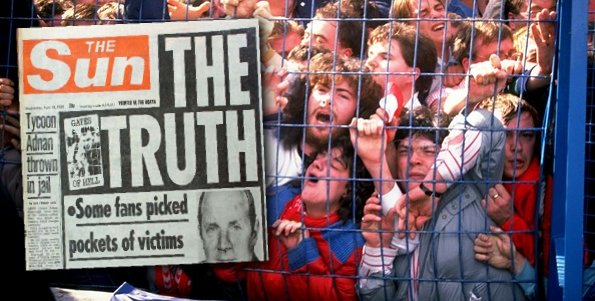
Hillsborough Disaster (Lies Inset)

Hillsborough Disaster (Lies Inset)

It has emerged in a report carried by the i newspaper that the police force charged with ensuring public safety on the occasion of the Hillsborough Disaster kept money found among the dead and dying, choosing to pay the amount found into the police bank account after they’d held it for a period of three years, rather than donating the sum to the disaster fund which had been set up to help victims and the bereaved.  The sum?  £14.53.

It’s perhaps because of the paltry amount involved, rather than in spite of it, that this is such a shocking story.  A full three years passed before the casual decision was made – without objection or reservation – to pay the money into the police account.  The cash was made up of loose change gathered from among the bodies of the dead and dying in the immediate aftermath of the tragedy, and it appeared as part of an inventory detailed in a memorandum dated January 1992, which also recorded the decision to bank the money.

In the midst of all the other negative findings about the conduct of the police at several levels that day, and in the light of the fact that they appeared complicit in the lies that were spread in the days and weeks after Hillsborough – notably by the Sun newspaper – the amount of £14.53 seems trifling enough.  And yet, understandably, the impact felt by the families of the victims at this unsavoury incident is likely to be out of all proportion to the actual size of the cash amount involved.

Only last month, it was reported that South Yorkshire Police attempted to apply to the disaster fund for a sum running into thousands, earmarked for the provision of microwaves, gym equipment and a holiday home for police use.  In conjunction with this new revelation about the fate of loose change picked up from among the dead, it really does beg the question of exactly what motivates those who make decisions like this, and what level of awareness they have of public opinion in such sensitive matters relating to a disaster that continues to reverberate almost a quarter of a century on.

If there is anybody in a position of authority in the police organisation with the slightest trace of decency, honour and plain good taste, then they will take a look at this latest disgrace, take careful note of the sum of £14.53, multiply it by one thousand – and donate that amount into the Hillsborough Disaster Fund.  That may still be a case of too little, too late – but better late than never and surely – surely – some gesture now needs to be made in the face of what has been nothing more or less than a 24 year public relations disaster for the South Yorkshire Police. 

RIP The 96.

Liverpool Edge Out Man Utd to Pay Fitting Bill Shankly Centenary Tribute

Bill Shankly - Legend

Bill Shankly – Legend

Monday 2nd September 2013 marks the centenary of the birth of Bill Shankly OBE, Liverpool’s legendary gravel-voiced Scottish manager, the man who took a moribund club and transformed it into a European power in a manner rivaled only by his great friend and contemporary rival, Don Revie at Leeds United.  It was fitting, therefore, that Liverpool should choose their last fixture before this notable anniversary to deliver a resounding “We are back” message to the rest of the top division, deservedly beating a Man U side that was never allowed to play their own game, and succumbed to an early goal of devastating simplicity.

Liverpool had entered the game on a high – two previous league games had yielded six precious points via steady 1-0 wins for a 100% record as Brendan Rodgers finally looks like putting his own stamp on this famous old club.  The Reds started in a fluent and cohesive style and within four minutes they were ahead.  A corner from the right was swung in and Daniel Agger showed great movement in the area to completely fox Rio Ferdinand, losing the defender to nip in front and get a firm header in on goal.  As the ball arrowed towards the net, two Man U defenders looked able to deal with it, but there was Daniel Sturridge, celebrating his 24th birthday by sneaking between them to apply a decisive touch and send the ball into the net. Mayhem ensued around the ground, apart from the glum band of away supporters who were doubtless contemplating a long and possibly empty-handed trip back down south.

After that, it was a question of plenty of possession for the away side, comfortably dealt with on the whole by Liverpool, who were content to blot out the Manchester attacks and wait for their chances to break away.  Wayne Rooney was missing for Man U, and Robin van Persie was uncharacteristically subdued, his sole chance of note coming late on when he was in space on the right of the Liverpool area but put his shot well wide.

New Man U boss David Moyes must have been hoping for a change of luck after 12 fruitless managerial appearances at Anfield, all as manager of Everton.  His debut as Old Trafford manager turned out to be unlucky 13, but in reality luck didn’t have much to do with this result.  To Liverpool’s credit, they seized their chance to take an early lead, and were thereafter little troubled despite surrendering the majority of the possession.

It was a result to savour for all Liverpool fans, as any win over their bitter rivals must be – but to triumph over former Everton boss Moyes, on the eve of the 100th anniversary of the late great Shankly’s birth – this was a script it would have been hard to write.  Shanks would be proud to see Liverpool sitting proudly at the top of the league with maximum points – it was the kind of thing he demanded.  Whether Liverpool can maintain the early pace is another question, but on this evidence they will be hard to topple.