Tag Archives: Manchester United

How Ex-Ref Poll Lifted Lid on Myth of Man U “Dominance” – by Rob Atkinson

Ferguson: intimidation

Ferguson: intimidation

As a Leeds United fan, the twenty year period between the start of the Premier League era and the departure from Man U of Alex Ferguson was for me a two-decades long spell of misery and disillusionment, relieved only by occasional peaks when some other team got a chance at the game’s major honours.

Man U monopolised the action to an extent unprecedented in modern history; to an extent, what’s more, unheralded even by their own respectable record prior to 1993. It was as if, with the inception of the Murdoch-backed elite top flight, a switch had been thrown to activate a Man U winning machine and reduce all rivals to the status of also-rans.

It was a modern phenomenon – but, as it now turns out, it was all a myth, all smoke and mirrors. This was aptly summed up by the present-day Man U struggling, with most of the same personnel and all the same financial advantages, against League Two basement boys Cambridge United. This was the reality masked by that twenty year bubble. Man U are relatively ordinary – the Taggart years were a myth. What we were watching over those two decades was nothing more than an over-long retelling of “The Emperor’s New Clothes” – and we’re now some way past the part where the clear-sighted little boy has blown the gaff.

Thousands upon thousands of pissed-off football fans could tell you their own tale of a refereeing injustice sustained by their team, to the benefit of Man U. I have a variety of my own where Leeds United have been denied – a penalty given two yards outside the area at the Gelderd End, the disallowing of a Wes Brown own goal (for offside!), the failure to dismiss Man U keeper Fabien Barthez after he had conceded a penalty so crudely that it had had to be given – only for him to remain ludicrously undismissed and poised in goal to save the spot kick when he should have been taking an early bath.

Many other clubs will have similar anecdotal evidence. Tottenham’s “goal” at the Theatre of Hollow Myths, two yards over the line but not given, Barnsley’s non-awarded penalty at the Beckford End when the foul was so blatant that even the commentators swore it should have been awarded.  There are many, many more. It’s happened time and again, over the whole history of the Premier League.  A notorious statistical study found that, over an extended period of time, 87% of all fifty-fifty decisions went the way of the Pride of Devon.  In a game of fine margins, as any top-level professional sport is, that is a deeply damning statistic – and it makes a vital difference.

Over this whole period, naturally, official reassurances and denials of the obvious were as bland and unctuous as they were patronising and insulting to the intelligence of fans everywhere.  The media were complaisant in this, and the commercially-driven circus travelled on. At any slight sign of rebellion or disagreement with the party line, Ferguson himself would make a choleric proclamation; damning whichever referee had failed to decide in his team’s favour, or pouring Govan bile over whichever media organisation had dared think the unthinkable, or presumed to print heresy. One of the most familiar of radio sports headlines was “The FA have confirmed that Alex Ferguson will face no further action over [insert blatant transgression of rules here]”. It was tiresome, it was depressing – but it was the norm and, over time, a weary acceptance crept in that this is how our game now was.

Graham Poll - admission

Graham Poll – admission

Sooner or later, though, there was bound to be someone intimately involved with all of this, who would finally break ranks and confirm what we always knew: namely that two decades of unprecedented success have been founded upon bullying and intimidation to influence the game’s authorities both on and off the field, and to ensure a smooth passage in the print and broadcast media.  Then, finally, ex-referee Graham Poll came out in print and admitted how it was to be officiating in that era when Fergie’s word was law and referees (together with their support officials and governing body) were under immense pressure to rule on matters in a manner favourable to Man U.

“All the refs wanted in a Man U game,” said Poll, “was to get the match over, without having made any controversial decisions against Fergie’s boys – and ideally with Man U having won.”

Damning stuff, straight from the horse’s mouth. Again, we’re back to those fine margins. At the top level of any sport, it doesn’t take much to destroy the balance upon which depends true competition to ensure a reasonably level playing field.  It turns out that the playing field was as skewed as Yeovil’s legendary sloping pitch of giant-killing memory.  But at least at Yeovil, both teams got to play with the slope for half a game each.  Poll’s evidence is that the slope was in favour of Man U for 90 minutes plus however many were needed to ensure the “right” result.  Man U have won all those Fergie years honours with the aid of loaded dice.  So much in control of the game were they, it redounds to their shame that they didn’t win absolutely everything, every year.

Don’t take it from me.  Why would you?  I’m a Leeds fan with my own instinctive dislike and contempt for that over-blown club, that media-inflated false legend built on a well-marketed tragedy.  But just think back over all those incidents going back all those years.  Look at the watershed of the Premier League being founded – how the game was suddenly all about commercial interests, flogging satellite dishes and replica shirts.  Look where the biggest market was – all those plastic Man U fans in Devon and Cornwall, all of those merchandise-hungry fanatics who never saw a match day but shelled out for tacky Man U tat.  Look at the record of the Man U club prior to 1993 – seven titles in all their history.  And then 13 titles in twenty years after Murdoch bought the game and gift-wrapped it for Man U.  That’s quite a before and after picture, isn’t it?

The insistent pressure was extended beyond its mere effect on referees, too.  How many times have you seen Sky TV lingering lovingly over some Man U performance where the opposition simply caved in and rolled over to play dead?  And they’d win, 7-0, 9-0 even. Because they weren’t a bad team, and over the course of those twenty years they may well have won four or five titles, even if the game hadn’t been bent out of shape in their favour. See, I can be realistic about these matters. But ask any sports psychologist about the drip, drip, drip effect of relentless media propaganda. How many times do you need to be told you have no chance, before you begin to believe it? Teams went there psyched-out, expecting to lose, knowing they’d never get a penalty and would more than likely concede one or two and maybe end up with ten men too. Sometimes, they would even rest important players for a game they had a chance of winning a week later. They’d naturally sink to a defeat they acknowledged as inevitable, and Man U’s title rivals could do nothing but grind their teeth. And so the whole basis on which league football is predicated was blown out of the water, all to the inevitable benefit of Man U.  Fine margins and psychological edge – it doesn’t take much to warp the whole shooting match hopelessly out of shape.

What Graham Poll has done is to admit – in so many words – just what a relief it was to get off the pitch without having made any significant decision against a victorious Man U – because he knew what would follow as Ferguson would bitch about it in the press, and nobody would hold him to account.  There are plenty of examples of referees making the “wrong” decision, leading to the “wrong” result – and then not being awarded another high-profile game involving the Pride of Devon for literally months.  It was freely bandied about that this or that ref had been “banned” by Taggart. Meanwhile, the refs who “behaved themselves” – and we all know who they are – were regular fixtures at Old Trafford games, or in away matches featuring Man U.  It was all so frightfully, disgustingly cosy.

Now Ferguson has gone, and Poll – possibly tongue-in-cheek – was “worried” this time last year for the tyrant’s successor David Moyes.  He warned Moyes that he has “no chance” of pulling off the same kind of influence that he cheerfully and willingly admits Ferguson exerted over the game’s arbiters.  Some may well have noticed attempts on the part of the pitifully inoffensive Moyes to act like some Fergie clone, blustering his way into some pallid imitation of the Beast of Govan. But really, it was to very little avail.  And, inevitably, Moyes paid the price as Poll clearly foresaw. It just wasn’t the same for Man U without Ferguson to tyrannise the game, and still isn’t the same feeling under the almost equally baffled van Gaal, for whom the cracks are now starting to show in the shape of tetchiness and intolerance on camera. The Beast is gone – for the moment anyway – and with him has gone most of the edge of intimidation granted to Man U for so many years.

The thing is, this will come as news to not all that many people.  Figures within the media will profess astonishment and cynicism, preferring to dismiss even such compelling testimony as a storm in a teacup.  You still hear, week after week, commentators doing their best to sound surprised when another Man U foul goes unpunished, another good penalty shout goes un-awarded.  In tones of wonderment, they will observe “Well, the ref seemed to have a good view of that, I can’t quite understand why he’s not given it…”  Week after week, month after month, year after monotonous year.  But the fans know – and the fans, other than those with a vested interest and an armchair in Milton Keynes, will be totally unsurprised over those admissions of Graham Poll.  They will not be startled by what he has said – maybe just at the fact that he chose to say it. All of this has been so ‘nudge, nudge, wink, wink’ over the Premier League era.  But the fans have known, alright.

It explains why, whenever a fan answers the question “who do you support” with “Man U” – and despite all those trophies, all that dominance – there is no gasp of respect, no acknowledgement of success.  It’s much more likely that they’ll be laughed at, and there’s no greater tragedy than that for what was once a name respected throughout world football – even if they HAD gone 25 years without the Title.  Ultimately, this will affect the way in which a famous club is regarded by history.  Nobody needs to tell a Leeds United fan about that – and there are more reasons to damn this United from just outside Manchester than there ever were to damn our own beloved United of Leeds.

It’s not clear why Graham Poll chose to come out and confirm what so many of us have known for so long.  Maybe it was a warning ahead of a possible return for Ferguson should even Louis van Gaal suffer Moyes’ fate and be cast adrift as the failures and defeats pile up. There is a precedent for this. Busby returned briefly when Wilf McGuinness, his hapless successor, found he’d inherited a poisoned chalice.  But that was 40-odd years ago and there was no Premier League to warp the game out of shape for pecuniary considerations. And Ferguson, it goes without saying, is no Sir Matt – he is unfit to lick Busby’s shoes, never mind fill them. Our game is far better off without his malign presence and influence.

Could Graham Poll, resentful of the pressure he had to work under as a ref for Man U games, be trying to warn the current batch of officials not to go back to their cowardly old ways if Ferguson DID make a comeback?  Could he belatedly be recognising where his duty to the game should actually be leading him?  One thing’s for sure: it’s out in the open now – and it’s the job of everyone with the interests of football and fair competition at heart to make sure that’s exactly how it stays.

Brave Leeds United Fan Makes Ultimate Sacrifice for Charity – by Rob Atkinson

Brave Darren Forsyth suffers in the name of charity

Brave Darren Forsyth suffers courageously in the name of charity

The remarkable bravery and noble self-sacrifice of a lifelong Leeds United fan drew plaudits over the Christmas holiday, when a deal was agreed which will benefit Wakefield Hospice to the tune of an additional £400 on top of cash already raised. The extra money will be welcomed by the charity – but it will be very hard-earned indeed. For Darren Forsyth, 38, landlord of the Hammer & Stithy in Ossett, West Yorkshire, has had to agree to wear a Man U baseball cap for this coming Sunday evening’s five hour bar shift. Coincidentally, this weekend also marks the fifth anniversary of Leeds’ famous victory at the Theatre of Hollow Myths – when as a third-tier team, they knocked the then-champions out of the FA Cup.

The bizarre charity deal was struck after a Boxing Day raffle in Mr Forsyth’s pub raised £400 for the Hospice. Big-hearted Darren has notable form for fundraising, having helped raise over £10,000 for several charities over the past couple of years, since he has been in charge at the Hammer & Stithy. After the success of the Boxing Day raffle, Darren’s friend – scum fan Phil Hemingway – offered to double the £400 total if Mr. Forsyth would agree to wear a Pride of Devon shirt. Darren was not prepared to sell his pride that cheaply though, and remarked that wearing such a despicable shirt would cost his friend £1,000. An agreement was reached that five hours under the scum cap would be worth £400. Mr. Forsyth is pictured above, with Mr. Hemingway, as donations are handed to Samantha Wood of Wakefield Hospice.

The mind rather boggles at such an outstanding display of self-sacrifice and nobility. Mr Forsyth knows that his ordeal on Sunday will earn him some ribbing from the regulars – but he’s quite prepared to put up with this in such a good cause. “If wearing the hat raises more money for charity, then I’m not bothered,” he said, courageously. ““Me and (Man U fan) Phil always have a bit of rival football banter!”

Rumours that Mr. Forsyth will spend Monday having his head completely shaved and thoroughly disinfected are not be confirmed, but clearly cannot be discounted. It has also been claimed that an additional sum of money might have been raised by the Man U fan Mr Hemingway’s agreement to wear a Leeds United shirt for the duration of Darren’s cap ordeal. Sadly, however, the shirt in question allegedly rotted away the instant it touched the gloryhunter’s skin, so that deal had to be called off.

Those who admire and appreciate Darren Forsyth’s singular act of courage and sacrifice can support his efforts by making a donation to the Wakefield Hospice here.

Stand Up, If You Hate Man United (And Think It Might Be TV’s Fault) – by Rob Atkinson

The Mighty Man U supporting experience

The Mighty Man U supporting experience

On Saturday 8th January 2005, Manchester United played Exeter City in the 3rd round of the F.A. Cup. It was something of a mismatch on paper, but surprisingly a plucky Exeter team held out for a 0-0 draw, and took the holders to a replay. A significant achievement for the minnows, but this game was noteworthy for another reason; to date it remains the last F.A. Cup tie involving Manchester United not to have been shown live on TV.

Even on the face of it, this is a remarkable statistic. Particularly in the earlier rounds, there are many matches from which TV companies can take their pick, and traditionally the perceived likelihood of an upset is a big draw. Given the perennial dominance of Manchester United until quite recently, it’s usually difficult to see much chance of a giant-killing, and the interest in games involving them, you might think, will be mainly for those occasions when they’re drawn against a Chelsea, or a Liverpool, or maybe even a Manchester City or an Arsenal.

Looking at the list of games included in this amazing run of uninterrupted TV spotlight, some of them really do make you wonder what the companies concerned hoped to achieve, with the chances of an embarrassingly one-sided contest surely outweighing by far any prospect of a surprise. It begs the question of whether broadcasters are putting too high a priority on audience over entertainment value. There may be a certain piquant charm in seeing the likes of Burton Albion gazing wide-eyed at the immensity of the Theatre of Hollow Myths, but some of the ties televised have lacked even this saving grace. Middlesbrough, Fulham or Reading at home? Hardly sets the pulse racing, does it?

Ten years on from that neglected Exeter tie, the unprecedented run of unbroken TV coverage shows no sign of ending. Despite a less than challenging tie away to either Accrington Stanley (who are dey??) or Yeovil to kick off their 2015 FA Cup campaign, the Pride of Devon have once again been selected for live coverage, much to the joy of their loyal fans from Milton Keynes to Singapore and back again.

Any hint of complaint about Manchester United will, naturally, bring anguished howls of protest from the direction of London and Devon, as hard-core Reds, some of whom may even have visited Old Trafford, loudly complain about this latest manifestation of “jealousy”. It’s become rather a knee-jerk reaction, but there’s really not a lot of foundation for it. Anyone truly motivated by envy (jealousy means something different, chaps, look it up) has a simple solution at hand – simply jump aboard the bandwagon. The prevalence of the Old Trafford club on our TV screens will certainly garner them increased “support” from those who just want to be identified with such a vulgar example of a club gorging (until lately) on success. It is the more negative effect of blanket coverage that should be worrying, not so much for Manchester United, but for the sport itself in a wider sense.

There is a danger here, after all, that the media have not only created a monster, but that they are actively encouraging that monster to eclipse all their rivals. The basis of any sport must be healthy competition, but there is disquieting evidence that the playing field has not been level for a long time now. It doesn’t take too much digging to unearth some unsettling trends. One study over a number of matches suggested that 88% of all marginal decisions went the way of Manchester United, and of course there was also a distinct lack of penalties awarded against them in league games at Old Trafford over a period of years.

There have also been instances of referees who had displeased former tyrant manager Alex Ferguson mysteriously disappearing for months from their fixtures. In a game of fine margins, as any game is at professional level, evidence that one club enjoys preferential treatment is a matter of concern. Such a trend, given the amount of money flowing into the game, could easily lead that one club into an unhealthy dominance, to the detriment, ultimately, of the spectacle as a whole. Fierce competition is so crucial to any healthy sport, that the importance of this principle is difficult to overstate.

Success, they say, is all about the steady accumulation of marginal gains. Manchester United as an institution appears fully to appreciate this, as any club should. But these days, the media are the game’s paymasters, particularly the TV companies – and when they start favouring one club above all others, then you have to fear for the ability of others to compete in the long term. It’s a matter of concern – and it could easily become a self-fulfilling prophecy, as more coverage (of an almost exclusively favourable nature) promotes more support ever further afield for “United” as the media love to call them. And the more support they gain, the more of a market there is which will feed on their success, so the more commercially desirable their success will become – and commercial pressure speaks volumes when knife-edge decisions are to be made.

It would be difficult to imagine that any other club should have such a long, unbroken run of live TV coverage in their F.A. Cup ties. In the 3rd round of last year’s competition, they figured in their 42nd consecutive such event when Swansea knocked out the media favourites at the earliest stage possible amid national media mourning with black armbands de rigueur in press rooms everywhere.

As a Leeds United supporter, I’ve had cause to bless the tendency of TV companies to cover even the games where “United” seem certain to roll over the opposition. On January 3rd 2010, Leeds, then of the third tier, triumphed at Old Trafford before a live ITV audience, sending the Champions spinning out of the Cup at the first time of asking. But satisfactory as this was, it’s the exception, not the rule – normally the colossus will trample the underdogs, and their millions of fans worldwide will be happy. But what about the rest of us? Are we to continue paying our satellite subscriptions, and buying our match tickets, for the privilege of watching Man U clean up as the stakes become higher, and the odds become ever more skewed in their favour?

Nowadays, of course, there is hot competition between various companies for the right to show plum ties. Rightly or wrongly, the men in suits behind the scenes seem to regard any Man U tie as “plum” – whatever the opposition. They will wring their hands and argue (probably rightly) that if they don’t take the option of showing the next Pride of Devon cup event, then some other TV station will. For better or worse, there appears to be no prospect of any cup match featuring the media darlings being left off our screens – however boring, turgid or predictable such games might frequently be.

So the view seems to be that Man U are good for the TV companies, good for audiences, good for advertisers – and clearly the guaranteed coverage is good news for Nigel McWurzel and his plastic glory-hunting chums in their bedsits in Torquay. But it’s not good for the game, not good for fairness of competition, and decidedly not fair on other clubs. Will this situation be tolerated ad infinitum? probably not. At some point, worms will start turning and – at the risk of mixing metaphors – maybe the bubble will finally burst. Then, chill winds of reality will blast through the offices of the TV moguls. Don’t say you weren’t warned.

Forget George Best: King John Charles Was the Greatest British Player Ever – by Rob Atkinson

John Charles - the Greatest

John Charles – the Greatest

Ask any football fan to tell you who in their opinion was the greatest British footballer ever, and you’ll get a variety of answers. Danny Blanchflower, Tom Finney, George Best, Duncan Edwards, Dave Mackay, Billy Bremner, Kenny Dalglish, Paul Gascoigne – and many, many more, some with reasonable claims for recognition, others less so.  Probably most will go for Best, partly because of the hype that surrounds the self-proclaimed Greatest Club in the World and partly because Best himself wasn’t shy about telling everyone he was the best ever, anywhere, which must have given World Cup Winners Zidane and Maradona slight cases of mirth-induced hiccups.

The claims of Best tend to be perpetuated by the media, who have their own agenda when proclaiming superlatives about the game, especially these days when markets are so important and merchandise-buying fans must be kept happy.  So we hear that Man U are the biggest/greatest, that Old Trafford, the Theatre of Hollow Myths itself, is the finest ground this side of Betelgeuse, that the Busby Babes were going to be the greatest team in all four dimensions for ever and ever – and that Best was, well, the Best. It’s a self-perpetuating myth that glosses lightly over George’s many faults: his predilection for taking the field in important semi-finals tired and emotional as a newt, or not-so-fresh from some young strumpet’s bed; his dislike of discipline and inconveniences such as training; his waste of a massive natural talent upon early retirement and then a succession of ever more embarrassing comebacks.  This was the greatest player ever?  Really??  What does the word “great” mean, exactly?

If you ask a Juventus fan of a certain age, he’d probably have a pretty unanswerable argument to put for the unparalleled greatness of William John Charles (1931 – 2004). Proud Welshman Charles shone for several seasons in the top two leagues of the English game with Leeds United before a then British record fee of £65,000 was enough to take him to Italy.  There he scored on his debut for Juventus and never really looked back, performing with such masterly grace, skill, power and sportsmanship that the Juve fans took him to heart forever, dubbing him il Gigante Buono – The Gentle Giant.

In 1997, Charles was voted by fans of the Italian game as “best-ever foreign import” – this over and above the likes of Platini, Maradona, Law, Rush, Sivori, Gullit and Zidane (who had been at Juventus a year when the vote was taken). For a player to be deemed the best ever in that sort of company, and well over 30 years after he had left Italy into the bargain, argues for a truly special, unique performer, someone who possessed very great gifts indeed.

Those tifosi know their football, after all – and in Charles they knew they had a world-class centre-half and a world-class centre-forward, all wrapped up in one modest and loveable package.  Who else embodied skill, strength, temperament, courage better than the Gentle Giant, a man described by the Juve club doctor after his transfer medical as “quite the most perfect human machine I have ever seen”?

John Charles was all that, and so much more besides.  He has been described as being simultaneously the best defender and best attacker in the world, blessed with heading power to surpass many a player’s shooting ability, a rocket shot in either foot, an incredible physique and amazing skill on the floor, especially for such a big and powerful man.

In the whole of his career, encompassing all those seasons in the physical battleground of Serie A, he was never once sent off, nor even cautioned.  That is perhaps even his greatest achievement, considering the attention paid to trying to mark him out of his attacking contribution – and yet Charles’ spell with Juventus was so honour-laden that he carried home many tangible rewards also.

His spell at Juventus must count as the John Charles heyday, although he had enjoyed considerable success in a mediocre team at Leeds United.  Several goal-scoring records fell to the giant Welshman during his first and most productive spell at Elland Road, and yet he’d had a long spell as a central defender, another position in which he was a truly daunting opponent.  Leeds were sometimes nicknamed “John Charles United” at this period of their history and none who saw him play doubted that here was the finest footballer in the world.

It was the versatility of Charles, his ability to excel in two such different positions, stopping attacks and scoring goals with equally deadly proficiency, that made him such a valuable asset to any team he played for.  In 1958, Wales came as close as they ever would to World Cup glory, falling only to Brazil in a match for which Charles was injured – the deciding goal in a 1-0 defeat being scored by a young lad known simply as Pelé.  To this day, Welsh supporters wonder what might have been had John Charles been available for that game. The phenomenal Welshman was a potential match-winner against any opposition.

John Charles died in 2004 after a prolonged spell of ill health.  My dad remains one of his biggest fans and due to this I got to meet him a few times – a more likeable, self-deprecating and gentle man it would be hard to imagine.  For him to declare himself the Greatest is impossible to imagine.  That sort of thing is for someone who’s indisputably the best around and a showman too – the likes of Muhammed Ali.  And examples of flawed genius like Georgie Best, that doomed Belfast boy, they might come out with such immodesty as well – but that sort of blarney can’t hide the truth about genuine, five-star greatness.

I went to Elland Road to see John’s funeral cortège complete one solemn, dignified circuit of the pitch as thousands stood in silent tribute to the King.  He had his greatest years on foreign soil and became a world star, but he always came back to Leeds, his adopted home, where he was loved and revered in equal measure.

Greatness isn’t just snake-hipped skill, it isn’t just about wonderful goals and flashes of brilliance that might make you forget for a while the drink and the women and the missed training sessions – the wasted years.  That is the tragedy of Georgie Best. Greatness belongs to a different magnitude of star, one who rises literally and metaphorically above all others, encompassing skill, power, dedication, athleticism modesty, respect for opponent and team-mate alike. That was the greatness of John Charles CBE, hero of Leeds United, Juventus and Wales.

The sadness is that, in these glitzy, Murdoch-funded, money-obsessed days, you rarely hear the name of Charles mentioned when the greats are discussed – maybe just a passing reference here and there.  Some of his contemporaries still get the plaudits – Jimmy Greaves, Nat Lofthouse, the tragic Duncan Edwards, who may well have developed into a player the equal of Charles.  Perhaps John himself is tainted, in the eyes of the chattering classes, by association with what they will always see as “The Damned United” – and doomed therefore along with Don Revie and all of his greats to be left out of the reckoning when hypocrites gather to compare memories.  That is indeed regrettable, but it’s a part of the modern condition that, just as the media need heroes to shove down our eager, consuming throats, so they need a pantomime villain – and just as the former will always be Man U, the latter is always going to be Leeds, whatever those of us who know better might argue.

So let them have their skewed discussions, their little lists of greats, their exclusive club of what they deem acceptable in the history of the game.  It’s a fools’ paradise they inhabit, and just as we Leeds fans can nod wisely and tell them all exactly which was the finest English club side of all time, so we can identify the greatest British player.  John Charles, il Gigante Buono, King John. Simply the best.

Three Pivotal Moments in Leeds United’s FA Cup History

The FA Cup is undoubtedly the premier competition of its type in the world, despite the fact that it may have been marginalised by leading Premier League clubs since the advent of the lucrative European Champions League. Its history can be traced back over 140 years of football and it continues to deliver thrills, spills and excitement to this day. There are some clubs that have a greater affinity with the competition than others, however, with Leeds United providing an example of a team that has lived through both heartache and triumph in the pursuit of cup glory.

3 Major Moments that have Shaped Leeds’ FA Cup History

With this in mind, let’s take a look at three of the most inspirational moments that have shaped Leeds United’s cup history:

1.  Jermaine Beckford Scores the Winner Against Manchester United, 2010

FAC Beckford

After their heroic exploits at the turn of the century when Leeds reached the dizzying heights of the European Champions League semi-finals, few would have expected the club to by plying their trade in League One less than a decade later. This, though, was the situation that Leeds United found themselves in during 2010, as they headed to Premier League champions Manchester United for an FA Cup third round tie. Despite being huge underdogs and with 9,000 travelling fans providing fanatical backing, yet fearing a thrashing at the hands of their bitterest rivals, Leeds pulled off one of the proudest moments in their cup history as Jermaine Beckford’s first half goal was enough to send Man U to their earliest exit from the competition since 1984.

2.  Ray Crawford Stuns Leeds as Colchester Utd Record Huge Upset, 1971

FAC Crawford

In 1971, Leeds United were on the way to becoming the best and most combative team in the English League under the managership of Don Revie. Hailed far and wide as “Super Leeds”, the Whites were therefore overwhelming favourites when they visited an ageing, lower league Colchester side for the fifth round of the FA Cup in February, 1971. Nicknamed ‘Dad’s Army’ by the press, few gave the home side a chance but a brace from striker Ray Crawford and a deceptively narrow pitch, together with some typically bizarre goalkeeping from Sprake, helped Colchester earn a stunning 3-0 lead early in the second half. Although Leeds recovered with two late goals, they eventually lost 3-2 as Colchester recorded a significant act of an FA Cup giant killing.

3.  Alan Clarke Wins the Cup for Leeds United, 1972

FAC Clarke

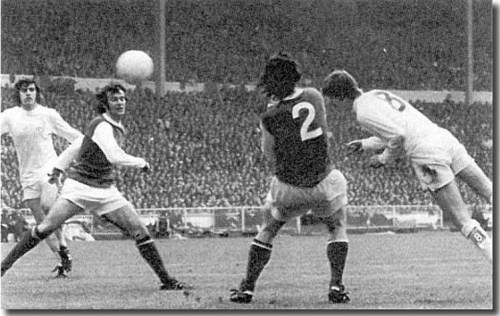
From the ridiculous low of their defeat at Layer Road the previous year, Leeds United recovered admirably to beat the cup holders and the previous seasons’ double winners Arsenal and lift the cup at Wembley in 1972. The game was a hard-fought and at times brutal affair, but it was decided by a flash of brilliance and what has to be the finest moment in Leeds United’s outstanding cup history. Allan Clarke was the match-winner, as he dived at full length to head home Mick Jones’ accurate cut-back. Although Leeds United were to fall victim to another act of giant-killing against Sunderland in the following years’ final, nothing could dampen the enthusiasm surrounding the clubs’ first and, to date, only FA Cup win.

These are just three historic moments in a long history of FA Cup football for Leeds. Perhaps you have different favourites – it would be interesting to hear from you with your own FA Cup memories of Leeds United.


Gary Neville asks Manchester City fan Noel Gallagher to sign guitar, ends up defaced

Gary Neville got sort of what he asked for – but really more than he bargained for – when he asked City fan Noel Gallagher to sign his guitar. Wherever your sympathies might lie – it was rather a dumb thing to ask for, wasn’t it??

As a Leeds fan and self-confessed Neville-hater, I confess to a juvenile level of snortling amusement.

Decline of Man U Shows the Premier League Needs “The Damned United” – by Rob Atkinson

Giggs facepalm as Man U decline

Giggs facepalm as Man U decline

When the Premier League lost Leeds United, it lost more than just another member club. With Leeds went a focal point for all those nasty, negative emotions that are so much a part of a football fan’s essential make-up. Football has always been a source of catharsis – a safety valve, if you will, for the letting-off of pent-up steam – even back in the days when the game was a lot more tribal than it is now, when there was no steep financial pecking order, when players were a lot closer to fans both literally and economically.  Nowadays, under the all-seeing glare of perpetual TV coverage and in an era when every fan is in touch with every other fan courtesy of social media, it is even more the case that such a soap opera needs its villains as well as its heroes.

Over the past decade, in the absence of The Damned United, it has been Man U that, paradoxically given their numerous triumphs, have more often than not filled the villain’s role in the minds of many.  Of course, every team is someone’s villain, someone’s hero too. It’s a question of balance and degree; between extremes there are a number of comparatively pallid clubs which inspire nothing more than indifference in the minds of the masses, the likes of West Ham, Newcastle and Aston Villa who are hated or loved locally but largely ignored everywhere else. Some teams are much more loved than hated beyond their own provincial spheres: Liverpool and Arsenal for example.  And some are hated passionately for differing reasons of varying validity.  Man U and Leeds are two such clubs.

Obviously as a Leeds fan I have a view on what’s behind the hatred directed at both clubs. In the case of Leeds, it seems to be down to historical myths surrounding Don Revie’s grisly hard but enormously skilful and hard-done-by Super Leeds, with added seasoning provided by the misdeeds of some of our over-zealous fans down the years.  The case for hating Man U is, I would argue, down to what I can only sum up as “intrinsic detestability”. In other words, it’s just something about the institution; the attitude, the arrogance and the vainglory of club, employees and supporters alike.  The fawning of the media over them, the way they have capitalised on a historic tragedy to build a global franchise, while still, with no apparent appreciation of the irony of this, calling Liverpool the City of Pity.  The time-honoured tradition of favourable treatment by referees and administrators, the former group of gentlemen managing somehow to give 88% of 50-50 decisions the way of the Mighty Red Devils over an extended period.  “We’re Man United, we’ll do what we want”, you hear sung in mixed cockney and West Country accents, and it’s something the game’s authorities have seemed loath to dispute. Given all this, they’re easy to hate – for me and thousands of other discerning Leeds fans, anyway.

This visceral hatred was accentuated under the tyrannical reign of the former manager Alex Ferguson; the scum (as we fondly refer to them down Elland Road way) won more, they were more arrogant and reprehensible in their conduct, they got much more given to them on a plate.  Give or take the odd dodgy offside and penalty here and there, that era is over and, as the latest result shows – unseemly celebration over a 1-1 draw at home to Chelsea – the illusion of invincibility and the assumption of superiority both seem to have gone with it.

The outcome is that Man U have now been drawn back into the pack and superseded by the likes of Arsenal, Chelsea, Man City, Liverpool and, last season, even Everton and Spurs.  Champions League qualification is no longer a given; the edifice that the empire was built on may well be crumbling.  One effect of this is that Man U are going to be a lot less easy for some to hate as they further decline – it may well be that only those who have always hated them will still have this particular emotional outlet.

In 2008, a poll in the “Sun” newspaper still had Leeds United as the number one most hated club in the land; this was four long and harrowing years after the Whites had dipped out of the Premier League.  By 2012 another poll had Man U succeeding Leeds as most-hated.  Leeds had by now been out of the spotlight for eight years, but were still sung about in terms of extreme disapproval at grounds around the country, not least the Pride of Devon’s own Theatre of Hollow Myths. Man U’s continuing dominance, however, had seen them move clear as the number one hate target nationwide.

Now, it all seems to be up for grabs again as the fallen franchise appears likely to slide further away from the top of the game, with the tyranny of Alex McTaggart an increasingly distant memory. Over time, they will haemorrhage support, but there’s a waiting list of Milton Keynes mugs and suckers, so in the short term the turnstiles will continue to click as the glory-hunting hordes travel North every fortnight or so.  It is the notoriety of hate that they stand to lose, the perverse respect accorded to any club top of the nation’s most-despised list.  There will be a gap at the hate end of everyone’s emotions, a vacancy for a perennial panto villain.

As the Man U star wanes, it’s possible that other candidates for most-hated might emerge. Chelsea under Mourinho are the equivalent, for some, of fingernails scraped down a blackboard.  Liverpool – with Suarez on their books – seemed to have a certain potential, especially with the media smiling upon them again. But with Luis gone, their detestabilty potential has declined, with Balotelli more of a clown than a hate figure so far. Man City with their millions and billions may attract the envious aspect of hatred, but these days they’re being shamelessly out-spent by a desperate scum, who used to affect to look down their nose at such a sordid way of courting success. But for all this variable hate potential, I would suggest that none of those candidates really cut the mustard in quite the same way that Leeds United did, and still do.

A return to the top flight for Leeds would probably fill this vitriol vacuum. All that is needed to test the likelihood of this is a swift look around the internet message boards on any occasion when Leeds play a top flight team in a cup. “Come back, we miss you” is the gist of it. And they do miss us – they miss the atmosphere, the raucous indomitability of our away support, the whole Dirty Leeds legend. They miss hating Leeds United.

The simple fact is, now that the most despicable British club of all seems to be descending into a more benign mediocrity, long bereft of their choleric Scottish dictator and his ability to give the rest of the game the hair-dryer treatment, they miss us more than ever.  And yet all we seem to do down at Elland Road is run around in small circles, victims of self-inflicted crises as the revolving door on the Head Coach office spins itself into a dizzy blur. Leeds United simply have to get their act together – urgently. In short, now that Man U are crap, the game is in sore need of that focus for hatred which we always so effortlessly provided.

So do the game a favour, Leeds, for badness’ sake. Sort yourselves out, get back up there and get on with being hated in your own inimitable fashion. Drive your enemies mad with impotent rage again as you make those of us who love you proud once more, in that deliciously perverse manner of the old days.
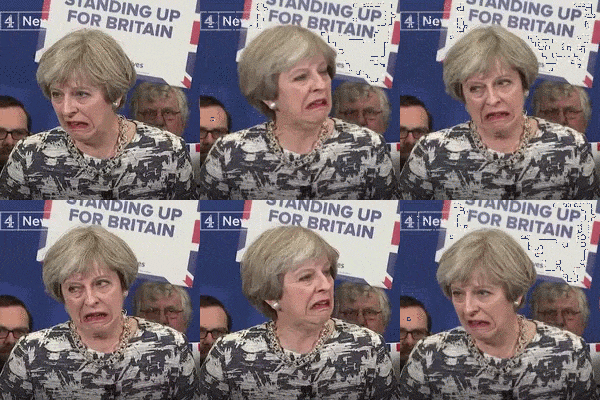
You know it’s your destiny – we all know it – and, now more than ever, you owe it to your public to fill that void at the very top of the Hate Parade.

Can Darko’s Leeds Cope with the “Cup Final” Mentality of Local Rivals Rotherham? – by Rob Atkinson

Image

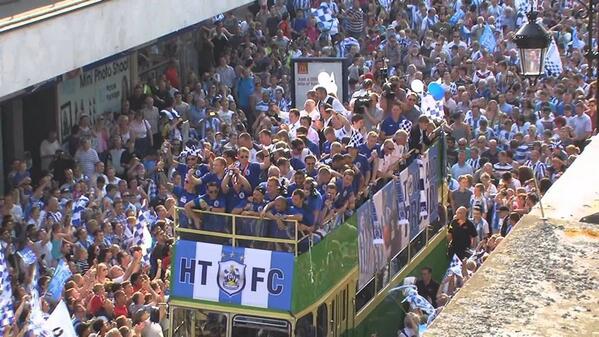
Huddersfield’s low-key celebrations after edging out Leeds

In the wake of Leeds United’s recent failures on the road against inferior local opposition, it’s well past time to take stock of the problem behind this unwelcome phenomenon, which is set fair to drag us down and keep us away from the top level –  if it continues as it has in past campaigns. It’s to be hoped that, in the new Darko Milanic era, things might be different. There were some promising signs against the Wendies the other week, but away from home against pumped-up (yet lower-class) opposition, some fight is what’s sorely needed.

Firstly, let’s put to bed any foolish suggestion that the local opposition aren’t inferior. They are – by definition.  Leeds do not and never have in living memory played local derbies where they are the underdog in terms of club size and history.  We’ve been the biggest club in Yorkshire – by far the biggest, and the only one with a global profile – for the last fifty years plus. Whatever the relative squad merits – and for 90% of the time, Leeds have possessed demonstrably more accomplished players too – any meeting between Leeds and a smaller Yorkshire club has seen the Elland Road outfit cast as Goliath to some horrible, backstreet David. The real question is – does such superiority of status confer any advantage at all?  The answer to that would appear to be a resounding No, and a reminder that, horrible and provincial though David might have been, he still gave Goliath one in the eye.

The extent of the problem may be brought into focus simply by comparing two different sets of results over the past few years.  If you look at league games against other Yorkshire teams, together with a selection of upstarts around the country who have a similar chip on the shoulder, as compared with our reasonably regular Cup meetings with Premier League clubs over the past three or four years, the contrast is startling – and it says a lot about what it has taken to motivate our white-shirted heroes.

Taking league games first, and looking at the locals – the likes of Barnsley, the Sheffield clubs, Huddersfield and Hull, together with self-appointed rivals like Millwall – the results have been unacceptably bad.  Barnsley in particular have visited embarrassment upon us in match after match, often by a significant margin, whilst keeling over to most other clubs and usually only escaping relegation by the skin of their teeth, prior to their welcome demise last year.  Our relatively close West Yorkshire neighbours Huddersfield are nearly as bad for our health. The other season, these two clubs met on the last day, and over the course of ninety minutes, first one and then the other seemed doomed to the drop.  In the end, both escaped because of events elsewhere – and what did both sets of fans do to celebrate their shared reprieve?  Why, they joined together in a rousing chorus of “We all hate Leeds scum” of course.  This tells you all you need to know about what motivates such dire and blinkered clubs – but at least the motivation is there.

And the motivation is there for Leeds United, too – just not, seemingly, on those bread-and-butter league occasions when we need it.  What seems to turn your average Leeds United player on over the past few years, is the glamour of the Cup – either domestic cup will do, apparently.  Results and performances in these games have left bewildered fans scratching their heads and wondering how such high achievers can then go on to perform so miserably against the envious pariahs from down the road in Cleckhuddersfax.  Look at the results – going back to League One days.  A narrow home defeat to Liverpool in the League Cup when by common consent we should have won and Snoddy ripped them up from wide areas.  The famous win at Man U when we went to the Theatre of Hollow Myths and showed neither fear nor respect in dumping the Pride of Devon out of the FA Cup.  Draws at Spurs and Arsenal, beating Spurs, Gareth Bale and all, at Elland Road.  Beating other Premier League sides such as Everton and Southampton in games that had you wondering which was the higher status club.  Great occasions – but of course we haven’t the squad to go through and win a cup, so these achievements ultimately gain us little but pride. And, naturally, when we draw a Yorkshire “rival” away in a Cup, we contrive to lose embarrassingly as per Bratfud earlier this season. It’s just not good enough.
Often we will sing to daft smaller clubs’ fans about the Leeds fixtures being their Cup Finals, but this is becoming a joke very much against us.  The teams concerned seem to take the Cup Final thing literally, they get highly motivated, roll their metaphorical sleeves up, the veins in their temples start to throb and the battle cry is sounded.  Their fans, normally present in miserable numbers, are out in force – and they are demanding superhuman endeavour.  Faced with this, too many Leeds teams over the past few years have simply failed to find a comparable level of commitment and effort.  There’s no excuse for that – it has meant we’re almost starting off a goal down – even when we swiftly go a goal up.

The sheer number of local derbies will count against a team which allows itself to suffer this disadvantage, this moral weakness.  For Leeds, since we came back to the second tier, there has usually been one Sheffield or another, usually Barnsley or Huddersfield or Hull, Middlesbrough perhaps – even the just-over-the-border outfits like Oldham and Burnley feel the same ambition and desire to slay the Mighty Leeds.  It amounts to a sizeable chunk of a season’s fixtures – if you fail to perform in these, then you’re struggling.  The pressure is then on to get results against the better teams at the top end of the table, and we don’t fare too well there either.

It’s easy to say that it’s a matter of getting better players.  Largely that’s true.  But we’ve usually had better players than these annoying little Davids, and yet the slingshot has still flown accurately right into Goliath’s eye and knocked us over. Professional football is a game of attitude, motivation, mental readiness to match the opposition and earn the right to make your higher quality tell.  This, over a number of years, is what Leeds United have signally failed to do.

Can it change?  Well, so far this season we’ve played Sheffield Wednesday and Huddersfield at home  – plus Millwall, who qualify as a southern member of the chip on the shoulder brigade, away.  We’ve four points out of nine to show from that little lot, which is the difference between our current position and sixth – in the play-off zone.  Even three of those lost five points would see us just a point off the top six places.  And the thing is, ALL of those games were distinctly winnable, so it’s no pipe-dream to look at where we might have been.  The difference is down to attitude; our opponents have had it and – with the notable exception of the Huddersfield performance – we simply haven’t.

It’s a sobering message at this stage of the season, with only three such games played – and plenty more to come.  But it’s a message that should be heeded, or the effect on our season will become more profound as it goes on.  The potential is there for us to take advantage of games against inferior but highly-motivated opposition, to match the attitude of these teams and to reap our rewards.  The failure to do this will see us endure yet another season of under-achievement. We have to overcome the “Cup Final Mentality” of certain other clubs, mainly those in Yorkshire but elsewhere too.

The Rotherham game next Friday night is an ideal opportunity for this new, tougher mental attitude to kick in. Again, we have small local rivals who nurse a fierce and unrequited hatred of Leeds United – and they have the odd old boy in their ranks as well as a wily manager who has been busily bigging us up. Our heroes will include a number of quite new foreign signings, who may still be a little wide-eyed and naive on occasions like this. So the ingredients are all there for the relative big boys of Leeds to turn up, find the environment not to their liking – and roll over once again in abject surrender. Please, let it not be so.

Leeds United –  you just need to get psyched-up and go out to win some of these pesky and troublesome “Cup Finals”.  Darko can inculcate his principles and make a pretty pattern of play – but when blood and guts are needed, some fight and some grit – then it really is up to you lads who wear the shirt we’d all of us out here be willing to walk on hot coals for. 

Leeds Legend Alfi Haaland Trolls Beardy Coward Keane – by Rob Atkinson

Roy                        -                         Saddam

Roy <—————————————————> Saddam

Nineties Leeds cult hero Alf-Inge Haaland has reignited the decades-long feud between himself and former Man U bully-boy Roy Keane, with a mischievous tweet (above) comparing Royston to the late Iraqi dictator Saddam Hussein. Alf tweeted the provocative image, along with the message “can’t take a man seriously when he’s got a beard like….” Keane had earlier revisited the issue of his cowardly attack on Haaland during a Manchester derby, confusingly claiming that he never meant to injure Haaland, but had meant to hurt him. Eh?

Perhaps this self-contradiction is an insight into what goes on inside Keane’s head, which seems muddled and somewhat paranoid at the best of times. The media, as we know, are determined to portray the former Pride of Devon midfielder as the ultimate hardman, never missing an opportunity to speak in hushed tones of awe about his trademark glower and supposed talent for fisticuffs. The rest of us know, of course, that Keane’s scowl masks a coward, someone who will exact his revenge after an extended period of sulky brooding, but not face to face, preferring the over the ball tackle, as with Haaland, or sneaking up from behind to plant a crafty elbow in an opponent’s face, as he did with the not-exactly-scary Jason McAteer.

One can only wonder at Keane’s motivation for growing such a horrible dead badger of a beard – was it to reinforce his own persistent delusion that he’s somehow impressive and the type to strike terror into brave men’s hearts? Or could it have been, perhaps, to deflect the unwelcome attentions of ITV anchor Adrian Chiles, whose breathless admiration for Roy always appears to be about to cross that blurred line into unrequited love? That is one unilateral bromance which makes for particularly queasy viewing.

In his latest self-justifying whinge, Keane mentions a short list of people who were always on his mind as targets to hit “if I got the chance” – Batty, Shearer and Vieira among them. The phrase “In your dreams, Royston” springs readily to mind. And, significantly, there’s a whole world of sneaky cowardice about just those last five words, “if I got the chance“. This is not the attitude of an up and at ’em loveable nutcase like Vinnie Jones, or anyone of several of the Revie boys who weren’t shy about landing a good old-fashioned left-hook when the occasion demanded (Johnny Giles, come on down…) Keane’s modus operandi was to bide his time, wait until he could strike – and then move away, probably towards the dressing room and safety, after a rare Man U red card.

The origins of Keane’s spat with Haaland are illuminating in themselves. Keane had been pursuing a Leeds opponent at Elland Road, intent on fouling him (characteristically from behind) – and had mistimed it horribly, over-stretching and rupturing a cruciate ligament, as karma paid him a brief and devastating visit. Haaland, reasonably assuming the Man U player was faking injury to avoid a caution, was bent over the fallen Keane to communicate this point of view. Keane never forgot or forgave – despite the fact that he was the author of his own misfortune – and waited, as a coward will, for the safest opportunity to get some payback.

It’s instructive also to recall that Keane could be termed a traitor to his country, allowing his own small concerns to spark an attack of paranoia and cause him to flounce out of the Irish squad for the Japanese World Cup. Again, Roy being Roy, he could see no possible grounds for any criticism of his own actions. An immeasurably greater midfielder than Keane, Billy Bremner, used to hold as a maxim “Side Before Self, Every Time”. This kind of team spirit is not to be found in Keane’s lexicon; his mindset is best illustrated by reversing Billy’s motto. For Roy, Roy matters before all else and Roy is always right. It’s a shame he’s usually surrounded by brainless sycophants who encourage him in this sad delusion.

At the end of the day, all Leeds fans and many other less fortunate football lovers will see clearly that Haaland has emerged from this whole saga with infinitely more credit than the ridiculous Keane. The humour at the core of his “Beard” tweet is a concept alien to poor old Roy, who really does take himself far too seriously. In retrospect, he’d have been better off remaining under the guidance of Brian Clough, who was the type of boss to batter such petulant nonsense out of a young and bumptious footballer. The Theatre of Hollow Myths, with its track record of promoting and nurturing the kind of empty-headed arrogance typified by Keane, Rooney, Cantona and too many others, was the very last place to bring out the best in the volatile but less-than-tough Irishman.

It’s a tragedy in its way. Much as is the case – and thanks, Alf, for pointing this out so wittily – with that bloody awful beard…

It’s a League Cup Tale of Two Uniteds as Minnows Progress – by Rob Atkinson

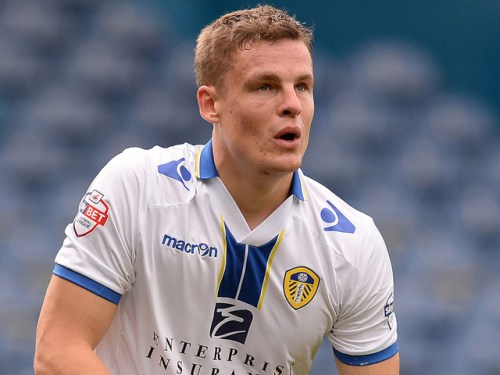
Matt Smith - scored for Leeds to momentarily cause despair among the Gobshite Tendency

Matt Smith – scored for Leeds to momentarily cause despair among the Gobshite Tendency

To be more accurate, it was a tale of two alleged Uniteds – plus one City and what might politely be termed a franchise as Milton Keynes Dons and Bradford City saw off the ‘disuniteds’ of Manchester and Leeds respectively. On the face of it, the similarities in the two cases are striking.  The Pride of Devon were condemned by English football’s only even more plastic club to a pre-Christmas period of plain and simple League fare, unrelieved by any spicy Cup-tie delicacies. They must concentrate on recovering, under new management, from a wobbly start to that bread-and-butter marathon, and forget all about knock-out glamour until it’s time to get knocked out of the FA Cup.

Leeds have likewise been dragged down to the level of that other United from ovver t’hills. They, too, will be stuck with repairing a dodgy league position until the new year rolls around. They, too, are in transition, rebuilding under a new regime. But there the similarities end – in terms of the manner in which the two Uniteds departed this season’s League Cup competition, anyway. Leeds, for the umpteenth time this season, were reduced to ten men, due on this occasion to foolhardy rashness on the part of Luke Murphy, who gave the ref every opportunity to brandish a second yellow. Murphy let down his team-mates, his coach and indeed his club, all of whom were relying on a united performance. The remaining ten stalwarts delivered though, and in the end Leeds were somewhat unfortunate to lose, as was pointed out by coach Hockaday afterwards – to depressingly predictable storms of social media abuse – about which more anon.

Man U, for their part, had no dismissals to cope with. They were simply out-played, out-fought, out-thought, thrashed out of sight by a team nominally two leagues inferior. Their much-vaunted manager, the former World Cup coach of the Netherlands, left out some supposed big-hitters, despite the lack of European distractions. Man U contributed in full measure to their own downfall, but the wretched MK Dons, a club whose origins leave the nastiest of nasty tastes in the mouth, nevertheless thoroughly deserved their crushing victory.

So the two Uniteds are no more, in this Cup competition at least. Life and the League Cup will go on without them, though there will be a few regrets on all sides about a third round draw that could have been a Roses clash at the Theatre of Hollow Myths, or which could have seen either minnow land a big fish instead of nibbling away at each other. Such is Cup football.

What remains to be said, other than that, in summary, Leeds were slightly unlucky and Man U got exactly what they deserved? Well, quite a bit, actually.

I’ve been rather quiet this season so far, due to some family health problems and various other slings and arrows of outrageous fortune, all of which – I’m glad to say – are being properly addressed. But I’ve still been keeping an eye on things, shaking my head gloomily at times, brightening up at bits of exciting transfer news at other times – and tut-tutting away as a middle-aged fan who remembers better times is wont to do. It’s been quite a good and exciting season, really – except for those pesky occasions when some fool has blown a whistle and we’ve actually tried to play a game of football. Big mistake, that. But the over-riding impression of this season so far, for me anyway, has been the clatter and clash of bandwagons being jumped on, over and over again, by far too many people who really should know a lot better.

The people I’m talking about, for the most part, manifest themselves in social media – Twitter being a particular offender in this respect. Some alleged Leeds United fans out there need to take a long, hard look at themselves after some of the unprecedented abuse being heaped on the head of a man in Dave Hockaday who is totally unable to defend himself and has managed to weather an ongoing storm with what can only be described as impeccable dignity. Hockaday has copped for the lot, from school playground stuff like the oh-so-clever plays on his name (Whackaday, Hockalot, Shockaday – and all the other dismally unfunny variants), to far more serious abuse from the kind of people who feel free to say what they like from what they gleefully feel to be safely unaccountable positions. I’ve seen fans freely expressing a hope that we would lose at Bradford, so that Hockaday might be sacked. Some of the bile and spleen vented has been utterly disgusting and degrading; some has been frankly laughable. The other day, there was a veritable Twitter-storm because Hockaday mentioned that Leeds would “inevitably” be back in the Champions League some day. He expressed a desire to be involved in that. And the world and his scabby dog seemed to join in an unseemly scramble to pour contempt on those innocent and sincere words.

Now, just imagine. What if Hockaday had faced the interviewer’s mike and had said “There’s not an earthly of Leeds ever getting into Europe again, not unless there’s a war. As for the Champions League – don’t make me laugh. And if they did, well – I wouldn’t want any part of it. Stuff that for a game of soldiers!” Would he have been applauded for his disarming frankness? Would the various social media have been abuzz with praise for his words of wisdom? No, of course they bloody wouldn’t. The fans would be outraged at such defeatist nonsense, and quite right too. So why go for the guy’s jugular when he expresses the naked ambition and belief in a brighter future that should be burning hot in any true fan’s heart? It makes no sense, and it reflects even less credit on those who, mindlessly sheep-like, follow the masses onto that overloaded bandwagon. For heaven’s sake, it’s nothing less than pathetic. And it grieves me to say this – but after what’s been said and written lately, I’m thoroughly ashamed of many, many Leeds fans right now.

It’s already been the same in the wake of the Bradford defeat. A few saner souls have pointed out that Murphy was an idiot getting himself sent off, that we battled well for an hour when a man down, took the lead and were only undone by a worldie and then a crap header that zipped through our keeper’s legs. AND we should have had a penalty when Poleon was taken out by the keeper – no, don’t listen to Don Goodman, he’s rabidly anti-Leeds and spouts nonsense. So, a few have broken the ranks of the silent majority – and they’ve highlighted the positives of the Bradford match. But many, many more of that knee-jerk faction of jerks have simply resorted to more abuse, more insults, more demands for the sacking of a guy who’s been there five minutes, and has spent that short time coping with the least helpful circumstances imaginable. That’s disgusting, ridiculous and completely unforgivable.

I’m old enough to remember demonstrations in the West Stand car-park when the fans had had enough and wanted Adamson Out, or on another occasion, Eddie Gray Back. I’ve seen little if any of that this time around. It’s mainly those big, brave Twitter types, sniping away from the safe anonymity of their keyboards, pouring their brainless vitriol onto the head of a man who probably will be gone soon, and who should, anyway, probably walk of his own accord – because he’s up against more than the opposition in the other dressing room every day of his working life. I’ll not comment on whether he’s a good enough coach – there hasn’t been the time or the proper circumstances in force to make a reliable judgement on that. But the players seem to like him – and aren’t they the best ones to ask, normally?

Back to the Bradford game. Once Luke “Stupid Boy” Murphy signed his own dismissal warrant, there were three possible objectives for Leeds United. In ascending order of importance, least important first: get to the next round of the Cup. OK, we didn’t make it, so what. We weren’t far off, in the end. Secondly; secure local bragging rights. I’d argue we managed that, making a good fist of a rearguard action against a spirited and motivated Bradford, and taking the lead against those formidable odds. Relative to the Man U debacle, we’ve no need to be ashamed of the effort and commitment of our ten warriors at Bradford. But the most important objective was to use an adverse situation to kick-start the bonding and gelling of this new group, under a new coach. The hour of battle against superior numbers in a hostile atmosphere will have gone a long way towards getting that process under way – and that really IS important, with the vast bulk of this nascent season still ahead of us.

In truth, I’m sick of the current situation, sick of the poisonous atmosphere in that odd virtual world, which is so much less apparent in the more old-fashioned world where fans still go to the match and get behind the shirts – I’m sick to death of so many of Leeds United’s yappier, dafter and more deluded fans – a vociferous but less than cerebral group I can only describe, rather impolitely, as the Gobshite Tendency. It’s a toxic mix, for anyone who loves the club, and I really am less than happy with it right now – so I shall return for the time being to looking after my family and parents as they struggle with real problems, far more intimidating than the daft footballing ones which seem to provoke such nastiness in some people. I’ve had enough, for the moment. So, as on a few occasions before, I shall take refuge in the past. I’ll write some nostalgia pieces, starting with one I promised a while back to my good mate Andy Gregory, of the excellent “We All Love Leeds” blog. We beat Southampton 7-0 in that one – but if Twitter had been around then, I’m sure there’d have been some eejits moaning that it should have been eight or nine and calling for the Don to be sacked. Just now, it really is that daft and annoying.

So – see you back in the Seventies, maybe.