Tag Archives: UK Football

Getting Promoted the Leeds United Way – by Rob Atkinson

Image

Leeds United have achieved promotion to the top League of English football (Football League Division One of blessed memory) on two occasions within my lifetime – 1963/64 and 1989/90.  Both promotions followed significant lower status periods – we don’t really do “bounce-back” promotions – and here we are again, a decade away from the game’s shop window, and this time we actually plumbed the depths of the third tier for the first time in our illustrious history. So – talking about history – do those last two promotion successes have anything to teach us today?  The answer seems to be: yes, quite a bit.  But sadly, there’s not necessarily all that much encouragement to be derived from the lessons of yesteryear.

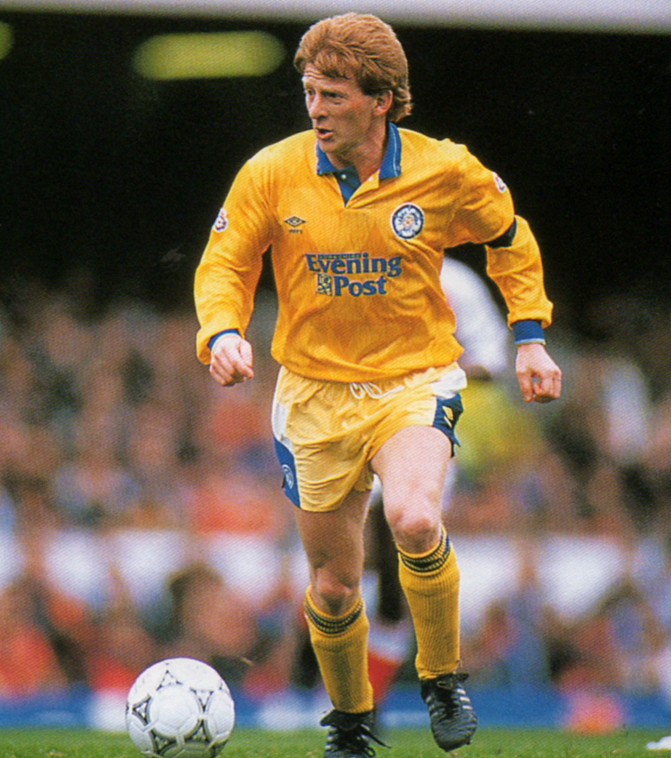
The fact appears to be that the last two Leeds United sides to have achieved promotion to the top flight both did it with quality to spare.  Both finished as Division Two Champions, and both squads included a number of players who would go on to help add to the Club’s Honours Board.  In 1990, the team that pipped Sheffield United for the Second Division title included as mainstays Gordon Strachan, Gary Speed, Lee Chapman, Chris Fairclough, Mel Sterland and David Batty.  That’s over half a team, and all of those players figured heavily in the squad that won the last Football League Championship title in 1992.  Also appearing in that “Last Real Champions” line-up were four more survivors of the 1990 promotion side: Carl Shutt, Imre Varadi, John McClelland and Mike Whitlow.  So TEN members of the promotion squad were good enough to figure in the season that brought the ultimate League honour back to Elland Road.  All but Batty and Speed were incoming transfers, some costing what was significant money for the late eighties.

In 1964, the picture was similar, though with more of a bias towards home-grown talent – unsurprisingly given the quality of the youngsters coming through from an outstanding youth policy. The names trip off the tongue:  Gary Sprake, Paul Reaney, Billy Bremner, Jack Charlton, Norman Hunter, Paul Madeley, Terry Cooper and Peter Lorimer.  The ultimate success took longer to achieve for Revie’s boys, but all eight of these players, plus the genius of Johnny Giles – purchased for a song from Man U in a transfer Revie described as “robbery with violence” – were major contributors to the side which proved itself the best-ever in 1969. The later transfers in of Mick Jones and Allan Clarke, with the emergence of Eddie Gray from that legendary youth setup, simply applied the final coat of gloss to what was a very fine side indeed. The makings of Champions were there in the 1964 promotion team, just as they were for that of 1990.

So what does all this tell us about the here and now?  Nothing very happy, to be sure.  The squad we have today might – with a few judiciously-selected additions – have some sort of chance of achieving promotion, though you’d have to say the lottery of the play-offs would be the likeliest route.  And as a club, we’re famously poor at play-offs.  But if we DID scramble promotion – what sort of foundation would there be for becoming a successful Premier League side? Hardly any, in truth.  Look through the playing staff we have, and name players who might figure in a Premier League winning side in the next few years.  Sam Byram, maybe – and probably, almost certainly – NOT in a Leeds United shirt. So we’re in danger of becoming the Leeds United side least well-equipped in living memory to go up, and stay up to do well. Much more likely though is that – with the element of quality currently so sadly lacking – we’d just bob around in mid-table in the Championship, and listen to a load of excuses every week or so.

History shows that, on both the occasions we’ve won promotion in my lifetime, there has been relatively major investment in the team to make that possible.  It was more the case in 1990 than in ’64, but the whole game was much more about money by the 90’s – and of course vastly more so today.  But even in 1964, players had been added to the squad to see us over that promotion-winning line – Alan Peacock was an England-capped forward, bought for decent money from Middlesbrough.  Bobby Collins commanded a fee even as a “veteran” when he moved to Leeds from Everton.  In the 1990 side, Strachan, Fairclough, Chapman and Sterland all cost well into the six figures, as did John Hendrie and Vinnie Jones. This was proper investment, speculating to accumulate.

There is as yet no real indication of the path that might be trodden by the Leeds of today, under the guidance of new owner Massimo Cellino.  We are given to understand that he has inherited an almighty mess from a list of previous owners, who can only be distinguished one from the other by the slightly varying degrees of their wretched crookedness.  Some will say, serves you right Massimo for foolishly dispensing with the need for due diligence – others will simply be glad that the Italian’s on board – despite the vicious attempts by the senile and dithering old fools of the Football League to block him – and looking to sort things out.

Cellino appears determined to be faithful to his own methods and philosophy – and it’s fairly clear that we won’t find out very much about on-field recruitment until he’s laid the foundations for a properly-run club.  The Head Coach appointment seems likely to be the next significant step, and from that will flow the rest of the preparations for next season.  By now, Cellino must be aware of the fans’ voracious appetite for success – a term to be defined by the Leeds United history of the past fifty years, as opposed to the yardstick of just any old club.

The fans’ expectations are extravagant but understandable, having their roots in a proud and glorious tradition, from eras past when this club did things properly.  Where expectations such as these are dashed, sooner or later there will be rebellion – even in what might still be, relatively speaking, a honeymoon period for the new owner. Whether such rebellion would come in the form of apathy over match-day attendance, or some more incendiary form whereby dissatisfaction might be expressed by marches and sit-ins, or by the owner being barricaded inside Elland Road (Massimo has had some experience of this already) – this would depend upon the depth of supporter anger or unhappiness.

Cellino’s staff would be well-advised to do plenty of rooting about in Leeds United Football Club’s history, both to see how things were managed when the people in charge knew what they were doing, and also to advise themselves of what happens with the support – and indeed the staff and management – when they feel they’re having the urine taken out of them.  That feeling has been abroad too often for comfort in the past few years, and what is needed right now is a campaign of relative harmony.  From that point of view as much as any other, there may well be advantages in the appointment of a head coach with an intimate working knowledge of the club and its traditions and character – and of the fan-base.  This is not just any club – and we need someone at a high level in the organisation, who is acutely aware of that fact.

Former skipper and manager Gary MacAllister’s name is evidently on Cellino’s very short short-list – and if anyone can pick up the reins effectively at Elland Road right now, then maybe Macca can. He should not, in my view, be judged too harshly in the light of his previous stint in charge – he was not working under the most favourable circumstances, or indeed the most favourable owner. Even so, some of his signings turned out to be legends of their time; his eye for a player, certainly an attacking player, seems reliable – as witness Becchio and Snodgrass.

But it is Gary MacAllister’s Leeds United DNA that we probably need as much as anything else right now, when one major priority should be the re-establishment of a definite Leeds United identity, now that Bates has gone, and now that GFH have been reduced to the role of mere parasites.  The club needs to hold its collective head up high, and march on saying We Are Leeds.  That was the spirit in which those previous two promotions were earned, and it is that spirit which needs to be rekindled over this summer, so that we come out fighting – and Keep Fighting – for the season ahead.

I would say – get MacAllister in, let him surround himself with people he can work with (including, please God, a defensive coach and someone with a Plan B) – and let him put his stamp back on the club.  To me, this would also add to Cellino’s credibility. Anybody who has read McAllister’s book, or who has seen how he has conducted himself throughout his career, will know that here is a real football man.  This would not be a Massimo’s yes-man type of appointment.  That would be a very important message to send out, bearing in mind the lessons of Cardiff City under Vincent Tan. One thing we could do with is the reassurance that Cellino is not cut from that cloth.

Next week might just be the start of a positive summer for Leeds – if the right appointment is made and some sort of recruitment programme can then commence.  Let’s sincerely hope so – it’s been too long since we had any really good news at Elland Road.  A feel-good factor would be a long-forgotten but welcome visitor to the club – and who knows?  If we can achieve that, then surely anything is possible.  A promotion charge next season?  England winning the World Cup with a 30 yard volley by Leeds lad Jamie Milner?  Why not?

If we’re going to dare to dream – then let’s make it a good one.  MOT – We Are Leeds.
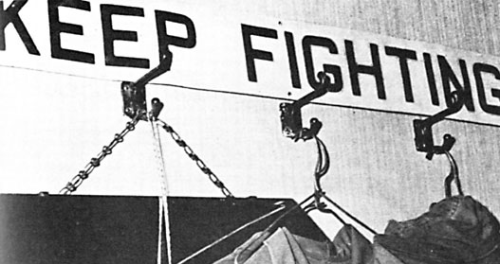
That unquenchable Leeds United spirit

That unquenchable Leeds United spirit
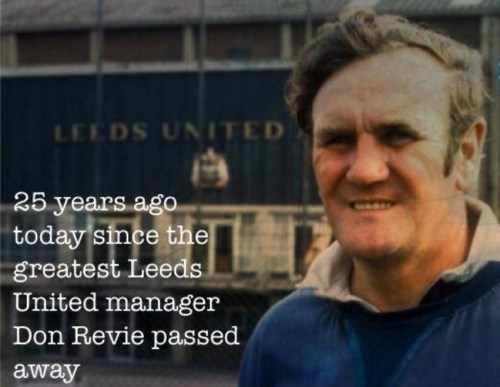
Taken From Us 25 Years Ago Today: Revie, The Don of Elland Road – by Rob Atkinson

The Don - the Greatest

The Don – the Greatest

They say that great players don’t always make great managers, and Bobby Charlton is a stand-out example of that essential truth.  His brother Jack, by common consent not anything like the player Bobby was, but ten times the bloke, was by far the more successful manager.  Then again – he learned from the best.

And they will twist the argument around to show that average players can make great managers. We’re usually invited by a brainwashed and indoctrinated media to take Alex Ferguson as an example of this; my own choice would be Arsene Wenger, a deeply average player but a highly superior coach, tactician and innovator who made a significant dent in the Man U monopoly of the Premier League – despite the vast off-field advantages of the Salford club. Remember Wenger’s “Invincibles”?  There is also, of course, Jose Mourinho – and many others who pulled up no trees as players, but blossomed into legendary managers.

But there are a select few examples of truly great players who went on to be truly great managers – the likes of Busby and Dalglish, for instance – and I will argue passionately to my last breath that the best of the best was Donald George Revie, who died of Motor Neurone Disease 25 years ago today.

Don Revie was an innovative, thinking footballer, the pivot of the famous “Revie Plan” at Manchester City when he was the first to exploit deep-lying centre-forward play to great effect as City hit the heights in the mid to late fifties. He was instrumental in the Wembley defeat of Birmingham City in the FA Cup Final of 1956, and also helped restore English pride after two batterings by Hungary – the Magnificent Magyars having trounced England 6-3 at Wembley and 7-1 in Budapest. Revie’s adapted attacking role helped the National team annihilate Scotland 7-2 and his reputation was made as a selfless team player who was adept at making the ball do the work while team-mates found space as he dropped deep, baffling the defences of the time.
Revie was clearly a thinker, and developed very definite ideas about the game during his playing career, ideas he would later put into practice to devastating effect as a club manager. It is undeniable that, during his thirteen years in charge at Leeds, he elevated them from simply nowhere in the game to its very pinnacle, preaching togetherness and the team ethic above all else. Respected judges within the game have described the football played by Leeds at their peak as unmatched, before or since. In the eyes of many, that Leeds United team were the finest English side ever, a unit of grisly efficiency and teak-hardness yet capable of football which was outstandingly, breathtakingly beautiful, intricate in its conception and build-up, devastating in its effect.

Here is the scale of Revie’s achievement: in an era before the advent of lavish sponsorship and advanced commercial operations, he built a club from the ground upwards – a club with an apathetic support, which had hardly two ha’pennies to rub together, and whose prime asset was a group of raw but promising youngsters. The way that Revie nurtured those youngsters, moulding them into a team of supreme talent and majestic ability, is the stuff of legend. In some cases, he had to ward off the threats of homesickness: a young Billy Bremner was determined to go home to his native Scotland and Revie arranged for his girlfriend to move to Leeds, helping the lad settle down. Sometimes he had to adapt a player from one position to another – Terry Cooper was an indifferent winger who was made into a world-class overlapping full-back. Examples of his inspirational and man-management skills are many; he wrote the modern managerial manual from scratch.

Revie raised almost an entire squad from the junior ranks through to full international status, but he also had an unerring eye for a transfer market bargain. He took Bobby Collins from Everton, and saw the diminutive veteran midfielder produce the best form of his career. He lured a disaffected John Giles from Old Trafford where he was an under-rated performer. Giles swore that he would “haunt” Matt Busby, the manager who let him go, and Revie enabled this vow to be realised, converting Giles to a more central role after the end of Collins’ first team career. Giles and Bremner would form an almost telepathic central midfield partnership for Leeds, carrying all before them over the muddy battlefields of Division One. Revie later described his recruitment of Giles from Man U as “robbery with violence”.

As the sixties wore on, the Don would add Mick Jones and Allan Clarke to his formidable squad while it grew up together in a family atmosphere at Elland Road. Rarely if ever before or since can a manager have been so involved in his team’s welfare and well-being, no mere tracksuit manager this. There would be flowers and chocolates when a girlfriend or wife celebrated a birthday, a listening ear and helping hand whenever problems threatened to affect a player’s form. Revie was a father figure to his players for over a decade, forming a bond of mutual loyalty and respect that still sets the standard for enlightened management today.

Don Revie has been described in scornful terms by the ignorant, as a dossier-obsessed and over-superstitious manager by some people of insight and judgement, and as simply the best by his players who still survive from that amazing period of Leeds United’s dominance at home and abroad. He was perhaps too reliant on lucky suits and the lifting of gypsy curses, and other such supernatural preoccupations. He could maybe have let his team “off the leash” a little earlier than he did – when given full rein, they were next door to unstoppable. But it’s hard to hold the caution and superstition of the man against him; this was a time unlike today when livelihoods depended on a bounce of the ball, when results mattered in a bread and butter way. There were no cossetted millionaires then, no examples of young men who could pack it all in tomorrow and live in luxury for the rest of their lives. It all meant so much more in those days and the word “pressure” had real resonance.

The modern coaches have greats among their number, there’s no doubt about that. It would be invidious to single out names; after all, the media in a misguided fit of uncritical and commercially-motivated hero-worship have been busily engaged for most of the last three decades in dubbing “S’ralex” as the greatest ever. But the legend that is Don Revie can sit comfortably on his laurels, the man who – more than any other – took a sow’s ear of a football club and made of it a purse of the very finest silk which yet concealed a core of Yorkshire steel.

Donald George Revie (1927 – 1989) – Simply The Best.

Forget Man U “Class of ’92” – Salute the Leeds MASTERS of ’92 – by Rob Atkinson

Super Jon Newsome

Super Jon Newsome

There’s been a lot of talk this past couple of days about the “Class of ’92”, a somewhat disingenuous reference to Man U’s FA Youth Cup winners of that year, what with Giggsy Wiggsy taking over as temp. manager at the Theatre of Hollow Myths, with Scholesy Wolsey and Butty Wutty on board as well.

The media, bless ’em, love this sort of thing – and they’re seemingly eager to ignore the fact that 1992 was, actually, all about another United – Leeds United, the one and only United – as they won the last ever proper Football League Championship, four points clear of you-know-who and their rabidly frothing Scotch git of a manager.

It all happened 22 years ago today, actually – so let’s have a nostalgic look back and, while we’re at it, set the record straight about all of this “Class of ’92” crap. Because we’re not talking pupils here, we’re talking masters.

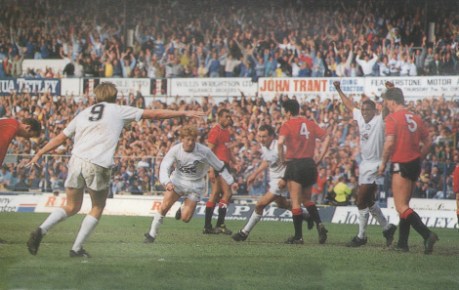
The 26th April 1992 was not just a normal Sunday morning like any other; for all fans of Leeds United it would turn out to be a date with destiny, the unlikely culmination of a footballing journey that had started in October 1988.  Howard Wilkinson’s move from First Division Sheffield Wednesday to take over as boss at Second Division strugglers Leeds United had been – perhaps unwisely – summed up by the Sheffield Wednesday chairman as “a chance we couldn’t deny Howard to better himself.”   That must have fallen like rocks on the ears of the Wednesday fans who nevertheless could not have envisaged their rivals’ subsequent meteoric rise at a time when the Wednesday star was on the wane.  Such is life.

History will show that Wilkinson breezed into Leeds United, seized the place by the scruff of its neck and shook it up good and proper.  Remnants of his legacy are still visible in the club’s world-class Academy and training complex not to mention the gigantic East Stand, but it is for the phoenix-like resurrection of The Whites that the fanatical Leeds support will best remember Sergeant Wilko.  Leeds were promoted in 1990 after Wilkinson’s first full season, trading places with Sheffield Wednesday as they dropped into the Second Division – bittersweet irony there.  A season of consolidation followed, and then the full-on assault on the Football League Championship itself, a challenge unexpectedly sustained right to the sweetest of ends.  By April 20th 1992, Leeds were still clinging on in the title race, but Man U were clear favourites with a points lead and a match in hand.  That day though was the start of the turning of the tide in Leeds’ favour.  As fans gathered on the Kop for the late afternoon visit of Coventry City, radios were clamped to anxious ears as news was awaited from Man U’s home game against Nottingham Forest.  Two explosions of joy from the swelling Elland Road crowd signalled two Forest goals and a defeat for the leaders that Leeds were to capitalise on, beating Coventry 2-0 in front of a live TV audience.

Now it was game on in earnest, and I vividly remember a nervous evening at home that midweek as West Ham played host to Man U who were finally playing their remaining game in hand.  Win, and they would be in the box seat – but, as I frantically tidied and re-tidied my bedside table drawer to save myself from chewing my nails down to my elbows, they lost, wonderfully, miraculously lost to leave Leeds in charge of their own destiny. Choleric Man U manager Alex Ferguson must have bitterly tasted the sourest of grapes as he described the already-relegated Hammers’ effort levels in beating his charges as “obscene”.  His lack of grace drew a stark contrast with the phlegmatic Wilko, who was calmly reminding the world that Leeds had secured a place in Europe, his main aim for the season, and that anything more would be “a bonus.”

But Leeds now knew that if they won their last two games – away at Sheffield United and at home to Norwich City – they would be English Champions in the last old-style Football League programme – a signal honour.  Everybody thought it would go down to the last game of the season, that Norwich would be the big game.  Yet if Leeds were to win at Bramall Lane, Man U would then face the formidable task of winning at Anfield to take the Title race to its last day.

Back to April 26th, and as I walked up the hill into Wakefield that mid-morning, I saw cars trailing the colours of Leeds United, the scarves fluttering bravely – and I felt a sense of occasion but still could not quite comprehend that this might just be The Day.  I met up with my mate Dave, and we shared a tense journey to Sheffield, not much said, both knowing that this was a Sunday that could equally easily end up being triumph or disaster.  Parked up in the scruffy environs of Bramall Lane, just about the first thing Dave did as we walked to the ground was to drag me back out of the path of a careering van as I stepped out to cross a road, oblivious of traffic, lost in thought.  We both grinned at my narrow escape and agreed: good omen.  And then we were high up in the seats of the upper tier behind the goal at the away end of Sheffield United’s quaintly ill-designed stadium.  The day was gusty, and so the football would prove to be.  It was a match of ebb and flow, the Sheffield faithful eager to deny Leeds their chance of clinching the title, Leeds fans loud and defiant with self-belief.

If you’re a Leeds supporter, you’ll have seen the goals from that game hundreds, thousands of time.  It plays through now, all these years later, in the Football Highlights studio of my mind; joy for the home side as Alan Cork, gleaming of bald pate, pokes the ball home to give Sheffield the lead.  Then, a midfield tussle in the swirling wind, as Leeds try valiantly to come back.  A late first-half free kick, which Gordon Strachan races to take before the home defence can set themselves, he finds Rod Wallace in the area who tips the ball past home keeper Mel Rees’s attempt to save, defenders scramble to clear, only to hit Gary Speed who pings the ball back to ricochet off Wallace – into the net.  Pandemonium in the away end.   Level at half time, we’re breathless with drama and the hurly-burly of it all, raucous with United anthems, nervous of what’s yet to come.

In the second half, though we don’t know it, human tragedy unfolds: Sheffield ‘keeper Mel Rees, injured in the melee leading to Leeds’ leveller, his thigh heavily strapped, can hardly move and is hampered for the second Leeds goal as Jon Newsome stoops to head in at the far post.  Mel Rees, who was due an international call-up for Wales the next day but has to pull out because of his injury.  Mel Rees, who would never play football again because he was to develop cancer and die a year later, tragically young at 26.  RIP Mel Rees.

The crazy game continues crazily.  A dangerous ball across the Leeds box is retrieved by home defender and future Leeds man John Pemberton, who turns it back towards the goal-line where Lee Chapman sticks out a leg for an own-goal greeted with horrified stupefaction by the Leeds fans behind the goal and we’re level again.  Then enfant terrible Eric Cantona enters the fray, and within a few minutes he is chasing a loose ball into the Sheffield half, with Rod Wallace scampering alongside and home defender Brian Gayle lumbering back in a desperate attempt to clear the danger.  And it’s Gayle, former Man City man, who finally slays Man United.  From my vantage point at the opposite end of the ground I see him get his head to the ball, and the action is suddenly slow motion.  Gayle has headed the ball, poor Mel Rees is stranded far out of his goal, the ball goes over his head in a slow, slow loop, and bounces tantalisingly towards the unguarded net…

Then I’m watching at full speed from the far end as Cantona and Wallace raise their arms in triumph, wheeling away in delight, and even as I wonder what they’re up to I realise that the ball has nestled in the Sheffield United net.  A red mist descends, and I am utterly outside of my skull and beside myself in delirious joy and fevered madness, looking around me, roaring like a demented bull, face congested with blood, eyes bulging; I grab a tiny and helpless St John’s Ambulance man by his lapels and scream beer and spittle into his terrified face “Get me some oxygen!!!”, I bellow. “I’m going to have a bloody heart attack!!!”  The mad moment passes, I drop the ashen medic and some measure of sanity returns, but we’re still cavorting and diving all over each other, a seething, sweating mass of Leeds, because we know it’s over, we know that Sheffield are beaten, and we know that Man U don’t have an earthly at Anfield, not a prayer.  We were going to be Champions; on that windiest and gustiest of days, a Gayle from Manchester City has blown the Scum away and decided in an instant the fate of all three Uniteds from Manchester, Sheffield and Leeds.

And so, of course, it panned out.  Later I watched mesmerised on TV as Liverpool beat a demoralised Man U, Denis Law and Ian St John trying to put a brave face on it, Elton Welsby’s foot bobbing away in thwarted anger as the script turned out just as none of them wanted.  Ian Rush scored his first ever goal against Them, and it was settled late on as Man U conceded a second.  “And now the title goes to Leeds without any doubt at all” intoned Brian Moore in the ITV commentary as I sat there with tears of joy streaming down my unashamed face.  Gary Lineker had called into the studio earlier to complain that Rod Wallace’s goal had been offside (it was).  St John and Moore bemoaned that Man U had had no luck at all, and Welsby ground his teeth in the studio as the Man U fans outside hurled abuse at him, heedless of the fact that he shared their bitter disappointment.  All was frustration in the media and the rest of football and Leeds fans everywhere utterly failed to give a toss.

Twenty-two years on from that nutty day, when Leeds reached the summit of the game, the images are all still vivid and clear for me.  I’ve worn out four video tapes and at least three DVD’s, but I don’t need them, I don’t need YouTube, I can see it all any time I choose just by relaxing and closing my eyes.  Mel Rees is no longer with us, nor is Gary Speed and Brian Moore has passed away too.  Rest in peace, all.  And my mate Dave who shared that memorable day with me, he’s gone as well, taken far too young by cancer in 1999.  I have a picture of us both, taken before the home game with Norwich a week after we’d won the league, triumphant in our freshly-purchased “Champions” t-shirts, happily blind as to what the future would bring.  RIP, Dave mate.  We celebrated hard that day as little Rod Wallace won that last game with a sublime goal, rounding off our greatest season.  We’d earned it, me and Dave, tramping around the second division grounds of the eighties as Leeds struggled to come back.  Thousands of us had earned it.  Now we were top dogs, and boy did we enjoy it while it lasted.

United were back, as Champions of England.  The Last Real Champions. One of our unique, unbeatable accolades, like being at the top of the League when the Millennium clicked its four digits over.  Something that can never be taken away from us: Immortality, pure and simple.  Happy Memories, Champs.

25 Years Today Since Gordon Strachan Signed for Leeds – by Rob Atkinson

"Have you ever seen a better goal?  Have you ever seen one better timed??" John Helm, YTV

Amazingly, for those of us who remember the breaking of the news so well, it’s a quarter of a century today since Leeds United made the historic signing of Gordon Strachan from a minor club over the Pennines.  Over the next seven seasons as the Whites skipper, there were many, many memorable occasions for United’s second-most famous ginger Scottish captain.  Not least among these, of course, was hoisting the last ever Football League Championship Trophy, as well as scoring the first goal in the Stuttgart play-off at the Nou Camp in 1992.

But, as I’ve done before, I thought I’d look back to the famous Leicester City game in 1990 and what was probably Strachan’s defining moment as the man who did more than just about anyone to reinvent Leeds as a post-Revie force in English football.  It had been a long time coming since Don’s Glory Boys dispersed to pastures new and a Golden Era faded into the dim haze of memory.  We had been eight years in the second division doldrums and had almost forgotten what it was like to be a top team.  But – finally! – it looked as though the nightmare was ending as Sergeant Wilko and Captain Strachan were set to lead United back to the Promised Land at long last.  A home fixture against Leicester City was the penultimate hurdle to overcome, and expectations were soaring at Elland Road.

Twelve days before the Leicester game, United had appeared to strike a decisive blow, battering closest rivals Sheffield United 4-0 at Elland Road. But any hope that promotion could be clinched early was dashed over the next two fixtures, a draw at Brighton where the lead was squandered to sacrifice two points, and then a home defeat to a relegation-threatened Barnsley who even then had the ability to put one over on us with an inferior team.  So the nerves were jangling for this home date with the Foxes.

Leicester breezed into town with no pressure on them at all as they bobbed about serenely in mid-table, but Leeds just had to win. A victory could possibly clinch promotion; anything else and we would be relying on others to give us that final leg-up – not an attractive prospect. The atmosphere at Elland Road that day was something to behold as 32,597 packed the stands and terraces, the Kop a seething mass of bodies, a solid wall of sound. If the weight of support counted for anything, then it seemed Leicester might just as well turn around and go home – but to their eternal credit they fought the good fight and played their part in a memorable afternoon.

It all started well. Leeds pressed hard, this had been their preferred approach all season long. No opponent was allowed the luxury of untroubled possession as Leeds snapped at ankles and harried the enemy, hungry for the ball and well able to use it productively. At their best, United had proved a match for any team in the Division; as ever though it was the off days that had let us down. On this particular occasion, attacking the Kop End in the first half, the forward momentum seemed irresistible. Before long, the overlapping Mel Sterland fastened on to a ball at the right corner of the penalty area and fired low and hard into the net to open the scoring. The overwhelming relief was as evident as the unconfined joy around the packed stadium; surely now United would go on to consolidate their advantage and seal the promotion we’d wanted for so long.

It was not to be. Despite further pressure, Leeds failed to make another breakthrough before half-time and Leicester – relaxed and pressure-free – were looking more and more ominously like potential party-poopers. These fears solidified in the second half as the away side pressed an increasingly nervous Leeds back, and eventually – inevitably – they drew level. The blow when it came was struck by a rumoured transfer target for Leeds, promising young Scot Gary McAllister. He proved that he packed some punch by belting a fine strike past veteran Mervyn Day to shock the Kop rigid and momentarily silence Elland Road. Worse was so nearly to follow as McAllister almost did it again, another superb shot coming within an ace of giving Leicester the lead, something which would doubtless have produced the unedifying spectacle of grown men crying in their thousands. It may well be that McAllister sealed his move to Leeds with this performance and those two efforts, but I could have seen him far enough from LS11 that day. Leeds were rocking, looking at each other, scratching heads and clenching fists in the time-honoured “come on, let’s bloody sort this out” gesture. Slowly, by sheer force of will, the lads in White regained the initiative and it looked at least as though the danger of further damage was receding. The football was still nerve-shredding stuff, all urgency and little fluency, a desperate battle to eke out the extra two points that would make promotion so much more likely.

Time was ebbing away fast now, as Leeds hurled themselves time and again into the defensive barrier of red Leicester away shirts. Panic was setting in, the biggest enemy of constructive football. It was looking like a draw, which would not be enough. Then, a throw halfway inside the Leicester half in front of the West Stand, under the eyes of a bleakly worried Wilko. Sterland gathered himself and hurled a massively long throw deep into the away penalty area, only for it to be headed out from around the near post. McAllister attempted to complete the clearance with an overhead effort to get rid, but the ball hit Gordon Strachan to bounce back into the box. And there was Gary Speed to lay that ball back instantly to the still-lurking Strachan who simply lashed it, left-footed, into the net. The ball had gone in like a bullet; Strachan – too tired to control it and try to work a yard of space to dink one of those cute little far-post crosses as he might normally – settled instead for catching the ball right on the sweet spot and it arrowed home to a positive explosion of noise from all around Elland Road – the sudden release of what had been unbearable tension produced a massive roar to buffet the ear drums of innocent bystanders miles away.

It was one of those occasions when several things seem to happen at once. The crowd behind the goal at the South Stand end seemed to boil with passion and relief, a maelstrom of delighted celebration which was echoed across the whole stadium. Strachan himself ran to the byline, face contorted, weary limbs pumping in triumphant exultation as he took the plaudits of the faithful. A lone copper is visible on the TV footage between Strach and the cavorting hordes, a grin on his face as he moves to quell any ambitious pitch-invaders. In the commentary box, John Helm unwittingly propelled himself into immortality, not for the last time that afternoon. “Have you ever seen a better goal?” he demanded. “And have you ever seen one better timed?” It was a good question, and right then, right there, I doubt you’d have found a Leeds fan to answer “yes” to either part of it. The rest was a blur; Leeds held out, and we had won – and seemingly gained promotion. Rumours were flying around that Newcastle had failed to win, sending us up. But John Helm was at it again, more iconic words: “Is that confirmed…?” When the confirmation arrived, it was of a late Toon win; we still had it all to do at Bournemouth the following week. But Strachan’s late cracker had kept us in a race that we were ultimately destined to win.

My final memory of that day is of walking down off the Kop and onto the pitch as the masses there were starting to disperse. We crossed the sacred turf from goal-line to goal-line, eventually exiting the ground into Elland Road at the south-west corner, where the Jumbotron big screen now stands. I can still remember the heady scent of stud-holed mud and trodden turf, my head was still buzzing as I walked over the spot where wee Gordon had made that perfect half-volley contact to send us all into delirium. It had been an atmosphere the like of which I have rarely seen before or since, only the mayhem at Bramall Lane when Gayle scored that own-goal title-clincher coming anywhere near, or maybe that ankle-busting semi-riot of a celebration when Dave Batty broke his long goal drought against Man City in 1991.

For the sheer relief of it however – the absolute nerve-shredding, tension-breaking release of it – this was definitely THE one. Without Strachan’s sublime strike, we could well have missed out on automatic promotion, and we all know only too well that there’s a law against us succeeding in the play-offs. Gordon’s Golden Goal had kept the dream alive and made possible all that followed up to the League Championship triumph two years later. Make no mistake – it was THAT important. Thank you, wee man – 25 years on, Leeds United have yet to make another signing so vital and important in the history of a great club. Chances are, they never will.

Link

Leeds United MD David Haigh on Transfers and Stadium Development

Click here:  Leeds United MD David Haigh on Transfers and Stadium Development

An upbeat interview from the charming and urbane Mr Haigh, who promises an exciting time ahead and commits to supporting manager Brian McDermott in the January transfer window.  Well worth listening to – and even an unabashed cynic such as myself couldn’t fail to be impressed by the enthusiasm in the man’s voice when he talks about the club which he has, apparently, supported since boyhood.  Developments in both the stadium and the transfer situation will be awaited with bated breath – and a certain amount of that very unfamiliar commodity as far as Leeds United fans are concerned – optimism.

Arsenal and Cardiff Serve Up a Football Treat With Added Class – by Rob Atkinson

Image

The definitive “Good Advert for Football”

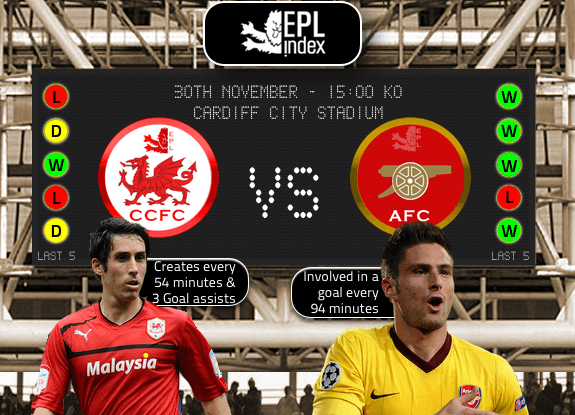
Yesterday’s clash between Cardiff City and Arsenal at the imaginatively-named Cardiff City Stadium produced much that we might have expected – as well as quite a lot that we didn’t.

First things first, and a fantastic performance by the league leaders resulted in a win that looked, on the face of it, comfortable. Arsenal produced everything we all know they’re capable of: shimmering moves going forward with chance upon chance being created; bewildering interchanges of position which saw the most unlikely people cropping up at centre-forward – how do you mark your men against a team like Arsenal? It was a feast of flowing, creative football, beautiful to watch, virtually impossible to cope with and ultimately very, very effective.

And yet Cardiff, newcomers to the Premier League let’s not forget, more than played their part in a highly entertaining game which was always closer than the scoreline might suggest. Their promising forward Fraizer Campbell got himself on the end of a few quality deliveries, and on another day might easily have had one or two goals himself. But the goal-scoring honours on the day rested squarely with a former Cardiff player, Aaron Ramsey of Arsenal.

Ramsey’s was a performance to drool over, not just for his two expertly-taken goals, not even for the overall quality of his performance within a highly proficient overall Arsenal display.  What really caught the eye was Ramsey’s poise, self control and a disarming humility in the way he reacted to his goals. Not a flicker of celebration, just quiet satisfaction and the full measure of respect to the club that gave him his start.  You see this sometimes, it’s a bit of a phenomenon over the past few years, and while it’s not universally observed – van Persie’s tasteless degree of triumphalism against Arsenal themselves springs readily to mind – it always gilds the occasion with that extra patina of class; there’s just something fitting about it that reminds you what football should be all about.

Even in this, Cardiff City more than played their part.  It’s a shattering, disappointing feeling to see your favourites concede a goal, at the best of times – to see a former favourite score not one, but two – that’s really unpalatable. And yet the Cardiff fans, all of them from what could be seen, responded magnificently to the prodigal Ramsey’s return and successes.  When the former Bluebird scored his first goal – a header of stunning quality – his muted response brought the stadium to its feet as the home fans stood and applauded, clearly affected by the respect shown by their departed star.  How often do you see that?

As a Leeds fan, I can only remember one comparable occasion at Elland Road, back in the early nineties when Roy Wegerle of QPR scored a wonder goal of such world-class quality that even the notoriously partisan Leeds fans gave it a unanimous ovation.  To see the Cardiff fans applaud Ramsey – for his second goal as well, which put the seal on Arsenal’s win – made you feel good about the game again, as if the underlying decency of sporting competition will always, in the end, prevail over the less attractive features we’re sometimes exposed to.

In between Ramsey’s two strikes, we had the spectacle of Mathieu Flamini – brought off the bench nine minutes earlier as a holding midfielder – materialising at centre-forward to sweep the ball into Cardiff’s net from Mesut Ozil’s perceptive through pass.  it was another outstanding example of the sheer brilliance Arsenal have in their locker this season.  The third goal right at the death came when the outcome of the game was certain, but it was another quality finish, and another immaculate display of respect from the outstanding Aaron Ramsey.  He took the applause from all sides of the ground, from his fans new and old, clearly touched by the emotion of the moment.

Arsenal’s prospects look genuinely good, there are really only a couple of question marks over their possibilities for the rest of this campaign.  The first concerns how they will fare against the better teams in the Premier League – of these, they have only met a less-than-vintage Man U so far, who scraped a win that will have disappointed the Gunners – knowing themselves to be capable of much better.

The second possible issue is around the back-up they have available in the event of injury or suspension for striker Olivier Giroud. Reserve forward Nicklas Bendtner does not appear to have what it takes at this level, and Arsenal may need to look to the transfer market again when the window opens.  Their stunning pre-season swoop for Ozil has cured any notions that the Gunners lack clout and ambition in their recruitment policy – they will probably need to reaffirm this new determination in the new year.

A highly enjoyable game for more than the usual reasons, and great credit to both clubs. On this display, you would have to back Cardiff to survive with something to spare – and as for Arsenal, they should have their sights set firmly on nothing less than the Premier League title itself.  What better way to break that trophy drought, a millstone around Arsene Wenger’s neck for far too long now?  And also, what better for the game in this country than Champions of the quality and class of Arsenal, still our foremost club despite populist claims for clubs lower down the food-chain.  Arsenal for the Title – I’ll drink to that.

Leeds United Fans – Why do Some Appear to Revel in Negativity? – by Rob Atkinson

Leeds, Leeds, Leeds!

Leeds, Leeds, Leeds!

I’ve read a couple of articles lately, both decently-written and making some good points – but both leaving me despairing over the massively negative attitude current among a certain section of Leeds “support”.  The tendency, in fact is not only massively negative, it’s eagerly, loudly, brassily negative.  It embraces negativity and holds it close like it never wants to let it go.  It’s the very antithesis of what support should be all about. It’s defeatism in its most depressing and demoralising form; if these articles had been written in wartime, they may very well have been taken out and shot.

The common theme of course, hammered home with relish and supportive statistics, is that We Are Not A Big Club Anymore.  The people saying this say it passionately and with conviction.  Not only do they wish to believe that Leeds aren’t a big club, the very idea that some fans may not believe this – may, in fact be holding dear the belief that United are still big – clearly upsets and offends them.  They crop up everywhere, these pallid little people, spreading their message of gloom and churning out invidious comparisons by the bucketload.  They’re becoming an effective voice wherever fans gather together to discuss matters Leeds.  In fact there’s only one real problem with their whole campaign. It’s utter, unmitigated bollocks.

The fact of the matter is, no club is bigger or smaller than its fanbase, its potential for support.  A very reliable gauge of this is freely available in these tech-savvy days we live in. It’s what is nattily called “online presence”.  Give your mouse some exercise and find out for yourself – if you don’t already know.  In cyberworld, second division, under-achieving, out-spent and unregarded Leeds United are absolutely HUGE.  This is the best barometer you could wish for of the measure of passion out there, the incredible hunger and thirst for any morsel of news, any topic of debate about the Mighty Whites of LS11. They’re out there, right now, all over the globe.  They’re clicking away at their computer terminals reading and digesting, or they’re writing in dozens of languages about Leeds past, present and future.  Our great days on the field are an increasingly distant memory, and a large proportion of the match-day support of a decade ago are marginalised and still priced out of actual engagement with the match-going experience, despite a return to relative sanity in the pricing structure.  But around the globe, in the ether, over the airwaves and most importantly inside the heads of millions of fanatics, Leeds United are top four, a phenomenon.

So, why this overweening eagerness to paint us as a small club?  Is it the tiresome need of social writers to dress themselves up as that bit different?  You know – slightly windswept and interesting, with that world-weary air of cynicism etching attractive lines into their fashionably-troubled yet intellectual brows.  It’s odd.  Any real pretensions to “cool” tend to be dissipated by the unseemly scramble to out-do each other in the negativity stakes, and they’re usually followed by eager-beaver starry-eyed acolytes who wish to attach themselves to any view that doesn’t qualify as mainstream.  Perhaps that’s the answer – are we dealing with an online football-flavoured brand of snob obscurantism?

I’m not advocating the other pole of this issue, by the way.  That worryingly Freudian habit of a certain Franchise’s fans to shout from the virtual rooftops about how they’re the biggest, the best and totally huge and wonderful throughout the world and all four dimensions of spacetime. I’ll mention no names here, but the initials are man u.  I’d be even more concerned if our collective attitude was as deluded as that, not least because – in the case of our acquaintances from over the hills – their Devon and Cornwall-based support have made of themselves a laughing-stock with such wishful thinking.  Certainly in Barcelona and Madrid, and in various other centres of realism too, not excluding Beeston.

No, all I want is for certain people to remember the basic meaning of the word “support”. It does not include the peddling of negative thinking, nor does it encompass unhelpful and misleading assertions regarding comparisons with such giants as Norwich and Dull City.  All of this is willful and groundless cant, calculated to spread misery and crush hope.

Support is about identifying yourself with the club you love, and spreading the word to those less fortunate who have not seen the light.  It’s about getting the shoulder behind the momentum of recent promising form – and being prepared to back it all the way, in the face of the withering carpings of naysayers as and when necessary.  Support is an overwhelmingly positive thing, and it needs to espouse and reflect positivity in everything it does.

Criticism is part of this, we are not simply a massive band of yes-men.  But criticism can be couched in positive terms too – this will not do for Leeds United, we said of Bates, and behold, he is gone.  The same applies to ticket prices, or transfer policy, or anything else we’ve been unhappy with from time to time.  We say “this will not do because We Are Leeds, and we demand better”.  So we can be critical – and that can be effective – but it’s still our overriding duty to be biased, and to talk the club up – because we’re supporters. Criticism that amounts to a wholesale belittling of the club relative to other clubs who may be enjoying some temporary success – that’s just ridiculous, and so counter-productive as to be a sin. Spreading alarm and despondency is not needed, not helpful, not to be embraced.  There are idiots enough in the media eager as all hell to do that, without people who are supposedly fans getting in on the act.

So please, those who peddle pessimism or deal in negativity, think again.  Think not only of whatever you’re getting out of venting these frustrations of yours, but also of your obligations towards the club you’re supposed to be supporting.  Let’s not give our enemies, among rival clubs’ support and within the media, such a cheap advantage.  If you’re a fan, then act and speak as one.  Support your club as a supporter should.  After all – We Are Leeds United, and we are the best.

United Flashback: Wembley 1992 as Leeds Put Four Past Liverpool – by Rob Atkinson

leeds_united_win_the_charity_shield_in_1992_5861482

Leeds United – Wembley Winners

For all the rival claims of the FA Cup and (don’t laugh) the variously-sponsored League Cup, there’s little doubt about the Wembley occasion it’s hardest to reach, the honour it’s toughest to compete for.  Yes, ladies and gentlemen, I give you the FA Community Shield, or the Charity Shield as it used to be known in less politically-correct times.  This is not an event you get to be part of merely by winning a few games at home against the likes of Orient and Norwich, with maybe a semi-final against Aston Villa to spice it up.  It’s not a trophy you can win simply by the luck of the draw.  This is an event for winners, although League runners-up sometimes get a look-in if one club has been greedy enough to win the “Double”.  The Charity Shield is billed as the clash between reigning Champions and FA Cup-holders and as such it has the stardust of success and glory sprinkled all over it.

The Battle of Wembley '74

The Battle of Wembley ’74

Some will demur, saying it’s just a pre-season friendly.  Well, it does take place pre-season – but a friendly?  Before we look at this 1992 meeting of old foes Leeds and Liverpool, let’s cast our minds back to 1974 when the two sides met in the very first Wembley Charity Shield.  Kevin Keegan and Billy Bremner sent off, Giles displaying the art of the left hook on the ref’s blind side to dislodge Keegan’s perm – and all manner of malicious goings-on besides as Cup-holders Liverpool edged out Champions Leeds on penalties after a 1-1 draw for which “combative” is a hopelessly inadequate description.  Ray Clemence conning David Harvey over the ‘keepers taking the last two penalties, then grinning broadly as he reneged on the deal.  The violence and then the discarded shirts of the guilty as they walked off, dismissed by the schoolmasterly Bob Matthewson, a ref who towered over the pocket battleships in the opposing midfields.  The fuss and bother afterward as the FA decided examples should be made, long bans handed out.  A “friendly” it most definitely was not.

This 1992 match though was played out in a much lighter and more entertaining vein.  There was an air of conspiratorial glee around the old ground; Liverpool had administered the fatal blow to Man U’s title challenge at the end of the previous season with a 2-0 victory, the faithful of the Anfield Kop taunting their misery-stricken rivals with chants of “Leeds, Leeds, Leeds” as the last hopes of Man U and media alike drained away.  The real Reds then went on to Wembley and routinely won the Cup against Leeds’ old Nemesis Sunderland, so that this “Traditional Curtain Raiser to the Season” had about it a faintly gloating atmosphere – mutual congratulation was in the breeze as we all celebrated the discomfiture of the Mancunian and Mackem scum.

The game itself was a crazy mixture of potent attacking and Keystone Kops defending which foreshadowed the season both clubs were to experience, but which was avidly lapped up by both Kops at either end of Wembley.  Leeds opened the scoring when Rodney Wallace scampered into acres of space on the left before squaring for one Eric Cantona to finish confidently past Grobbelaar in the Liverpool goal.  That was on 25 minutes, but only ten more were to elapse before Liverpool were level.  A deep cross from Ronnie Rosenthal found Ian Rush with enough far-post space to plant a header past John Lukic.  This was at the Leeds fans’ end, and I remember at the time thinking that Liverpool would now go on to win, but what a cracking day we were having anyway.  But shortly before half-time, Leeds were ahead again, Tony Dorigo sending a deflected free kick beyond Brucie into the left hand corner of the net.

The second half saw the game continuing to see-saw as both sides went for it.  Liverpool contrived a second equaliser when Dean Saunders fastened on to a loose ball and powered it past Lukic in the blink of an eye.  Again that feeling of slight resignation and again Leeds blew it away, regaining the lead after 75 minutes when Cantona headed a cross ball down for Wallace to tap back to him.  Cantona looked up and calmly directed the ball wide of Grobbelaar for 3-2.  The joy among the Leeds fans at this cherry on the icing of last year’s title triumph raised itself to a still higher level when the match seemed to have been decided 4 minutes from the end.  Wallace chased a ball out wide which, instead of trickling out of play, bounced off the corner flag and gave the live-wire Rodney an ideal chance to put in a telling cross.  And there was Cantona again, lurking at the far post as Grobbelaar flapped ineffectively for the ball, watching it all the way and planting a header into the empty net.  4-2 up against Liverpool at Wembley!  Eleven months before the birth of my daughter, this was probably just about up there with the Title decider at Bramall Lane for the most joyous events of my life to that point, and for a few delirious moments I didn’t rightly know where or who I was.

Sanity had barely returned when, way down at the other end, Gordon Strachan scored what must be the comedy own-goal of all time, executing a singularly ungraceful backward stagger as he tried to clear from the goal-line but succeeded only in trickling the ball over it.  Some cheered, some laughed; nobody was downcast except perhaps wee Gordon himself who looked distinctly pissed-off.  Leeds had won though, the occasion had lived up to and beyond expectations for me and my happy band and we waited joyously to watch the lifting of silverware at Wembley.

Before that happened, another display of respect and gratitude as the defeated Liverpool players trooped off into the tunnel at the United end of the ground.  The jubilant Leeds fans as a body stood to applaud their old enemies, the chants of “Liverpool, Liverpool, Liverpool” drawing reciprocal if shattered applause from the bemused players in red, honour satisfied, tributes paid.  Then the Leeds players going up the thirty-nine steps to hoist the Shield high, and cheers echoing anew from our throat-sore and ecstatic hordes.  Leeds United: Champions of England – the Last Champions – Charity Shield winners and the only team ever to score four against Liverpool in all of the Anfield giants’ numerous Wembley appearances.  Vivid memories of a truly wonderful day.

Disappointment at Huddersfield – Can Marius Zaliukas Steady the Ship for Leeds? – by Rob Atkinson

New Boy Marius Zaliukas

New Boy Marius Zaliukas

Another derby day defeat, another three goals conceded, this time against a team shorn of their top scorer due to suspension.  There were some crumbs of comfort: Matt Smith scored again, and could prove to be a handful for Championship defences as the season goes on.  Dexter Blackstock came on from the bench for his United debut, and he scored too, which is a great way to start with a new club.  We probably should have had a penalty, we scored one of their goals for them – and last but not least, we’ve signed an international central defender who captained Hearts to a Scottish Cup win.

Marius Zaliukas has been without a club since the summer, but played for his country only last week.  He was wanted by ‘Arry at QPR and nobody has had anything worse to say about the lad than that he’s got a bit of a temper on him.  At 29, he’s in his prime as a defender, and we’ve got him initially till the end of the season.  Yay.

It’s looking likely that Marius will have an active role to play at Elland Road sooner rather than later.  Our defence didn’t look exactly comfortable at times in the second half against Birmingham, even though we recorded a clean sheet in a 4-0 win.  Three at the back, if that’s how we’re to continue, will demand a decent pool of centre backs to allow for inconveniences such as suspensions and injuries.  It seems that Messrs Pearce and Lees were culpable in at least two of the three we let in from our chip-on-the-shoulder bearing neighbours down the road, so maybe an injection of international know-how and experience is just what the doctor ordered.

From all accounts, the boy might be a tiny bit aggressive, but again that’s more virtue than vice down Elland Road way.  Since the days of Norman the Great – in fact tracing our illustrious club’s history back as far as Wilf Copping – we’ve always appreciated a lad who understands the tactical subtleties of “getting stuck in” and “getting rid”. Marius Zaliukas sounds like he might be just our cup of Yorkshire Tea and it goes without saying that we wish him well.

If we can get the defence sorted out, and if we can convert a few more of the chances that we again created in reasonably great number today, maybe things can still look up in time for this season to mean something.  Well, anyway, that’s the positive spin on another disappointing day for Leeds United Football Club and its devoted army of fans.

It’s Yeovil next, and they beat Forest today.  Bring it on.

Loyalty Is a One-Way Street in Alex Ferguson’s World – by Rob Atkinson

Taggart:  Why I Was Always Right, by the waaaaaaaayy.

Taggart: Why I Was Always Right, by the waaaaaaaayy

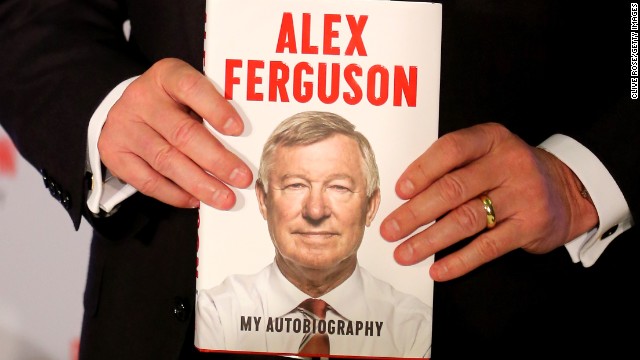
After nearly half a season of relative silence from their much-missed guru, hero, source of inspiration and occasional bête-noire, the media breathed a collective sigh of relief last week. The Ego Had Landed. Fergie was back, at least in print, and those fangs were still bared and ready. The latest autobiography of Alex Ferguson has shown the old curmudgeon has lost none of his ability to dispense vitriol, none of his elephantine memory for anyone who has ever annoyed him – and certainly none of his oddly unilateral approach to the issue of loyalty.

Apparently, during Fergie’s tenure, loyalty was a word much bandied-about behind the scenes at the Theatre of Hollow Myths. That it was evidently used to specify the absolute need for a slavish adherence to the Govan Guv’nor’s every wish goes almost without saying. This requirement extended beyond the confines of Man U. Should a rival manager ever have the brass neck and utter nerve to question or criticise the great man, a familiar growl would issue from his lair along the lines of “After all I’ve done fae him…”

Fergie was not a man to be crossed, not by subordinates, not by rivals, not even by his nominal superiors. Criticism was not to be tolerated. Resistance was futile. His was as near to an absolute rule as existed at any football club anywhere, certainly in the 21st century. Fergie’s Man U was the last autocracy in the professional game – a factor upon which, extending as it did to terrified administrators and wary match officials, was founded their unprecedented success.

The latest in a series of literary self-portraits has, in the august opinion of respected sportswriter Patrick Barclay, little new to offer in terms of revelation – the longed-for “blowing the lid off” the game, or portions thereof. What we do get is a series of little packages of poison as Alexander the Great reviews the vast canvas of his career and delivers his venom to those he believes were found wanting. The loyalty so prized by SAF in his managerial career is evidently a currency he does not feel it necessary to repay. This will come as no surprise to the likes of Brian Kidd, now the Manchester City assistant boss, or Gordon Strachan, now manager of Scotland. Each of them have had both barrels between the shoulder blades in the past, and to their credit they’ve largely maintained a dignified silence. But Fergie was in his Man U job then, and there were certain perceived perils associated with biting back at a figure who had managed to create for himself a tyrannical position whereby he held sway over most of football. Will he benefit from such forbearance after this latest raft of assassinations?

In this latest addition to the former manager’s stable of autobiographies (the whole possibly to be known as “Why I Was Always Right, Vols. 1-5”), the less-than-likeable Alex has turned his baleful gaze on, among others: David Beckham (the football boot in the eye incident, marrying a pop star and wanting to move to a bigger club); Arsene Wenger (Pizzagate and being offensively intelligent); Roberto Mancini (failing to sell Tevez when Fergie thought he should and then going on to win the Title with malice aforethought and a 6-1 tonking of Man U on their own manor); Rafa Benitez (for having the sheer bad taste to tell it like it was and also, with no evident irony, for being a “control freak”); then, last but not least here, the Rio Ferdinand drug-testers whose fault it apparently was that the former defender “forgot” to provide a sample when required. It’s an impressive list, but not exhaustive.

At least one other target, casually denigrated in the course of this epic litany of nasties, wants to have a word in Fergie’s ear. Ex-goalkeeper Marc Bosnich, described as a “terrible professional” by the man who nevertheless signed him twice, is putting a fairly stoical face on it, but appears not to be best-pleased and has hinted that he’d appreciate a frank discussion face to face.

The over-riding impression, delivered with all the subtlety of a Royston Keane tackle, is that anyone in his club who fancied himself bigger than the boss would have to either learn the error of his ways and that right swiftly – or get out. Keane himself is one who was moved on, in some haste, after “disagreements” with Ferguson. Keane it is now who remarks that his ex-manager, for all his preaching about loyalty, doesn’t know the meaning of the word, a sentiment which will be echoed by many of the men who served Ferguson well and have now been left bullet-riddled by the former chief’s paranoid rhetoric. The latest proof of this anomaly runs to many thousands of words, is available from this week, imaginatively titled “My Autobiography” and will cost you a decidedly prettier penny if you want your copy signed by lifelong socialist and latter day profiteer Sir Fergie himself.

It seems likely that the Ferguson Factor is what is missing from this season’s pallid Man U; the fear that gave them that edge seemingly gone with the wind. But on this most recent evidence of the choleric and treacherous nature of the man, who – other than the many millions of Man U fans from Torquay to Jakarta and back again, plus a few sensation-staved tabloid hacks – just who will really miss him now he’s gone?