Tag Archives: Liverpool FC

Leeds Utd’s Luke Murphy Puts Loyalty Before Pounds Sterling   –   by Rob Atkinson

  
Luke Murphy has seen his stock rise dramatically among the demanding constituency of Leeds United fans of late – and not just for his markedly improved form during the latter part of last season. That upping of his game, to more nearly approach what is rightly expected of a man with a seven-figure price tag, was certainly welcome enough, and warmly received by the Elland Road congregation. The resulting blast of approval must have been music to the ears of a man whose tepid earlier displays had earned him more brickbats than bouquets. But these recent accolades have, of course, resulted primarily from Murphy’s willingness to sign a new deal – reportedly on significantly lower terms. 

Just run that by yourself again, with the stereotypical modern, mercenary, grasping footballer in mind for the purposes of comparison. Take Raheem Sterling, for example. That young man’s surname bears more than a coincidental similarity to the unit of currency in these islands. This is a young lad of sublime talent who has proved himself, by his actions of late, not big enough to play for a club like Liverpool FC, much less their rabidly fanatical fans.

Sterling will have benefited greatly in financial terms from his move to Man City. He may even win a Cup or two in the seasons to come, as he sits on the bench for Manchester‘s premier club. But he has lost far more in terms of reputation and respect – though exactly how much that means to today’s young, deeply shallow, relentlessly materialistic Princes of Association Football must be open to grave doubt.

So there you have Sterling on the one hand. And there’s our own Luke Murphy on the other. You might wonder what options there were in front of young Luke, before he committed the next four years of his career to Leeds. It’s a fair bet that there will have been an agent hovering somewhere close by, whispering blandishments of temptation into those callow ears. It’s good, after all, for agents when footballers move on – and if Murphy could be persuaded his future lay elsewhere, then you can be sure that Leeds would have been looking to recoup their £1m outlay. And that’d have meant some wedge for Luke – and any agent – quite apart from the terms he might expect from a prospective buying club. 

But Murphy has opted to stay, and what he has gained in increased security by the greater length of his deal, he has largely lost by virtue of a reduced weekly wage. He’s still remarkably well-off, clearly, compared to other lads of his age – or mine, come to that. But it does warm the cockles to see a young pro prioritising where he wants to be, over what he wants to be paid. 

The contrast between Sterling and Murphy is stark, and it goes way beyond matters such as ability and potential. Sterling has – it’s blindingly obvious – had his head turned to a degree which makes that poor young lass out of The Exorcist seem comparatively stiff-necked. It is a pity that such a major talent should have been so poorly advised as to treat the greatest club and the greatest fans he will ever play for, quite so shoddily.

Luke Murphy, in that precisely identical situation of playing for the greatest club and fans he’ll know in his career, has chosen to show respect rather than contempt, humility rather than arrogance. It’s an attitude that deserves reward, and this blog wishes him a triumphant season, crowned with success. As for Sterling, we wish him not too many splinters in his arse as he bench-warms his way to cups and titles with Citeh. 

It does rather beg the question of whether we Leeds fans should perhaps be wary what we ask for, the danger being that we might get it. Obviously, we all want promotion, followed by establishment as a Premier League power, with silverware and continental domination, for preference, as is surely our Don-given destiny. But, should that come to pass, will we really be able to relate to and respect the wearers of those iconic white shirts? You do have to wonder. 

Sadly, when Leeds do become successful again, the squad we’ll be supporting is likely to contain rather more Sterling-like characters – eye on the main chance and sod the supporters – than it will the good, honest Murphy type. That, we can assume, will be part of the price of success. And we all crave success – don’t we?

The thing is though, this story of two young footballers, Sterling and Murphy, leaves me wondering if that success would really be worth the price we’d most probably have to pay. 

Sam Byram Presented With Bewildering Choice of Relegation Battles – by Rob Atkinson

Byram - spoilt for choice?

Byram – spoilt for choice?

For a young man still learning his trade after graduating from one of football’s finest academy setups at Leeds United, hot prospect Sam Byram now looks to have a tempting choice in front of him; he could be fighting relegation with either Sunderland or West Ham United this coming season.

Of course it might also be that Byram will prefer to continue his development at Elland Road, where great changes are afoot with a new head coach promising fast, aggressive, attacking football. This is surely just the kind of menu to have a pacy young wing-back, effective all the way up and down the right flank, licking his lips and champing at the bit – if I may be permitted to mix my metaphors. But the lure of the Premier League has seen United shorn of many a promising young talent before; our Sam would be in illustrious company if he decided his future would be best spent elsewhere.

This blog’s opinion, for what it is worth, is that any deal for Byram should be sanctioned only if the benefits to the club are absolutely irresistible. From that point of view, the rumours suggesting that Sunderland might be prepared to offer their richly-talented forward Connor Wickham and a cash adjustment not unadjacent to £6 million would have any discerning Leeds fan urging the club to snatch the Mackems’ hands off. Life, Leeds United, the Universe & Everything has given its opinion on a couple of previous occasions that a nominal right-back (albeit with attacking ability) as sumptuously talented as Byram is a distinct luxury in the Championship. A player like Wickham and a cool six mill besides would provide a wealth of options in terms of building a team that could challenge at the top end of this league. If Sunderland are that keen to capture Byram, then it’d be extremely tempting to roll out the welcome carpet when they come a-calling – and make sure they get the worse of any bargain. This is something that Massimo Cellino notably has form for, with last season’s brutal mugging of Fulham over Ross McCormack being the obvious example of seeing coming a club with more cash than sense.

From Byram’s point of view, though, it’s hard to accept that he couldn’t do better than clubs likely to be scrapping away at the foot of the Premier League. Names of much greater pedigree than Sunderland or the Hammers have also been whispered as possible destinations – Liverpool, maybe, or even Manchester City. Again, Cellino would be expected to drive a hard bargain, if Byram were to be winkled out of our clutches – and at least we’d have the admittedly dubious satisfaction of seeing yet another Leeds old boy strutting his stuff at the top end of the top league.

It’s always difficult, contemplating the loss of a home-grown star – thankfully, there is no sign of the supply drying up, and this is likely to have to provide one of our club’s main income streams until that glorious time rolls around when we, too, dine at the top table in the swanky restaurant that is the Premier League. Things will be different then – or so we must hope. Leeds would be looking to storm the top flight for the third successive time, following promotion in the early sixties and late eighties and the subsequent swaggering domination of the game enjoyed by those two great sides.

Whether it’s feasible to expect a hat-trick of such achievements must be open to the gravest doubt, given the radically different landscape of football now as opposed to then. But it’s in the nature of Leeds to gatecrash cosy, elitist parties and make their presence felt. Those previous two promotion outfits have surely written that into the club’s DNA – and now, as then, we have the same promising knack of producing our own, sparkling talent.

Perhaps Sam Byram will be leaving this summer – or perhaps he will pen a new deal and stay. Either way, whatever happens has to be for the good of the club, and in the longer term at that – no short-sighted squinting at the immediate future should get in the way of a focus on lofty ambitions beyond the next season or two. This blog hopes that the lad will stay, but is philosophically accepting of the possibility that he might well be seduced away.

And, whatever his destination, surely Leeds fans will wish him all the best – especially if any deal done helps United lay the foundation for a brighter future. That, much more than the future of any individual player, is what matters above all to anyone with the interests of Leeds United at heart. 

Bradford Fire Disaster 30th Anniversary – by Rob Atkinson

Image

Horrific scenes as the Bradford main stand burns fiercely

30 years ago today, I went to watch Leeds United play at St Andrews, Birmingham City‘s ground, in order to support the United lads, who still had a faint mathematical chance of promotion. These were the bad old days, when football violence was still highly fashionable, and it was predictable that things would get out of hand given the slightest excuse. Well, Leeds went one down, it was a crap game, and get out of hand things certainly did. There was a mass riot, invasions of the pitch from both sets of supporters, police horses tried to get between the warring groups and general mayhem ensued for quite a time. Inside the ground, a 12 foot wall collapsed and a young lad was crushed to death. It was a tragedy of the times, crowd disturbances were commonplace and only 18 days later, trouble at the Heysel Stadium in Belgium would cost the lives of 39 Italian fans as the European Cup Final between Liverpool and Juventus was fatally marred by ugly scenes of violence.

As the Leeds fans emerged from Birmingham’s ground though, we were totally unaware that an event had been unfolding back home in Yorkshire that would cost 56 more lives, leave hundreds injured and traumatised and form another catastrophic part of that dreadful month of May 1985. At Valley Parade, the antiquated home of Bradford City, a fire had broken out in the main stand, a ramshackle construction of timber with an oft commented-on build-up of litter beneath the wooden seats – a calamity waiting to happen. On that Saturday afternoon, as spectators packed the old stand to greet their promotion-winning Third Division Champions, the calamity did happen, and with unbelievable speed and ferocity.

At about 3:40 pm, ITV commentator John Helm noted that there appeared to be a small outbreak of fire in the main stand. Within four minutes, on a dry and windy day, the fire had engulfed the whole of the stand, trapping many in their seats. People dashing to the back of the stand for fire extinguishers found none – they had amazingly been removed for fear of vandalism – and the fleeing crowds were forced to break down locked exits in order to escape. Others escaped forward onto the pitch, and within the burning stand there were acts of outstanding heroism as some people tried to assist those less able, without regard for their own safety. The design and build of the ancient stand conspired in its swift destruction; the roof was of wood covered with tarpaulin and sealed with asphalt and bitumen. The whole structure was, in effect, one big incendiary bomb which had been waiting to go off for years.  Now, a single lighted match or cigarette, dropped under the seats onto the accumulated litter below, had started a conflagration that raged out of control before anyone could summon help. It was a miracle, aided by the selfless bravery of many of the spectators who rescued their neighbours, that more weren’t killed.

As it was, 56 deaths and hundreds injured left its mark on the game, and rightly so. The Popplewell Inquiry led to the introduction of new legislation to improve safety at sports grounds, and construction of new stands from wood was banned at all UK sports venues. Thankfully, the death toll had been somewhat limited by the absence of perimeter fencing around the pitch, a lethal factor in the 96 deaths at the Hillsborough disaster 4 years later. Bradford City’s ground now is unrecognisable from the ramshackle stadium I remember as a student in the city in 1981, when I attended a League Cup tie against Ipswich and marvelled from the open Kop at the sheer age and dilapidation of the wooden stand to my right. A magnificent state-of-the-art main stand now crowns the development which has taken place on all four sides of the arena – a credit to the City, to the Football Club and to the memory of those fans who died – 54 from Bradford City and 2 from their opponents that day, Lincoln City.

Later that year, in July, I attended a Bradford City memorial game at Elland Road when the majority of the 1966 World Cup Final teams, England and West Germany, turned out for a rematch. England won again, 6-4 with Geoff Hurst scoring another hat-trick, Uwe Seeler scoring a quite magnificent goal at the Kop End, and the late Alan Ball notching for England too, as did Martin Peters – the other Three Lions scorer in ’66. England were captained by the late, great Bobby Moore, and our own Jack Charlton appeared with lesser-known brother Bobby. It was a wonderful occasion and a fitting tribute to the dead and injured of the Valley Parade fire, raising many thousands towards an eventual total of £3.5 million for the Bradford Disaster Appeal Fund.

On this pleasant late spring day, when the memories of that awful summer of 1985 are receding further and further into the past, let us pause and remember those who died this day 30 years ago, as well as the victims of the Heysel Tragedy – and not forgetting young Ian Hambridge who died when that wall collapsed at St Andrews while football fans unknowingly rioted all around. Ian would be 45 now; he and 56 others at Bradford were robbed of their lives by the events of the day. Rest in peace, all of them – and let’s be thankful that we’ve seemingly moved on from that dark period in football and stadium history.

Daily Star Fabricates Leeds Story, Wins Weekly Gutter Press Award   –   by Rob Atkinson

That award-winning Star rubbish - with original incorrect pic

That award-winning Daily Star rubbish – with original incorrect image

The weekly award for Most Outrageously Crap Made-Up Story About Leeds United, keenly fought over by the entire cadre of gutter press tabloids, has this week been awarded to the Daily Star – even though it’s only Monday. The judging panel decided that it was so unlikely anyone would come up with a worse effort this week, than that dreamed up by clueless Star hack Jeremy Cross, it was safe to award the trophy – a pile of pig ordure tastefully crafted in finest pewter, to the ridiculous yet amusing sports scribbler. 

The story, based on zero evidence and fraught with inaccuracies, was deemed to be in the finest traditions of tabloid journalism for those reasons alone. The fact that the piece, which centred on young Sam Byram as the player the Star wish to unsettle, was illustrated with a picture of team-mate Luke Murphy, was the clincher for the award. A spokesman said: “The brilliance of making up a highly unlikely shot-in-the-dark story about one player, accompanied by a picture of a quite different player, was well appreciated by the awards panel. We’re seriously considering inducting Jeremy Cross into our legendary Salon des Incompétents Hall of Tabloid Fame, for services to base hackery.”

Following a hasty correction, the original picture of Luke Murphy was replaced by one of Byram, around whom the Cross fantasy had originally been spun, disappointingly detracting somewhat from the brilliant effrontery of the piece. However, this craven piece of backtracking was not thought sufficiently cowardly for the Gutter Hack Award to be withdrawn.

Sadly, the winner was unable to accept his award in person, as he was busy rifling through the dustbins of an England U-21 International for his next made-up “scoop”. In the absence of Jeremy Cross, the trophy was picked up by his faithful assistant, Jeremy Mildly-Annoyed.

The Daily Star is regrettably not available from newsagents, as they prefer more serious publications – like The Sun – but it can be obtained wherever budget toilet paper is sold. 

Forty Years Ago Today: Getting Bitten by the Leeds United Bug – by Rob Atkinson

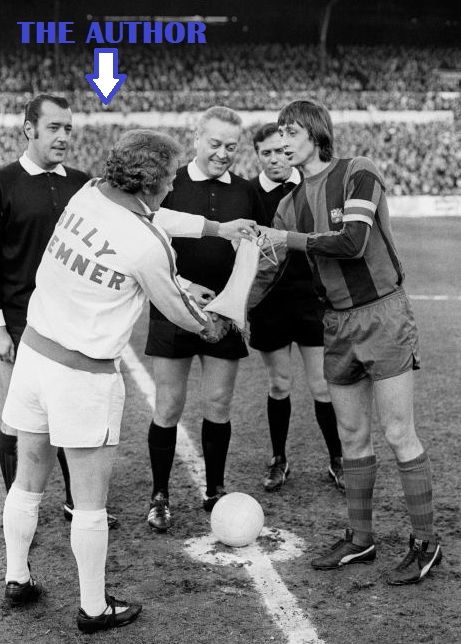
Billy and CruyffAuthor

When I was just a little boy I asked my mother, what should I be? Should I be Chelsea? Should I be Leeds? Here’s what she said to me…

Of course, it wasn’t like that, not for me – nor was it for thousands of others like me. For the vast majority of us, Mum was blameless; our Dads were the ones to thank – or blame – for starting an obsession that would run through the rest of our lives. Yeah, cheers, Dad. Every time you took the mick after another grisly home defeat, or rolled your eyes and intoned: “Never again”, I felt like snapping back and reminding you that it was your bloody fault in the first place. All those dreadful defeats and Cup exits. But there were also some good times…

Football support is such an individual thing, yet there are themes which are surely common to all football supporters. Over a period of years, seasons, decades of loving a football club, there will have been hot-blooded highs, and there will equally have been the coldest of despairing lows.  This will be so, whatever the size of the club we love, however successful or otherwise they may be.  It’s certainly the case for me – I can look back over my forty year love/hate affair with Leeds United, and there they are, all the memories, all the feelings, all the good and the bad that an obsession can visit upon a hapless fanatic. My Dad didn’t quite make it to my 40 year anniversary – he died in February, just in time to avoid a home defeat against Watford. But I will still have him to thank, when the good times roll around again. So, watch this space, Dad.

My Leeds United era started on April 5th 1975, timed to perfection for me to witness the death agonies of what was then still Don Revie’s great team, which had dominated English football for over a decade – albeit now under new management in the urbane form of Jimmy Armfield. This says all anyone needs to know about my fatally flawed sense of timing. During those years of success and near-success, when I could have been sharing the roller-coaster ride with my younger brother as he accompanied Dad on so many Saturday afternoons at Elland Road – what was I doing?  Why, I was curled up with a book, or watching some elderly MGM musical on BBC2 with Mum, completely unaware of the appeal, the magnetic attraction of Leeds United. How could this be?

In retrospect, it seems amazing that I should have missed out completely on the most sustained period of success United ever knew. But I was always a bookish lad, and I leaned far enough towards home and hearth, and far enough away from the Big Lads’ Club relationship between our kid and my Dad, to be happy with my nose in the goings-on at Greyfriars, or sampling the adventures of dare-devil astronauts on a Journey to Jupiter. On the day in 1972 that Leeds United won their only FA Cup, I was at the Town Hall in Pontefract winning second prize for poetry at the annual Music Festival. I wuz bloody robbed out of first place, too – on one of the few occasions when United weren’t.  But them’s the breaks, and it’s not as if I was straining at the leash to be off to t’match.  I just had no idea of what I was missing, and my treacherous brother and father didn’t see fit to enlighten me.

I really should be bitter about this – even now, my brother seeks to claim the moral high-ground as the one who saw Big Jack and Top Cat Cooper play, the one who saw us torturing Southampton with a cruel bout of possession at 7-0 up, the one who saw, for whatever it was worth, Georgie Best – on the few occasions he emerged from Paul Reaney’s back pocket. But the fact is, I’m not that bitter. I’d have liked to have seen for myself some of the vintage Glory Years stuff, and some of the Osgoods, Laws, Greaves and St Johns of the opposition; but it seems to me now that so many who witnessed all that were spoiled by it, and lacked the character to see it through when the good times stopped.  It was never easy to be a Leeds fan – even then in what we may fairly call glory, glory days, we had far more than our fair share of disappointment and defeat, and we reaped the bitter fruits of hatred, from all sections of the game, not least the referees – as I’ve ranted about elsewhere.

So, it was clearly no cakewalk even at its best, but still a time to be envied and marvelled at by those of us who came afterwards, and who had to starve for success until Sergeant Wilko stomped through the door. The thing is – not having seen the hits and near-misses of those days – I and many more like me were better able to subsist on the poor diet of the late seventies and especially the eighties. Many of the relatively success-sated Revie period fans fell by the wayside during these barren years, my dad and sibling included, and the essential character of the fan base changed from almost complacent to virtually feral.

So, there I was, thirteen years old and still a Leeds United virgin, slouching happily home from school one weekday evening in March 1975, and never a suspicion that my life was about to change.  I’d have had homework on my mind, quite possibly – a French translation to do, or some equations to balance. First it’d be tea: burgers peas and chips or something equally mundane, with Nationwide on in the background, then the homework, then some telly and whatever book I had on the go.  I was a happy and grounded child, in those pre-football angst days.

When I got home on this particular day, though, Dad had a surprise for me.  Off you go upstairs, he said, look in our bedroom and tell me what you find. I was more intrigued than fired with enthusiasm by this – what was I expecting?  A new book, maybe. A tube of Smarties and a Milky Way, perhaps. Anything, I’m sure, but the six oblong pieces of stiff paper on my Dad’s side of the counterpane.  Two tickets each for Dad, me and our kid, Liverpool at home on Saturday, and then – the biggest game on the planet that next Wednesday evening, Barcelona at home, Cruyff, Neeskens  and all, in the semi final home leg of the European Champions Cup.

Dad beamed over my shoulder as I stared at the tickets.  Biggest two games of the season, those are, he said. I remember I nodded my head, the idea not growing on me as yet, but somehow aware that this was a grand gesture on my dad’s part. Unwilling to disappoint him with apathy, I turned, smiled and said, great – thanks Dad. Now, of course, I know that it was a watershed in my life. Then – well, I just wanted to catch the last bit of Hong Kong Phooey, before carrying on with my familiar evening routine. And so, the last few days of my innocence passed, before it was time to get into the car and be taken to Elland Road football ground for the very first time.

It’s surprising what stays with you, years and years later.  So many of the countless games I’ve seen at Elland Road, and at other grounds at home and abroad, have faded into blurry anonymity.  I suppose my first game was special just because it was the first; and the second – that European night – had a magic all of its own, which was apparent even to a rookie such as me.  I can recall little of the Liverpool match itself. The colours were vivid – we didn’t have a colour TV at home at that time, and I think I imagined that football was a grainy experience, a mixture of grey and darker greys.  The Technicolor reality of it hit me with an impact I can readily bring to mind even now.  The field seemed to be vast, and brilliantly green, but the ground itself, viewed from under the pitched roof of the old Lowfields side, wasn’t as huge as I’d imagined it.

The strongest memory is still that of the Bay City Rollers’ “Bye Bye Baby” being played over the tannoy (they were tannoys in those days, none of your fancy PA systems). That one naff record is a massive reminder of that day, even now, and it remains one of the guiltiest pleasures on my nostalgia playlist. The green of the pitch, with the all-white strip of our lads, and the all red of Liverpool, the composite sound, Dad’s loud pessimism against a background of the grumbling roar of the crowd, the smell of tobacco and the taste of hamburgers and onions washed down with Bovril – and the pressure of the crowd behind, in front, everywhere – this was the assault on all my senses that blew away any thought of resistance as I entered a whole new world.

Already, I was hooked, and I knew it. We lost 2-0, but I was far too lacking in cynicism or expert discernment to let that detail bother me. Dad and our kid were sulkily disappointed, having seen it all before, and seen far better, but I loved it, loved the whole thing. If I’d known at that moment that I was in for a string of league defeats, and not even a league goal to cheer until the first day of the 76-77 season – well, would I have wanted to carry on?  I would have, I’m emphatically sure.  I loved Leeds United, completely and uncritically, and I was champing at the bit to get back to Elland Road.  And CF Barcelona, with their galaxy of exotic stars, were just four days away.

Over the next year or so after these initial matchday experiences, I was taken to a few, carefully selected games, something I settled for willingly, rather than going back to being completely excluded. I don’t remember if Dad’s pattern of support was dwindling even then, or if perhaps he still preferred to go as the original dynamic duo with my brother, the anointed “favourite son”. Whatever the reason, it soon became a standing joke that my visits to Elland Road were guaranteed something-nil defeats. I saw the Liverpool game the following season.  We lost, 0-3.  I saw us play Norwich towards the end of that season, when we were actually handily placed near the top of the league, with games in reserve. We lost 0-3 again. There was a growing desperation that I should break my duck, so the next game chosen was Sheffield United, who were already relegated. We contrived to lose that one as well, 0-1 with the grey-haired Alan Woodward scoring for the Blunts.

I was obviously a Jonah, carrying the can for the team’s inability to live up to the recent glorious past. I would never see Leeds win, or even score, not if I went along to Elland Road till I was ninety.  Or that’s how it felt.  Of course things did improve, but I’ve never quite been able to shed the Jonah part of my make-up, and many is the game I’ve cost us, simply by being there and wanting too much for us to win. Or maybe it’s not me, maybe it’s just Leeds. Whatever the case, it was an inauspicious start – in the league at least.

That European campaign though was different.  The whole city, the whole county it seemed, was buzzing with excitement, and the feeling that Don Revie’s Champions of Europe dream was about to be realised was irresistible. After the hors d’oeuvre of the Liverpool game, I was ready for my Catalan main course and, despite my début defeat, I just knew we were going to win. With the all-consuming passion of the new convert, I anticipated the game, how the arena would look under the floodlights, packed to the rafters with hysterically expectant Leeds fans. Cruyff, the Dutch master, the most expensive player in the world (nearly a million pounds!), would not, could not, stand in our way. We beat Barca over the two legs and, in my naivete, I was sure we would now be unstoppable. Bayern Munich were ours for the effortless taking in Paris. We were going to win the European Cup.

And that peak of optimism prior to crushing disappointment was as good as it got for me and for Leeds United, for the next 15 years, anyway. As any Leeds fan of a certain age will be aware, there’s a whole separate blog in what happened next at the hands, not primarily of Bayern, but mainly of a bent French ref acting in the best traditions of the game’s masters. Having hit the heights against Barcelona, we were to be cast down yet again, and it was the end for Revie’s boys. For me, however, it had barely yet begun…
Leeds United to Miss Out as FA Introduce Selective New “Joker” Rule – by Rob Atkinson

I heff het...enOUGH of losink. I em playink - our JOKER in all games now.

I heff het…enOUGH of losink. I em playink…our JOKER in all games now

It hardly comes as news to the fans of Leeds United, long used to English football’s tiresome habit of “playing favourites”, that there is some perplexity in the corridors of power about the inability of the “most popular club” to win the league title. Since a certain choleric Glaswegian shuffled off into the sunset to brood over old feuds and current grievances, the supply of plastic EPL titles for Club Popular has dried up somewhat, much to the chagrin of the suits. Needless to say, that most popular club is not located in LS11 – the Whites of Elland Road occupy a ranking at the other end of the adulation scale, with the game’s administrators being accustomed to wrinkle their noses slightly if forced to acknowledge Leeds’ existence, affecting a rather pained expression, as if they were suffering patiently in the presence of some noxious odour.

No, the “most popular” – naturally – are the club I joshingly if not exactly fondly refer to as the Pride of Devon – due to their vast appeal to the more insecure type of West Country glory-hunter. But they’re all the rage in parts of London too, this lot – as well as Wales, Ireland, Milton Keynes, Barnsley, for God’s sake – and not to mention great chunks of the Far East and even isolated neighbourhoods in less salubrious areas of Manchester itself. 

The dilemma faced by the game’s rulers appears to be a matter of clear and present danger to those earnest men in their sober garb, as they brandish calculators and contemplate massive markets, domestic and foreign, previously of great productivity, with bale after bale of tatty replica Sharp, AIG or Chevrolet shirts being demanded every high day and holiday by precocious Man U-supporting spoilt brats. Having expressed concern over the poor form of the EPL Golden Boys, the Premier League CEO Richard Scudamore is now rumoured to have come up with a foolproof plan to redress the balance and get away from the current, annoyingly level playing field in English top flight football. The Chief’s idea is the product of much serious thought and an increasing awareness that the problem of Man U’s chronic lack of dominance is not going away anytime soon. Now, Scudamore has allegedly been inspired by the popular summer evening silly games contest of the mid 1970s, It’s A Knockout, to come up with a novel solution to a thorny problem.

Uncle Stuart - butter wouldn't melt

Uncle Stuart – butter wouldn’t melt

For those of us of a certain age, that evocative theme music is just so reminiscent of long summer evenings when we were young; coming home from playing football on the village green, hot and dusty and pleasantly tired, ready to sit down, relax – and enjoy some more seemingly innocent fun as good old “Uncle” Stuart Hall treated us to his dulcet tones, his manic laugh – but thankfully not the gift of his intimate acquaintance. Genial old rugby league fart Eddie Waring bumbled about in the background, sounding ever more like a Mike Yarwood impression of himself, joining in with Hall for the title of maddest chortler. It was quintessential family entertainment, or so it seemed in those pre-Operation Yewtree days.

Happy days, for some. But the appeal of It’s A Knockout was – thankfully – more down to the nuttiness of the games and the rules, than any peculiarities of the show’s host. The contests were between a number of teams representing various obscure towns around the UK. Massive costumes figured heavily, huge false heads on them which would put Joe Royle or even Wayne Rooney to shame, colourful, crazy, hilarious. There was water, there were custard pies, there were enough card-carrying prats to ensure pratfalls aplenty – it was hilarious, playful anarchy – and the presenters could be heard crying with mirth as the participants struggle gamely. Nobody was too bothered about the scoring system – and yet it was one bizarre element of this which may now restore Man U to what the suits see as that troubled franchise’s rightful place at the top of the English game.

The idea is that Man U – at their own discretion – will be able to “play their joker” whenever the need arises. It’s important to emphasise that this is not a reference to the team selection and the appearance in a Man U shirt of Angel di Maria or the latest “next George Best”. Rather, it is a maverick twist to the scoring system of any particular game – whereby the team playing its joker will have any subsequent score doubled.

Scudamore is believed to favour a refinement of this system, seeing the Man U joker double the value of any goal scored, rule out any goal against them, or produce a penalty on demand, regardless of where play happens to be on the field. It is envisaged that this would enable even a team managed by a total incompetent – or “onbekwaam” as Mijnheer van Gaal’s compatriots would say – to prevail in most games. Theoretically, at least, the return of the Pride of Devon to the summit of the game would be assured – and the Theatre of Hollow Myths would once again ring to the rafters with songs of West Country and cockney triumphalism.

One important feature of the new system is that – surprise, surprise, Leeds fans – it would not be open to all teams, as that would merely introduce an annoyingly random element whilst maintaining what is seen as an undesirable status quo. The conditions of entitlement so far envisaged are extremely stringent; only clubs who can demonstrate that every single one of their FA Cup ties since 2005 has been televised live on TV – even when they’ve played no-hopers at home (Exeter and Cambridge, for example. Or Leeds United…) – will have the option of “playing their Joker”. It has been concluded that only one club, based just outside Manchester, would fall within these parameters. Coincidentally, the identity of this randomly selected club would fit in precisely with Mr Scudamore’s idea for the future of the game.

Scudamore is said to be delighted with his plan. and hopes that its introduction will be a new start for English football, with better times ahead for all – unless you happen to be a fan of Chelsea, Arsenal, Liverpool, Manchester City – or indeed any club that lacks the postcode M16 0RA.

Louis van Gaal, 83, is an extreme embarrassment.

How Premier League CEO Scudamore Blew the Gaff on Man Utd Bias – by Rob Atkinson

Pet lip:  Premier League CEO Scudamore misses those Man U days of success

Pet lip: Premier League CEO Scudamore misses those Man U days of success

As a Leeds United fanatic, a card-carrying cynic and someone with no faith in the football authorities these days to run a fair and disinterested league competition, I have written many times on this blog about my belief that the Man U domination of the game in this country after 1993 (the FA Premier League début season) was deeply suspicious. The last season or so’s steep decline, with a squad not at first markedly different to the one that romped home in Taggart’s final season, begs the question: what’s really different? It has appeared ever since The Demented One left that the change of stewardship is behind this relative failure. But was Alex Ferguson the sole factor in the unprecedented success enjoyed by the Pride of Devon over the last two decades?

These days, following a series of revealing comments over the past year or so from people who should know whereof they speak, it appears that at least a couple of other factors have been at play throughout that twenty year period. I have said over and over again in Life, Leeds United, the Universe & Everything, that the Fergie years have been trophy-laden for three well-defined reasons, none of them all that adjacent to the quality of their playing squad. They may be summed up as: Ferguson, match officials and the rulers of the game itself. These three influences conspired over two decades to exaggerate the success of Man U out of all proportion to the abilities of their playing and coaching staff in that period, many of whom have gone on to enjoy sustained mediocrity elsewhere. Add into the mix the drip, drip, drip effect of blind, unquestioning media adulation, spearheaded by Murdoch’s Sky empire and endorsed by lapdog attitudes from the terrestrial broadcasters who know which side the commercial bread is buttered, and you have what is technically known as a “Scum-friendly environment”.

This may to the unwary sound like just another conspiracy theory.  But you only have to look at the unprecedented before and after picture of Man U’s record pre-Murdoch as compared to their success under Uncle Rupert. After all, we’re talking an almost total domination of the Premier League era here, by a club that – for the 26 years immediately preceding the league reorganisation – couldn’t buy a title. Seven times Champions in their whole history prior to 1993, and then thirteen Premier League titles in the first twenty years after Rupert Murdoch bought the game.

That’s such a sharp delineation between failure and success – it’s not coincidental that the demarcation line is the inception of the Premier League, the changing of football in this country from a sport to a brand – and the new understanding that the game was now about markets and money to a much greater extent than it had ever been before. Man U were the new brand leader, and they had better succeed – or the Premier League product might not fulfil its immense potential for dominating the world in terms of TV audiences, syndication and merchandising. And that would never do. So the game leant the way of the Man U scum – as we at Leeds United fondly refer to them – and the pressure applied by Ferguson to match officials was allowed to take effect. Professional sport is a matter of extremely fine margins; a slight bias over a long period will skew outcomes to a massive degree – and that’s exactly what has happened.

Naturally, none of this has ever been acknowledged. It’s been of paramount importance, after all, that the Premier League should at least retain the appearance of being a fair competition, on the proverbial level playing field. But now – Ferguson has gone, Man U are failing, the referees are not by any means as intimidated, opposing teams are not scared any more; not, as they used to be, beaten before they took the field. And now people are speaking out, very revealingly – and in some cases that is clearly intentional, in other cases less so. Ex-referee Graham Poll is one who has made his views known quite deliberately; he has spoken out about the feelings of a ref in the Fergie years, how the priority was to get off the field without having made any close calls against Man U – and, ideally, with them having won the game. What is the cumulative effect of that kind of insidious pressure over twenty years? Self-evidently, it’s significant; look at the trophy records, the penalty for and against statistics, the time added on if Man U weren’t winning – and so on and so forth.

Poll has also written about the unprecedented scenes when three penalties were given against Man U in a home game against old rivals Liverpool. Even though things have changed in terms of the favourable decisions enjoyed by Man U, these were the first penalties awarded against Man U as the home team since December 2011 – well over two years without conceding a home league penalty. Poll’s observations on that make for interesting reading for anyone who, as I do, strongly suspects that Man U had it easy from match officials in the Fergie years.

And then, to put the tin lid on it, we had Premier League Chief Executive Richard Scudamore sounding off, in earnestly worried tones, about how the Premier League “brand” is being adversely affected by the difficulties Man U were having last season (happily, it’s carried on in pretty much the same vein this time around). It’s difficult to believe that he was quite aware of the import of what he was saying – this was a tacit admission, after all, that the supposedly disinterested rulers of the game actually have a vested interest – as I’ve been saying long and loud – in the regular success of Man U. “It’s a double-edged sword,” said Scudamore, at the time. “When your most popular club isn’t doing as well, that costs you interest and audience in some places.” The hapless Peter doesn’t identify the other edge of that sword, but he’s clearly perturbed by the prospect of a future with Man U as the also-rans they’ve been this last two campaigns.

Speaking in greater depth about the ethos of the Premier League, as well as its duty to fans around the world, Scudamore went on: “There are lots of fans around the world who wish Manchester United were winning it again. But you have to balance that off against, generally, we’re in the business of putting on a competition and competition means people can compete.” The wistful tone of that last sentence was massively telling. Other clubs will insist on competing, particularly now that Ferguson is history. How very inconvenient and bad for business. What a deuced bore.

The FA Premier League mandarins at a high level clearly see even competition, where any old Tom, Dick or Manuel (or even Jose) can win the League, as their cross to bear, something that will inhibit their ability to market their “brand” around a global audience in thrall to Man U. But they have made a rod for their own back in allowing the creation of that trophy-winning monster, under the inimical sway of a tyrant from Govan, to become so all-consuming in the first place. Now they’re reaping what they have sown – in pumping up the bubble of unrealistic success for one favoured club, they have left themselves without a Plan B for when that bubble bursts – as bubbles inevitably will.

For real football people – the fans out here, the people who have always gone along to the match, with little if any thought of global markets and syndication deals – this new reality of genuine competition has come as a breath of fresh air. There’s a new top four out there, of varied make-up which usually excludes Man U, and they’ve all played wonderful football and succeeded on their own merits.

We’ve also seen less of the media-beloved “mind games” which are so tiresome to the fan in the street. We’ve not missed that old curmudgeon, railing at authority whenever he gets any less than his own way and intimidating anybody who gets in his way. Football seems fresh and new again; Man U were seventh last time – which is probably about where they should have finished the season before. The first twenty years of the Premier League can be seen as a statistical blip, the product of a tyrant dominating and bullying the people charged with the responsibility to see that the game is run fairly. The evidence is there; listen to Poll, listen to what Scudamore is actually saying. Look at the results and standings this season and last.

We’re so very sorry, Mr Scudamore, if your product and your brand are suffering from the failure of “your most popular club”. Perhaps you should take the view that popularity is there to be earned by whichever club can succeed on merit? That it’s not something to be inculcated by the favourable treatment of one chosen club, amounting to institutional bias over twenty long years. Perhaps you can learn that – and then all we will have to regret is the two decades when, aided by Ferguson and a terrified cadre of referees and officials, you – blatantly and with malice aforethought – sold the game down the river.

The Top Three Leeds United Transfer Rumours Ever – by Rob Atkinson

Image

Well, another transfer window is flapping wide open in LS11 just as it is in less crisis-torn football outposts and, embargo notwithstanding, a couple of Serie A fringe performers have breezed into Elland Road and signed for Leeds. Possibly there are more to come, maybe an outgoing or two as well. It’s certainly different, in a good way too, from some of the depressingly inert United transfer markets of the unlamented Bates era – but it hardly compares with the wheeling and dealing we did in more halcyon days. And, if anything, some of the rumours that never came to fruition down the years were more exciting and entertaining than certain signings that actually did happen (take a bow, Messrs. Sharpe & Brolin).

There have been so many players linked with transfers to Leeds United over our chequered history and, in the nature of these things, only a small proportion ever actually pulled on the famous white shirt.  Of those who never arrived, it would probably be easy to name at least two world-class International sides comprising players who were rumoured to be signing for United, but missed out on that pinnacle of honours and finished their careers tragically unfulfilled – apart from the odd cartload of silverware. The likes of Tomáš Skuhravý, Rainer Bonhof, Peter Shilton, Trevor Francis and even Dean Saunders have all, at one time or another, been tipped as Leeds United players, only to remain trapped in dreadful anonymity at the likes of Liverpool, Bayern Munich or Nottingham Forest.  Here – in time-honoured reverse order – are my top three exciting but unrealised rumours – you may well have candidates of your own, so please feel free to comment.

3. Duncan Ferguson
In 1994, it really did look as though this one might happen. The wonderfully talented if ever so slightly thuggish Scottish Imagestriker, looking to move south to England from then mighty Rangers FC, seemed nailed-on for a transfer to Leeds in the region of £4million, but ended up at Everton where he prospered before moving on to Newcastle.  Ferguson had a bit of a “reputation” on and off the field as a nutter – in fact he did time in Barlinnie for over-generous use of that nut in a dispute with Raith Rovers defender John McStay.  A little prone to over-exuberance when he’d had a drop or two (he was known as Drunken Ferguson or alternatively Duncan Disorderly) he had previous convictions for nutting a policeman and punching and kicking a supporter on crutches. Nice.

2. Peter Beardsley
This was one of those “definitely happening, mark my words and get your money on it” rumours Imagethat you’d have so loved to be true.  Beardsley was a wonderful player, class, poise and jinking speed all rolled into one dynamite package of energy and skill. I’d first noticed him in rather abbreviated TV highlights of a Cup game he played for Carlisle United, when he stood out as the real deal among a load of dross.  After a spell in Vancouver, he moved briefly to Man U – but the other thing about Beardsley was that he was such a nice, modest guy – not really the type of player for the Theatre of Hollow Myths at all.  Leeds could have signed him whilst he was at Vancouver – Peter Lorimer recommended that they do just that – but we couldn’t raise the cash (some things never change).  Beardsley made his name at Newcastle, in the same side as a veteran Kevin Keegan and emerging Chris Waddle. From there, a big money move to Liverpool, and it was whilst unaccountably out of favour at Anfield that the Leeds rumour surfaced again – he was buying a house locally, he’d been seen at Elland Road – there really did seem to be something in it. Sadly, Beardsley was The One Who Got Away – Twice.  A great shame, as any club would have been improved by the addition of Beardsley, a phenomenal talent you could have built a team around.

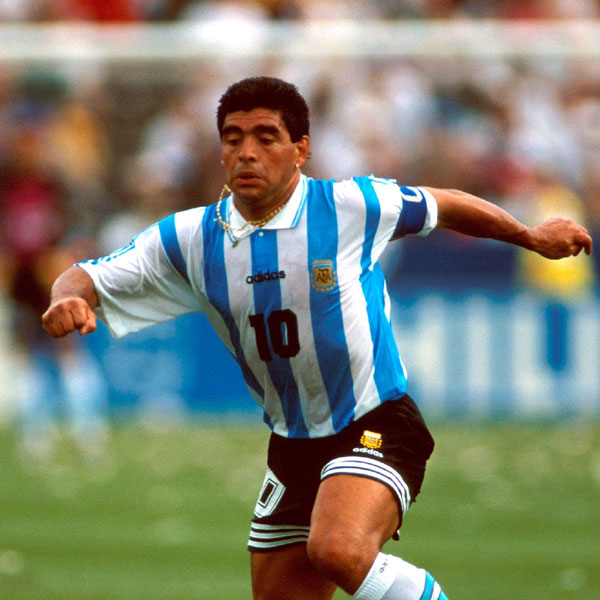
1. Diego Maradona
Surely the craziest rumour ever, bar none. In 1987, Leeds had just missed out, under Billy ImageBremner, on an FA Cup Final and promotion to the top flight in the first-ever play-offs. We were doomed to a hangover season in 87-88 and the fans’ mood and expectations were dulled. Then sensational whispers emerged that managing director Bill Fotherby, a larger-than-life used-car-salesman of a bloke, had managed to persuade the agent of Diego Armando Maradona to enter into talks with Leeds United over the proposed signing of the Argentine superstar. This was only just a year after Maradona had just about single-handedly (geddit?) won the World Cup for the Argies, and his stock could hardly have been higher on the global football scene. Strangely, he had very nearly signed for Sheffield United as a youngster, and for a measly £250,000 at that. The Blunts got Alejandro Sabella instead, who actually did end up briefly at Elland Road. But Maradona was different – astoundingly different to just about anyone else – people compared him favourably to Pele. He was even compared – unfavourably, and by the ever modest and unassuming George Best himself – to self-proclaimed greatest player ever, G. Best. It was a signing that was never going to happen, and surely the Number One Daft Rumour of all time.

-o0o-

It’s tempting to wonder how the history of Leeds United might have differed if we’d signed Trevor Francis and Peter Shilton in 1974, or Peter Beardsley in 1990, or even the “Hand of God” himself in 1987. The story of any major club is littered with “what ifs” and this certainly applies to our beloved Leeds. Of course our sights are set lower these days – although we’re now roughly about where we were in ’87 when an enterprising director started that Diego rumour, with a view to putting us back on the map.

Perhaps somebody in the Elland Road corridors of power will try to get the excitement going this time around with an audacious loan-with-a-view-to-permanent swoop for the undeniably promising prospect Lionel Messi? Watch this space…

Be the Judge: the Top Ten Leeds United Goals? – by Rob Atkinson

Now, this is not my personal selection of the top ten Leeds United goals – I suspect that I’m older than the compiler of this excellent video, so I’d have had some of my favourites from further back in there – then again, you could easily end up with a Top 20 or 30 that way. Fifty or a hundred, even – there’s a rich seam to be mined if your memory’s long enough. Off the top of my head, I’d go for David Batty‘s goal drought-ending effort against Man City – for the crowd reaction as much as anything else. And I’d have Tony Currie‘s famous “banana shot” for sheer quality. Both goals scored in games I saw from the Kop, at that end of the ground – which perhaps explains my bias.

I’m sure there are many, many more goals that could or should merit inclusion in a top ten that goes back further than this one – I’d love to hear your nominations too – but I reckon that this guy has done a pretty fair job all round. I agree with the order of his top two, for a start – I’ve always thought that Yeboah’s thunderbolt at Wimbledon was better than his goal of the season effort at home to Liverpool.

In the course of this video, Liverpool come in for a fair bit of punishment, actually. All four of Viduka’s famous quartet are there – even the offside winner, which seems a little harsh. And of course Yeboah picked on the Scousers too, with that wondrous dipping volley.

Speaking of “Goals of the Season, there’s one in there that should have been a winner – but it wasn’t, due to the clueless ineptitude of Andy Gray. Long before he got sacked for his sexist pig double-act with his hirsute mate Richard Keyes, Gray used to apply his “expertise” to the Sky version of MoTD‘s annual beauty contest for goals. He passed over little Rodders’ effort against Spurs, saying that the Spurs defence had basically stood aside and politely waved Wallace through. Andy – yooouu PLONKER. And, to add insult to injury, he actually chose a bog-standard far-post header by Alan Shearer against Leeds. Clueless Scottish git.

Anyway, see what you think if you have a few spare minutes. It’s a video well worth watching – and you can decide for yourselves about the goals left out, and what order these ten should have been in according to your own preferred favourite.  But most of all, just enjoy these mainly fabulous goals all over again. 

“Art of Football”: a Fitting Souvenir of THAT Yeboah Volley Against Liverpool – by Rob Atkinson

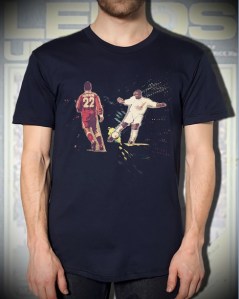
Art of Football Yeboah Tribute shirt detail

“Art of Football” Yeboah Tribute shirt detail

As Leeds United fans, we’re accustomed to wearing our hearts on our sleeves. We like to go even further in honour of our beloved club, wearing our badge proudly over our hearts. Now, thanks to a brainwave from Art of Football, you can actually wear on your chest one of the iconic goals of the last generation. It’s a goal most Leeds fans – even those who were too young to appreciate it at the time, or who weren’t yet around – only have to close their eyes to see. The ball comes out towards Tony Yeboah as Leeds attack late on at the Kop End of Elland Road. The Ghanaian watches as it drops towards him and instantly shapes to hit it on the full – and his effort rockets into the back of the net off the crossbar with Liverpool keeper David James beaten all ends up. Goal of the Season! Check it out here…

What a goal! It was a moment of pace, power and consummate brilliance. A packed Elland Road under floodlights is pure football theatre at any time – but with the red shirts of Liverpool standing between United and victory, with time fast ebbing away and with a striker of Yeboah’s lithe and muscular presence exploding suddenly into action – it was an instant of football history which stood out immediately as one destined for immortality. I was lucky, blessed, to be there that night, right behind the line of the ball as it rocketed into the net. It’s been a treasured memory for me and for thousands of others, ever since.

Yeboaaahh!!!

Yeboaaahh!!!

The t-shirt produced by Art of Football to commemorate this unforgettable strike is in itself a thing of beauty and a worthy tribute to Yeboah’s virtuosity. The one I have is white – I have a thing about white – but they do it in navy and royal blue as well. Whatever the background, Yeboah’s volley is there at the instant of impact between the ball and that amazing, thunderous right foot; a split second later Leeds were ahead and the crowd was thundering its approval. Tony Yeboah, in the first flush of what was a purple patch of spectacular goals for Leeds in the early part of that season, wheeled away exultant, knowing that he’d produced a moment of pure genius. Happily for the fans, there would be more to come.

Tony Yeboah’s time at Leeds United was too short, but unforgettably sweet. He left us memories of just about every type of goal you could imagine – but he definitely favoured the spectacular over the more mundane tap-in. He claimed to be more naturally left-footed, but the goal so evocatively captured here by the Art of Football, together with efforts against West Ham, Wimbledon, Monaco, Sheffield Wednesday and others, confirmed that he was eminently capable with either foot, head – you name it, Yeboah would belt the ball into the back of the net with it.

Yeboah’s was a cameo role in the history of Leeds United, but nonetheless memorable for that – and his goal against Liverpool shines as brightly in the memory now as it did when it emblazoned headlines all over the national press nineteen years ago. If ever a goal deserved to be marked by a quality item of wearable memorabilia, then surely Tony’s was one that stands out as a worthy candidate. The t-shirt has got pride of place in my Whites Wardrobe, and doubtless it’ll solve many a Christmas gift dilemma for those with a Leeds-supporting loved one to buy for.

If YOU fondly remember that masterblast against Liverpool, I’d recommend you treat yourself – or perhaps include it in a note to Santa. It’s not often I’m moved to plug a product, but this quality piece of merchandise, also available as a print, definitely carries the Life, Leeds United, the Universe & Everything seal of approval.